Owned by OfficeBooks. A vendor may propose a correction to a fact — never to a score or a rank.
Z
ZernioReview 2026: Social media API and MCP server for posting, DMs, analytics and ads from code, priced per connected account with the first 2 free
Social Media & Messaging APIs · SaaS & Productivity
Verified · vs zernio.com/pricing Watch price
Price from
Freepaid: usage-basedAs we read the vendor’s pricing: Free for the first 2 connected accounts, no credit card; then usage-based at $6 per connected account per month for accounts 3 to 10, $3 for 11 to 100 and $1 from 101 (no cap); X API calls, sent messages beyond 10,000 a month and managed ads beyond 500 are metered on top
—No answer showncould not be read (HTTP 403)G2 refused our requests (HTTP 403) when we tried to read the profile on 6 Nov 2026, so we show no G2 score.G2 page →
—No answer shownNo change recorded since the first reading we hold (6 Nov 2026).
Pricing verified 6 Nov 2026 · always confirm the current offer on the vendor’s site.
We verify
List prices and plan names as written, whether a lasting free plan exists, the billing unit where the vendor states it, third-party scores with 10+ reviews, and the page and date we read them.
We do not verify
Negotiated discounts, regional prices and taxes, anything behind a sales call, how well features work (we read documentation; we do not test), uptime, support or security. Opinions on those live in Tier 2.
Zernio plans, in the vendor's words
Plan
Price
Included
Free tier: first 2 connected accounts
$0 per month
No credit card. The pricing page says it includes 10,000 inbox messages a month, unlimited posts, analytics and the full API; posts stay within the per-account posting caps. The billing docs grant it as a $12 credit every calendar month, equal to 2 accounts at the $6 rate. It is ongoing, not a time-limited trial. A card is needed before the 3rd account or the first X account, X API usage is billed on top at X’s published rates, and the API limit is 60 requests a minute.
Build: accounts 3 to 10
Usage-based: $6 per connected account per month
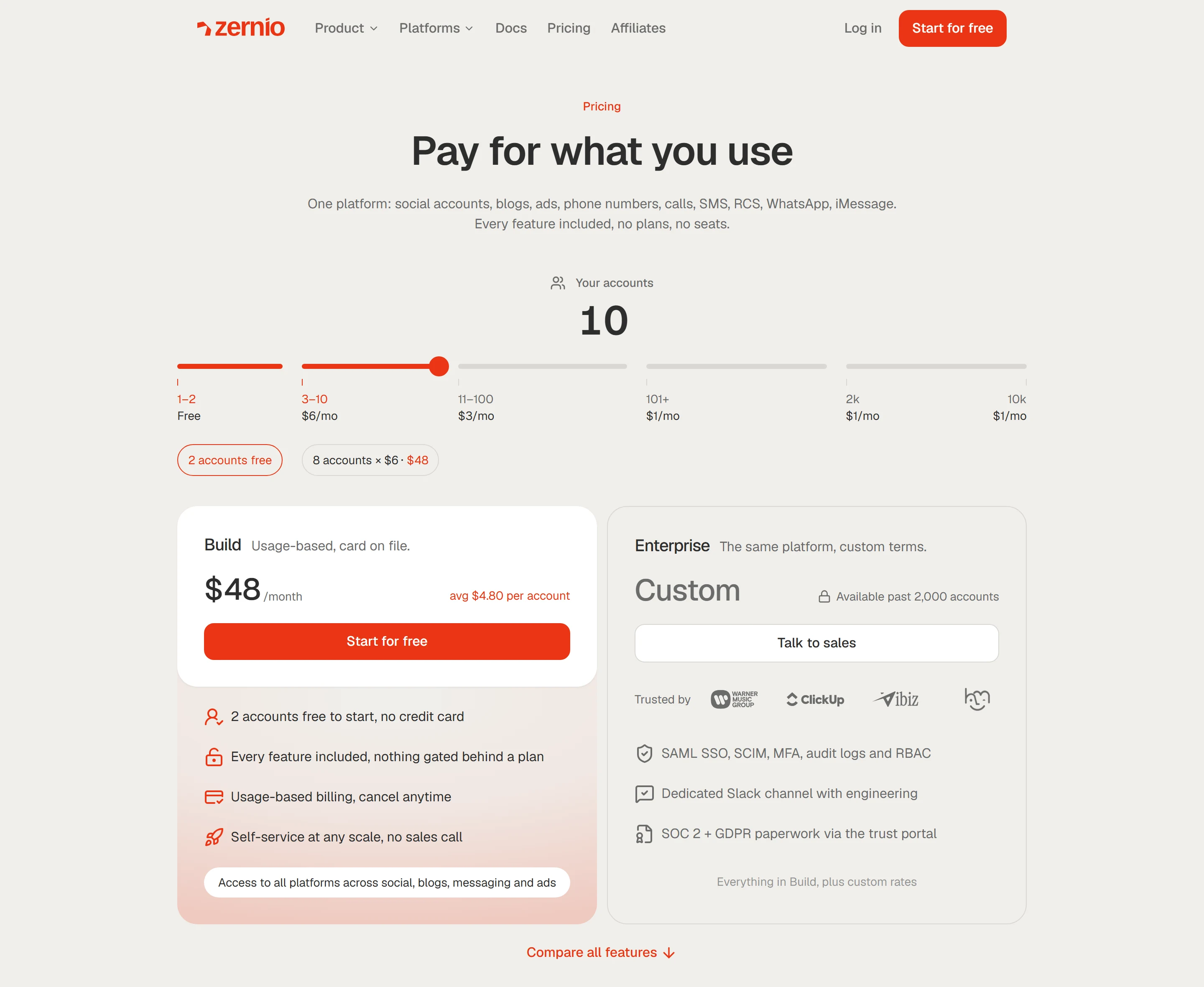
Graduated: each band prices only the accounts inside it, and the month’s account-days are divided by 30 before the ladder applies. 10 accounts cost $48 a month (8 × $6), the average of $4.80 per account the pricing page shows. A connected account is any active connection: a posting account, an ad account, a WhatsApp number, an iMessage sender, a creator account tracked in a creator campaign or a blog site or store; SMS and voice on a number never count, and profiles are free. Support by chat and email; the API limit rises to 600 requests a minute.
Build: accounts 11 to 100
Usage-based: $3 per connected account per month
The docs’ example of 12 accounts costs $54 a month ($48 for accounts 3 to 10 plus 2 × $3). 100 accounts cost $318 a month ($48 plus 90 × $3).
Build: accounts 101 and up
Usage-based: $1 per connected account per month, no cap
150 accounts cost $368 a month ($318 plus 50 × $1). Above 2,000 connected accounts the API limit is 1,200 requests a minute, and Enterprise terms become available.
X API calls
Usage-based: X published rate per call, no markup
In the docs’ table: $0.015 per post created and $0.200 per post with a link, per request; $0.005 per post read (analytics, lookups), $0.010 per DM read and $0.015 per DM sent, per resource. The pricing page shows each X rate per request and also bills user reads, follows and X Article actions at $0.010 per request; an X Article costs $0.020, as draft plus publish. Charged only when an X account is connected; the pricing FAQ says analytics and inbox sync for X accounts are opt-in. You can set an X spend cap in the dashboard; there is none until you do, and at 100% billable X calls stop: posts are refused, and analytics and inbox sync pause until the period resets or you raise the cap.
Inbox messages sent
Usage-based: first 10,000 a month free, then $1 per 10,000
Counts outbound inbox and broadcast messages only, WhatsApp sends included. Received messages, comments and reviews never count, and X DMs and SMS are billed separately, at X’s rates and per SMS segment. Without a card on file, the send that would pass 10,000 fails; with one, the overage is metered.
Managed ads
Usage-based: first 500 active ads free, then $0.01 per active ad per month
Across 9 ad networks. Each ad account also counts as a connected account. The vendor says it never takes a percentage of ad spend.
Phone numbers, calls and messaging channels
Usage-based: numbers from $3 per number per month; calls, SMS and messages per use
Numbers in 55 countries plus 12 more by pre-order, $3 to $30 per number a month in the docs, charged in full at activation and on the 1st of each month. Calls from $0.01 a minute by destination on the pricing page (the docs give that rate for outbound calls and bill inbound minutes at the carrier’s settled cost, with no rate card), recording $0.004 a minute, US branded calling $100 a month per brand plus $0.10 per branded outbound call. SMS from $0.008 per outbound segment; inbound is $0.010 per received segment on US numbers on the pricing page, but free on most numbers in the docs, billed per segment only on some US routes. US 10DLC registration $9 once, plus a campaign fee of $20 a month ($4 for sole proprietors, per the docs). iMessage $200 a month per sender plus the connected-account fee, messages $0. RCS $150 setup, $750 one-time US carrier approval, agent $160 a month in the US or $75 elsewhere, US messages from $0.0098. WhatsApp has two billers: Meta bills templates, service messages beyond 1,000 per number a month and outbound call minutes on your Meta invoice; Zernio bills the number, the carrier leg of calls and outbound WhatsApp messages through its inbox meter, and each WhatsApp number counts as a connected account. Payout transfers 4% per transfer, $0.50 minimum, added on top; funding the payout balance by card adds Stripe’s card fee on top (3.15% + 30¢ on a US card), and funds can be paid out 7 days after the charge.
Enterprise
Custom
Available past 2,000 accounts. Everything in Build plus custom rates (the Enterprise page says most contracts include volume-based discounts on the public ladder), a dedicated Slack channel with engineering, SCIM on enterprise contracts, and postpaid invoicing (net-30 by default, net-60 on request).
Price history · every reading logged
We hold one reading of this price, so there is no history to chart yet. We will not draw a curve from fewer than two points.
All readings (1)
Every reading we hold of Zernio's listed price
Date
Result
Read on
First reading we hold: Free for the first 2 connected accounts, no credit card; then usage-based at $6 per connected account per month for accounts 3 to 10, $3 for 11 to 100 and $1 from 101 (no cap); X API calls, sent messages beyond 10,000 a month and managed ads beyond 500 are metered on top
Propose a correction to a price, free plan or billing unit, with evidence from your own site. An editor reads it before anything changes; a correction never touches a score or a rank.
Written by people. Signed, dated, and kept apart from the facts above.
Who writes what on this page: each source, who writes it, their incentive, and what OfficeBooks checks
Source
Who writes it
Their incentive
Checked by OfficeBooks?
Editor's verdict and review
OfficeBooks research desk. Desk research from documentation; no hands-on test.
A commission only on links to partner programmes, disclosed beside the link. It never changes a score.
Yes · It is ours: every figure in it comes from the sources listed.
Creator stacks
Independent creators, named on every take
Whatever each creator declares on each take: none, a commission, sponsorship or employment. OfficeBooks credits them with the clicks and demo bookings they refer.
Partly · The facts beside their take, read live. Not their opinion; an editor reviews each stack before it is listed.
G2 and Trustpilot ratings
Those platforms' reviewers
Set by each platform. Some invite or reward reviews.
Partly · Only the score and review count, on the date shown. We do not vet the reviews.
Sponsored slot
The vendor who booked it
Paid placement.
No · The copy is the vendor's. Labelled "Sponsored · not ranked"; never in a table, score, shortlist or search result.
Verified facts (Tier 1)
OfficeBooks research desk
None. Vendors cannot pay to change a fact, a score or a rank.
Yes · On the vendor's own pages where it publishes them, otherwise on the sources listed; always with the date.
Editor's verdict
updated
“Zernio is a developer API and should be judged as one. On that measure it is well documented and publishes its price ladder, though its own pages disagree on several billing details. The ladder is a free tier for 2 connected accounts with the full API and no card, then $6 per connected account a month for accounts 3 to 10 (the docs’ and the slider’s range), $3 up to 100 and $1 beyond, prorated by the day, and the product comes with official SDKs in 8 languages, a hosted MCP server, signed webhooks and a public changelog whose newest entry was dated the day we read it. One request shape publishes to 10 social networks plus WhatsApp, Telegram, Discord and Slack, and the same API covers DMs, comments, analytics, 9 ad networks and blog articles. Two more listed networks cannot be used today. Reddit’s docs page says it is temporarily unavailable because Reddit has blocked third-party apps, though Reddit Ads still works. Snapchat’s docs page says it is not available yet because Snap has not approved Zernio’s app. The catches sit around the edges: X API usage is billed at X’s published rates, posting is capped per account, extras such as iMessage and RCS are costly, the company is a 9-person team founded in 2025, and its own pages disagree on platform and MCP tool counts, Reddit’s and Snapchat’s availability, the iMessage new-contact limit, uptime, billing timing, the $6 band’s range, white-labelling, add-ons, setup fees, X and telephony charges, and data location. Start on the free tier, price your account count against the ladder, and confirm the limits your product depends on in the docs.”
Best for
SaaS products that let their users post, reply or report on social networks from inside the product
Developers and AI agents publishing, answering DMs and comments or reading analytics through the API, MCP or a CLI
Agencies and platforms running many accounts, where the price per account falls to $3 after 10 accounts and $1 after 100
Watch out for
X is billed per API call on top, at X’s rates: $0.015 per post and $0.200 per post with a link, and a card is needed before the first X account even on the free tier
Its own pages disagree on platform count (16, 15, 30 or 38), MCP tool count (496, 280+ or 20 core plus generated), uptime (99.97%, 99.7%+ or 99.990%), whether Reddit and Snapchat are available, the daily limit on new iMessage contacts (1,000, or 2 rising to 50), when the card is charged, whether add-ons or setup fees exist, whether X reads bill per request or per resource, how inbound calls and US inbound SMS are charged, which accounts the $6 band covers (“$6/account for 1-10” in the pricing FAQ, accounts 3 to 10 in the docs and on the slider), whether users ever see Zernio branding, and where data is processed
OBOfficeBooks Editorial · Research desk · desk research from documentation, no hands-on test
Creator takes belong to their authors and are not verified by OfficeBooks; each creator declares their tie to the vendor on every take. OfficeBooks earns a commission only on links to partner programmes, disclosed beside each link. None of this changes Tier 1.
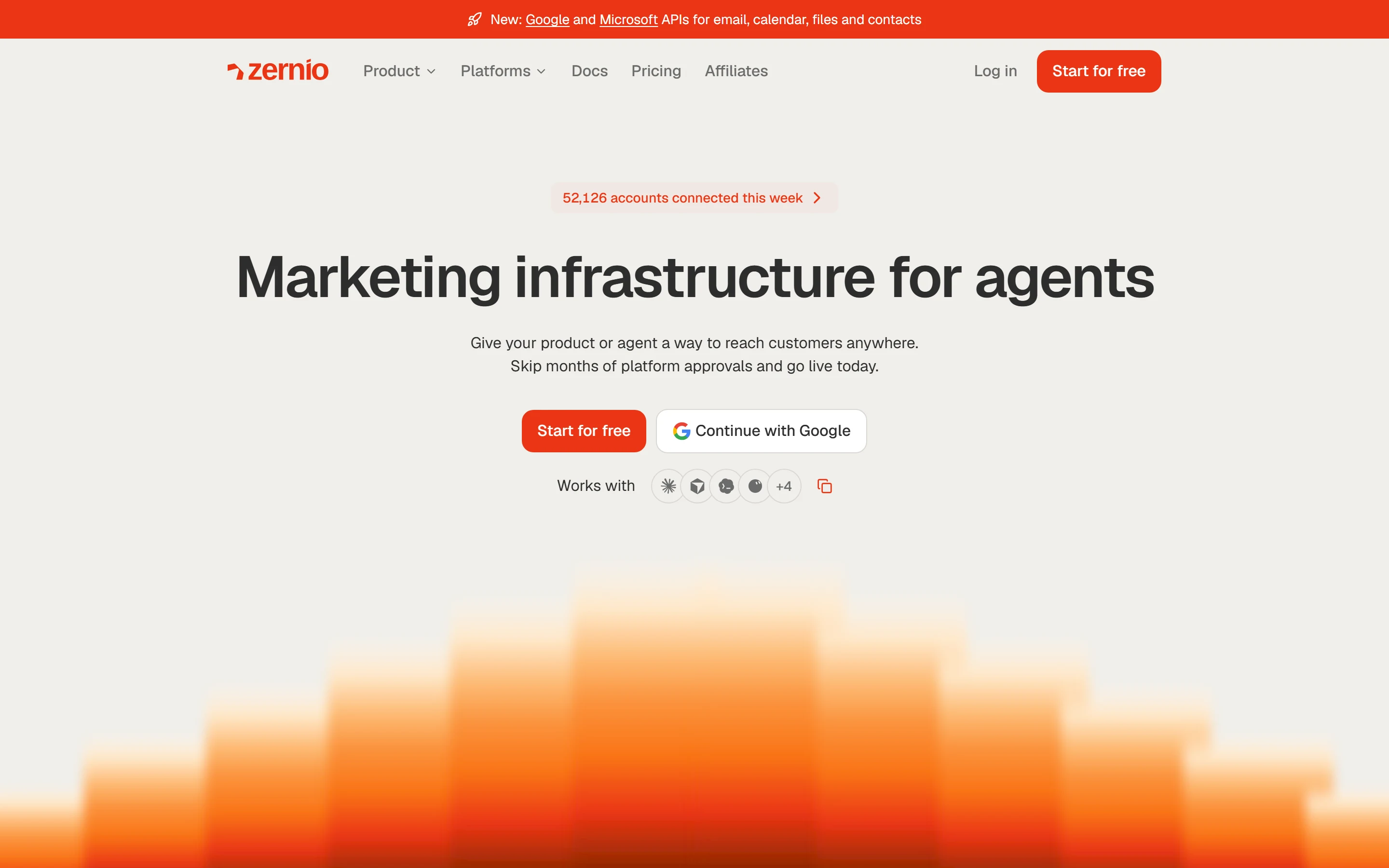
Zernio is a single API that a developer, a SaaS product or an AI agent calls to publish to social networks, answer comments and DMs, read analytics and run ads. Its homepage headline is “Marketing infrastructure for agents”, the page says “One integration covers social, blogs, messaging, voice, and ads.”, and its first code sample calls POST /v1/posts. The pricing page says Zernio is “built for developers and teams with technical resources”, and names n8n, Make and Zapier as the route for people who do not write code.
Zernio is the new name of Late. Its rebrand page says “Late is now Zernio.”, getlate.dev redirects to zernio.com, and API keys, endpoints and webhooks carry over unchanged. The Impressum names the company as ZERNIO SOFTWARE SL of Palamós, Girona, Spain, and the About page lists it as founded in 2025, based in Girona, bootstrapped and 9 people strong, with Miki Palet as founder.
The homepage asks readers to “Join 200,000+ of the world’s most ambitious developers and builders” and describes the product as “One integration for every channel. Official APIs only”. Both are the vendor’s claims, not figures we could check, as is its FAQ line that custom integrations take 8 to 12 months while Zernio “takes under an hour”. The FAQ also says Zernio is white-label friendly: “Your users never see Zernio branding.” Its docs page on using your own platform apps does not match that line: accounts connected without your own app “keep running on Zernio’s app”. For the consent screen to show your app’s name and logo, you add your own app on each platform, and on Instagram and Facebook that app needs the platform’s App Review with advanced access before outside accounts can connect. The same page says ads connections and WhatsApp’s Embedded Signup stay on Zernio’s app even then.
What the API covers
The docs’ platforms page says you can “publish to 16 of them with one request shape”. It lists 12 social networks for posting: X, Instagram, Facebook, LinkedIn, TikTok, YouTube, Pinterest, Reddit, Bluesky, Threads, Google Business Profile and Snapchat. Snapchat cannot be used yet: the platforms page and the support table badge it “Closed beta”, but its own docs page says “Snapchat is not available yet: Snap has not approved Zernio’s app”, so new connections return 403 for every account, with no access list to join and no release date, while Zernio’s marketing page for Snapchat promises “No allowlist needed - start posting immediately”. Reddit has no badge on the platforms page, and the support table ticks it for posts, DMs, comments and analytics, but its own docs page opens with “Reddit is temporarily unavailable”: Reddit has blocked third-party apps, posts fail, messages and analytics stop syncing, and Reddit-only endpoints return 503. Reddit Ads is not affected. The changelog dates this to October 20, 2026, and zernio.com/reddit shows the same warning. WhatsApp, Telegram, Discord and Slack also take posts; with the 12 social networks that makes the 16 the docs quote. The docs’ support table also ticks Post for the four blog platforms (blog articles only) and for HubSpot and Google Analytics, whose format column reads None. Beyond posting, the docs list messaging on WhatsApp, RCS, iMessage, Telegram, Discord and Slack; phone numbers, voice calls and SMS; 9 ad networks (Meta, Google, LinkedIn, TikTok, Pinterest, X, OpenAI, Reddit and Microsoft Ads); blog articles on Shopify, WordPress, Wix and Webflow; HubSpot, which syncs inbox contacts and messages; Google Analytics; and Google and Microsoft accounts for email, calendar, files and contacts, which the homepage banner announces as new.
What you can do differs by network, and the per-platform pages qualify the support table’s ticks. The table marks posts, analytics, DMs and comments for X, Instagram, TikTok, Reddit and Bluesky, and Facebook adds reviews; on TikTok, DMs are replies only, on Business Accounts registered outside the EEA, Switzerland and the UK, and comments need a connection through TikTok’s Business app, while Reddit and Bluesky DMs are text only (and Reddit is unavailable for now, as above). LinkedIn, YouTube and Threads have posts, analytics and comments but no DMs; LinkedIn comments are for organization pages only, and its page says “LinkedIn blocks third-party DM access”. Pinterest and Snapchat are marked for posts and analytics only, and Google Business Profile for posts, analytics and reviews, with its analytics at location level only. iMessage and SMS are DMs only. Discord is ticked for posting only; its page adds that the bot sends DMs, outbound only, with no DM inbox. Telegram’s inbox covers the connected group or channel only, and private DMs to the bot are not stored. The TikTok, Reddit and Bluesky pages call their analytics limited. The pricing FAQ says video can be scheduled to YouTube, TikTok, Instagram (Reels), Facebook, LinkedIn and Pinterest.
The vendor’s own counts do not agree, so we report them as they stand. The homepage says “Sixteen networks, one API.” while its footer lists 12 social networks. Its FAQ names 16 channels, a list that leaves out Reddit and includes iMessage, which the docs mark for DMs only. The affiliate page says 15 platforms, the API reference overview says the API spans 30, and the docs’ platforms index lists 38 across its 8 categories.
There are no plans to pick and no seats. The pricing page says “Every feature included, no plans, no seats.” Its self-serve option, Build, is “Usage-based, card on file.”, and Enterprise is custom-priced and “Available past 2,000 accounts”. You pay per connected account per month on a graduated ladder: the first 2 accounts are free, accounts 3 to 10 cost $6 each, 11 to 100 cost $3 each and every account from 101 costs $1, with no cap. The same page’s FAQ words the first band differently: “The first 2 accounts are free. After that, pricing is graduated: $6/account for 1-10”; the slider and the pricing docs say 3 to 10. Since the billing docs grant the 2 free accounts as a $12 monthly credit, both wordings give the same bill (10 accounts come to $48 either way, by our arithmetic), but the pages still disagree on the wording. Each band prices only the accounts inside it. The page offers no annual billing and mentions no discount, and neither card is labelled popular or recommended. The Enterprise page adds that most enterprise contracts include volume-based discounts on the public ladder.
A connected account is any active connection: a posting account such as an Instagram account, a Facebook Page or a YouTube channel, an ad account, a WhatsApp number (which also pays its number fee), an iMessage sender (on top of its $200 a month, per the iMessage docs), a creator account tracked in a creator campaign (per the pricing page) or a connected blog site or store. SMS and voice on a number never count. Profiles, which group the accounts of one brand or customer, are free. The docs give the example that “A Page, its Instagram account and the Meta ad account behind them are 3.”
Billing is prorated by the day. The docs add up the month’s account-days, divide them by 30 and run that total through the ladder, so an account connected for half the month counts as half an account. The free tier appears in the billing docs as a flat $12 credit each calendar month, “which covers the first 2 accounts at the $6 rate”. A card is needed before the third account or the first X account, and payment is by Visa, MasterCard or American Express through Stripe.
Two pages disagree on when you pay. The pricing FAQ says you pay per account per month, “billed at the end of each billing period”; the billing docs say “Zernio charges your card as you accrue usage, not once at the end of the month”, starting at a $10 threshold that then doubles. There is no prepaid time to refund: you stop charges by disconnecting accounts, and the FAQ says billing errors and charges caused by an outage on Zernio’s side are credited. Support is chat and email on Build and a dedicated Slack channel on Enterprise, where postpaid invoicing on net-30 or net-60 terms is available.
The pricing page says “Every feature included, nothing gated behind a plan”, and its FAQ says “No add-ons, no feature tiers.” The API reference treats many of its add-on notes as legacy: “Legacy plans need the Analytics add-on; included by default on usage-based plans”, and the same for Ads. But its ads sections (Ad Campaigns, Ad Insights and Ad Rules among them) still say “Requires the Ads add-on.”, a few analytics endpoints say “Requires the Analytics add-on.” and several inbox endpoints say “Requires Inbox addon”, all without that qualifier, so the pages still disagree and we report both.
What a small product pays
Worked examples from the published ladder, per month, before X API calls, other metered extras and any tax: 2 accounts cost $0. One brand with a Facebook Page, its Instagram account and its Meta ad account is 3 accounts and costs $6. 5 accounts cost $18 (3 × $6), and 10 accounts cost $48 (8 × $6), the $4.80 average the pricing page shows. The docs’ 12-account example comes to $54. 25 accounts cost $93 ($48 for accounts 3 to 10 plus 15 × $3), and 100 accounts cost $318 ($48 plus 90 × $3). With no annual price, 10 accounts held all year cost $576.
X adds its own charges per API call, passed through at X’s published rates with no markup: $0.015 to create a post, $0.200 for a post with a link, $0.005 per post read for analytics or lookups, $0.010 per DM read and $0.015 per DM sent. The docs bill reads and DMs per resource, while the pricing page shows every X rate per request; the pricing page also lists user reads, follows and X Article actions at $0.010 per request, so an X Article costs $0.020. There is no X spend cap until you set one in the dashboard, and at 100% of it posts are refused and analytics and inbox sync pause. Thirty X posts with links in a month add $6.00, the price of one more account in the $6 band; thirty without links add $0.45.
Two other meters apply to everyone who uses them. Messages you send from the inbox are free up to 10,000 a month, then $1 per 10,000; received messages, comments and reviews never count. Managed ads are free for the first 500 active ads, then $0.01 per active ad per month, and the vendor says it never takes a percentage of ad spend.
Against the other social media APIs we price on the same monthly basis, 10 accounts (an Instagram and a LinkedIn account for each of 5 brands) cost $19 at Outstand (3,000 posts included), $24 at Upload-Post, $29 at Blotato and $39 at Postiz, then $48 at Zernio, $55.00 at Unipile, $63.00 at Publer and $299 at Ayrshare, which puts Zernio fifth of eight in our ranking. Each vendor prices on its own unit (accounts, channels, profiles or posts), and what each plan leaves out is set out in that ranking and in each review. Buffer, a scheduling dashboard with an API, charged $60 a month for 10 channels on Essentials billed monthly ($6 per channel, $5 billed yearly) on its pricing page on November 6, 2026.
Messaging, phone numbers and other extras
The communication side is priced per item, on Zernio’s invoice apart from WhatsApp’s Meta fees (below). Dedicated phone numbers are sold in 55 countries, plus 12 more by pre-order, at a flat monthly price per number that the docs put between $3 and $30, charged in full at activation and again on the 1st of each month. The pricing page lists calls, inbound and outbound, from $0.01 a minute depending on the destination; the phone pricing docs give that rate for outbound calls and say inbound minutes have no rate card and bill at the carrier’s settled cost. Recording costs $0.004 a minute, and US-only branded calling is $100 a month per brand plus $0.10 per branded outbound call. Outbound SMS starts at $0.008 per segment. On inbound SMS the pages differ: the pricing page lists $0.010 per received segment on US numbers, while the phone pricing docs say inbound SMS is free on most numbers and bills at the per-segment rate only where the carrier charges an inbound fee, on some US routes. Texting in the US also needs a one-time $9 10DLC registration and a campaign fee of $20 a month ($4 for sole proprietors, per the docs).
WhatsApp has two billers, the docs say. Meta bills template messages, service messages beyond 1,000 per number a month and outbound call minutes, and those fees “appear on your Meta invoice”, charged to the payment method on your WhatsApp Business Account; the pricing page says service messages were free until 30 September 2026 and that from 1 October 2026 Meta charges for them after 1,000 free per number each month. Zernio bills the number, the carrier leg of calls and outbound WhatsApp messages, which count toward its inbox meter, and each WhatsApp number is also a connected account. An iMessage sender costs $200 a month plus the connected-account fee, the iMessage docs say, with messages at $0, and it is non-refundable once activated. The pages disagree on how fast a sender can reach new contacts: the pricing page allows 1,000 new conversations per sender a day, while the iMessage docs allow one every 15 minutes, starting at 2 a day and rising to 50 over three weeks. An RCS agent needs a $150 setup and, in the US, a $750 one-time carrier approval (usually 4 to 6 weeks, the pricing page says); the docs then charge $160 a month per agent in the US and $75 elsewhere, which the pricing page shows as “from $75/mo”, and US messages start at $0.0098 each. The same pricing page’s FAQ says there are no setup fees. Creator payout transfers carry a fee of 4%, $0.50 minimum, added on top of the transfer. Funding that balance by card adds Stripe’s card fee on top, 3.15% + 30¢ on a US card, the pricing page says, and the money can be paid out to creators 7 days after the charge.
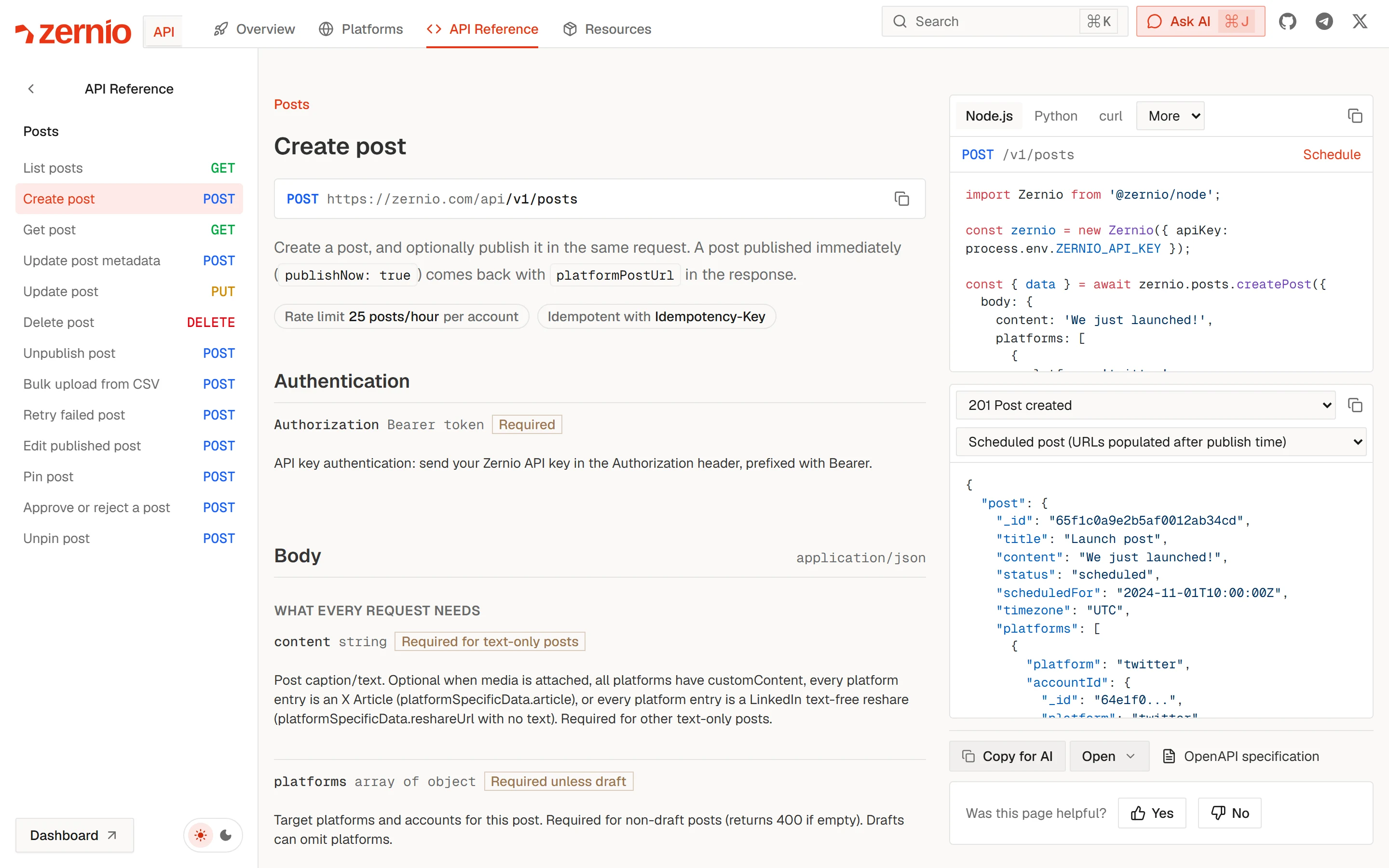
The REST API lives at https://zernio.com/api/v1 and takes an API key as a Bearer token. Its endpoint groups cover profiles, connecting accounts, accounts, posts, media, messages, comments, analytics, campaigns and ads, and webhooks. The Create post reference shows a rate limit of 25 posts per hour per account and support for an Idempotency-Key, and the Posts group also covers bulk upload from CSV, retrying a failed post, editing a published post, pinning and post approval. Zernio ships official SDKs for 8 languages, Node.js, Python, Go, Ruby, Java, PHP, .NET and Rust, all generated from one OpenAPI 3.1 spec.
For AI assistants there is a hosted MCP server at https://mcp.zernio.com/mcp. The docs say it works with Claude, Claude Code, ChatGPT, Codex, Cursor, Windsurf, VS Code and any other MCP client, that people sign in with their Zernio account, and that autonomous agents send an API key instead. The homepage lists Claude Code, Cursor, Codex, Grok bot, OpenAI dots, Meta Muse, OpenClaw and Hermes under Works with, and there is also a CLI (@zernio/cli) and a Chat SDK adapter. The vendor’s MCP tool counts disagree: the homepage FAQ says 496 tools, the affiliate page says 280+, and the docs describe 20 core tools plus one generated tool per API endpoint. An unauthenticated tools/list request we sent on November 6, 2026 returned HTTP 401, although the docs say that call needs no credential.
Webhooks are signed: the X-Zernio-Signature header carries an HMAC-SHA256 of the raw request body, keyed by a secret you set. You can create up to 50 webhook endpoints per user, and an event goes to a dead-letter queue after its 7th failed delivery. The docs publish an llms.txt file and the OpenAPI spec, the Create post page has a Copy for AI button, and the public changelog held more than 1,000 entries on November 6, 2026, the newest dated that day. The versioning policy says “A breaking change ships only as a new path version.”
Limits and reliability
Request limits are counted across the whole team and rise with connected accounts: 60 requests a minute with 0 to 2 accounts (6 a second on analytics endpoints), 600 with 3 to 2,000 (10 a second) and 1,200 above 2,000 (20 a second). Each account can publish at most 25 posts an hour, with daily caps of 100 on Instagram and Facebook, 250 on Threads, 50 on X, 25 on Pinterest, 15 videos and 15 photos on TikTok Business app connections, and 50 on every other platform. The “unlimited posts” on the pricing page are, in the docs’ words, “subject to the per-account rate limits”. Post analytics are cached for 60 minutes, and follower counts refresh once a day.
Zernio retries a platform’s 429 or 5xx response up to 3 times. Its rate-limits guide also says platforms add their own limits, “some shared by every customer because Zernio is one application”, and the guide names Reddit’s request budget, Google Ads’ single developer token and TikTok’s direct-posting cap on developer-app connections among them (Reddit itself is unavailable for now; see What the API covers). On X, DMs are limited to 200 requests per 15 minutes and 1,000 per 24 hours per connected account, and the docs say customers who bring their own X API key need X’s Pro tier, which the docs price at $5,000 a month, or Enterprise access to send DMs.
Uptime figures differ by page: the homepage footer says 99.97%, the pricing FAQ and the affiliate page say 99.7%+, and the status page showed 99.990% for the dashboard and the public API over 90 days. On November 6, 2026 the status page read “All services are online” and its Previous incidents section listed two resolved incidents. From about 19:00 to 22:30 UTC on November 4, some customers saw timeouts when connecting to the MCP server from AI tools. The incident notes say the API and dashboard were not affected, though the incident page lists Public API as the affected service. From about 02:00 UTC on November 3 to about 04:40 UTC on November 4, many attempts to connect a TikTok account failed at the authorization step. The same page’s 90-day history lists more. Besides that MCP incident, five name the dashboard or the public API as affected: on August 21, from 14:01 to 14:59 UTC, what the vendor calls a “minimal and transient spike from our database system”, with “No data loss” (Dashboard and Public API); on September 28, from 14:18 to 15:10 UTC, “delays in outbound webhook delivery due to elevated event volume” (Dashboard); on October 8, “Between 14:44 and 15:52 UTC, some customers saw the dashboard and API respond slowly or time out”; on October 19, “Between 19:10 and 19:31 UTC, new posts could not be created from the dashboard or the API”; and on October 26, “Between 21:18 and 21:37 UTC, many API requests failed and some accounts could not load in the dashboard.” It also logs incidents on other parts of the service: new comments not detected for some accounts from October 8 until a fix on October 12, though the incident was opened only on October 12 and the daily bars log 7 hours and 54 minutes of degradation; WhatsApp sends failing for some accounts on October 15; incoming events and WhatsApp messages arriving late on October 23, 26 and 28 (on October 23, between 13:35 and 14:05 UTC, some accounts also saw dashboard logins fail); and Reddit posting and account connections failing from 15:34 UTC on October 19 until the incident was closed at 02:32 UTC on October 21 (the daily bars log downtime on all three days), with the closing update saying “Reddit is temporarily unavailable” because Reddit has blocked third-party apps from its API. Four more are publishing incidents: some Google Business Profile posts with images failed to publish from September 27 to September 30; some Instagram posts scheduled before their account was reconnected with a different login type could fail to publish from October 4 until 09:08 UTC on October 5; and on October 19 some TikTok posts failed between 02:24 and 03:28 UTC, when requests to TikTok failed intermittently, and some Pinterest video pins could fail to publish between 16:55 and 20:30 UTC. Zernio puts the comment incident, the October 23 and 28 delays and the Google Business Profile and Instagram failures down to an issue on its side.
Security, compliance and data location
Zernio’s trust portal, run on Comp AI, lists SOC 2 Type 2 and GDPR as compliant, and the SOC 2 Type II report is available on request with a work email; we have not seen it. The Enterprise page says SAML and OIDC single sign-on is self-serve on every workspace and SCIM is enabled on enterprise contracts, with owner, admin, member, viewer and billing roles. The pricing page’s Enterprise card lists SAML SSO, SCIM, MFA, audit logs and RBAC.
The vendor states where data lives in two ways. The Enterprise FAQ says “your data is stored and processed within Europe”, while the trust portal lists the Axiom logging and monitoring datasets on Axiom’s US East (Northern Virginia) deployment. If EU-only processing matters to you, ask before you sign.
Who Zernio fits, and who should look elsewhere
Zernio fits developers building a product that posts, replies or reports on social networks for its users, agencies and platforms that run many accounts, and people connecting an AI agent to social channels through MCP. The free tier is enough for a 2-account prototype with the full API, and the price per account drops from $6 to $3 after 10 accounts and to $1 after 100.
It is the wrong buy if your team wants a social media scheduler it can use without writing code: the vendor says it is built for developers and teams with technical resources, and the scheduling apps in our Social Media Management niche, such as Buffer, are made for that job. Heavy X publishers should budget for X’s per-call charges, Reddit and Snapchat are listed, but their docs pages say Reddit is temporarily unavailable and Snapchat is not available yet, LinkedIn has no DMs (its page says LinkedIn blocks third-party DM access), and teams that need EU-only processing should ask about the US logging region first.
The catches
On Trustpilot, Zernio scored 4.8 (Excellent) from 213 reviews when we read the page on November 6, 2026. Trustpilot itself notes that “This company hasn’t invited customers recently, so reviews may not be representative”, and the profile was claimed in April 2026. G2’s page blocked our requests, so we show no G2 score. The homepage’s structured data declares a 4.8 rating from 50 ratings of its own; that is the vendor’s markup, not a third-party score, and we do not use it.
The vendor’s pages disagree on several basic facts: the number of platforms (16, 15, 30 or 38), the number of MCP tools (496, 280+, or 20 core tools plus generated ones), uptime (99.97%, 99.7%+ or 99.990%), whether Reddit is available (listed without a warning on the platforms page and support table, “temporarily unavailable” on its docs page), whether Snapchat is available (badged closed beta in the docs, “not available yet” on its docs page, “start posting immediately” on its marketing page), how many new contacts an iMessage sender may message a day (1,000 on the pricing page; 2 at first, rising to 50, in the docs), when the card is charged, whether add-ons exist (the pricing FAQ says “No add-ons”; the API reference calls many of its Analytics and Ads add-on notes legacy, but its ads sections and several analytics and inbox endpoints still require an add-on with no such qualifier), whether there are setup fees (none, says the pricing FAQ; $150 per RCS agent, says the same page’s rate card), whether X reads are billed per request or per resource, how inbound calls and US inbound SMS are charged, which accounts the $6 band covers (1-10 in the pricing FAQ, 3 to 10 in the docs), whether users ever see Zernio branding (never, says the homepage FAQ; accounts connected without your own app “keep running on Zernio’s app”, say the docs), and where data is processed. Its comparison page also labels Buffer “No public API”, while Buffer’s own pricing page listed API access on every plan, including 1 API key on Free with 1,000 requests per connected channel, up to 3,000, over a 30-day window in its comparison table (“per channel/month” on its plan cards), when we read it on November 6, 2026. Confirm any number you build on in the docs and on your own usage page, where the vendor says every call, message and number is an itemized line.
Strengths
Free tier for 2 connected accounts with the full API, analytics and no credit card, and no seats or plan tiers to choose between
Published graduated price per connected account per month ($6, then $3, then $1, no cap), with the proration formula and worked examples in the docs
One request shape publishes to 10 social networks plus WhatsApp, Telegram, Discord and Slack (Reddit and Snapchat are listed too, but their docs pages say Reddit is temporarily unavailable and Snapchat is not available yet), and the same API covers DMs, comments, reviews, analytics, 9 ad networks and blog articles
Official SDKs in 8 languages generated from one OpenAPI 3.1 spec, a hosted MCP server that takes OAuth or an API key, a CLI and HMAC-signed webhooks
Public changelog of more than 1,000 entries (the newest dated November 6, 2026), path versioning for breaking changes, llms.txt and a public status page
Managed ads are metered per active ad (first 500 free), and the vendor says it never takes a percentage of ad spend
The vendor’s trust portal lists SOC 2 Type 2 and GDPR, with the SOC 2 report on request, and its Enterprise page says SAML/OIDC single sign-on is self-serve on every workspace
Watch out for
X is billed per API call on top, at X’s rates: $0.015 per post and $0.200 per post with a link, and a card is needed before the first X account even on the free tier
Its own pages disagree on platform count (16, 15, 30 or 38), MCP tool count (496, 280+ or 20 core plus generated), uptime (99.97%, 99.7%+ or 99.990%), whether Reddit and Snapchat are available, the daily limit on new iMessage contacts (1,000, or 2 rising to 50), when the card is charged, whether add-ons or setup fees exist, whether X reads bill per request or per resource, how inbound calls and US inbound SMS are charged, which accounts the $6 band covers (“$6/account for 1-10” in the pricing FAQ, accounts 3 to 10 in the docs and on the slider), whether users ever see Zernio branding, and where data is processed
Per-account posting caps: 25 posts an hour, plus daily caps per platform from 15 TikTok videos to 250 Threads posts; the free tier is limited to 60 API requests a minute, and some platform limits are shared by every customer because Zernio runs as one application, Google Ads’ single developer token and TikTok’s direct-posting cap on developer-app connections among them
Reddit is listed with no warning on the docs platforms page and support table, but its docs page says “Reddit is temporarily unavailable”: Reddit has blocked third-party apps, so posts fail and messages and analytics stop syncing. Reddit Ads is not affected, and the changelog dates the change to October 20, 2026
A young, small vendor: founded in 2025, 9 people and bootstrapped by its own account, and renamed from Late
Built for developers: the vendor says it is for teams that can make API calls, with n8n, Make and Zapier as the no-code route
Some extras are costly: an iMessage sender is $200 a month plus the connected-account fee, and a US RCS agent needs a $150 setup, a $750 carrier approval and $160 a month; there is no annual plan, and the only discounts mentioned are volume discounts on Enterprise contracts past 2,000 accounts
Reddit and Snapchat are listed but not usable: Reddit’s docs page says it is temporarily unavailable, and Snapchat is badged “Closed beta” while its docs page says new connections return 403 and there is no access list or release date; LinkedIn, YouTube, Threads and Pinterest have no DMs, TikTok DMs are replies only and only outside the EEA, Switzerland and the UK, and Shopify, WordPress, Wix and Webflow take blog articles only
Key features
Feature
What it does
Posting and scheduling API
POST /v1/posts creates a post and can publish it immediately (publishNow) or schedule it, with a rate limit of 25 posts per hour per account and an Idempotency-Key for safe retries. The Posts group also lists bulk upload from CSV, retrying a failed post, editing a published post, pinning and post approval. Video can be scheduled to YouTube, TikTok, Instagram Reels, Facebook, LinkedIn and Pinterest.
Comments, DMs and reviews
Read and reply to comments and DMs in one inbox. The docs’ support table marks DMs on X, Instagram, Facebook, TikTok, Reddit, Bluesky, WhatsApp, Telegram, Slack, iMessage and SMS, and reviews on Facebook and Google Business Profile. Reddit is temporarily unavailable, its docs page says, so Reddit messages stop syncing. The platform pages add limits: TikTok DMs are replies only, on Business Accounts registered outside the EEA, Switzerland and the UK; Reddit and Bluesky DMs are text only; Telegram’s inbox covers the connected group or channel, not private DMs to the bot; LinkedIn comments are for organization pages only. The first 10,000 messages sent a month are free, then $1 per 10,000; X DMs and SMS are billed separately.
Analytics
Impressions, reach, engagement and follower tracking for the social platforms. Post analytics are cached for 60 minutes, and follower counts refresh once a day.
Ads API
One set of endpoints for Meta, Google, LinkedIn, TikTok, Pinterest, X, OpenAI, Reddit and Microsoft Ads: create campaigns, change budgets, pause and resume, and read spend. Metered per active ad after the first 500.
Messaging and telephony
WhatsApp, RCS, iMessage, Telegram, Discord and Slack, plus phone numbers in 55 countries (12 more by pre-order), voice calls and SMS, billed on Zernio’s invoice except WhatsApp’s Meta fees (templates, service messages beyond 1,000 per number a month and outbound call minutes), which Meta bills to your WhatsApp Business Account.
Blogs API
Create, edit, publish and delete articles on WordPress, Shopify, Wix and Webflow. Each connected site or store counts as one account; these platforms take blog articles, not social posts.
Email, calendar, files and contacts
New on the homepage banner: Google and Microsoft accounts connect for email, calendar, files and contacts.
SDKs and OpenAPI
REST API at https://zernio.com/api/v1 with a Bearer API key, and official clients for Node.js, Python, Go, Ruby, Java, PHP, .NET and Rust, each generated from one OpenAPI 3.1 spec.
MCP server and CLI
Hosted MCP server at https://mcp.zernio.com/mcp for Claude, Claude Code, ChatGPT, Codex, Cursor, Windsurf, VS Code and other MCP clients, with sign-in by Zernio account or an API key for autonomous agents. Also a CLI (@zernio/cli) and a Chat SDK adapter.
Webhooks
Events for post status, messages and comments, signed with HMAC-SHA256 in the X-Zernio-Signature header. Up to 50 endpoints per user; an event moves to a dead-letter queue after its 7th failed delivery.
Enterprise controls
SAML and OIDC single sign-on (self-serve on every workspace, per the Enterprise page), SCIM on enterprise contracts, and owner, admin, member, viewer and billing roles.
Priced per post delivered, not per account: connected accounts and seats are free, and Pay as you go is $19 a month, billed monthly, with 3,000 posts included, then $0.007 a post up to 10,000; there is no free plan or trial. The 10 accounts that cost $48 a month on Zernio cost $19 on Outstand for up to 3,000 posts a month and stay below $48 up to 7,142 posts (our arithmetic). Reselling to clients needs its $129 Business plan or written permission.
Basic is $24 a month billed monthly ($16 billed yearly) for 5 profiles, where a profile holds one account on each network, so 5 brands with an Instagram and a LinkedIn account each fit Basic; its Free plan includes the API (10 uploads a month, 2 profiles, no TikTok, no card). It lists 22 networks, and its status page showed Reddit as unavailable on November 6, 2026. Zernio’s docs list posting on X, Instagram, Facebook, LinkedIn, TikTok, YouTube, Pinterest, Bluesky, Threads and Google Business Profile, plus WhatsApp, Telegram, Discord and Slack. Reddit and Snapchat are listed too, but their docs pages say Reddit is temporarily unavailable because Reddit has blocked third-party apps, and Snapchat is not available yet because Snap has not approved Zernio’s app.
Starter is a flat $29 a month, billed monthly, for up to 20 connected accounts on 9 networks, with the API and a 35-tool hosted MCP server on every plan; there is no free plan, and its 7-day trial needs a card and leaves out the API and MCP. If an AI agent will do the posting, compare agent tooling: Zernio has a hosted MCP server that takes an OAuth sign-in or an API key, a CLI, a Chat SDK adapter and official SDKs in 8 languages, where Blotato has no SDK.
Bills by channel: Team is $39 a month billed monthly ($31 billed yearly) for 10 channels, and Standard $29 for 5, with unlimited posts and the public API, CLI and MCP server on every plan; there is no free hosted plan, only a 7-day trial, and the open-source edition can be self-hosted. Zernio’s comparison page frames this one as “All-in-one platform vs focused API”, which is Zernio’s view. Decide first whether you need a scheduling app your team works in or an API your code calls: Zernio says it is built for developers and teams with technical resources, and points no-code users to n8n, Make and Zapier.
A $55.00 a month minimum (€49.00) covers up to 10 linked accounts, and from 11 to 50 each linked account costs $5.50, after a 7-day free trial with no credit card; it is mainly a messaging, email and calendar API and publishes only to LinkedIn, Instagram and Facebook. Zernio files Unipile under messaging and WhatsApp and frames the difference as “Messaging API vs publishing API”. If DMs are the main job, compare channel by channel: Zernio’s support table marks DMs on X, Instagram, Facebook, TikTok, Reddit (temporarily unavailable, its docs page says), Bluesky, WhatsApp, Telegram, Slack, iMessage and SMS, though TikTok DMs are replies only, on Business Accounts registered outside the EEA, Switzerland and the UK. It has no LinkedIn DMs: its LinkedIn page says “LinkedIn blocks third-party DM access”, and LinkedIn comments are for organization pages only.
Business, the first plan with its API, is $63.00 a month billed monthly for 10 social accounts ($10.00 for 1), and its Free plan has no API. Zernio’s comparison page calls Publer dashboard-first and itself API-first, in Zernio’s words. Compare the price for your account count on the same monthly basis; Zernio has no annual plan, so its monthly usage-based price is its only published price, and Enterprise contracts past 2,000 accounts are custom.
Billed per social profile, one brand or customer whatever networks it connects: five brands need Launch at $299 a month billed monthly (up to 10 profiles), and one brand needs Premium at $149; its only trial is 28 days on Launch, with a payment method. Zernio’s own comparison page files Ayrshare with the social media APIs. Zernio’s self-serve billing is monthly and usage-based only: 2 accounts free, then $6 per connected account a month for accounts 3 to 10, $3 to 100 and $1 beyond, with X API usage billed on top at X’s published rates.
A scheduling dashboard with an API. Buffer’s pricing page on November 6, 2026 listed a Free plan for up to 3 channels with 10 scheduled posts per channel at a time and 1 API key, and Essentials at $6 per channel a month billed monthly or $5 billed yearly ($60 a year per channel), with 3 API keys. Buffer counts API requests per connected channel, 1,000 up to 3,000 on Free and 3,000 up to 30,000 on Essentials, over a 30-day window in its pricing page’s comparison table and its API docs (“per channel/month” on its plan cards). On monthly billing, 10 channels on Essentials cost $60 a month; 10 connected accounts on Zernio cost $48. Zernio’s comparison page labels Buffer “No public API”, which Buffer’s pricing page contradicts.
Yes, for up to 2 connected accounts. The pricing page says the first 2 connected social accounts are completely free, no credit card required, and include 10,000 inbox messages a month, unlimited posts, analytics and the full API. It is an ongoing free tier, not a time-limited trial; the billing docs grant it as a $12 credit every calendar month, which covers 2 accounts at the $6 rate. A card is needed before you connect a 3rd account or your first X account, X API usage is billed on top at X’s published rates, and the free tier is limited to 60 API requests a minute.
How much does Zernio cost?
You pay per connected account per month on a graduated ladder: accounts 1 and 2 are free, 3 to 10 cost $6 each, 11 to 100 cost $3 each and every account from 101 costs $1, with no cap. Billing is prorated by the day. 10 accounts cost $48 a month, 25 cost $93 and 100 cost $318. There are no seats, no plan tiers and no annual billing. Sent inbox messages beyond 10,000 a month ($1 per 10,000), managed ads beyond 500 ($0.01 per active ad a month), X API calls and phone, SMS, RCS or iMessage use are metered on top, and Enterprise is custom-priced past 2,000 accounts.
What counts as a connected account?
Every active connection counts once, the docs say: each posting account (an Instagram account, a Facebook Page, a YouTube channel and so on), each ad account, each WhatsApp number (which also pays its number fee), each iMessage sender (on top of its $200 a month, per the iMessage docs), each creator account tracked in a creator campaign (per the pricing page) and each connected blog site or store. SMS and voice on a number never count. Profiles, which group the accounts of one brand or customer, are free. The docs’ example: a Facebook Page, its Instagram account and the Meta ad account behind them are 3 accounts. Disconnecting an account stops its charges.
Why is X (Twitter) charged separately?
X charges per API call, and Zernio passes those charges through at X’s published rates with no markup. The docs’ table lists $0.015 to create a post and $0.200 for a post with a link, per request, and $0.005 per post read, $0.010 per DM read and $0.015 per DM sent, per resource; the pricing page shows each X rate per request and also bills user reads, follows and X Article actions at $0.010 per request, so publishing an X Article (draft plus publish) costs $0.020. The charges apply only when an X account is connected, and the pricing FAQ says analytics and inbox sync for X accounts are opt-in. A card is required before the first X account, even inside the free tier. You can set an X spend cap in the dashboard; there is none until you do, and at 100% of it billable X calls stop: posts are refused, and analytics and inbox sync pause until the period resets or you raise the cap.
Which platforms does Zernio support?
The docs list 12 social networks for posting: X, Instagram, Facebook, LinkedIn, TikTok, YouTube, Pinterest, Reddit, Bluesky, Threads, Google Business Profile and Snapchat. Snapchat cannot be used yet: the docs badge it “Closed beta”, but its own docs page says it is not available because Snap has not approved Zernio’s app, with no access list and no release date. Reddit cannot be used either: its docs page says “Reddit is temporarily unavailable” because Reddit has blocked third-party apps, so posts fail and messages and analytics stop syncing; Reddit Ads is not affected. The docs also list posting on WhatsApp, Telegram, Discord and Slack; messaging on WhatsApp, RCS, iMessage, Telegram, Discord and Slack (Discord’s bot sends DMs outbound only); phone numbers, voice calls and SMS; 9 ad networks; blog articles on Shopify, WordPress, Wix and Webflow; HubSpot; Google Analytics; and Google and Microsoft email, calendar, files and contacts. The vendor’s own totals vary: 16 on the homepage, 15 on the affiliate page, 30 in the API reference overview and 38 on the docs’ platforms index, and the homepage FAQ’s list of 16 channels leaves out Reddit and includes iMessage.
Does Zernio work with Claude, ChatGPT or Cursor?
Yes, through its hosted MCP server at https://mcp.zernio.com/mcp, which the docs say works with Claude, Claude Code, ChatGPT, Codex, Cursor, Windsurf, VS Code and other MCP clients and can call every API endpoint. You sign in with your Zernio account, and an autonomous agent can send an API key instead. There is also a CLI. The vendor gives three different tool counts: 496 on the homepage, 280+ on the affiliate page, and 20 core tools plus one generated tool per API endpoint in the docs.
Is there a limit on how much I can post?
The pricing page lists unlimited posts, and the docs add that posts are subject to per-account rate limits: 25 posts an hour per account, and a daily cap of 100 on Instagram and Facebook, 250 on Threads, 50 on X, 25 on Pinterest, 15 videos and 15 photos on TikTok Business app connections and 50 on every other platform. API requests are limited team-wide by connected accounts: 60 a minute with up to 2 accounts, 600 with 3 to 2,000 and 1,200 above that.
Is Zernio the same as Late (getlate.dev)?
Yes. Zernio’s rebrand page says “Late is now Zernio.”, getlate.dev redirects to zernio.com, and the vendor says API keys, endpoints and webhooks keep working unchanged.
Is Zernio SOC 2 compliant, and where is data stored?
Its trust portal lists SOC 2 Type 2 and GDPR as compliant, and you can request the SOC 2 Type II report with a work email; we have not seen the report. On data location the vendor’s pages differ: the Enterprise FAQ says data is stored and processed within Europe, while the trust portal lists its Axiom logging datasets in the US East (Northern Virginia) region. The Enterprise page says SAML and OIDC single sign-on is self-serve on every workspace and SCIM comes with enterprise contracts.
When am I charged, and can I get a refund?
The vendor’s pages differ on timing. The pricing FAQ says you are billed at the end of each billing period; the billing docs say your card is charged as usage accrues, first at a threshold that starts at $10 and then doubles. There is no prepaid time to refund: you stop charges by disconnecting accounts, and the FAQ says billing errors and charges caused by an outage on Zernio’s side are credited. Payment is by Visa, MasterCard or American Express through Stripe.
Is there a Zernio discount?
Not on self-serve pricing. The pricing page mentions no discount, coupon or annual plan, and the free tier for 2 connected accounts is the standing offer. The Enterprise page, for teams past 2,000 accounts, says “Most enterprise contracts include volume-based discounts on the public ladder.” The link to Zernio on this page opens the standard homepage, which showed no offer, discount or credit when we checked, and its Start for free button leads to the normal signup with Google, GitHub or email.
Zernio ratings on other platforms
Independent user ratings from third-party review sites, linked here for transparency.
These are not our editorial score, are captured on the date shown, and may have changed since.
Free. Nobody pays for rooms, and vendors never see their notes or votes.Or start a new room.
Book a demo
Zernio does not take demo requests through OfficeBooks yet, so we do not collect your details for it. Zernio's own site: zernio.com ↗
Affiliate link: we earn a commission if you buy, at no cost to you.
Verified deal
Free tier for the first 2 connected accounts every month with no credit card (a card is needed before the 3rd account or the first X account); no annual plan and no self-serve discount, though the Enterprise page says most Enterprise contracts (past 2,000 accounts) include volume-based discounts
Free. Creators add data-ref with the referral id from their creator page to be credited for the clicks they send. The card updates when we re-verify and never changes a score.
Zernio
Our rating 4.3/5 · Free for the first 2 connected accounts, no credit card; then usage-based at $6 per connected account per month for accounts 3 to 10, $3 for 11 to 100 and $1 from 101 (no cap); X API calls, sent messages beyond 10,000 a month and managed ads beyond 500 are metered on top