The full review
What is Vercel?
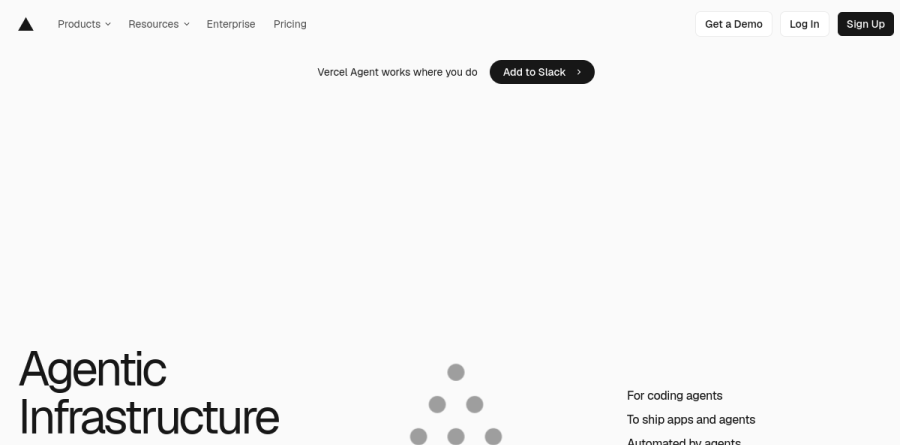
Vercel is a deployment platform: you connect a Git repository, push code, and the platform builds it and deploys it globally in seconds. It began as the home of Next.js and has since grown into much more — the current homepage leads with agentic infrastructure, pitching Vercel as the place to run AI agents alongside the websites and apps it has always hosted.
The pitch to developers is simplicity at the front and scale at the back: zero-configuration deploys, a Preview Deployment for every pull request, and infrastructure that Vercel says lets apps scale from zero to millions instantly.
From Git push to Preview Deployment
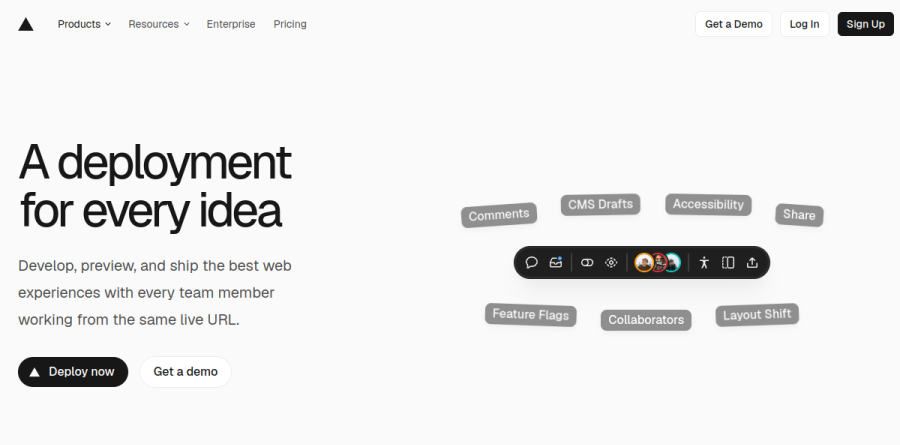
The daily workflow is what wins people over. Connect GitHub, GitLab, Bitbucket, or Azure DevOps — or use the Vercel CLI — and every pull request gets a fully functional Preview Deployment, ready to share at a live URL as soon as it builds. Every team member works from the same live URL and can gather insights and refine work through built-in commenting on deployments.
The previews product goes further than a shareable link: a built-in toolbar lets teams toggle feature flags on a running preview, audit accessibility against WCAG criteria, and trace layout shifts back to their cause. If a production release goes wrong, instant rollbacks restore the previous deployment.
Vercel is made by the creators of Next.js, and its frameworks page describes the service as the native Next.js platform. In practice that means zero configuration: push a Next.js app and capabilities like Incremental Static Regeneration, Server-Side Rendering on autoscaling Serverless Functions, Static Site Generation, and Partial Prerendering simply work.
Routing Middleware runs ahead of your routes for A/B testing and feature flagging, while ISR pulls fresh content from a headless CMS or database without a full rebuild — Vercel quotes updates propagating in roughly 300 milliseconds.
Built for AI agents
The most visible recent shift is toward AI workloads. The homepage showcases Eve, a framework for building durable agents; Passport, which secures internal agents and deployments behind your identity provider; and Containers for running production workloads in isolation. Underneath sit an AI Model Gateway, Fluid Compute, Sandboxed Environments, and the familiar Serverless Functions.
Vercel backs this with named customers: its homepage credits Notion with millions of agent conversations daily on the platform, Zapier with over 100 million monthly website visits, and Mintlify with powering documentation for more than 20,000 companies.
Plans, security, and scaling
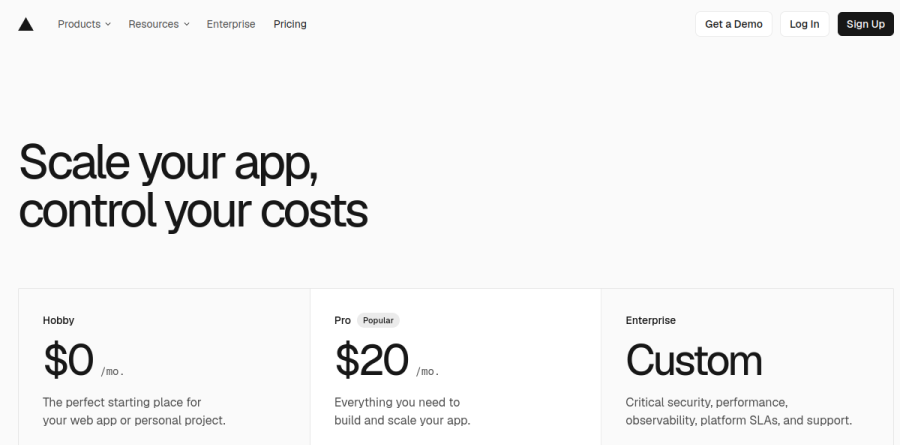
Vercel sells three plans. Hobby is free and genuinely usable for personal projects, with monthly allowances for edge requests, fast data transfer, image transformations, and serverless compute, plus basic bot protection. Pro layers on an included usage credit, far larger allowances, unlimited Viewer seats, webhook triggers, and up to forty custom firewall rules, with overages billed per unit of usage.
Enterprise moves to custom pricing and adds what large organizations ask for: SAML SSO and Directory Sync included, a dozen Custom Environments, Advanced Deployment Protection, and a tier built around critical security, performance, observability, platform SLAs, and support. A Web Application Firewall is part of the platform across plans.
Who should choose Vercel
Vercel fits frontend and full-stack JavaScript teams best — above all anyone building with Next.js, where the zero-config promise is most complete. It also suits product teams that live in pull requests and want stakeholders reviewing Preview Deployments instead of a shared staging server, plus startups shipping AI features who would rather rent an agent stack than assemble one.
It is not the right home for long-running backend monoliths, heavy non-HTTP workloads, or teams that need a flat, fully predictable infrastructure bill — usage-based overages on Pro reward careful monitoring, and high-traffic sites should model their usage before committing. Start on Hobby, ship something real, and upgrade when a team forms around it.
Strengths
- Instant git-based deploys with preview URLs for every branch
- Generous free Hobby tier for personal projects
- Best-in-class developer experience for Next.js
- Global edge network and serverless/edge functions
Watch out for
- Hobby is non-commercial only — revenue projects must upgrade
- Usage overages beyond included allowances ($0.15/GB after 1TB)
- All-in Pro cost often lands around $67/mo with overages
- Enterprise pricing is steep
Key features
| Feature | What it does |
|---|
| Git-based deploys | Push to deploy, with automatic preview URLs per branch. |
| Edge network | Global CDN with edge and serverless functions. |
| Analytics | Built-in web and speed analytics. |
| Framework support | First-class Next.js plus most frontend frameworks. |
How Vercel compares
| Alternative | How it differs |
|---|
| Netlify | Similar Jamstack host; compare build minutes and pricing. |
| Cloudflare Pages | Cheaper bandwidth; less Next.js-specific polish. |
| Render | Broader backend hosting beyond frontends. |
Frequently asked questions
Is Vercel free?
Vercel’s Hobby plan is free but restricted to personal, non-commercial use. Any project that generates revenue needs the Pro plan at $20 per seat per month (with $20 of usage credit included).
Can I host a commercial site on Vercel Hobby?
No — the Hobby tier is non-commercial only. Commercial or revenue-generating projects must be on Pro or Enterprise.
Vercel ratings on other platforms
Independent user ratings from third-party review sites, linked here for transparency.
These are not our editorial score, are captured on the date shown, and may have changed since.