The full review
What is Google Cloud Run?
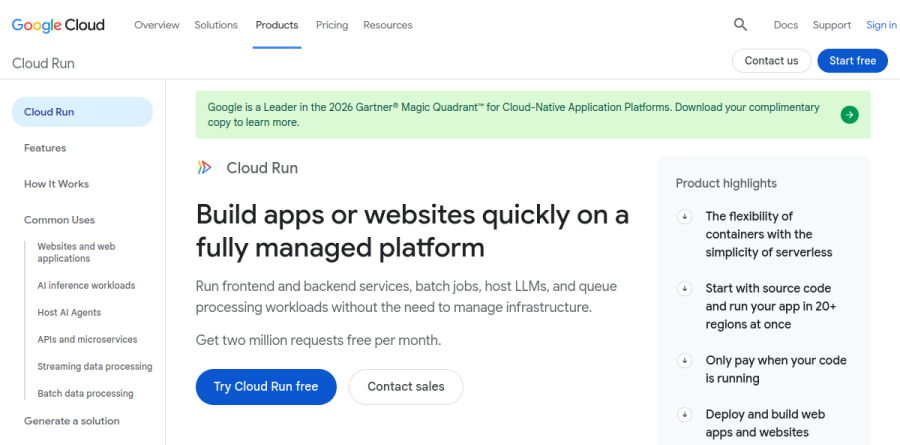
Google Cloud Run is a fully managed platform for running containers directly on Google infrastructure. You hand it a container image or plain source code, and it runs on Google's scalable infrastructure, automatically scaling containers up and down from zero with no infrastructure to manage. The product page frames the scope broadly: frontend and backend services, batch jobs, hosted LLMs, and queue processing workloads, all without managing servers.
The defining trait is that instances scale down to zero when nothing is happening. Google positions Cloud Run as the flexibility of containers with the simplicity of serverless, and the metering reflects that, billed in vCPU-seconds and GiB-seconds rounded up to the nearest 100 milliseconds.
Deploying code without touching infrastructure
Cloud Run accepts any language, any library, any binary. Package your app as a container, issue gcloud run deploy, and the service goes live with what it needs for production. Building the container is optional: for Go, Node.js, Python, Java, .NET Core, and Ruby, source-based deployment uses buildpacks to construct the image for you, with no local Docker install required.
Builds can be wired to a Git branch so fresh commits deploy on push. Behind the scenes Cloud Build produces the image and Artifact Registry stores it, and both are billed separately from Cloud Run itself.
How Cloud Run scales and bills
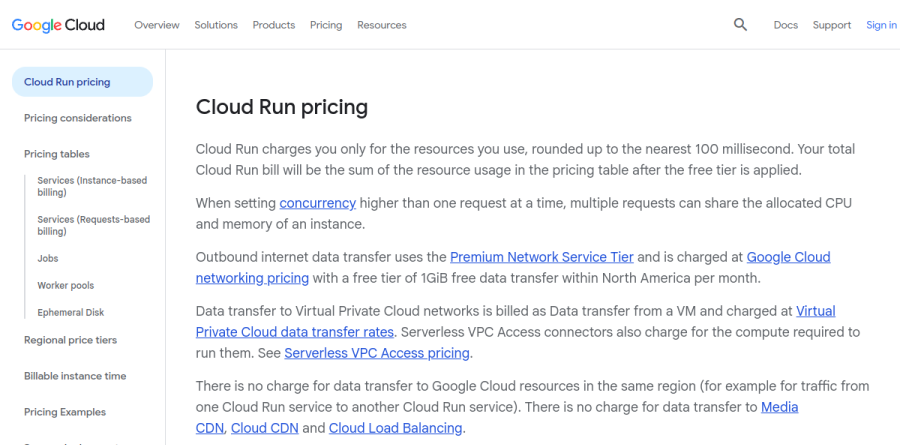
Cloud Run autoscales containers up and down from zero, so you pay only while code executes. Two billing configurations govern the meter. Request-based billing charges CPU and memory while an instance is starting, shutting down, or handling at least one request. Instance-based billing charges for the entire lifetime of an instance with a one-minute floor, and carries no per-request fee.
Concurrency shapes the result: set above one request at a time, multiple requests share the allocated CPU and memory of an instance. An always free monthly tier absorbs a baseline of compute and requests before anything is billed, and minimum instances stay warm at a lower idle rate when cold starts hurt.
Jobs, worker pools, and GPU inference
HTTP services are only part of the story. Cloud Run jobs run to completion and bill at the instance-based rate, which suits scheduled reports and large data transformations. Worker pools handle asynchronous background work such as bulk email or video processing, keeping the main application responsive. For AI inference, Cloud Run offers on-demand NVIDIA L4 GPUs, and the vendor reports that GPU instances start in five seconds and scale to zero. NVIDIA RTX Pro 6000 appears in the tables too: the services and worker pool tables price both GPU types with and without zonal redundancy, while the jobs table lists only the no-zonal-redundancy option.
Where Cloud Run sits in the Google Cloud stack
Cloud Run functions is the current home of what used to ship as Cloud Functions, giving you function-level code with full control over the underlying service configuration. Eventarc handles event delivery, Serverless VPC Access reaches private networks, and traffic between Cloud Run services inside the same region carries no data transfer charge.
Regions fall into Tier 1 and Tier 2 price bands. Steady baseline load can be discounted through committed use discounts, and Compute Flexible CUDs stretch across GKE, Compute Engine, and Cloud Run together. Google cites Telegraph Media Group seeing a 90 percent reduction in costs and carbon emissions after moving from microservices to serverless.
Who should choose Google Cloud Run
Cloud Run fits teams already invested in Google Cloud who want container portability without operating Kubernetes: web apps, APIs, microservices, event-driven glue, and increasingly AI agents and inference endpoints. Bursty or unpredictable traffic is where scaling to zero pays off hardest, and the GPUs are on demand rather than reserved: NVIDIA L4 instances start in 5 seconds and scale to zero.
It is a weaker fit for workloads that need persistent local state or node-level control: Google describes Cloud Run as an environment for stateless containers, and points to VM- and Kubernetes-based deployments, meaning Compute Engine or GKE, when you want that level of control. Finance teams who want one flat, predictable monthly figure will also find per-second metering harder to forecast, though the pricing calculator and committed use discounts take some sting out of that.
Strengths
- True scale-to-zero under request-based billing: pay nothing while idle, only per 100ms of actual use
- Generous always-free monthly tier (180K vCPU-seconds, 360K GiB-seconds, 2M requests)
- Runs any container image in any language, up to 8 vCPU / 32 GiB and 1,000 concurrent requests per instance
- Two billing modes (request-based and instance-based) let you tune cost for spiky vs steady workloads
Watch out for
- Usage-based pricing is hard to forecast; bills can spike with high request volume or always-on minimum instances
- Tier 2 regions cost roughly 30-40% more per vCPU-second and GiB-second than Tier 1
- Egress beyond the 1 GiB/month North America free allowance is billed at standard Google networking rates
- Cold starts on scale-to-zero services add latency unless you pay for minimum instances
Key features
| Feature | What it does |
|---|
| Scale to zero | Automatically scales instances down to zero when there is no traffic, so idle request-based services cost nothing. |
| Per-100ms metering | CPU and memory are billed per vCPU-second and GiB-second, rounded up to the nearest 100 milliseconds of use. |
| Request-based vs instance-based billing | Choose per-request billing (pay only during requests, $0.40/M) or instance-based billing (pay full lifecycle, no per-request fee). |
| Any container | Deploy any Docker/OCI image in any language, with up to 8 vCPU and 32 GiB of memory per instance. |
| High concurrency | A single instance can serve up to 1,000 concurrent requests, lowering per-request cost versus one-request-per-instance platforms. |
| Committed use discounts | Commit to steady monthly spend for up to roughly 17% off the standard vCPU and memory rates. |
How Google Cloud Run compares
| Alternative | How it differs |
|---|
| AWS Lambda | Function-first serverless billed per request plus GB-second; frees 1M requests + 400,000 GB-seconds/month vs Cloud Run's container-first, 2M-request model. |
| Azure Container Apps | Microsoft's serverless container platform with similar scale-to-zero and per-second vCPU/memory billing; tighter Azure integration. |
| AWS Fargate | Serverless containers for ECS/EKS billed per vCPU/GB-hour, but without Cloud Run's true scale-to-zero for idle services. |
Frequently asked questions
How much does Google Cloud Run pricing cost?
Cloud Run is pay-per-use. In Tier 1 regions, request-based billing costs about $0.000024 per vCPU-second (roughly $0.0864 per vCPU-hour), $0.0000025 per GiB-second of memory, and $0.40 per million requests. You are billed per 100 milliseconds of actual use, and idle request-based services scale to zero at no cost.
Is Google Cloud Run free?
Yes, there is an always-free monthly tier: 180,000 vCPU-seconds, 360,000 GiB-seconds of memory, 2 million requests, and 1 GiB of North America egress each month. New Google Cloud customers also receive $300 in credits for 90 days. Small apps and prototypes often run entirely within these free allowances.
Google Cloud Run vs AWS Lambda: which is cheaper?
It depends on the workload. Lambda charges per request plus GB-seconds and frees 1M requests and 400,000 GB-seconds monthly. Cloud Run bills per vCPU-second and GiB-second ($0.000024 and $0.0000025 in Tier 1) plus $0.40 per million requests, freeing 2M requests. Cloud Run's 1,000-request concurrency can win for steady, high-traffic containerized apps.
What is the difference between request-based and instance-based billing?
Request-based billing (the default) charges CPU only while an instance handles requests, adds $0.40 per million requests, and scales to zero when idle. Instance-based billing charges for an instance's entire lifecycle at a lower per-second rate with no per-request fee, which suits always-on services using minimum instances or steady traffic.
Does Google Cloud Run charge when there is no traffic?
Under request-based billing, no. Instances scale to zero and you pay nothing while idle, unless you configure minimum instances. If you set minimum instances or use instance-based billing, you pay for that reserved capacity even with zero requests. Cold-start latency is the trade-off for scaling fully to zero.
Google Cloud Run ratings on other platforms
Independent user ratings from third-party review sites, linked here for transparency.
These are not our editorial score, are captured on the date shown, and may have changed since.