The full review
What is Netlify?
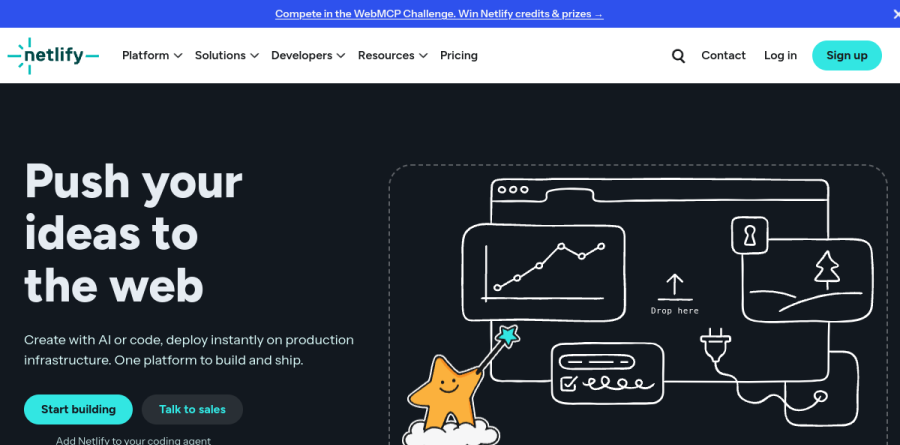
Netlify is a hosting and application platform that connects a Git repository — or an AI prompt — to a global edge network, then handles the build, deploy, and delivery steps in between. The homepage pitch is to push your ideas to the web: create with AI or code, deploy instantly on production infrastructure.
What separates Netlify from a plain static host is everything wrapped around the file serving. Alongside delivery it ships a set of backend primitives — Functions, AI Gateway, Netlify Database, Netlify Blobs, Identity, Forms, and Caching & CDN — so a frontend team can add server-side behaviour without provisioning servers or opening a separate cloud account.
Deploy previews and the Git workflow
The deploy model is the part most teams notice first. Connect a repository and every push, pull request, or prompt gets its own Deploy Preview at a unique URL, so a reviewer clicks a link and sees the rendered change rather than reading a diff. Branch deploys, Build hooks, and Git integration round out the same deploy flow, which the platform page describes as a unique preview URL for every branch and PR.
Because deploys are retained rather than overwritten, rolling back is a one-click operation instead of a revert-and-rebuild scramble. Netlify also covers secret scanning: the pricing page describes Smart secret detection as automatically detecting and blocking potential secrets in your code without manual configuration, available from the $9 Personal plan up.

The Primitives layer is where Netlify stops being a static host. Functions cover serverless, edge, background, and scheduled execution, so a form handler, a cron-style cleanup job, and a low-latency personalisation rule can live in one repository. Netlify Database and Netlify Blobs handle structured data and unstructured objects, while Identity covers authentication, sparing small teams a separate auth vendor for a login screen.
AI Gateway is the primitive aimed squarely at AI apps, summed up on the platform page as "Any AI model, zero API keys" — and the Agent Runners section repeats that no setup or API keys are required. Forms stays quietly useful: mark up a form and submissions are captured with no backend code.
Framework coverage across the ecosystem
Netlify is genuinely framework-agnostic, and its frameworks directory backs that up. Next.js, Nuxt, Astro, SvelteKit, Remix, TanStack, Angular, and Gatsby are documented alongside non-JavaScript generators including Hugo, Jekyll, Middleman, MkDocs, and Hexo, plus Hydrogen for Shopify storefronts. That breadth matters when a company runs its marketing site on Hugo, docs on MkDocs, and the product on Next.js: one platform, one workflow, one bill.
Agent Runners and AI-assisted building
Netlify has leaned hard into AI-assisted development. Agent Runners spin up a project from a prompt or iterate on a live app using Claude, Gemini, Codex, or OpenCode, landing the result on the same production infrastructure a hand-written project would use. The loop Netlify pitches is prompt, preview, repeat — and generated code inherits the normal guardrails, since preview URLs, rollbacks, and Secret scanning all still apply.
Scaling, observability, and team access
On delivery, the Netlify Network spans more than 100 edge locations with always-on DDoS protection and auto-scaling for traffic spikes; the vendor reports 99.99% uptime. Image CDN optimises images on the fly, Rate limiting and firewall rules sit in front of your endpoints, and Observability with Analytics shows what happened during a deploy or a surge. Team controls scale by plan: shared environment variables, private organization repos, and extra concurrent builds arrive on Pro, while Enterprise adds SSO and SCIM, log drains, and an uptime SLA.
Who should choose Netlify
Netlify fits frontend and full-stack teams that want deploy previews, rollbacks, and edge delivery without hiring anyone to run infrastructure. Agencies and product teams benefit most, because Pro bills $20 a month for unlimited members, where Personal is $9 a month for a single member and Free is limited to one. Solo builders and side projects are served well by Free and Personal.
It is less ideal for teams needing deep control over long-running backend services, container workloads, or bespoke networking; the model here is credit-metered serverless execution on managed infrastructure, so a stateful or data-heavy backend belongs on a general-purpose cloud with Netlify serving the frontend in front of it. Anyone with spiky, hard-to-forecast traffic should model credit consumption before committing.
Strengths
- Flat $20/mo Pro covers unlimited team members — a 5-person team pays $20 vs Vercel's $100 (5 x $20/seat)
- Framework-agnostic: first-class support for Astro, SvelteKit, Nuxt, Remix, Hugo and 30+ frameworks, not just Next.js
- Rich built-ins Vercel lacks: native forms, identity/auth, background and durable functions, A/B testing, one-command serverless Postgres
- Local CLI mirrors production (functions, redirects, env vars), reducing deploy surprises
Watch out for
- New credit-based billing (since April 2026) is harder to forecast; bandwidth rose to 20 credits/GB ($0.13)
- Smaller edge network — ~16 core CDN nodes vs Vercel's 126 points of presence — and slower Next.js builds (2-3 min vs 1-2)
- Free and Personal tiers are single-user; team collaboration requires the $20 Pro plan
- Bleeding-edge Next.js features (RSC, PPR) land on Vercel first; Netlify can lag
Key features
| Feature | What it does |
|---|
| Global CDN & instant rollbacks | Atomic deploys served from a global edge with one-click rollback to any previous version |
| Serverless & edge functions | Standard, edge, background, and durable functions; function invocations carry no extra credit fee |
| Built-in Forms | Native form handling with spam filtering — form submissions are now free on all plans |
| Identity & Auth | Managed user authentication and role-based access without a separate auth provider |
| Netlify DB (serverless Postgres) | One-command serverless Postgres provisioning integrated with the platform |
| Deploy Previews & A/B testing | Per-PR preview URLs plus native branch-based split testing for experiments |
How Netlify compares
| Alternative | How it differs |
|---|
| Vercel | Faster Next.js builds and a much larger 126-PoP edge network, but charges $20 per seat vs Netlify's flat $20 team price |
| Cloudflare Pages | Cheaper bandwidth and a huge global edge, but leaner built-ins (no native forms, auth, or split testing) |
| Render | Full-stack hosting with persistent servers and managed databases; less Jamstack/edge-focused than Netlify |
Frequently asked questions
Is Netlify free?
Yes. Netlify's Free plan costs $0/month and includes 300 credits, unlimited deploy previews, custom domains with SSL, serverless functions, and its global CDN. As of 2026 the free tier is single-user only (no team seats). Usage beyond 300 credits requires upgrading to Personal ($9) or Pro ($20).
How much does Netlify cost?
Netlify uses credit-based pricing since April 2026. Free is $0 (300 credits), Personal $9/month (1,000 credits), and Pro $20/month (3,000 credits, unlimited team members). Enterprise is custom-quoted. Overages bill per meter: bandwidth 20 credits/GB ($0.13), compute 10 credits/GB-hour ($0.07), production deploys 15 credits ($0.10 each).
What are the best Netlify alternatives?
The top Netlify alternatives are Vercel (best for Next.js, larger edge network), Cloudflare Pages (cheapest bandwidth, huge edge), and Render (full-stack apps with persistent servers and databases). GitHub Pages and AWS Amplify are also options. Vercel is the closest head-to-head competitor for frontend deployment.
Netlify vs Vercel: which is better?
Netlify is framework-agnostic (30+ frameworks) with built-in forms, auth, and A/B testing, and a flat $20/month Pro covering unlimited team members. Vercel wins for Next.js, faster builds, and a larger 126-PoP edge network, but charges $20 per seat. Pick Netlify for multi-framework teams; Vercel for Next.js-heavy, performance-critical apps.
Did Netlify get rid of per-seat pricing?
Yes. On April 14, 2026, Netlify ended seat-based pricing ('the end of seats'). The Pro plan is now $20/month flat with unlimited team members, including Git contributors who previously each cost $20. Form submissions also became free. Netlify says 98% of customers saw bills stay flat or decrease.
Netlify ratings on other platforms
Independent user ratings from third-party review sites, linked here for transparency.
These are not our editorial score, are captured on the date shown, and may have changed since.