Atoms review: what it costs, what it builds, where it stops
Atoms is the commercial product of the team behind MetaGPT, and at $20 a month it bundles more into its entry tier than most rivals: a hosted Postgres backend, auth, Stripe, custom domains and unlimited team seats. It is also the hardest of the group to budget for, because Atoms publishes no conversion between credits and work, only partial unit rates for running a published app, and a refund window that closes the moment you spend your first credit. Worth a free-tier afternoon if you are building a small web app or a marketing site and can afford to lose the first $20. Avoid it if you need a native mobile app, a predictable monthly bill, or a vendor that will survive a procurement review.
Should you pay for it?
Only if you treat the first $20 as an experiment rather than a commitment, and only after you have used the free tier on the actual thing you want to build. Atoms Pro is $20 a month for 100 credits, or $15.8 a month on yearly billing, which puts it at the cheap end of the category with a genuinely fuller backend included than most. The problem is everything Atoms does not publish. There is no stated conversion between credits and work anywhere on the pricing page, the models page or the credit help article. There is no way to buy a one-off top-up when you run out, only a full upgrade that Atoms’ own worked example charges at the full price difference. Running a published app is billed separately from a Cloud & AI Wallet that carries a $1 free AI allowance, prepaid top-ups from $10, published rates for three of its billed dimensions but none for compute or AI inference, and a documented behaviour of stopping your live app when the balance empties. Add a refund window of 24 hours for most of the world, 14 days in the EU, UK and Turkey, that closes the instant credits begin to be consumed, and the honest position is that you cannot know what a month costs before you have paid for one. Spend the free 25 credits a month first and measure the burn yourself.
Strong at
- A genuinely fuller backend at the entry price: hosted database, auth, Stripe and custom domains are in Pro, not an add-on
- Eight named agents with fixed roles, run as one workflow from a single brief
- A free tier substantial enough to build something real and measure the credit burn yourself
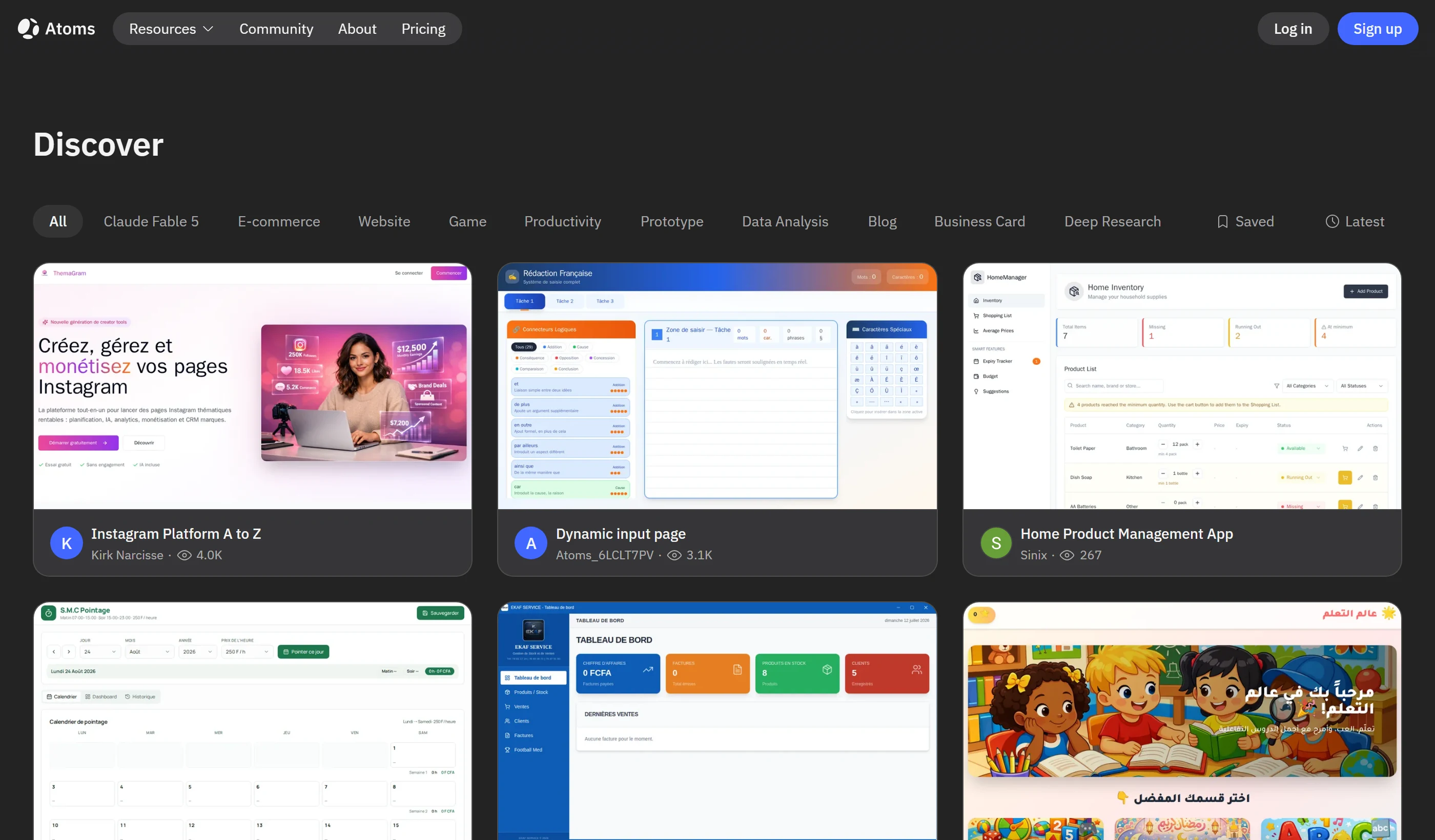
- A public Discover gallery of what strangers actually shipped, which is rarer and more useful than a vendor demo reel
- Real lineage: the team behind MetaGPT and OpenManus, both large open-source projects
Weak at
- No published conversion between a credit and any unit of work, anywhere on the site
- A second, separately metered bill for running a published app, with no rate published for compute or AI inference
- Refunds close as soon as the first credit is spent, and the window is 24 hours in most of the world
- Its own documentation contradicts itself on mobile builds, custom domains and the Free plan project count
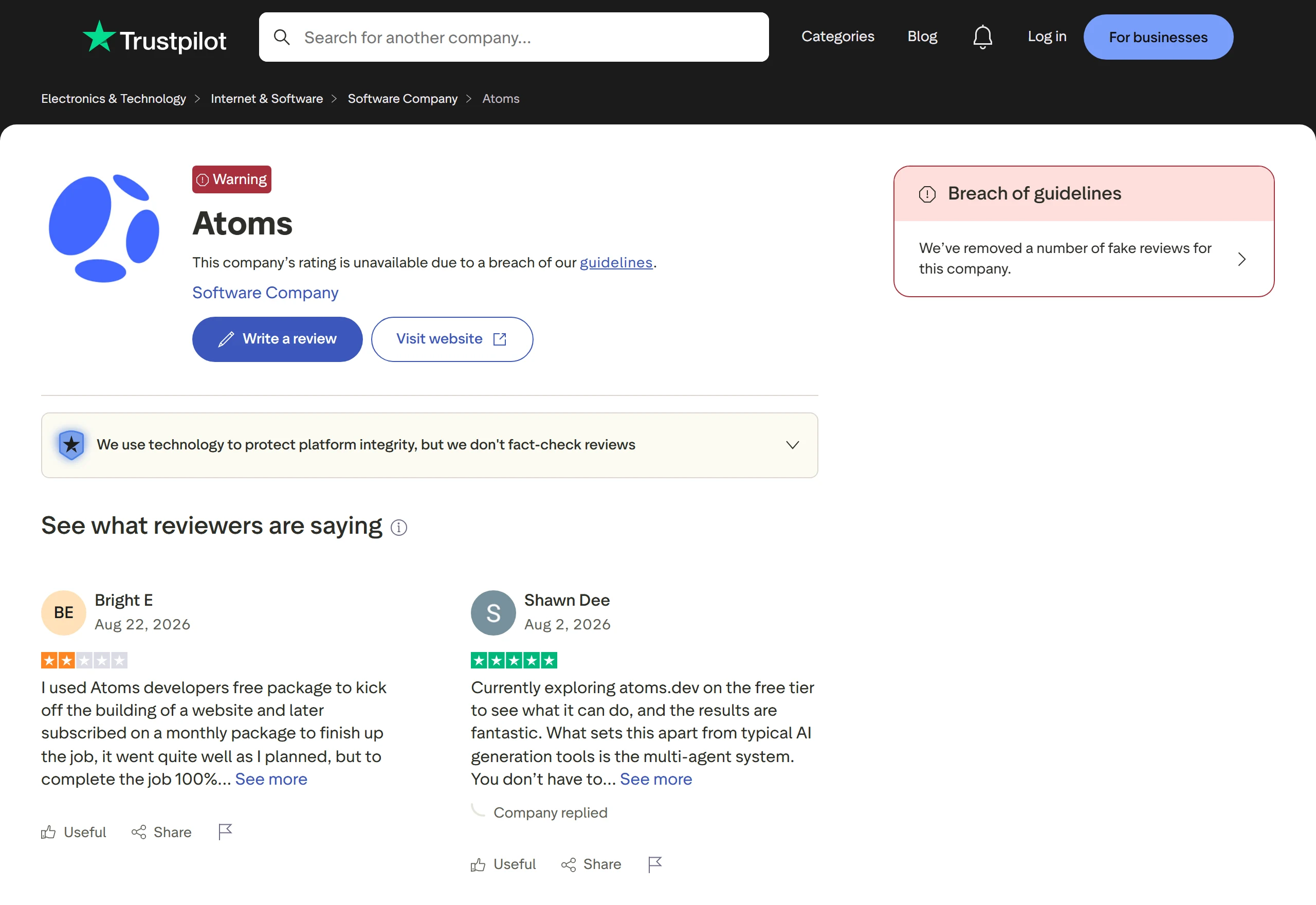
- Trustpilot has withdrawn its star rating after removing fake reviews, so the public review record cannot be read either way
Free plan, no card required. You can test the whole build flow before paying.
OfficeBooks earns a commission if you subscribe through links on this page. It costs you nothing extra, and it did not soften the limitations section below. We did not run a paid build: everything here comes from Atoms’ own pages, its help centre and terms, and the third-party sources we list. Where we could not confirm something, we say so rather than guess.
What Atoms actually is, and how it works
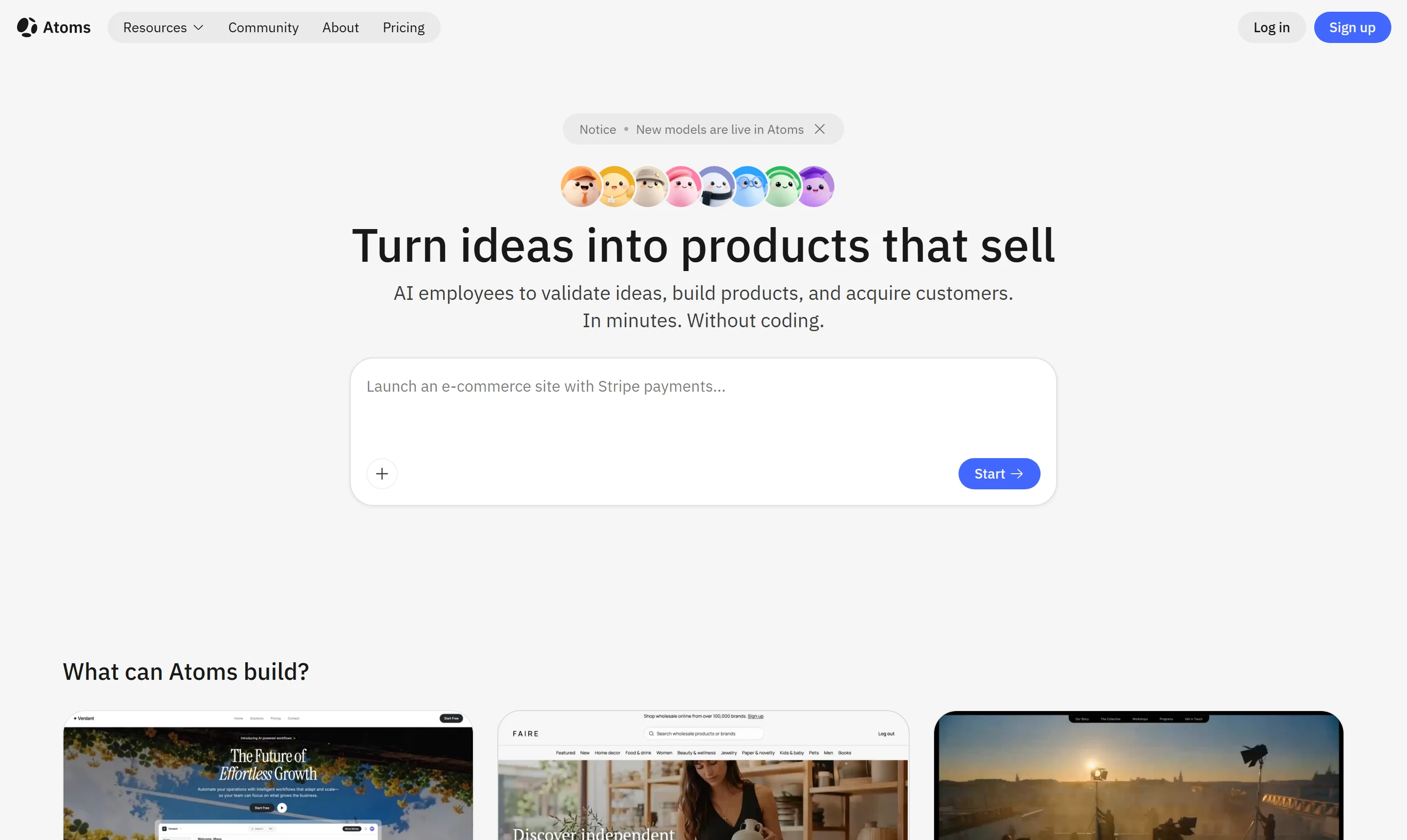
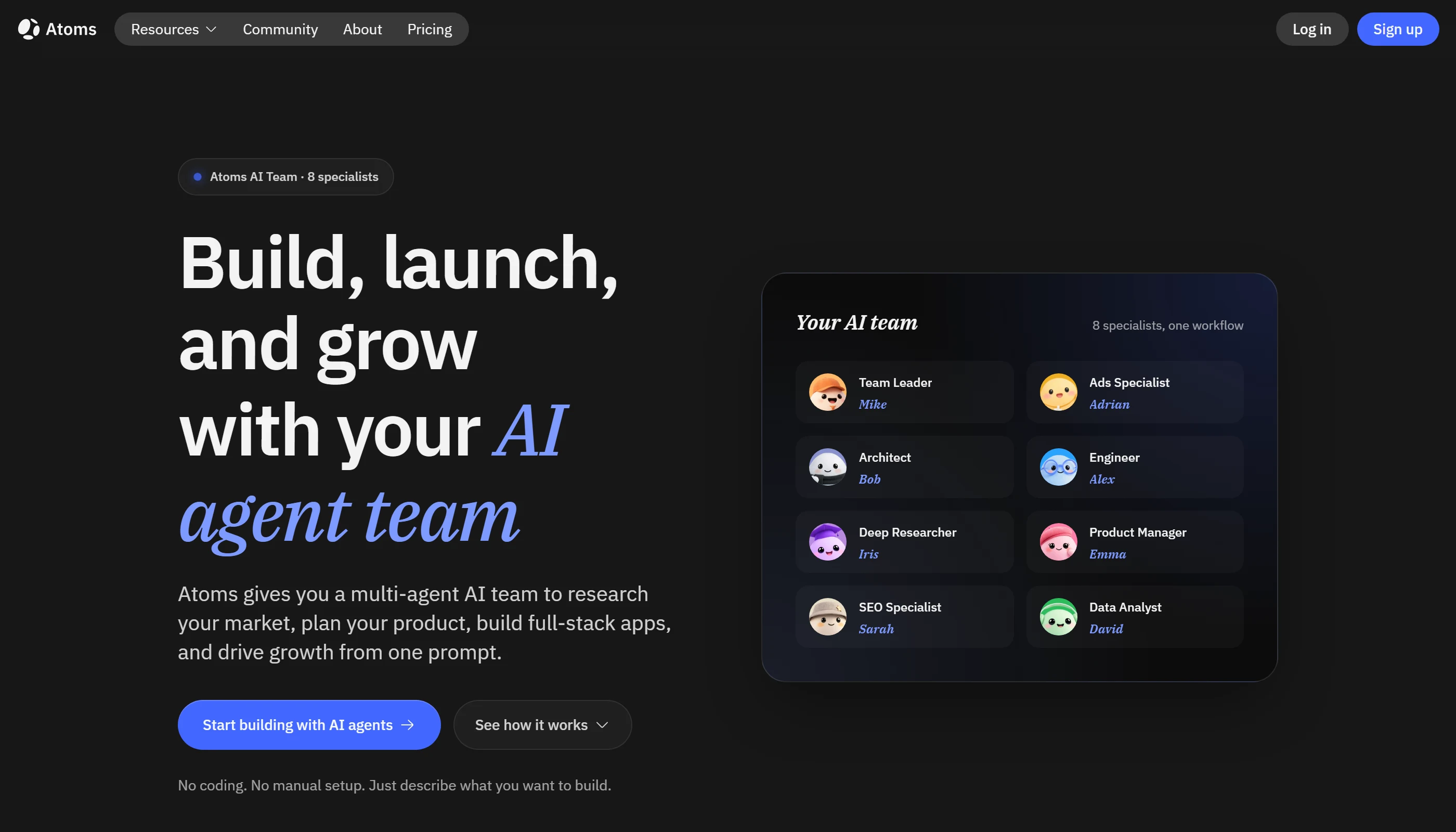
Atoms sells itself as AI employees rather than a chat assistant. The homepage promises idea validation, product build and customer acquisition without coding. The AI Agents page names eight personas: Mike the Team Leader, Iris the Deep Researcher, Bob the Architect, Emma the Product Manager, Alex the Engineer, Sarah the SEO Specialist, Adrian the Ads Specialist and David the Data Analyst. The working interface is an input box with a Mode Switch control at the bottom left, and the agents run behind it.
The roster is not stable across Atoms’ own documentation. The help centre’s official ’Your Agents Team’ article documents only seven agents and omits Adrian the Ads Specialist entirely. It also heads David’s entry ’Data Scientist’ while his own bio text calls him a Data Analyst, against the marketing site’s Data Analyst. Where Adrian is documented, he works only with Google Ads, and he requires you to hold a Google Ads account and spend real money. Atoms does not fund the ads.
There are four documented modes but three different ways of reaching them. Engineer Mode runs Alex alone and is cheaper. Team Mode is multi-agent and costs more credits. Race Mode is Max-plan only. Deep Research Mode is Iris. The Mode Switch button only offers Engineer or Team. Deep Research is invoked by typing @Iris, and Race Mode is chosen separately at the chat box. Neither Atoms’ pricing page nor its help centre attaches a credit number to any of these, so ’more credits’ is the only guidance you get before you spend.
Atoms Cloud is the substantive part of the product. It provides six named services: a database, user authentication including Google social login, Stripe payments, custom domains, API key management and native LLM or agent integration, and it configures itself by detecting what the project needs. The launch blog describes the stack as OIDC authentication, an object-relational database, managed object storage, serverless compute and Stripe, provisioned by agents from a natural-language description. The blog does not name the database engine. The only place Atoms names PostgreSQL is a changelog entry dated 18 May 2026, which shipped an in-product database interface with table browsing, editing and CSV import and export.
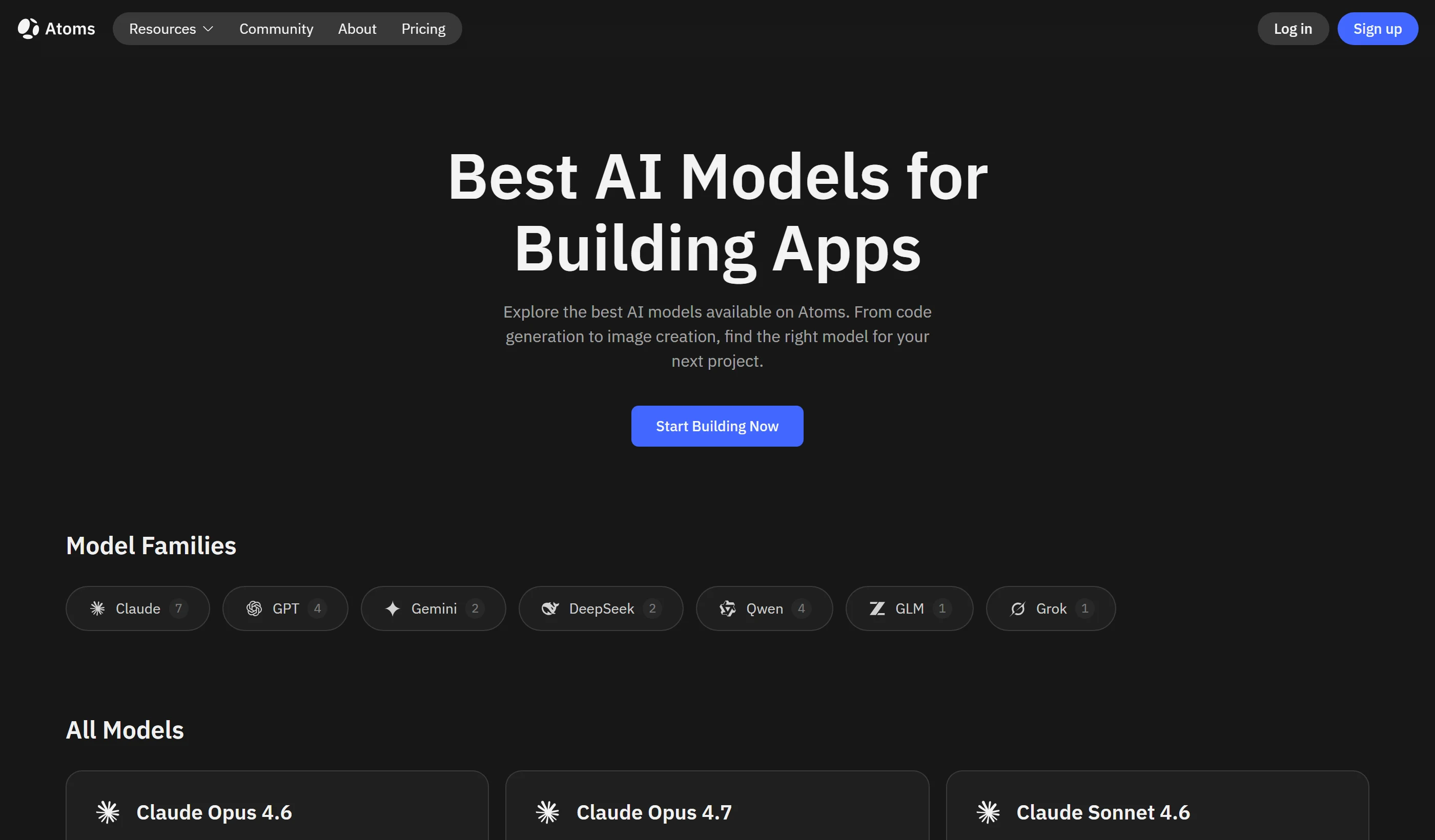
Model choice is documented badly. The Models page lists 24 model cards and claims these are the models available on Atoms, with family counts of Claude 7, GPT 4, Gemini 2, DeepSeek 2, Qwen 4, GLM 1 and Grok 1. It states no credit cost and no plan availability for any of them, so you cannot tell from that page which models a Free, Pro or Max subscriber can actually select. The help centre’s model-selection guide is worse: it documents five selectable models, and four of them no longer appear on the Models page at all.
The trade-off is the whole bet of the product. If a team of personas plans and builds better than one strong model, the overhead is worth paying. The published evidence does not settle that. A Trustpilot reviewer argues directly that the multi-agent setup produces worse output than a single LLM such as Claude, with the agents hallucinating while consuming credits. Atoms’ own troubleshooting documentation concedes that agents can repeat actions without making progress and can enter infinite loops, and tells the user to stop and rewrite the prompt. In a metered product, a loop is a bill.
What it can really build, and what it cannot
The marketing claims widen as you move through the site. The homepage’s ’What can Atoms build?’ strip names six output types, including a video and a game alongside websites. The About page claims more, promising websites, apps, slides, videos, workflows and games from one idea. The homepage also claims that every app comes with user login, data storage and Stripe payments, under the heading ’Real apps, not just demos’, and advertises embedding third-party models such as Gemini and GPT into your own product with no API keys and no setup.
The Use Cases page is narrower and more revealing. It is organised into just three categories: Website, Deep Research and App. The overwhelming majority are industry-templated website builders for salons, dental practices, law firms, weddings, hotels, bands and spas. Games and full-stack apps do appear, under App, with the game entry promising scoring, accounts and multiplayer. If you want to know what Atoms is used for rather than what it can theoretically produce, that page is the better guide.
The most useful sentence Atoms has written about its own scope is in the help centre, not the marketing. The project-scope article says Atoms is optimised for rapid prototyping, data visualisation, web applications and custom mini-games, while it continues to work toward more complex systems. That is a prototyping tool describing itself accurately, and it should carry more weight in your decision than the six-output-type strip on the homepage.
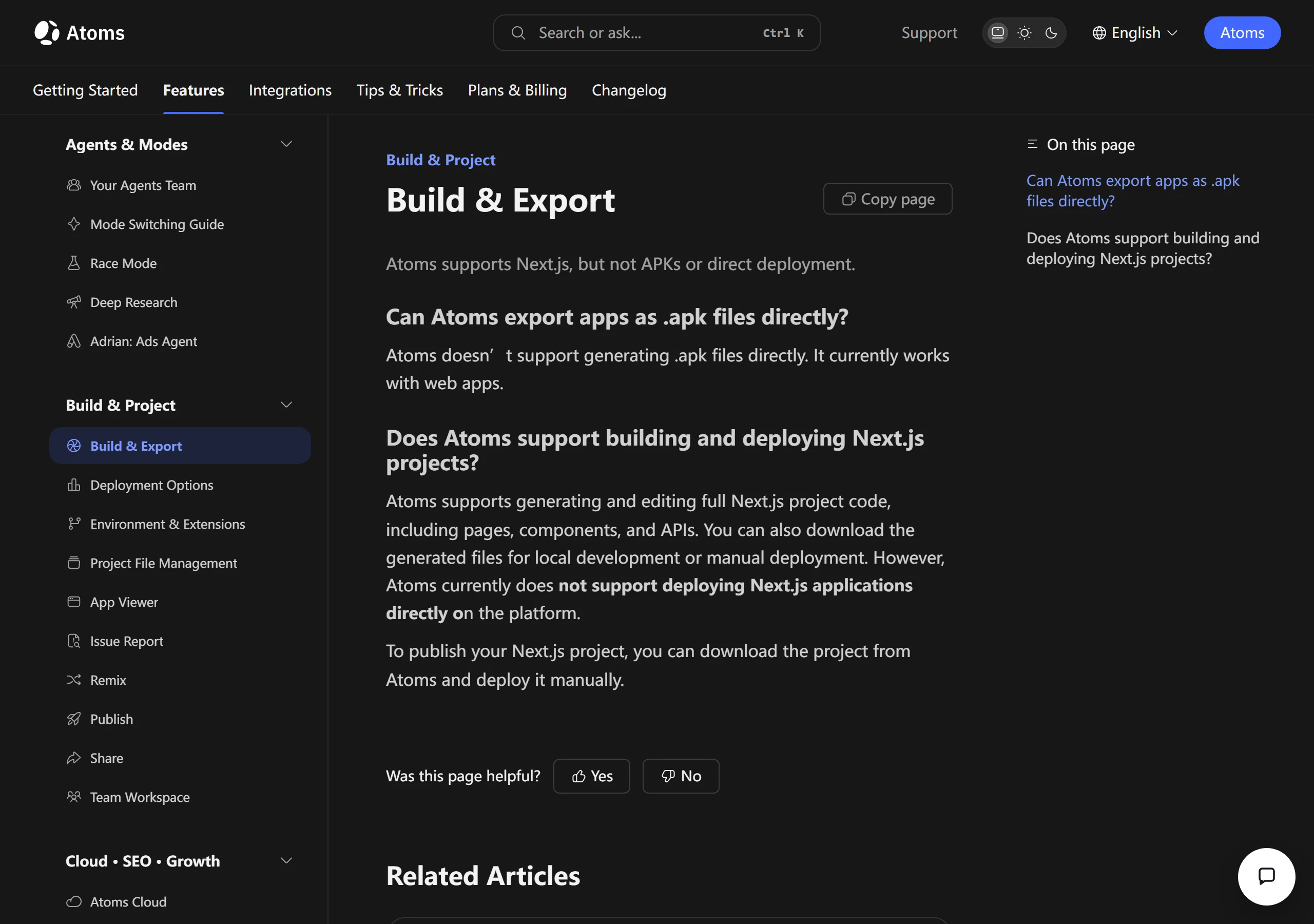
Mobile is where the documentation openly conflicts. A May 2026 changelog entry added mobile app projects with preview, QR-code device testing and Android build support. The Build & Export article still says Atoms currently works with web apps and cannot export a project as an .apk or generate mobile app packages. The project-scope article says Atoms does not generate native iOS or Android binaries or desktop executables, and delivers mobile experiences via Progressive Web Apps and responsive web applications. Three documents, three positions. We could not establish which is current.
The deployment gaps are real and specific. Atoms generates full Next.js project code but cannot deploy Next.js applications on its own platform, so you download the project and host it elsewhere. Static standalone HTML output gets no one-click hosting, which sits awkwardly against an ’HTML Website Builder’ on the Use Cases page. The documented deployment options include no Atoms-hosted path for exported code at all. What Atoms hosts and what Atoms generates are not the same set.
Video Mode exists, with an in-product editor covering clip selection, splitting, zooming and local export. Access is gated to ’eligible users’ rather than open to everyone, and Atoms does not publish the eligibility criteria. Treat the video output type on the homepage as conditional until you have confirmed you qualify.
The trade-off: what Atoms reliably builds is a web application that lives on Atoms’ hosting with Atoms’ backend attached. Everything the marketing adds beyond that is either plan-gated, contradicted elsewhere in the docs, or requires you to take the code and host it yourself. Buy it for the first thing. Do not buy it for the list.
The credit system, and what a month really costs
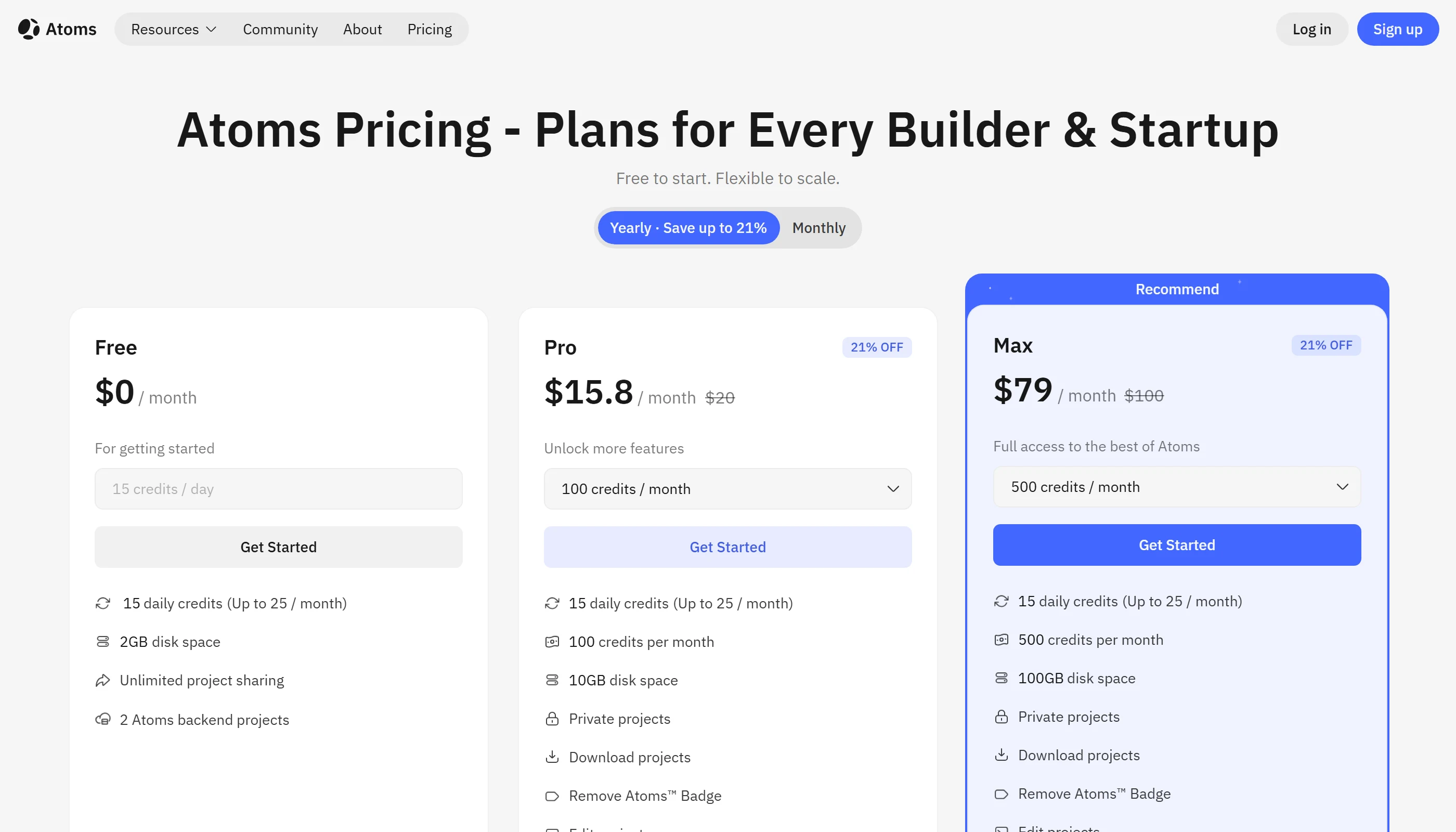
There are three plans: Free at $0, Pro starting from $20 a month, and Max starting from $100. ’From’ is load-bearing. Pro is not one price but a set of monthly credit tiers: 100 credits for $20, which is the default, 250 credits for $50, and 350 credits for $70. Max runs 500 credits for $100 as the default, 1,000 for $200 and 1,500 for $300, with tiers extending up to 10,000 credits a month. The $20 headline is the floor of a ladder, not the price of the product.
The pricing page carries a billing-period toggle labelled ’Yearly · Save up to 21%’ and ’Monthly’. On yearly, Pro shows at $15.8 a month and Max at $79 a month, each badged 21% OFF against the $20 and $100 monthly figures. Our passes over the page did not agree on whether the monthly rates also appear struck through beside the yearly ones. Either way this is a billing-period toggle, not a limited-time discount off a list price. The help centre is more precise than the badge: annual billing gives 21% off on the first credit tier and 18% on tiers above it, measured against twelve consecutive monthly payments. No annual total is published anywhere, only per-month rates, so the multiplication is yours to do.
Every plan carries the same free allowance, and this is widely misread. The line ’Credits: 15 per day / 25 per month’ is printed under Free, Pro and Max alike. It is a baseline daily grant across tiers, not a Free-only perk, and it stacks on top of your plan credits. Credits are spent in a fixed order: daily free first, then subscription, then bonus, so your paid balance is only touched once the free allowance is gone. The daily figure is not fixed either. Atoms says the per-day amount may adjust based on earlier usage while the cycle total stays the same, and once the 25-credit cycle cap is hit the daily refresh stops until the next billing cycle.
Here is the gap that matters more than any price on the page. Atoms nowhere publishes what a credit buys. We expanded the pricing page’s own credit FAQ: the answer defines where credits come from and the order in which they are spent, and never states what one credit does. The Models page lists 24 models with no credit cost against any of them. Team Mode is documented as costing more than Engineer Mode, without a number. Race Mode costs extra credits, without a number. You are being sold a currency with no published exchange rate.
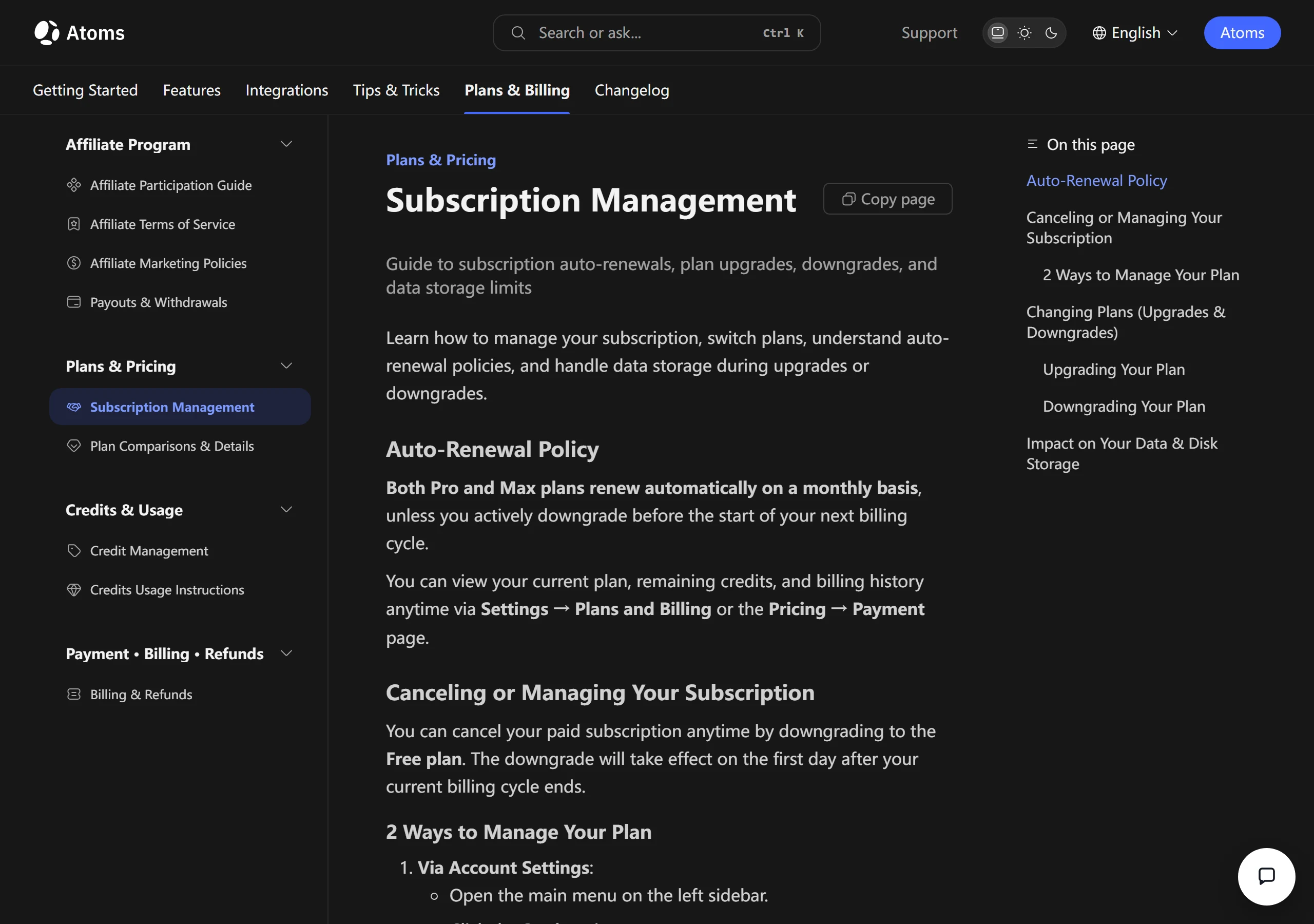
Rollover is thinner than it looks. On monthly billing, rollover applies to four specific credit sources only: mid-cycle upgrade surplus, special-circumstance bonus credits (explicitly excluding the daily 15-credit gift), referral credits and redemption-code credits. Those roll for one additional month and then expire, and the rollover is not cumulative. Ordinary unused subscription credits are not covered. On the pricing page, ’Credits rollovers’ appears in the Pro and Max feature lists only when the toggle is set to Yearly, and disappears from both when you switch to Monthly. Annual plans genuinely get better treatment: credits release in twelve equal monthly instalments, unused credits roll within the same billing year up to the annual limit, and leftovers can carry into the next annual cycle on renewal.
When you run out mid-month there is no small fix. Atoms documents no way to buy one-off credit top-ups. Asked directly whether you can buy extra credits if you run out, the pricing FAQ answers only that you can upgrade to a higher plan at any time, effective immediately. Upgrading does not reset your billing date, and Atoms says you pay the difference in plan price for the remainder of the period. But its own worked example charges the full difference rather than a day-weighted share: upgrading from a $20 plan to a $100 plan with 20 days left costs $80. The mid-month escape hatch is priced like a full month.
Reviewers report the predictable outcome. One says his $20 plan was exhausted after only a few basic prompts, that Atoms then asked for a further $50 a month, and that it is impossibly expensive to actually finish a website there. Another says the credit mechanics are not clearly explained, leaving users repeatedly buying more. Another reports $700 spent under continuous upgrade pressure with a website that still did not work. The trade-off is clean: Atoms starts cheaper than most of its rivals and includes more. What it does not give you is any way to predict the number at the bottom of the month.
| Plan | Billed yearly | Billed monthly | Credits | Disk | What it adds |
|---|---|---|---|---|---|
| Free | $0 | $0 | 15/day, capped at 25 per month | 2 GB | Unlimited project sharing. Projects are public. The pricing page says 2 backend projects; the Cloud help article says 1. |
| Pro | $15.8/mo | $20/mo | 100/month, plus the same 25 free | 10 GB | Private projects, code download, badge removal, Atoms Cloud, custom domain, unlimited team members. |
| Max | $79/mo | $100/mo | 500/month, plus the same 25 free | 100 GB | Everything in Pro, twice the compute, and the only tier with Race mode. Scales to 10,000 credits a month at $300 and above. |
Measure the burn before you commit
Atoms does not publish what a credit buys, so nobody can tell you what a month will cost. The free allowance is enough to build something real and find out.
Start on the free plan →The second bill: Atoms Cloud and the AI Wallet
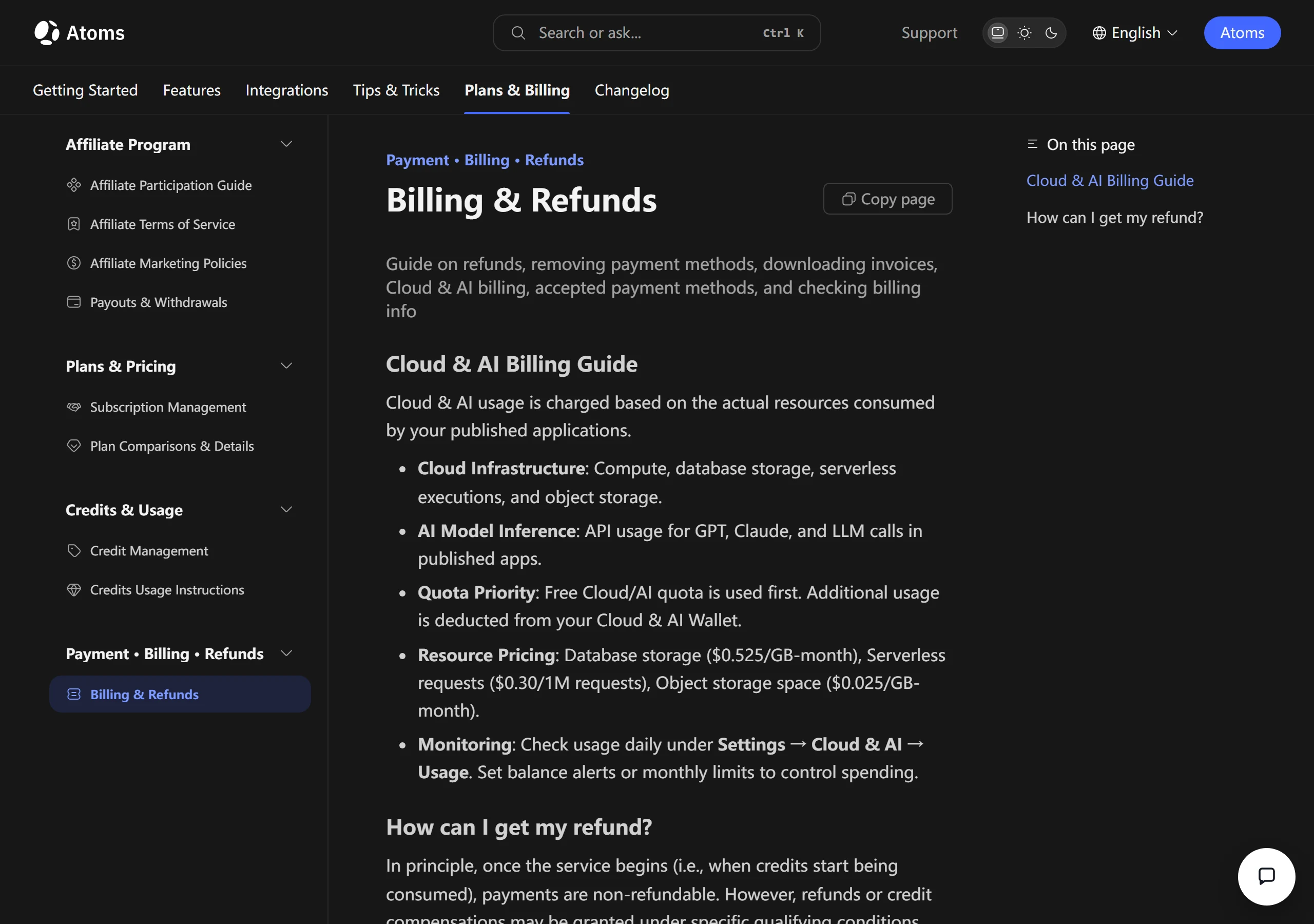
Your subscription does not pay to run what you build. Atoms bills cloud and AI usage separately, from something called the Cloud & AI Wallet, covering compute, storage, serverless executions and LLM API calls once the free quota is used up. If you read only the pricing page you will not budget for this, because the pricing page is about build credits and the wallet is about running the result.
The free AI allowance inside the wallet is worth exactly $1. After that, running any AI feature in a published app requires topping the wallet up. Top-ups are prepaid, in amounts between $10 and $1,000, and they buy infrastructure, not build credits. This is the only thing Atoms sells on top of a subscription, which is a strange asymmetry: you can prepay for hosting but you cannot buy 50 more credits.
Free-plan users cannot top up the wallet at all. They must buy Pro or Max first. So any app that exceeds a dollar of AI usage forces a paid upgrade, no matter how many build credits you still have. If the thing you want to make calls a model on every page view, the free tier will not host it for long.
What happens when the wallet empties is documented, and it is the clearest published answer to the question of what takes a running Atoms app offline: the application stops when the wallet balance and the free quotas run out. That is worth reading twice if you were planning to point a client’s domain at this.
The spending cap is not a hard stop. The default monthly limit is $500, and the default action on hitting it is to pause every one of your apps. Atoms then warns that actual charges may exceed the cap, because billing is postpaid and storage is billed hourly. So the cap is a pause trigger with an overshoot warning attached, not a ceiling.
The unit rates are published in part, and the part that is missing is the part that scales. Atoms’ Billing & Refunds article states three: database storage at $0.525 per GB-month, serverless requests at $0.30 per million requests, and object storage at $0.025 per GB-month. Those are the cheap, predictable dimensions. It states no rate at all for compute, and none for AI model inference, which it describes only as API usage for GPT, Claude and LLM calls in published apps. Those two are the ones that move with traffic. So you can forecast what it costs to store your data and not what it costs to serve it, which is the wrong half to know. For contrast, Bolt publishes hosting quotas on its public pricing page: 1M web requests and a 100MB upload limit on Pro, 333k requests and 10MB on Free, with unlimited databases on both.
The trade-off: bundling hosting, auth, a database and Stripe is the substantive claim behind Atoms’ whole competitive pitch, and its own comparison page concedes Lovable has a backend product too. The price of that bundle is that your app’s running cost is a variable Atoms has chosen not to publish. Assume it is small for a brochure site. Do not assume anything for an app that talks to a model.
Refunds, cancellation, and the terms you are agreeing to
The default position is non-refundable. Atoms’ terms of service and its help centre both state that subscription fees stop being refundable as soon as credits begin to be consumed, with refunds or credit compensation granted only case by case. Almost everything else in this section follows from that one sentence.
The refund window is published in the terms, not in the help centre. EU, UK and Turkey users have 14 days from the charge. Everyone else has 24 hours. In both cases the clock stops the moment credits begin to be consumed, whichever comes first. A refund also requires that you have generated zero service call records, verified against Atoms’ system logs. In practice this means any use of the product at all disqualifies you, which is a meaningful thing to know before you type your first prompt after paying.
The two official channels contradict each other. The terms route refund applications to service@atoms.dev. The help centre says refunds must be requested through Help Center chat, reached via Avatar then Help Center then the chat icon, supplying your registered account email, an invoice screenshot and proof of payment, and choosing between a cash refund and credit compensation. The help centre commits to reviewing and responding within 24 hours. The terms state a five business day review and a Stripe payout of five to ten business days. Both are Atoms’ own documents.
The one refund route that survives credit consumption is a product bug, and the terms place the burden of proof entirely on the user while committing Atoms only to ’reasonable compensation’ rather than a cash refund. Compensation, where granted, is issued as credits that cannot be exchanged for cash. Credits spent on poor AI output are explicitly excluded: quality problems and unsatisfactory results do not qualify for compensation at all. One reviewer reports platform bugs burning through his credits, followed by his live website and custom domain going offline with no warning, fix or compensation.
Cancellation is framed as a downgrade. You downgrade to the Free plan in Settings, under Plans and credits. It never takes effect immediately and never produces a refund: the paid tier runs to the end of the current cycle and Free starts the first day after. Cancellation must be completed before the current billing cycle starts, so a cancellation made after a new cycle has begun does not stop that cycle’s charge. Unused credits are forfeited at the end of the cycle. Atoms explicitly refuses refunds for partial usage periods, and refuses any refund or compensation for gifted credits. Both paid plans auto-renew every month unless you act.
The rest of the terms are mostly what you would expect, with a few worth flagging. The service is provided as is, with no uptime or availability commitment anywhere in the document. Total liability is capped at what you paid in the twelve months preceding the claim. You indemnify Atoms, its affiliates and its personnel for third-party liability or governmental penalties arising from your actions. Disputes are governed by Delaware and US federal law, so non-US customers pursue claims under a foreign legal system. Atoms may suspend or terminate access without prior notice where it believes you materially breached, and reserves the right to delete any materials or data associated with a terminated account. One point cuts the buyer’s way: there is no arbitration clause, no class-action waiver and no jury-trial waiver, which is unusual for a US-incorporated SaaS.
The privacy policy is thin in the places that matter to a business buyer. Atoms stores all content you post, send, receive or share through the service, alongside log, device and geolocation data and cookies. It commits only to ’commercially reasonable’ security and names no encryption standard and no certification such as SOC 2 or ISO 27001. It sets no fixed retention period. It warns that deletion requests may not fully take effect where data has already been backed up, with no deadline for eventual deletion. It allows personal data to be transferred to a successor company in a merger or acquisition, names no specific subprocessors or AI model providers, and hosts in the United States, treating continued use as your transfer of data there. It never names the GDPR or the CCPA. And in roughly 12,000 characters it never uses the words ’train’ or ’machine learning’, so Atoms makes no statement in either direction about whether your prompts, project content or generated code are used to train models. The trade-off here is simple to state: this policy set is internally consistent, and it is consistent in one direction.
Who is behind Atoms
The entity you contract with is MetaGPT LLC, described in Atoms’ terms of service as a US incorporated company with its principal place of business at Ste R 8 The Green, Dover, Delaware, document number 7606285. The privacy policy names the same entity and address. The team operating it is DeepWisdom, according to KrASIA’s reporting. Atoms’ own About page does not itself state that Atoms is built by DeepWisdom, and does not give its lead a founder or CEO title.
The lineage is stated openly. Atoms’ About page labels three eras: 2022 to 2023 MetaGPT, described as the first open-source multi-agent coding framework; 2024 to 2025 MetaGPT X, or MGX, billed as the World’s First AI Development Team; and now Atoms. Atoms is a rename of MGX announced on 13 January 2026, done, per KrASIA, because MGX was judged difficult to pronounce in English and poorly suited to consumer adoption. The South China Morning Post confirms Atoms was previously known as MGX. The MetaGPT, OpenManus and Foundation Agents links in Atoms’ footer are the company’s own research heritage rather than partnerships, and deepwisdom.ai now issues a 301 permanent redirect to atoms.dev/metagpt.
The funding is real and recent. DeepWisdom was founded in 2019 by Wu Chenglin, who previously led large-scale AI deployments at Huawei and Tencent. It raised roughly RMB 220 million across two rounds in the first half of 2025, about US$31 million, in Series A and A+ rounds led by Cathay Capital and publicly announced in January 2026. Reported backers include Ant Group, Cathay Capital, Jinqiu, Baidu Ventures, MindWorks Capital and Concept Fund. KrASIA reports the company had more than 80 employees, and a February 2026 report put it at about 100. KrASIA also notes MGX launched under financial strain, relying on server and model credits from UCloud and Amazon Web Services before the funding closed.
The academic standing is genuine. The MetaGPT paper was published at ICLR 2024 and lists Chenglin Wu and Jürgen Schmidhuber among its authors. Atoms claims roughly 30 papers including MetaGPT (ICLR 2024 Oral) and AFlow (ICLR 2025 Oral). Lead investor Cathay Capital writes that MetaGPT had ranked number one on GitHub Trending 17 times. MetaGPT is MIT licensed, was created on 30 June 2023, and on 1 September 2026 had 70,145 GitHub stars, 8,915 forks and 132 open issues.
The traction numbers around that research are looser, and worth handling carefully. Atoms claims 168K GitHub stars, but that is an aggregate across the team’s open-source projects, not stars on Atoms. Investor MindWorks Capital states MetaGPT and OpenManus have accumulated over 150,000 stars; the two repositories measured 128,287 between them on 1 September 2026. On MGX’s first month, 36Kr reports 500,000 registered users and US$1 million ARR, while MindWorks reports more than 700,000 users for the same period. By September 2025, 36Kr records 1.2 million monthly visits and more than 10,000 applications generated per day. Atoms itself claims over 1,000,000 builders across more than 170 countries and regions, plus a World Economic Forum Technology Pioneer naming in 2026 and a number one Product of the Day and Week on Product Hunt attributed to MGX. We did not independently verify any of those awards or user figures.
Two maintenance signals are worth weighing. MetaGPT, the project Atoms names as its foundation, had received no pushed commits since 21 January 2026, roughly seven months of inactivity as of 1 September 2026. OpenManus, built by MetaGPT team members and hosted in the same FoundationAgents GitHub organisation, was still receiving commits on 22 August 2026 and had 58,142 stars, 10,100 forks and 465 open issues. The FoundationAgents organisation itself was created in February 2025, has 23 public repositories and about 1,100 followers, is not GitHub-verified, and publishes no company name, location or contact metadata. The MetaGPT README still references the repository under a personal account path. Foundation Agents, the third footer link, presents itself as a research organisation, names no people, companies or institutions, and does not mention MetaGPT, OpenManus, DeepWisdom or Atoms anywhere on its site.
The trade-off: this is a well-funded team with real academic standing and an investor list that includes Ant Group and Baidu Ventures. None of that tells you whether your billing ticket will be answered. It is also worth knowing that the company’s headquarters is reported inconsistently. 36Kr and KrASIA place DeepWisdom in Shenzhen; the South China Morning Post reports Shanghai. As of February 2026 the company had not yet entered the US market and described the expansion as forthcoming. If where your vendor is legally and operationally based matters to your organisation, treat that as unsettled.
The contradictions in Atoms’ own documentation
The rebrand is not finished, eight months on. The help centre still refers to the product as MGX in its plan documentation. The terms of service, effective 13 January 2026, still assert ownership of the MGX brand and the mgx.dev domain. Front-end assets are served from a path named nuxt-mgx, and custom domain verification uses a TXT record whose host is literally _mgx_verify. On its own this is cosmetic. As a gauge of how much of the documentation has actually been reviewed since January, it is useful.
Several contradictions have a price attached. The homepage card for Race Mode describes running one prompt across multiple models and states no plan restriction; the pricing page lists Race mode only under Max, and the help centre says it is only available to Max Plan users. The homepage claims code export and GitHub sync are available ’anytime’ with no plan qualifier; the pricing page lists ’Download projects’ only under Pro and Max. Atoms’ own Base44 comparison page then states that Atoms offers code export and GitHub sync on all plans, while criticising Base44 for gating GitHub integration behind its Builder tier. Atoms’ marketing contradicts Atoms’ pricing page on a feature Atoms uses to attack a competitor.
Custom domains produce the strangest one. The Domain Management article gives step-by-step DNS instructions, pointing an A record at Atoms’ gateway IP 107.150.101.9 and adding a TXT record on host _mgx_verify, and then states in an FAQ on the same page that custom domains are not supported. The pricing page lists Custom domain as a Pro and Max feature, and Atoms resells domain registration inside the product through a partnership with IONOS. On balance the feature exists and the FAQ line is stale, but a buyer should not have to arbitrate that.
Counts disagree too. The pricing page gives Free users 2 Atoms backend projects; the Atoms Cloud help article says 1. That same article refers to a ’Pro+’ tier that does not exist on the pricing page, and notes that Free users’ cloud projects default to public with privacy requiring a paid upgrade. The marketing site names eight agents; the help centre documents seven and gives one of them a different job title from the one in his own bio.
Some pages are simply stale or empty. The model-selection guide documents five selectable models, four of which no longer appear on the Models page at all; only Qwen3 Coder Plus survives. The Models page’s own category filters are internally inconsistent: Kimi K3 is the sole entry under ’Video Models’ while Seedance 2.0, the one model the page describes as a video model, appears in no category; ChatGPT Images 2.0 is missing from ’Image Models’; and text-only models such as Claude Opus 4.6 are filed under ’Image Models’. The Tools page, linked from the main product navigation, renders a headline and then ’No tools found’.
Several headline features are narrower than the marketing implies. Sarah, the SEO agent, is locked to Team Mode, the more credit-expensive of the two build modes, so the SEO capability advertised on the homepage cannot be used in the cheaper mode. She also does not get your site indexed: the documented workflow has the agent generate meta tags and a sitemap while you personally register the site in Google Search Console, paste a verification meta tag back to the agent, submit the sitemap and request indexing. The Marketing module is a dashboard over your own Google properties, requiring you to own a Google account, create a GA4 property and connect Search Console. Deep Research is Team-Mode only, switches itself off after every single message or Remix, cannot run alongside Race Mode, and simply fails if credits run out mid-run. Race Mode takes five to ten minutes per run, costs extra credits, and is blocked entirely on projects that use Supabase or Stripe integrations.
The trade-off is worth stating fairly. Detailed documentation is a good sign, and Atoms’ credit, wallet and terms articles are more detailed than several rivals’. The problem is that the detail contradicts the marketing more often than it confirms it, and every hour spent reconciling the two is an hour of your own. Read the help centre and the terms before you pay. Treat the homepage as a brochure.
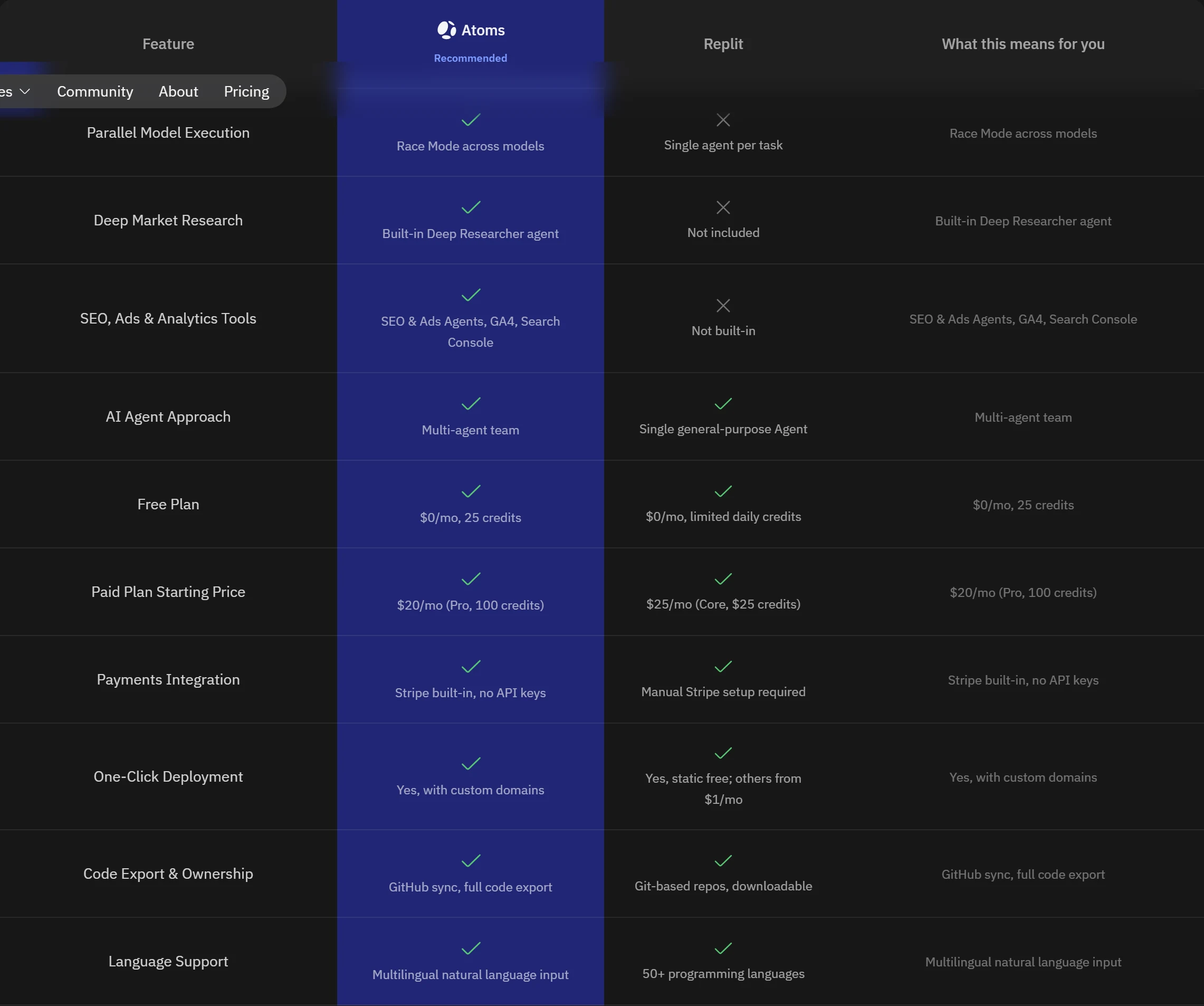
Atoms against Lovable, Bolt, v0 and Replit
Entry prices, taken from each vendor’s own pages on 1 September 2026. Atoms Pro: $20 a month for 100 credits, or $15.8 a month on yearly billing. Lovable Pro: $25 a month for 100 monthly credits, or $250 a year, an effective $21 a month. Bolt Pro: $25 monthly, $18 on annual, metered in tokens rather than credits, starting at 10M tokens a month with no daily limit and unused tokens rolling over. v0 Plus: $30 per user a month, buying $30 of included monthly credits plus $2 of free daily credits on login. Replit Core: $20 a month, $17 billed annually, including $20 towards its most powerful models and 2 parallel agents. Base44 Starter: $20 monthly or $16 billed annually, for 100 message credits and 2,000 integration credits.
Only Atoms and Lovable use directly comparable units at the entry tier: 100 credits for $20 against 100 credits for $25. Even there, a credit means whatever each vendor says it means, and neither publishes a conversion to actual work. Bolt’s tokens are at least a unit you can reason about if you have used an API. v0 and Replit sidestep the problem by denominating the allowance in dollars, $30 of credits and $20 towards models respectively, which is the most legible of the five approaches because you can compare it to a model bill you have already paid. Atoms is the only one of the five in this comparison that gives you neither a dollar figure nor a token count.
Free tiers vary more than the paid ones. Atoms gives 15 credits a day capped at 25 a month, 2GB of disk, unlimited project sharing and a single seat. Base44 gives 25 message credits a month, 100 integration credits and a cap of 5 apps. Lovable gives 5 build credits a day capped at 30 a month, plus monthly Cloud grants of 20 credits and AI grants of 4 that apply on Free, Pro and Business alike, and includes unlimited collaborators and 5 lovable.app domains. Bolt gives 300K tokens a day and 1M a month, with Bolt branding on what you build. v0 gives $5 of monthly credits and caps you at 7 messages a day. Replit’s free Starter lets you publish exactly one live project, with no comparable credit figure published. Atoms’ free monthly ceiling is level with Base44’s and just under Lovable’s.
Atoms wins clearly on seats. Both paid tiers include unlimited team members, centralised billing and centralised access management. Bolt charges $30 per member per month on Teams. Replit’s $100 Pro tier caps you at 15 collaborators and 50 viewers, with seat-unlimited access an Enterprise feature. That is a genuine price advantage for a small team. The catch is in Atoms’ own Team Workspace documentation: every member of a paid workspace draws from one shared credit pool, so ten collaborators on Pro share 100 credits a month, not 100 each. There are only two roles, Owner and Editor, with no viewer, reviewer or read-only option, and every Editor can send agent messages and edit code. Every seat can spend the pool.
Atoms loses on the mechanics around running out. Lovable and Base44 both sell mid-cycle credit top-ups; Lovable charges $15 per 50 credits on Pro and $30 per 50 on Business. Atoms sells none, so your only response to running dry is a full upgrade. Lovable offers credit rollover without an annual commitment; Atoms’ rollover is effectively an annual-billing feature and, on monthly, covers only four credit sources that exclude ordinary unused subscription credits. Base44 states plainly that apps stay live after cancellation; we could find no equivalent statement from Atoms. And Atoms sells no enterprise or contact-sales tier at all: its pricing page ends at Max, while Lovable, Bolt, Replit and Base44 all publish an Enterprise tier with SSO and security controls.
The governance gap shows up in the footer. Lovable’s pricing page footer links Security, a Trust center, Status, a DPA, Report abuse and Report security concerns. Atoms’ site footer offers no security page, no trust centre, no status page, no DPA and no security-disclosure contact. If you are buying on behalf of an employer with a vendor review process, that difference will likely end the conversation before the pricing does.
Do not use Atoms’ own comparison pages as a shortcut. They overstate Replit’s entry price at $25 when Replit’s own page lists Core at $20, discounted to $17 annually. They name a ’v0 Team plan’ starting at $30; v0 has no plan by that name, its $30 per-user tier is called Plus. Bolt is not among the 29 products Atoms compares itself against, and atoms.dev/comparison/atoms-vs-bolt returns HTTP 410 Gone. The comparison set is padded with Asana, Salesforce, Circle and Airtable, which are not AI app builders. The Lovable figure of $25 is the one we checked and found correct, and even that page’s feature table concedes Lovable has a backend product. Separately, one independent comparison, disclosed as paid placement and containing no from-scratch build and no credit-consumption figures, found Atoms strongest with JavaScript and TypeScript and recommended switching to Replit for Python, Go or Rust. KrASIA notes that Atoms’ own performance claims against Lovable and Replit have not been independently verified. Neither have we verified them, because we did not run a build.
What users report, and how much of it to believe
Start with the fact that governs everything else in this section. Trustpilot has suspended Atoms’ star rating, displaying a warning that the company breached Trustpilot’s guidelines and stating that Trustpilot removed fake reviews from the profile. The suspension was still in force on 1 September 2026. That does not mean the negative reviews are true and the positive ones invented. It means the profile has been manipulated, so nothing on it is clean evidence in either direction.
The distribution is polarised almost to the point of being useless as an average. Of 62 reviews in the last 12 months, 42% are one star and 40% are five stars, with 8% at four, 7% at three and 3% at two. There is almost nothing in the middle. The most recent review is dated 22 August 2026.
The negatives are specific, which is what makes them worth reading even on a compromised profile. Named reviewers report $700 spent under repeated upgrade pressure with a site that still did not work; $100 spent for a broken codebase with a refund refused despite detailed technical evidence; a refund refused on the grounds that 13 credits had already been consumed; a $20 plan exhausted after a few basic prompts followed by a request for $50 a month; a live website and custom domain going offline with no warning, fix or compensation after platform bugs burned through the credits; agents that are slow, write incorrect code and break functionality that previously worked; agents that charge credits before verifying feasibility, forget earlier work, make unauthorised changes and report an audit as done when it was not; and recurring card charges for a service the reviewers say they were not using, in one case totalling around EUR 60 and in another $70. One reviewer who had upgraded to a paid plan reports emailing support about connecting a domain on 14 August 2026 and receiving no response by 22 August.
The positives exist, and some are specific. One reviewer reports turning an idea into a working app in under one afternoon. Another says the team investigated root causes on her meditation platform rather than applying quick fixes. Another says the team responded within one day. But the shape of the positive set is itself informative: most five-star reviews are short and non-specific, they cluster in the four weeks from late July to mid-August 2026, and of the 16 five-star reviews listed only four describe an identifiable project. The negatives, by contrast, name dollar amounts, dates and technical failures.
One recurring complaint is wrong, and it is only fair to say so. A reviewer states they could not find any abuse, legal or privacy contact anywhere on the Atoms site. Atoms does publish one: service@atoms.dev, named in the terms of service for complaints, appeals, abuse reports, refunds and privacy rights. Burying it in a legal document instead of the footer is a real usability failure. It is not an absence.
Everywhere else the evidence base is thin or contradictory. Product Hunt still lists the product under its old name, ’MGX (Now Atoms)’, with 4.4 out of 5 from just 24 reviews, all timestamped 11 months to a year old and therefore predating the rebrand entirely. Reviewers there who rate it positively still flag weak context handling, shallow integrations and reliability problems in real-world use. One reports roughly 16 hours across two days and, in his telling, 33 million credits, without ending up with a working website after the admin dashboard link turned out to be dead; that credit figure does not map onto the units Atoms sells today, which is itself an argument for discounting pre-rebrand reviews. Another reports the platform destroyed work already completed, with unresponsive and dismissive support. Capterra lists the product as ’Atoms AI’ with a perfect 5.0 from 10 reviews, which cannot easily be reconciled with the Trustpilot profile. AlternativeTo’s listing has one like and no comments or reviews. A search of the full Hacker News archive returns zero results for atoms.dev, though Atoms does run an official subreddit linked from its own help centre, so absence from search indexes is not absence of discussion.
Finally, be careful what you count as a review. Atoms’ ’Videos’ navigation item is not a product feature. It is a marketing feed of third-party YouTube reviews and tutorials, many of them explicitly sponsored or affiliate-linked, so the performance claims inside them are creator claims rather than Atoms’. The most-cited written comparison of Atoms against Lovable and Replit is disclosed paid placement and contains no from-scratch build, no credit-consumption figures and no side-by-side hands-on testing. The trade-off: this is a product with a loud review record and no trustworthy one. If you need external validation before spending, you will not find it. You will have to test it yourself, which is the strongest argument for starting on the free tier.
Lock-in, and who should actually buy this
The good news on lock-in first, because it is better than the rest of this review might suggest. Atoms claims no ownership of generated code and permits commercial use, modification, distribution and open-sourcing of it. Atoms Cloud is built on Postgres and standard HTTP APIs rather than a proprietary data store, according to the Atoms Cloud launch post, and the May 2026 changelog names PostgreSQL directly alongside an in-product database interface with CSV import and export. If you can get the code and the data out, what you are left with is an ordinary application on ordinary infrastructure.
Getting it out is not frictionless. Export is a .zip download from the Editor panel. Automated GitHub or GitLab push requires handing the agent a repository address and a Personal Access Token, and Atoms’ own documentation recommends manual upload over the automated route. GitLab sync is restricted to repositories on a publicly accessible domain. Both ’Download projects’ and data download are Pro and Max features and do not appear in the Free plan’s feature list. The first thing you need in order to leave is a paid subscription.
The backend travels less easily than the code. Migrating off Atoms Cloud at scale is not self-serve: the documented path is to contact Atoms for on-demand infrastructure support. Turning on Atoms Cloud also disables version history for the project, so only the latest build is retained, which removes your ability to roll back a bad agent run. Downgrading does not delete project data outright, but with disk dropping from 100GB on Max to 10GB on Pro to 2GB on Free, Atoms puts the burden on you to back up or delete files before the reduction takes effect.
Account-level risk sits above all of it. Atoms may suspend or terminate access without prior notice where it believes you have materially breached the terms, where it must comply with law, or where it judges immediate action necessary for security, and it reserves the right to delete any materials or data associated with a terminated account. If it terminates for what it judges a material breach, you forfeit any refund and Atoms reserves the right to pursue you for its losses. Free accounts inactive for over a year can be deleted with 30 days’ email notice. In the other direction, Atoms can terminate a paid subscription at any time on 30 days’ written notice with a pro-rata refund. The service is provided as is with no uptime commitment, and total liability is capped at what you paid in the preceding twelve months. Support channels are a Discord community, an AI bot in the help centre and email, with no human response-time commitment named, and Atoms Support is directed at paid users.
So, the practical sequence for someone deciding this week. Do not start by paying. The free tier gives 15 credits a day up to 25 a month, and that is enough to learn whether the agents can hold your actual project in their heads. Build the real thing, not a demo. Count how many credits one meaningful change costs, because Atoms will not tell you and that number is the only honest input to your budget. Be aware that on Free your projects are public by default, the Atoms badge stays on, direct code editing is off, and you cannot download what you make.
If the free run goes well, buy one month of Pro at $20 rather than committing to a year at $15.8 a month. The annual plan does have materially better credit mechanics, with twelve equal instalments, rollover within the billing year and leftovers carried on renewal, and that is precisely why you should not buy it until you know the product works for you. The refund window is 24 hours for most of the world, 14 days in the EU, UK and Turkey, and it closes the instant credits begin to be consumed. An annual commitment is effectively non-returnable from your first prompt.
Then decide your ceiling in advance. Set the Cloud & AI Wallet cap deliberately rather than accepting the $500 default, and remember Atoms warns that actual charges can exceed the cap because billing is postpaid and storage is billed hourly. Diarise the cancellation date, because cancelling after a new cycle has begun does not stop that cycle’s charge. The trade-off, stated plainly: Atoms is the cheapest route we found to a hosted full-stack web app generated from a prompt, from a research team with genuine credentials and unlimited seats included at $20. It is also the vendor in this comparison that publishes the least about what things cost and stands behind the least once you have paid.
Who should buy it, and who should not
Worth paying for if you are…
- The solo founder validating a web app idea this month. At $20 for 100 credits with a Postgres database, auth, Stripe and hosting attached, this is the cheapest entry point in the group with the fullest backend included. The free tier’s 15 credits a day, capped at 25 a month, is enough to test the agents on your real idea before paying anything. Just treat the first paid month as an experiment: there is no top-up, and the refund window closes the moment you spend a credit.
- A freelancer or small agency building marketing sites for local businesses. Atoms’ Use Cases page is overwhelmingly industry-templated website builders (salon, dental, law firm, wedding, hotel, band, spa), which is the workload the product is visibly shaped around. Pro unlocks custom domains, removal of the ’Built with Atoms’ badge, private projects and project download, and Atoms resells domain registration in-product via IONOS. Be aware the SEO agent generates meta tags and a sitemap but will not get the site indexed for you: you still do the Search Console work by hand.
- A team of three to ten who want one shared workspace without per-seat billing. Both paid tiers include unlimited team members with centralised billing and access management. Bolt charges $30 per member per month and Replit’s $100 Pro tier caps you at 15 collaborators plus 50 viewers. The catch is that every member draws from one shared credit pool, so ten people on Pro share 100 credits a month rather than 100 each, and with only Owner and Editor roles every seat can spend it.
- Someone already committed to JavaScript or TypeScript who wants the backend assembled for them. Atoms Cloud provides six services out of one description: database, authentication with Google social login, Stripe payments, custom domains, API key management and native LLM integration, configured by detecting what the project needs. One independent comparison, disclosed as paid placement, found Atoms strongest with JavaScript and TypeScript. If your stack is elsewhere, that same source pointed to Replit.
- A hobbyist or student who wants to see what multi-agent building feels like, at zero cost. The free plan is $0, gives 15 credits a day up to 25 a month, 2GB of disk and unlimited project sharing, and that allowance also stacks on top of any paid plan later. You get a real, publishable app on an atoms.world subdomain. Understand the limits going in: projects default to public, the badge stays, direct code editing is off, you cannot download your project, and you cannot top up the Cloud & AI Wallet at all past its $1 free AI allowance.
Look elsewhere if you are…
- Anyone who needs a native mobile app for the App Store or Play Store. Atoms’ project-scope article states it does not generate native iOS or Android binaries or desktop executables, and delivers mobile as Progressive Web Apps and responsive web. The Build & Export article says it cannot export an .apk or generate mobile app packages. A May 2026 changelog entry does announce mobile app projects with QR-code device testing and Android build support, so the documentation openly conflicts. We could not establish what actually ships today, and that is not a question to resolve after paying.
- Any buyer whose organisation runs a security or procurement review. The privacy policy commits only to ’commercially reasonable’ security and names no encryption standard and no certification such as SOC 2 or ISO 27001. It sets no retention period, names no subprocessors or model providers, never mentions the GDPR or the CCPA, and never uses the words ’train’ or ’machine learning’ in either direction. Atoms’ footer has no security page, trust centre, status page, DPA or security-disclosure contact, and there is no enterprise tier at all, while Lovable, Bolt, Replit and Base44 all publish one. The terms provide no uptime commitment, cap liability at twelve months of fees, and place disputes under Delaware law.
- Anyone who needs a predictable monthly bill. Atoms publishes no conversion between credits and work anywhere: not on the pricing page, not on the Models page, not in the credit help article. It sells no one-off top-ups, so running out mid-month means a full upgrade, and its own worked example charges the full price difference ($80 to go from a $20 to a $100 plan with 20 days left). Running the published app is billed separately from a Cloud & AI Wallet with no published unit rates for compute, storage, network or tokens, a $500 default cap that pauses your apps rather than stopping charges, and a warning that actual charges may exceed the cap.
- Anyone building primarily in Python, Go or Rust, or shipping complex commercial software. One independent comparison, disclosed as paid placement, recommends switching to Replit for Python, Go or Rust. More tellingly, Atoms’ own help centre positions the platform for rapid prototyping, data visualisation, web applications and custom mini-games while saying it continues to work toward more complex systems. Take the vendor at its word on that.
If that first list sounds like you
Start free, build one real page, and only upgrade once you have hit the daily limit on something you actually want to keep.
Build something on the free plan →Questions buyers ask
What will Atoms actually cost me in a month?
The subscription part is knowable: Free at $0, Pro from $20 a month for 100 credits ($15.8 on yearly billing), Max from $100 for 500 credits ($79 yearly), with Pro tiers at 250 credits for $50 and 350 for $70, and Max scaling up to 10,000 credits a month. The rest is not knowable in advance. Atoms publishes no conversion between credits and work, so nobody can tell you how many credits your project needs. And your published app is billed separately from a Cloud & AI Wallet that carries a $1 free AI allowance, prepaid top-ups from $10 to $1,000, and published rates for storage and requests but none for compute or AI inference. We could not forecast a monthly total, and we do not think you can either until you have run a month.
How much work does one credit buy?
Atoms does not say. We expanded the pricing page’s own credit FAQ and it defines only where credits come from and the order in which they are spent, never what one credit does. The Models page lists 24 models with no credit cost attached to any of them. Team Mode is documented as costing more than Engineer Mode, and Race Mode as costing extra, both without numbers. This is the single largest gap in Atoms’ published information, and the reason we recommend measuring your own burn rate on the free 25 credits a month before paying.
Can I get a refund if it does not work?
Probably not, once you have used it. Atoms’ terms give EU, UK and Turkey users 14 days from the charge and everyone else 24 hours, and in both cases the clock stops the moment credits begin to be consumed. A refund also requires zero service call records, verified against Atoms’ logs. The one route that survives credit consumption is a product bug, where the burden of proof is entirely on you and Atoms commits only to ’reasonable compensation’ rather than cash. Credits spent on poor AI output are explicitly excluded, and any compensation is issued as credits that cannot be exchanged for money. Note also that the terms route refund requests to service@atoms.dev while the help centre says to use Help Center chat, and the two documents give different response times (24 hours in the help centre, five business days plus a five to ten day Stripe payout in the terms).
How do I cancel, and what happens to my credits?
You cancel by downgrading to the Free plan in Settings, under Plans and credits. It never takes effect immediately and never produces a refund: your paid tier runs to the end of the cycle and Free starts the day after. Cancellation must be completed before the next cycle begins, because a cancellation made after a new cycle has started does not stop that cycle’s charge. Unused credits are forfeited at the end of the cycle. Both paid plans auto-renew monthly unless you act, and if the lower tier has less disk space (100GB on Max, 10GB on Pro, 2GB on Free) Atoms tells you to back up or delete files first. What we could not establish is whether an already-published app stays live after you drop to Free. Base44 answers that question on its pricing page; Atoms does not.
Do I own the code, and can I take it elsewhere?
Yes on ownership. Atoms claims no ownership of generated code and permits commercial use, modification, distribution and open-sourcing. Portability is decent but not free: export is a .zip download from the Editor panel, or a push to GitHub or GitLab that requires giving the agent a repository address and a Personal Access Token, and Atoms’ own docs recommend the manual upload over the automated route. ’Download projects’ and data download are Pro and Max features and are absent from Free, so you need a paid plan to leave. Atoms Cloud runs on Postgres and standard HTTP APIs, which limits backend lock-in, but migrating off it at scale is not self-serve: the documented path is to contact Atoms for infrastructure support.
Is Atoms cheaper than Lovable, Bolt, v0 or Replit?
On sticker price, yes at the entry tier: Atoms Pro is $20 for 100 credits, against Lovable Pro at $25 for 100 credits, Bolt Pro at $25 monthly, v0 Plus at $30 per user, Replit Core at $20 ($17 annually) and Base44 Starter at $20 monthly ($16 annually). Atoms also includes unlimited team seats on both paid tiers, where Bolt charges $30 per member and Replit’s $100 tier caps you at 15 collaborators. But Atoms’ seats share one credit pool, Lovable and Base44 both sell mid-cycle top-ups where Atoms sells none, and Lovable offers credit rollover without an annual commitment where Atoms’ rollover is effectively annual-only. Do not use Atoms’ own comparison pages to settle this: they list Replit Core at $25 when it is $20, name a ’v0 Team plan’ that does not exist, and omit Bolt entirely (the atoms-vs-bolt URL returns 410 Gone).
Who actually owns and runs Atoms?
The contracting entity is MetaGPT LLC, described in the terms as a US incorporated company at Ste R 8 The Green, Dover, Delaware, document number 7606285. The team behind it is DeepWisdom, founded in 2019 by Wu Chenglin, which raised roughly RMB 220 million (about US$31 million) across two rounds in the first half of 2025 from backers reported to include Ant Group, Cathay Capital, Jinqiu, Baidu Ventures, MindWorks Capital and Concept Fund. Atoms is a rename of MGX announced on 13 January 2026, itself descended from the open-source MetaGPT project. Headquarters is reported inconsistently: 36Kr and KrASIA say Shenzhen, the South China Morning Post says Shanghai.
Will my prompts, project content or generated code be used to train models?
We could not establish this in either direction, and that is the honest answer. Atoms’ privacy policy never uses the words ’train’ or ’machine learning’ anywhere in its roughly 12,000 characters. It does state that Atoms stores all content you post, send, receive or share through the service, names no subprocessors or AI model providers, sets no retention period, and warns that deletion requests may not fully take effect where data has already been backed up. If training use matters to you, ask Atoms directly at service@atoms.dev and get the answer in writing before you upload anything sensitive.
Affiliate link. It changes nothing about the price or about what this page says.
What we could not establish
A review that claims to know everything is hiding something. These are the questions we could not answer from sources we were willing to stand behind. If you need one of them settled before you buy, ask Atoms directly and hold them to the answer.
- What one credit actually buys. Atoms publishes no conversion between credits and work on its pricing page, its Models page, or its credit help article, and no per-mode or per-model credit cost anywhere we looked.
- The compute and AI-inference rates behind the Cloud & AI Wallet. Atoms does publish three: database storage at $0.525 per GB-month, serverless requests at $0.30 per million, and object storage at $0.025 per GB-month. It publishes nothing for compute or for the LLM calls a published app makes, and those are the two that scale with traffic, so a running cost still cannot be forecast from Atoms’ own documentation.
- The total annual price of Pro or Max. The pricing page publishes per-month rates only ($15.8 and $79 on the yearly toggle), with no annual total. We did not calculate one.
- Whether an already-published app stays live after you cancel or downgrade to Free. Base44 answers this explicitly on its pricing page; we found no equivalent statement from Atoms.
- Whether user prompts, project content or generated code are used to train models. Atoms’ privacy policy makes no statement in either direction and never uses the words ’train’ or ’machine learning’.
- Which models each plan can actually select. The Models page lists 24 models with no plan availability and no cost against any of them, and the help centre’s model guide is stale, listing five models of which four no longer appear on the Models page.
- Whether custom domains work. Atoms’ Domain Management article gives step-by-step DNS instructions and then states in an FAQ on the same page that custom domains are not supported, while the pricing page lists Custom domain as a Pro and Max feature. The balance of evidence says the feature exists and the FAQ is stale, but we could not confirm it.
- Whether the May 2026 Android build support produces an installable file. The Build & Export article still says Atoms works with web apps and cannot generate .apk files, and the project-scope article says mobile is delivered as PWAs and responsive web only.
- The eligibility criteria for Video Mode, which Atoms gates to ’eligible users’ without publishing what makes a user eligible.
- Whether the Free plan gets one or two Atoms backend projects. The pricing page says 2; the Atoms Cloud help article says 1. The same article also references a ’Pro+’ tier that does not exist on the pricing page.
- Real-world reliability and uptime. Atoms publishes no status page, its terms contain no uptime or availability commitment, and we found no independent monitoring of the platform.
- The true state of the review record. Trustpilot has suspended Atoms’ star rating and says it removed fake reviews, so neither the 42% one-star share nor the 40% five-star share can be treated as clean evidence. Capterra’s 5.0 from 10 reviews cannot be reconciled with it, and Product Hunt’s 4.4 from 24 reviews entirely predates the January 2026 rebrand.
- How Atoms performs in a real build. We did not run one. Every capability claim in this review comes from Atoms’ own pages, its help centre and terms, third-party reporting, or reviews of uncertain reliability. The most-cited written comparison against Lovable and Replit is disclosed paid placement with no from-scratch build and no credit figures, and KrASIA notes Atoms’ own performance claims against those rivals are not independently verified.
- DeepWisdom’s headquarters and current headcount. 36Kr and KrASIA report Shenzhen, the South China Morning Post reports Shanghai. Headcount is reported as more than 80 in one January 2026 article and about 100 in a February 2026 one.
- Whether Atoms’ award claims have been independently verified. The World Economic Forum Technology Pioneer naming and the ’#1 Product of the Day and Week on Product Hunt’ (attributed to predecessor product MGX) are Atoms’ own claims on its About page. We did not verify either.
- Whether DeepWisdom’s US market entry proceeded. As of February 2026 the company had not yet entered the US market and described the expansion as a forthcoming step.
- Who Foundation Agents is. The third project linked in Atoms’ footer presents itself as a research organisation, names no people, companies or institutional affiliations, and does not mention MetaGPT, OpenManus, DeepWisdom or Atoms anywhere on its site.
Where every figure came from
Every claim above traces to a page we opened. The full list is long because the checking was, so it is folded away rather than trimmed: deleting evidence to tidy a page is the one edit that would undermine the point of publishing it.
286 checked claims across 78 pages on 27 sites
- Atoms publishes three Cloud & AI unit rates: database storage at $0.525 per GB-month, serverless requests at $0.30 per million requests, and object storage at $0.025 per GB-month. It publishes no rate for compute or for AI model inference. help.atoms.dev
- Atoms sells three plans: Free at $0/month, Pro starting from $20/month, and Max starting from $100/month. atoms.dev 2026-09-01
- The Pro plan is not a single price but a set of monthly credit tiers: 100 credits for $20 (the default), 250 credits for $50, and 350 credits for $70. atoms.dev 2026-09-01
- The Max plan tiers are 500 credits for $100 (the default), 1,000 credits for $200, and 1,500 credits for $300, with tiers extending up to 10,000 credits per month. atoms.dev 2026-09-01
- The pricing page carries a billing-period toggle labelled ’Yearly · Save up to 21%’ and ’Monthly’ — it is a toggle between two billing periods, not a discount struck through a list price; no crossed-out original prices appear on the page. atoms.dev 2026-09-01
- The advertised annual saving is not a flat 21%: Atoms states annual billing gives a 21% discount on the first credit tier and 18% on tiers above the first, measured against 12 consecutive monthly payments. help.atoms.dev 2026-09-01
- A credit is Atoms’ internal service currency, drawn from three separate pools: a daily free allowance, monthly subscription credits, and bonus credits. atoms.dev 2026-09-01
- Credits are spent in a fixed order — daily free credits first, then subscription credits, then bonus credits — so a subscriber’s paid balance is only touched after the daily free allowance is exhausted. atoms.dev 2026-09-01
- The ’15 per day / 25 per month’ figure is the free allowance carried by every plan, not an extra that scales with tier: the daily cap is 15 credits and the total per plan cycle is capped at 25, with unused daily credits rolling over to following days until all 25 are used. help.atoms.dev 2026-09-01
- The daily free allowance is redistributed rather than fixed — Atoms states the per-day amount may adjust based on earlier usage while the cycle total stays the same. help.atoms.dev 2026-09-01
- Daily free credits and monthly subscription credits do stack: paid plans receive the 15/day (up to 25/month) free allowance on top of their plan credits. help.atoms.dev 2026-09-01
- Unused credits roll over for one month only and then expire — rollover is not cumulative. help.atoms.dev 2026-09-01
- Monthly-plan rollover is restricted to four specific credit sources — mid-cycle upgrade surplus, special-circumstance bonus credits (explicitly excluding the daily 15-credit gift), referral credits, and redemption-code credits — rather than applying to all unused subscription credits. help.atoms.dev 2026-09-01
- Annual plans get materially better credit treatment than monthly: annual credits are released in 12 equal monthly instalments, unused monthly credits roll over within the same billing year up to the annual limit, and leftovers can carry into the next annual cycle on renewal. help.atoms.dev 2026-09-01
- Atoms documents no way to buy one-off credit top-ups: asked ’Can I buy extra credits if I run out?’, the pricing FAQ answers only that you can upgrade to a higher plan at any time via Settings → Plans and credits or Pricing → Payment, which takes effect immediately. atoms.dev 2026-09-01
- Upgrading takes effect immediately on payment and does not reset the billing cycle date; you pay the difference in plan price for the remainder of the period — but Atoms’ own worked example charges the full difference, not a day-weighted share: upgrading from a $20 plan to a $100 plan with 20 days left costs $80. help.atoms.dev 2026-09-01
- Disk space is the clearest hard differentiator between tiers: 2 GB on Free, 10 GB on Pro, 100 GB on Max. help.atoms.dev 2026-09-01
- Paying unlocks private projects, removal of the Atoms badge, and direct code editing — all three are Pro-and-above features absent from Free. help.atoms.dev 2026-09-01
- Max’s exclusive additions over Pro are 2x computing resources and Race Mode, which Atoms’ pricing page says raises accuracy up to 3x. help.atoms.dev 2026-09-01
- Both paid plans renew automatically every month unless you act, and Atoms frames cancellation as a downgrade: the pricing FAQ says you can downgrade to the Free plan at any time via Settings → Plans and credits, and the Help Center likewise says you cancel by downgrading to Free. atoms.dev 2026-09-01
- Downgrades never take effect immediately and never produce a refund: the paid tier runs to the end of the current cycle and the Free plan starts the first day after. help.atoms.dev 2026-09-01
- Atoms’ stated default is that subscriptions are non-refundable as soon as credits begin to be consumed, with refunds or credit compensation only granted case by case. help.atoms.dev 2026-09-01
- Refunds must be requested manually through Help Center chat (Avatar → Help Center → chat icon) with the registered account email, an invoice screenshot and proof of payment, choosing cash refund or credit compensation; Atoms commits to reviewing and responding within 24 hours. help.atoms.dev 2026-09-01
- Cancelling a subscription forfeits unused credits at the end of that billing cycle. help.atoms.dev 2026-09-01
- Downgrading does not delete project data outright, but if the new tier has less storage Atoms warns the user to back up or delete files first. atoms.dev 2026-09-01
- The subscription price does not cover running a published app: Atoms bills cloud and AI usage — compute, storage, serverless executions and LLM API calls — from a separate ’Cloud & AI Wallet’ once the free quota is used up. help.atoms.dev 2026-09-01
- Atoms accepts cards (Visa, Mastercard, AMEX, Discover, JCB, UnionPay) plus Alipay and Amazon Pay, but does not support PayPal or Western Union; invoices are downloaded from the Stripe Customer Portal. help.atoms.dev 2026-09-01
- Atoms’ own footer places it in the MetaGPT lineage, listing MetaGPT, OpenManus and Foundation Agents as Company links alongside ’About us’. atoms.dev 2026-09-01
- Atoms runs an affiliate programme with its own participation guide, terms of service, marketing policies and payout rules, documented in four Help Center articles in the Plans and Billing collection. help.atoms.dev 2026-09-01
- Atoms’ homepage positions the product as ’AI employees’ rather than as a chat assistant, promising idea validation, product build and customer acquisition without coding. atoms.dev
- The Atoms homepage’s ’What can Atoms build?’ strip names six output types, including a video and a game, alongside websites. atoms.dev
- Atoms’ About page claims a wider output range than the homepage, adding slides and workflows: ’Create websites, apps, slides, videos, workflows, and games from one idea.’ atoms.dev
- The homepage describes Atoms Cloud as a bundled full-stack backend covering login, database, integrations and hosting. atoms.dev
- The homepage claims built-in user login, data storage and Stripe payments come with every app (’Real apps, not just demos’). atoms.dev
- The homepage describes Race Mode as running one prompt across multiple models to pick the best result and states no plan restriction on the card, while the pricing page lists Race mode only under Max and the help centre states it is ’only available to Max Plan users’. atoms.dev
- The homepage advertises embedding third-party AI models into the user’s own product with no API key setup: ’Add powerful AI to your products with models like Gemini and GPT - no API keys and no setup.’ atoms.dev
- The homepage claims code export and GitHub sync are available ’anytime’, with no plan qualifier stated on the card. atoms.dev
- Atoms markets two growth agents on the homepage — an SEO Agent that makes sites crawlable and an Ads Specialist that runs campaigns. atoms.dev
- The homepage also lists a Visual Editor for adjusting layouts and components, and a catch-all ’More features’ card naming only ’Deep Research and Theme’. atoms.dev
- The Atoms AI Agents page presents eight named agents: Mike (Team Leader), Iris (Deep Researcher), Bob (Architect), Emma (Product Manager), Alex (Engineer), Sarah (SEO Specialist), Adrian (Ads Specialist) and David (Data Analyst). atoms.dev
- The help centre’s official ’Your Agents Team’ article documents only seven agents and omits Adrian the Ads Specialist entirely; it also gives David the heading ’Data Scientist’ (his own bio text then calls him ’your Data Analyst’), against the marketing site’s Data Analyst. help.atoms.dev
- Adrian, the Ads agent, is documented only for Google Ads, and requires the user to hold a Google Ads account and spend real money; Atoms itself does not fund the ads. help.atoms.dev
- Atoms documents four modes — Engineer Mode (Alex alone, cheaper), Team Mode (multi-agent, more credits), Race Mode (Max users only) and Deep Research Mode (Iris) — but the Mode Switch button at the bottom-left of the input box only offers Engineer or Team; Deep Research is invoked by @Iris and Race Mode is chosen separately at the chat box. help.atoms.dev
- Race Mode is restricted to the Max plan, takes 5-10 minutes per run, costs extra credits, and is blocked entirely on projects that use Supabase or Stripe integrations. help.atoms.dev
- The Atoms Models page lists 24 model cards and claims they are the models ’available on Atoms’, with family counts of Claude 7, GPT 4, Gemini 2, DeepSeek 2, Qwen 4, GLM 1 and Grok 1. atoms.dev
- The Atoms Models page states no credit cost and no plan availability for any model — a reader cannot tell from it which models a Free, Pro or Max subscriber can actually select. atoms.dev
- The Models page’s own category filters are internally inconsistent — Kimi K3 is the sole entry under ’Video Models’ while Seedance 2.0, the one model the page describes as a video model, appears in no category at all; ChatGPT Images 2.0 is likewise missing from ’Image Models’, and text-only models such as Claude Opus 4.6 are listed under ’Image Models’. atoms.dev
- The help centre’s model-selection guide is badly out of date against the marketing Models page — it documents only five selectable models (Claude Sonnet 4, GPT-5, Qwen3-Coder-Plus, Gemini 2.5 Pro, DeepSeek V3), four of which no longer appear on the Models page at all; only Qwen3 Coder Plus is still listed there. help.atoms.dev
- The ’Tools’ page linked from Atoms’ main product navigation is empty — it renders a headline and then ’No tools found’. atoms.dev
- Atoms’ ’Connect and use integrations’ article documents three task-manager connectors — Linear, Asana and Todoist — connected via Settings > Connectors; the help centre separately documents GitHub, Supabase and Stripe connections, so these three are not the only third-party integrations. help.atoms.dev
- Atoms’ Free plan costs $0/month and gives 15 credits per day (’Up to 25 / month’), 2GB disk space, unlimited project sharing and 2 Atoms backend projects. atoms.dev
- The Pro plan is $15.8/month on the default yearly billing toggle (21% OFF against a $20/month list price, which is what the Monthly toggle shows) and is the tier at which Atoms Cloud, custom domains, project download, private projects, badge removal and unlimited backend projects unlock. atoms.dev
- The Max plan is $79/month on yearly billing (21% OFF a $100/month list price) and adds 500 monthly credits, 100GB disk, ’2x compute resources (versus Pro)’, and is the only tier that lists Race mode. atoms.dev
- Downloading your own project is a paid feature — ’Download projects’ appears only on the Pro and Max feature lists, which qualifies the homepage’s unconditional ’Export code and sync to GitHub anytime’ claim. atoms.dev
- Atoms’ pricing page and its own Atoms Cloud documentation disagree on how many backend projects a Free user gets — the pricing page says 2, the help centre FAQ says 1. help.atoms.dev
- Free users’ Atoms Cloud projects default to public and privacy requires a paid upgrade; the same FAQ references a ’Pro+’ tier that does not exist on the pricing page. help.atoms.dev
- Atoms Cloud provides six named services — database, user authentication (incl. Google social login), Stripe payments, custom domains, API key management and native LLM/agent integration — and configures itself by detecting the project’s backend needs. help.atoms.dev
- Turning on Atoms Cloud disables version history for the project — only the latest build is retained. help.atoms.dev
- Atoms shipped an in-product database management interface on 2026-05-18 that supports viewing PostgreSQL table structures, browsing and editing table data, and CSV import/export — the only place Atoms names PostgreSQL as its database engine. help.atoms.dev 2026-05-18
- Atoms’ Domain Management help article gives step-by-step custom-domain DNS instructions and then, in an FAQ on the same page, states that custom domains are not supported. help.atoms.dev
- Published Atoms projects get a random subdomain on atoms.world which the user can rename; custom domains are verified by pointing an A record at Atoms’ gateway IP 107.150.101.9 and adding a TXT record on host _mgx_verify. help.atoms.dev
- Atoms resells domain registration inside the product through a partnership with IONOS, and lets users nominate a primary domain that others redirect to. help.atoms.dev
- Publishing produces a stable public link, and the live version can be pinned — ’Always Latest’ auto-updates the public site, ’Specify Version’ locks it while you keep developing; the ’Built with Atoms’ badge can only be removed on Pro and Max. help.atoms.dev
- Project export is a .zip download from the Editor panel; automated GitHub or GitLab push requires the user to hand the agent a repository address and a Personal Access Token, and the docs recommend manual upload over the automated route. help.atoms.dev
- Atoms generates full Next.js project code but cannot deploy Next.js applications on its own platform — users must download the project and deploy it elsewhere. help.atoms.dev
- Atoms does not generate .apk files, despite the changelog announcing mobile app projects and Android build support in May 2026 — the Build & Export article still says Atoms ’currently works with web apps’. help.atoms.dev
- Static standalone HTML output cannot be one-click hosted by Atoms, which sits awkwardly against the Use Cases page marketing an ’HTML Website Builder’. help.atoms.dev
- Atoms added mobile app projects with preview, QR-code device testing and Android build support in May 2026, expanding beyond web output. help.atoms.dev 2026-05-06
- Atoms has a Video Mode with an in-product video editor (clip selection, splitting, zooming, local export), but access is gated to ’eligible users’ rather than open to everyone. help.atoms.dev 2026-05-28
- Supabase Edge Functions were made a Pro-only feature in the 2025-06-18 changelog entry, and support for connecting an external Supabase project from the homepage arrived later, in the 2025-09-08 entry. help.atoms.dev 2025-06-18
- Atoms’ Use Cases page is organised into just three categories — Website, Deep Research and App — with the overwhelming majority being industry-templated website builders (salon, dental, law firm, wedding, hotel, band, spa and so on). atoms.dev
- Games and full-stack apps appear on the Use Cases page under ’App’, with the game entry promising scoring, accounts and multiplayer. atoms.dev
- The Atoms Cloud launch blog post describes the stack as OIDC authentication, an object-relational database, managed object storage, serverless compute and Stripe, provisioned by agents from a natural-language description; it does not name the database engine. atoms.dev
- Atoms states its own lineage on its About page — MetaGPT (2022-2023), then MetaGPT X / MGX (2024-2025), then Atoms — led by MetaGPT’s creator, confirming that the MetaGPT, OpenManus and Foundation Agents links in the footer are the company’s own research heritage rather than partnerships. atoms.dev
- Atoms claims 168K GitHub stars across its team’s open-source projects — an aggregate across projects, not stars on Atoms itself — plus roughly 30 papers including MetaGPT (ICLR 2024 Oral) and AFlow (ICLR 2025 Oral). atoms.dev
- The MGX heritage is still baked into shipping infrastructure — Atoms serves front-end assets from a path named nuxt-mgx and verifies customer domains with a TXT record whose host is literally _mgx_verify. help.atoms.dev
- Atoms’ ’Videos’ navigation item is not a product feature — it is a marketing feed of third-party YouTube reviews and tutorials, many of them explicitly sponsored or affiliate-linked, so its performance claims are creator claims and not Atoms’ own. atoms.dev
- The legal entity operating Atoms is MetaGPT LLC, described in Atoms’ terms of service as “a U.S. incorporated company” with its principal place of business at Ste R 8 The Green, Dover, Delaware, USA, document number 7606285. atoms.dev
- Atoms’ privacy policy names the same operating entity as the terms of service: MetaGPT LLC of Ste R 8 The Green, Dover, Delaware, USA, document number 7606285. atoms.dev 2026-09-01
- The domain deepwisdom.ai issues an HTTP 301 permanent redirect to atoms.dev/metagpt - the DeepWisdom domain no longer serves its own site but resolves to a page on Atoms’ domain. deepwisdom.ai 2026-09-01
- The MetaGPT repository README ties the project to DeepWisdom through infrastructure rather than an ownership statement: it gives alexanderwu@deepwisdom.ai as the contact address and hosts its documentation at docs.deepwisdom.ai. The README also describes MGX (MetaGPT X), launched February 2025, as “the world’s first AI agent development team”. raw.githubusercontent.com
- OpenManus was built by members of the MetaGPT team: its README names Xinbing Liang and Jinyu Xiang as core authors, with Zhaoyang Yu, Jiayi Zhang and Sirui Hong, stating they are from MetaGPT. raw.githubusercontent.com
- MetaGPT and OpenManus are hosted under the same GitHub organisation, FoundationAgents. api.github.com 2026-09-01
- The MetaGPT GitHub repository lists https://atoms.dev/ as its official homepage, tying the open-source project to the commercial product. api.github.com 2026-09-01
- As of 1 September 2026 the MetaGPT repository had 70,145 GitHub stars, 8,915 forks and 132 open issues, and was created on 30 June 2023. api.github.com 2026-09-01
- MetaGPT, the project Atoms cites as its foundation, had received no pushed commits since 21 January 2026 - roughly seven months of inactivity as of 1 September 2026. api.github.com 2026-09-01
- As of 1 September 2026 the OpenManus repository had 58,142 GitHub stars, 10,100 forks and 465 open issues, and was created on 6 March 2025. api.github.com 2026-09-01
- OpenManus remains actively maintained, with commits pushed as recently as 22 August 2026. api.github.com 2026-09-01
- The FoundationAgents GitHub organisation was created on 6 February 2025, has 23 public repositories and about 1,100 followers, and is not a GitHub-verified organisation; it publishes no company name, location or contact metadata. api.github.com 2026-09-01
- Investor MindWorks Capital states MetaGPT and OpenManus have accumulated over 150,000 GitHub stars, but the two repositories’ measured star counts on 1 September 2026 sum to 128,287. mindworks.vc 2026-09-01
- DeepWisdom raised a total of US$31 million across Series A and Series A+ rounds led by Cathay Capital, in an announcement published 19 January 2026. cathaycapital.com 2026-01-19
- The funding was raised as two rounds completed during the first half of 2025 totalling approximately RMB 220 million, with the public announcement following in January 2026. eu.36kr.com 2026-01-15
- 36Kr names DeepWisdom’s investors as Ant Group, Cathay Capital, Jinqiu Fund, BV Baidu Ventures and Concept Fund. eu.36kr.com 2026-01-15
- MindWorks Capital’s portfolio page records its DeepWisdom investment as a Series A+ round in 2025, within a US$31 million funding package. mindworks.vc 2026-09-01
- South China Morning Post names DeepWisdom’s backers as Ant Group, Cathay Capital, Jinqiu Capital, Baidu Ventures and MindWorks Capital. scmp.com 2026-01-19
- DeepWisdom was founded in 2019 by Wu Chenglin, who previously led large-scale AI deployments at Huawei and Tencent. kr-asia.com 2026-01-26
- MindWorks Capital’s portfolio page gives DeepWisdom’s founding year as 2019 and names Chenglin Wu as Founder and CEO. mindworks.vc 2026-09-01
- KrASIA places DeepWisdom’s headquarters in Shenzhen, China. kr-asia.com 2026-01-26
- Sources conflict on DeepWisdom’s headquarters: 36Kr (15 January 2026) describes the company as Shenzhen-based, as does KrASIA, while the South China Morning Post (19 January 2026) reports Shanghai. eu.36kr.com 2026-01-15
- KrASIA reported DeepWisdom had more than 80 employees and expected to reach 100-120 “by the end of 2025”, in an article published 26 January 2026. kr-asia.com 2026-01-26
- As of February 2026 DeepWisdom employed about 100 people and said it expected to double that headcount by April of the following year. vktr.com 2026-02-02
- Atoms is a rebrand of the earlier MGX product, relaunched under the Atoms name on 13 January 2026; KrASIA gives the lineage as MetaGPT (June 2023) to MGX (February 2025) to Atoms. kr-asia.com 2026-01-26
- South China Morning Post confirms Atoms was previously known as MGX: “Previously known as MGX, Atoms allows users to build products such as websites, apps and games simply by describing their ideas in natural language.” scmp.com 2026-01-19
- Atoms’ own about page presents the MetaGPT to MGX to Atoms progression as one continuous company history, labelling the eras “2022-2023: MetaGPT” (described as the first open-source multi-agent coding framework), “2024-2025: MetaGPT X (MGX)” (the “World’s First AI Development Team”) and “Now: Atoms”. atoms.dev
- Atoms names Chenglin Wu, the MetaGPT creator, as the person leading its team, and describes staff as drawn from Google, ByteDance, Tencent, CMU, UC Berkeley and Tsinghua, without disclosing a headcount. atoms.dev
- Atoms claims a community of over 1,000,000 builders across more than 170 countries and regions. atoms.dev
- Lead investor Cathay Capital writes that MetaGPT “had ranked number one on GitHub Trending 17 times” by July. cathaycapital.com 2026-01-19
- 36Kr reports that MGX, the predecessor product to Atoms, reached 500,000 registered users globally and an ARR of US$1 million within one month of its February 2025 launch. eu.36kr.com 2026-01-15
- By September 2025 MGX was recording 1.2 million monthly visits and more than 10,000 applications generated per day, according to 36Kr. eu.36kr.com 2026-01-15
- Investor MindWorks Capital states the product attracted more than 700,000 registered users worldwide and ARR of over US$1 million within its first month - a higher user figure than the 500,000 first-month count reported by 36Kr. mindworks.vc 2026-09-01
- Cathay Capital, the lead investor, frames MetaGPT and OpenManus as early open-source frameworks leading to the commercial Atoms product: “From the early open-source frameworks-MetaGPT and OpenManus-to the fully commercialized Atoms, what we’re seeing is a journey from experiment to reality.” cathaycapital.com 2026-01-19
- Atoms’ own product page presents the three projects as one lineage, stating: “Built on MetaGPT and refined by MGX, Atoms is the realization of our vision.” atoms.dev
- As of February 2026 DeepWisdom had not yet entered the United States market and described the expansion as a forthcoming strategic step, with CEO Wu calling the US a decisive proving ground. vktr.com 2026-02-02
- Foundation Agents, the third project linked in the Atoms footer, presents itself as “a research organization dedicated to advancing Foundation Agent research and Agent Protocol”, and names no people, companies or institutional affiliations on its site; the page does not mention MetaGPT, OpenManus, DeepWisdom or Atoms. foundationagents.org
- The Foundation Agents survey paper linked from the organisation’s site is titled “Advances and Challenges in Foundation Agents: From Brain-Inspired Intelligence to Evolutionary, Collaborative, and Safe Systems”, a 47-author collaboration led by Bang Liu; no institutional affiliations are shown on the arXiv abstract page. arxiv.org 2025-03-31
- The MetaGPT academic paper “MetaGPT: Meta Programming for A Multi-Agent Collaborative Framework” was published at The Twelfth International Conference on Learning Representations (ICLR 2024) and lists Chenglin Wu and Jürgen Schmidhuber among its authors. raw.githubusercontent.com 2024-01-01
- The MetaGPT README still references the repository under the path github.com/geekan/MetaGPT - a personal GitHub account - even though the repository is now served under the FoundationAgents organisation. raw.githubusercontent.com
- MetaGPT is released under the MIT licence. api.github.com 2026-09-01
- Trustpilot has suspended Atoms’ star rating, displaying a warning that the company breached Trustpilot’s guidelines and that Trustpilot removed fake reviews from the profile. trustpilot.com accessed 2026-09-01
- Atoms’ Trustpilot profile shows 62 reviews in the last 12 months, of which 42% are 1-star and 40% are 5-star, with very few ratings in between (4-star 8%, 3-star 7%, 2-star 3%). trustpilot.com accessed 2026-09-01
- Trustpilot reviewer Soozan Mendel says she spent $700 on Atoms and was repeatedly pushed to upgrade for more credits, and that her website still did not work. trustpilot.com 2026-07-17
- Trustpilot reviewer Krys Diaz says he spent $100 on Atoms, received a broken codebase, and was refused a refund despite supplying technical evidence. trustpilot.com 2026-05-27
- Trustpilot reviewer Mehdi reports that after upgrading to the $20 monthly plan his credits were exhausted after only a few basic prompts, that Atoms then asked for a further $50 per month, and that it is “impossibly expensive to actually finish a website here”. trustpilot.com 2026-07-25
- Trustpilot reviewer Carolina Martini says Atoms refused her a refund on the grounds that she had already consumed 13 credits. trustpilot.com 2026-07-01
- A Trustpilot reviewer posting as ’Dr. P’ argues Atoms’ multi-agent setup produces worse output than a single LLM such as Claude, and that the agents hallucinate while consuming credits. trustpilot.com 2026-07-29
- Trustpilot reviewer William reports that after platform bugs burned through his credits, his live website and custom domain went offline with no warning, fix, or compensation, and that Atoms’ terms make credits spent through its own faults non-refundable. trustpilot.com 2026-03-27
- Trustpilot reviewer Simon Balol reports that Atoms is slow and that its agents introduce new issues, write incorrect code, and break functionality that previously worked. trustpilot.com 2026-03-26
- Multiple Trustpilot reviewers report recurring card charges for a service they say they were not using and that support did not resolve, including Ava Roxanne Stritt, Maria (charged EUR 20, around EUR 60 in total) and Alvaro Valdez (charged $70). trustpilot.com 2026-06-16 to 2026-07-25
- Trustpilot reviewer Sylvia B says Atoms does not clearly explain how its credit system works, leaving users repeatedly buying more credits. trustpilot.com 2026-05-14
- Trustpilot reviewer Bright E, in a 2-star review, reports emailing Atoms support on 14 August 2026 about connecting a domain purchased from Wix to his Atoms-hosted site and receiving no response by 22 August 2026. trustpilot.com 2026-08-22
- Some Trustpilot reviewers report the opposite support experience, with Marianne Magelssen saying the team investigated root causes on her meditation platform rather than applying quick fixes, and Tetiana Horodnova saying the team responded within one day. trustpilot.com 2026-08-05 and 2026-08-12
- Trustpilot reviewer Martin Lee reports successfully turning his idea into a working app in Atoms in under one afternoon. trustpilot.com 2026-07-27
- Most of Atoms’ positive Trustpilot reviews are short and non-specific and cluster in the four weeks from late July to mid-August 2026, while the negative reviews name dollar amounts, dates and technical failures; of the 16 five-star reviews listed, four describe an identifiable project. trustpilot.com accessed 2026-09-01
- On Product Hunt, reviewer Janus Rokkjaer reports spending roughly 16 hours across two days and 33 million credits on the product (then named MGX) without ending up with a working website, after the admin dashboard link turned out to be dead. producthunt.com posted ~12 months before 2026-09-01
- A Product Hunt reviewer using a Georgian-script account name reports that the platform destroyed work already completed and that support was unresponsive and dismissive. producthunt.com posted ~11 months before 2026-09-01
- Atoms’ Product Hunt page, still listed under its former name as “MGX (Now Atoms)”, holds a 4.4 out of 5 rating from just 24 reviews, all of which are timestamped 11 months to a year old and therefore predate the Atoms rebrand. producthunt.com accessed 2026-09-01
- Product Hunt reviewers who rate Atoms positively still flag the same structural weaknesses: weak context handling, shallow integrations and reliability problems in real-world use. producthunt.com accessed 2026-09-01
- There is no Hacker News discussion of atoms.dev: a search of the full Hacker News archive via the Algolia API returns zero results for the domain. hn.algolia.com accessed 2026-09-01
- AlternativeTo’s listing for Atoms.dev has one like and no user comments or reviews at all. alternativeto.net accessed 2026-09-01
- Capterra lists the product as “Atoms AI” with a perfect 5.0 overall rating based on 10 user reviews — a rating profile that contradicts the same product’s Trustpilot page, where 42% of the last 12 months’ 62 reviews are 1-star and the rating has been suspended for fake reviews. capterra.com accessed 2026-09-01
- Karo Zieminski’s Substack comparison of Atoms against Lovable and Replit is disclosed paid placement and includes no from-scratch build, no credit-consumption figures, and no side-by-side hands-on testing of Lovable and Replit. karozieminski.substack.com 2026-04-13
- Atoms’ entry paid tier, Pro, starts at $20/month and buys 100 credits. atoms.dev 2026-09-01
- Atoms’ free plan lists 15 credits per day and 25 per month. The identical line ’Credits: 15 per day / 25 per month’ is also printed under the Pro and Max plans, and the page’s FAQ describes the 15/day grant as a daily allowance consumed before subscription credits — so it is a baseline daily grant across tiers, not a Free-only allowance. atoms.dev 2026-09-01
- Atoms’ Max plan starts at $100/month for 500 credits and scales to 10,000 credits, and is the tier Atoms attaches its Race Mode accuracy claim to. atoms.dev 2026-09-01
- Atoms advertises yearly billing as saving up to 21%, but publishes no annual rates on its pricing page — only per-month tier prices. atoms.dev 2026-09-01
- Lovable’s entry paid tier, Pro, is $25/month for 100 monthly credits, or $250/year (an effective $21/month). docs.lovable.dev 2026-09-01
- Lovable’s next tier up, Business, costs $50/month for the same 100 monthly credits — double Pro for identical credit volume. docs.lovable.dev 2026-09-01
- Lovable’s free tier grants 5 build credits per day, capped at 30 per month, plus monthly Cloud grants of 20 credits and AI grants of 4 credits, which apply to Free, Pro and Business alike. docs.lovable.dev 2026-09-01
- Lovable charges $15 per 50 credits for Pro top-ups and $30 per 50 credits for Business top-ups, so buying overflow credits on Business costs twice as much per credit as on Pro. docs.lovable.dev 2026-09-01
- Lovable’s public pricing page renders no dollar figures to non-JavaScript fetchers; the prices are only retrievable from Lovable’s documentation site. lovable.dev 2026-09-01
- Lovable’s student offer is $12.50/month for a year of Pro, described as 50% off the 100-credit monthly Pro plan. lovable.dev 2026-09-01
- Bolt’s entry paid tier, Pro, is $25 per month billed monthly and is metered in tokens rather than credits — no daily token limit, starting at 10M tokens per month, with unused tokens rolling over to the next month. bolt.new 2026-09-01
- Bolt’s free tier is metered in tokens at 300K per day and 1M per month, and puts Bolt branding on sites built with it. bolt.new 2026-09-01
- Bolt’s Teams tier is $30 per month per member, billed monthly, and is described as including everything in Pro plus team collaboration features. Bolt does not state a per-member token allowance for Teams on its pricing page. bolt.new 2026-09-01
- v0’s entry paid tier, Plus, is $30 per user per month and buys $30 of included monthly credits per user plus $2 of free daily credits on login — a dollar-denominated allowance, not a credit or message count. v0.app 2026-09-01
- v0’s Business tier costs $100 per user per month but includes the same $30 of monthly credits as the $30 Plus tier — the extra $70 buys governance features such as training opt-out by default, not extra capacity. v0.app 2026-09-01
- v0’s free tier gives $5 of included monthly credits and caps usage at 7 messages per day. v0.app 2026-09-01
- Replit’s entry paid tier, Core, is $20/month with a discounted $17/month billed annually, and includes $20 towards most powerful models plus 2 parallel agents. replit.com 2026-09-01
- Replit’s Pro tier is $100/month with a discounted $95/month billed annually, with 10 parallel agents and $100 towards most powerful models. replit.com 2026-09-01
- Replit’s free Starter tier allows publishing only 1 live project. replit.com 2026-09-01
- Base44’s entry paid tier, Starter, is $16/mo billed annually and buys 100 message credits plus 2,000 integration credits per month. base44.com 2026-09-01
- Base44’s free tier gives 25 message credits per month, 100 integration credits per month, and a cap of 5 apps. base44.com 2026-09-01
- Base44’s pricing page defaults to annual billing and shows only annual per-month rates, each labelled ’Billed annually’. A Monthly toggle exists, but no month-to-month price was retrievable from the page. base44.com 2026-09-01
- Base44’s Builder tier is $40/mo billed annually for 250 message credits, and Pro is $80/mo billed annually for 500. base44.com 2026-09-01
- Atoms’ own comparison page overstates Replit’s entry price: it lists Replit Core at ’$25/mo (Core, $25 credits)’ beside Atoms Pro at ’$20/mo (Pro, 100 credits)’, while Replit’s own pricing page lists Core at $20/month, discounted to $17/month billed annually. atoms.dev 2026-09-01
- Atoms’ comparison page names a ’v0 Team plan’ starting at $30/month; v0’s own pricing page has no plan by that name — its $30/user/month tier is called Plus. atoms.dev 2026-09-01
- Atoms’ comparison of itself to Lovable quotes Lovable at $25/mo against Atoms Pro at $20/mo with backend included, and the $25 figure matches Lovable’s own documented monthly Pro price. atoms.dev 2026-09-01
- Atoms compares itself against 29 named products, and Bolt.new is not among them; the URL atoms.dev/comparison/atoms-vs-bolt returns HTTP 410 Gone. atoms.dev 2026-09-01
- Several of Atoms’ comparison targets are not AI app builders at all — the list includes Asana, Salesforce, Circle and Airtable, which pads the competitive set with categories Atoms is not actually replacing. atoms.dev 2026-09-01
- Atoms’ framing against Lovable rests on characterising Lovable as prototyping-oriented — ’While Lovable excels at UI prototyping’ — while its own feature table concedes Lovable has a backend product, listing ’Backend Logic & APIs’ as ’Full backend via Atoms Cloud’ for Atoms and ’Backend via Lovable Cloud’ for Lovable. atoms.dev 2026-09-01
- Atoms’ Base44 comparison gates its rival’s code export behind the Builder plan while presenting its own as unrestricted: the feature table row ’Code Export & GitHub’ reads ’Full code export + GitHub sync’ for Atoms and ’GitHub integration on Builder+’ for Base44, and the page’s FAQ states Atoms offers this ’on all plans’ while ’Base44 provides GitHub integration starting from its Builder plan ($40/mo billed annually)’. atoms.dev 2026-09-01
- Atoms positions itself as an AI-employee business builder rather than a code generator, naming eight persona agents including an SEO Specialist and an Ads Specialist. atoms.dev 2026-09-01
- Atoms bundles hosting, auth, database and Stripe payments under ’Atoms Cloud’ and claims no API keys are required — the substantive differentiator behind its comparison pages. atoms.dev 2026-09-01
- Atoms’ about page says the team is ’Led by MetaGPT creator Chenglin Wu’ and draws staff from Google, ByteDance, Tencent, CMU, UC Berkeley and Tsinghua. The page does not itself state that Atoms is built by DeepWisdom or give Wu a Founder/CEO title; the DeepWisdom relationship appears there only via a linked docs.deepwisdom.ai page and a third-party headline, and is stated directly in kr-asia’s reporting. Atoms’ footer links MetaGPT, OpenManus and Foundation Agent. atoms.dev 2026-09-01
- Atoms claims recognition as ’#1 Product of the Day and Week on Product Hunt’ — attributed on its about page to predecessor product MGX — and as a World Economic Forum Technology Pioneer, ’Named a Technology Pioneer in 2026’. atoms.dev 2026-09-01
- Atoms is a rename of MGX, announced 13 January, because ’MGX’ was judged difficult to pronounce in English and poorly suited for consumer adoption, while ’Atoms’ would travel more easily. kr-asia.com 2026-01-26
- DeepWisdom raised roughly RMB 220 million (about USD 30.8 million) across two rounds in the first half of 2025, backed by Ant Group, Cathay Capital, Jinqiu Capital, MindWorks Capital, Baidu Ventures and Concept Capital. kr-asia.com 2026-01-26
- The predecessor product MGX reached about 500,000 registered users globally and USD 1 million in annual recurring revenue within a month of its February 2025 launch, and roughly 1.2 million monthly visits with more than 10,000 applications generated daily by September 2025. kr-asia.com 2026-01-26
- An independent hands-on review flags credit-based pricing getting expensive under heavy use, web-only access with no mobile or desktop app, and dependence on prompt quality for complex or highly custom builds. unite.ai 2026-03-30
- An independent reviewer reports that Race Mode — the multi-model feature Atoms markets on its homepage — was only available on the Max plan, which Atoms lists as starting from $100/month. unite.ai 2026-03-30
- Atoms’ free-tier monthly credit allowance (25/month) is identical to Base44’s free tier (25 message credits/month), while Lovable’s free tier caps at 30 build credits per month. base44.com 2026-09-01
- Atoms does not generate native iOS/Android binary apps or desktop executables; it delivers mobile experiences via Progressive Web Apps and responsive web applications. help.atoms.dev
- Atoms’ own Help Center positions the platform for prototyping rather than complex commercial software, saying it is optimized for rapid prototyping, data visualization, web applications and custom mini-games while it continues to work toward more complex systems. help.atoms.dev
- Atoms cannot export a project as an .apk or generate mobile app packages. help.atoms.dev
- Atoms cannot deploy Next.js applications on its own platform, even though it generates full Next.js projects — exported Next.js code must be deployed elsewhere by the user. help.atoms.dev
- Atoms does not offer one-click hosting for static standalone HTML output. help.atoms.dev
- Code export on Atoms is a manual .zip download or a push to GitHub/GitLab; the documented deployment options do not include an Atoms-hosted path for exported code. help.atoms.dev
- Data download is listed as a Pro and Max plan feature and does not appear in the Free plan’s feature list on Atoms’ plan comparison page. help.atoms.dev
- Atoms’ Free plan is listed with 15 daily credits (up to 25 credits per monthly cycle), 2 GB disk space and unlimited project sharing; private projects appear only under the paid Pro and Max plans. help.atoms.dev
- Removing the “Built with Atoms” badge from a published site requires a paid Pro or Max subscription. help.atoms.dev
- Downgrading a plan reduces disk storage, and Atoms puts the burden on the user to export or delete projects before the reduction takes effect. help.atoms.dev
- Atoms’ live Help Center still refers to the product by its old name “MGX” in its plan documentation, eight months after the January 2026 rebrand. help.atoms.dev
- Atoms’ Terms of Service reserve the right to delete any materials or data associated with an account upon termination. atoms.dev January 13, 2026
- Atoms reserves the right to suspend or terminate a user’s access without prior notice where it believes the user has materially breached the Terms, where it must do so to comply with law, or where immediate action is necessary for security reasons. atoms.dev January 13, 2026
- Atoms will not compensate users for credits spent on poor AI output — quality problems and unsatisfactory results are explicitly excluded from compensation. help.atoms.dev
- Any compensation Atoms does grant is issued as credits that cannot be exchanged for cash. help.atoms.dev
- Free daily credits are capped at 25 per monthly cycle; once the cap is hit the daily refresh stops until the next billing cycle. help.atoms.dev
- Unused Atoms credits roll over for one month only in specific cases — mid-cycle upgrades, bonus credits, referral credits and redemption codes — and all rolled-over credits expire after one additional month; annual plans instead keep credits available across the 12-month period. help.atoms.dev
- Credits are consumed in a fixed priority order that spends free daily credits before subscription credits. help.atoms.dev
- Atoms subscription fees are non-refundable in principle once any credits have been consumed. atoms.dev January 13, 2026
- Atoms’ Help Center repeats that payment becomes non-refundable as soon as credits start being consumed, with refunds only available case-by-case. help.atoms.dev
- Atoms’ Help Center claims support will respond to a refund request within 24 hours. help.atoms.dev
- Downgrading an Atoms plan is non-refundable and only takes effect at the end of the current billing cycle. atoms.dev
- Atoms Pro and Max plans auto-renew every month unless the user actively downgrades before the next billing cycle. atoms.dev
- Atoms’ Terms of Service cap the company’s total liability at the amount the customer paid in the twelve month period immediately preceding the event giving rise to the claim. atoms.dev January 13, 2026
- Atoms is provided “as is” with no warranty of any kind, and the Terms of Service contain no uptime or availability commitment. atoms.dev January 13, 2026
- Atoms’ Terms of Service require the user to indemnify the company, its affiliates and its personnel for all losses incurred where the user’s actions give rise to third-party liability or governmental penalties. atoms.dev January 13, 2026
- Disputes with Atoms are governed by Delaware and U.S. federal law, which means non-U.S. customers must pursue claims under a foreign legal system. atoms.dev January 13, 2026
- Atoms claims no ownership of generated code and permits commercial use, modification, distribution and open-sourcing of it. atoms.dev January 13, 2026
- Atoms takes a perpetual, worldwide, irrevocable, royalty-free and sublicensable licence to any feedback a user submits, including the right to create derivative works. atoms.dev January 13, 2026
- Atoms places the legal compliance burden for generated content on the user, requiring proper handling of copyrighted or licence-restricted material. help.atoms.dev
- Atoms’ Privacy Policy states it stores all content users post, send, receive or share through the service, alongside log, device and geolocation data and cookies. atoms.dev January 13, 2026
- Atoms’ Privacy Policy commits only to “commercially reasonable” security measures and names no encryption standard or security certification such as SOC 2 or ISO 27001. atoms.dev January 13, 2026
- Atoms’ Privacy Policy sets no fixed data retention period, deferring instead to its own assessment of purpose and law. atoms.dev January 13, 2026
- Atoms warns that deletion requests may not fully take effect where data has already been backed up, with no stated deadline for eventual deletion. atoms.dev January 13, 2026
- Atoms’ Privacy Policy allows personal data to be transferred to a successor company in a merger or acquisition. atoms.dev January 13, 2026
- Atoms’ Privacy Policy names no specific subprocessors or AI model providers, describing them only in generic categories. atoms.dev January 13, 2026
- Atoms is hosted in the United States, and the Privacy Policy treats continued use of the service as the user transferring their personal information to the United States. atoms.dev January 13, 2026
- Atoms is operated by MetaGPT LLC, a U.S. incorporated company with its principal place of business at Ste R 8 The Green, Dover, Delaware (document number 7606285). atoms.dev January 13, 2026
- The product behind Atoms is built by DeepWisdom, a Shenzhen-based company behind MetaGPT and OpenManus; on 13 January 2026 it released a new generation of MGX and rebranded it as Atoms. kr-asia.com January 26, 2026
- DeepWisdom completed two funding rounds in the first half of 2025 raising roughly RMB 220 million (USD 30.8 million), and MGX launched under financial strain with limited cash flow, relying on server and model credits from UCloud and Amazon Web Services before funding closed. kr-asia.com January 26, 2026
- Atoms’ own performance claims against Lovable and Replit have not been independently verified. kr-asia.com January 26, 2026
- Trustpilot has made Atoms’ star rating unavailable because of a breach of its guidelines, and says it removed a number of fake reviews for the company. trustpilot.com
- 42% of Atoms’ 62 Trustpilot reviews in the last 12 months are one-star, against 40% five-star — a polarised distribution with almost nothing in the middle. trustpilot.com
- A Trustpilot reviewer reports that Atoms’ multi-agent team produced worse results than a single LLM, with agents hallucinating and wasting credits. trustpilot.com July 29, 2026
- A Trustpilot reviewer reports Atoms agents charge credits before verifying feasibility, forget earlier work, make unauthorised changes, and reported an audit as done when it was not. trustpilot.com July 27, 2026
- A Trustpilot reviewer reports spending USD 700 on Atoms under continuous upgrade pressure and still ending with a non-functional website. uk.trustpilot.com July 17, 2026
- A Trustpilot reviewer reports paying USD 100 to Atoms and receiving a completely broken codebase, with support refusing a refund despite detailed technical proof. uk.trustpilot.com May 27, 2026
- Trustpilot reviewers report that Atoms’ credit mechanics are not clearly explained, leaving them repeatedly buying more. uk.trustpilot.com May 14, 2026
- Multiple Trustpilot reviewers between June and July 2026 report unanswered or unfulfilled refund requests and continued billing after they tried to cancel, contradicting Atoms’ documented 24-hour support response claim. uk.trustpilot.com June–July 2026
- A Trustpilot reviewer reports being unable to find any abuse, legal or privacy contact anywhere on the Atoms site. trustpilot.com August 4, 2026
- A Trustpilot reviewer who upgraded to a paid Atoms plan reports being left without help connecting a domain for over a week. trustpilot.com August 22, 2026
- Atoms’ documented support channels are a Discord community, an AI bot assistant in the help center, and email — with no human response-time commitment named in the support article. help.atoms.dev
- Atoms’ Help Center directs account, billing and platform issues to Atoms Support only for paid users. help.atoms.dev
- Atoms’ own troubleshooting documentation acknowledges that its agents can repeat actions without making progress and can enter infinite loops, and tells the user to stop and rewrite the prompt. help.atoms.dev
- Migrating off Atoms Cloud at scale is not self-serve — the documented path is to contact Atoms for on-demand infrastructure support. atoms.dev January 12, 2026
- Atoms Cloud is built on Postgres and standard HTTP APIs rather than a proprietary data store, which limits backend lock-in. atoms.dev January 12, 2026
- An independent 2026 review found Atoms is strongest with JavaScript and TypeScript and recommends switching to Replit for Python, Go or Rust. karozieminski.substack.com April 13, 2026
- An independent review lists credit-based pricing getting expensive with heavy use, web-only availability, and dependence on prompt clarity for complex builds as Atoms’ main drawbacks. unite.ai February 24, 2026
- Atoms’ Terms of Service set the minimum age at 13, or the minimum age required by the laws of the user’s country or region. atoms.dev January 13, 2026
- Atoms’ Terms of Service publish the refund window the Help Center never states: EU, UK and Turkey users have 14 days from the charge, all other users have only 24 hours, and in both cases the clock stops the moment credits begin to be consumed, whichever comes first. atoms.dev 2026-01-13
- A refund also requires that the buyer has generated zero service call records — any use of the product at all disqualifies the refund, as verified against Atoms’ system logs. atoms.dev 2026-01-13
- The Terms of Service state a refund review time of five business days and a Stripe payout of five to ten business days, contradicting the Help Center’s claim that Atoms responds to refund requests within 24 hours. atoms.dev 2026-01-13
- Atoms’ Terms of Service route refund applications to the email address service@atoms.dev, while the Help Center says refunds must be requested through Help Center chat — the two official channels disagree. atoms.dev 2026-01-13
- The one refund route that survives credit consumption is a product bug, and the Terms place the burden of proof entirely on the user; Atoms commits only to ’reasonable compensation’, not a cash refund. atoms.dev 2026-01-13
- Atoms explicitly refuses refunds for partial usage periods and refuses any refund or compensation for gifted credits. atoms.dev 2026-01-13
- Cancellation must be completed before the current billing cycle starts; a cancellation made after a new cycle has begun does not stop that cycle’s charge and takes effect only in the following one. atoms.dev 2026-01-13
- The free AI allowance inside Atoms’ separate Cloud & AI Wallet is worth exactly $1; after that, running any AI feature in a published app requires topping the wallet up. help.atoms.dev
- Cloud & AI Wallet top-ups are prepaid in amounts between $10 and $1,000 — this is the only place Atoms sells anything on top of a subscription, and it buys infrastructure, not build credits. help.atoms.dev
- Free-plan users cannot top up the Cloud & AI Wallet at all — they must first buy a Pro or Max subscription, so any app that exceeds the $1 free AI quota forces an upgrade. help.atoms.dev
- Atoms documents that a live application stops when the wallet balance and free quotas run out — the first published answer to what takes a running Atoms app offline. help.atoms.dev
- Atoms’ spending cap does not hard-stop spending: the default monthly limit is $500, the default action on hitting it is to pause every app, and Atoms warns that actual charges may exceed the cap because billing is postpaid and storage is billed hourly. help.atoms.dev
- Atoms’ Cloud & AI Wallet article publishes no unit rates whatsoever — it names the billed dimensions (Compute, Storage, Network, Other, plus AI usage) but never states a price per GB, per hour, per request or per token, so a buyer cannot forecast the cost of running a published app. help.atoms.dev
- Atoms’ pricing page defaults to yearly billing and shows Pro at $15.8/month with $20 struck through and Max at $79/month with $100 struck through, each carrying a ’21% OFF’ badge; switching the toggle to Monthly replaces them with $20 and $100. atoms.dev
- Credit rollover is an annual-billing feature only: ’Credits rollovers’ is listed in the Pro and Max feature lists when the pricing toggle is set to Yearly and disappears from both lists when the toggle is switched to Monthly. atoms.dev
- With the pricing page’s credit FAQ actually expanded, Atoms still publishes no conversion between credits and work: the answer defines only where credits come from and the order they are spent, never what one credit buys. atoms.dev
- Atoms includes unlimited team members, centralized billing and centralized access management on both Pro and Max — a genuine price advantage, since Bolt charges $30 per member and Replit’s $100 Pro tier caps collaborators at 15. atoms.dev
- Atoms’ Team Workspace documentation confirms Free is a single-seat plan and that every member of a paid workspace draws from one shared credit pool — so ten collaborators on Pro share the same 100 monthly credits, not 100 each. help.atoms.dev
- Atoms workspaces support only two roles, Owner and Editor — there is no viewer, reviewer or read-only role, and every Editor can send agent messages and edit code, which means every seat can spend the shared credit pool. help.atoms.dev
- The custom-domain contradiction resolves in favour of the feature existing: Atoms’ pricing page lists ’Custom domain’ as a Pro and Max feature, against the Domain Management FAQ’s statement that custom domains are not supported. atoms.dev
- Atoms’ SEO agent Sarah is locked to Team Mode, the more credit-expensive of the two build modes, so the SEO capability Atoms markets on its homepage cannot be used in the cheaper Engineer Mode. help.atoms.dev
- Atoms’ SEO agent does not actually get a site indexed: the documented workflow has the agent generate meta tags and a sitemap, while the user must personally register the site in Google Search Console, paste a verification meta tag back to the agent, submit the sitemap and request indexing. help.atoms.dev
- Deep Research, one of Atoms’ four headline modes, is Team-Mode-only, is switched off again after every single message or Remix, cannot run alongside Race Mode, and simply fails if credits run out mid-run. help.atoms.dev
- Atoms’ Marketing module is a dashboard over the user’s own Google properties rather than a marketing engine: it requires the buyer to own a Google account and create a GA4 property, and it reports Search Console metrics. help.atoms.dev
- Atoms can take a published site offline on demand — an Unpublish control exists in the publishing menu — and GitLab sync is restricted to repositories hosted on a publicly accessible domain. help.atoms.dev
- Atoms reserves the right to delete a free account that has been inactive for over a year, with 30 days’ email notice, and to terminate a paid subscription at any time on 30 days’ written notice with a pro-rata refund. atoms.dev 2026-01-13
- If Atoms terminates an account for what it judges to be a material breach, the user forfeits any refund and Atoms reserves the right to pursue them for its own losses. atoms.dev 2026-01-13
- Atoms’ Privacy Policy contains no occurrence of the words ’train’ or ’machine learning’ anywhere in its 12,000-odd characters — the company makes no statement, in either direction, about whether user prompts, project content or generated code are used to train models. atoms.dev
- Atoms’ Privacy Policy never names the GDPR or the CCPA, offering data-subject rights only in generic terms with a ’local data protection authority’ complaint route. atoms.dev
- Atoms’ Terms of Service contain no arbitration clause, no class-action waiver and no jury-trial waiver — unusual for a US-incorporated SaaS, and it means disputes go to Delaware courts rather than to arbitration. atoms.dev 2026-01-13
- Atoms does publish a contact address for complaints, appeals, abuse reports, refunds and privacy rights — service@atoms.dev — which qualifies the Trustpilot reviewer’s claim that no abuse, legal or privacy contact could be found on the site. atoms.dev 2026-01-13
- Atoms’ site footer offers no security page, trust centre, status page, DPA or security-disclosure contact — while Lovable’s pricing-page footer links all of Security, Trust center, Status, DPA, Report abuse and Report security concerns. lovable.dev
- Atoms sells no enterprise or contact-sales tier: its pricing page ends at Max, whereas Lovable, Bolt, Replit and Base44 all publish an Enterprise tier with SSO and security controls. atoms.dev
- Base44’s month-to-month prices, previously unretrievable, are Starter $20, Builder $50, Pro $100 and Elite $200 per month — so Base44’s entry paid tier is level with Atoms Pro at $20 monthly and undercuts it at $16 annually. base44.com
- Base44 withdraws its ’Free domain for 1 year’ perk from monthly billing — the line appears in every paid tier’s highlights on the Yearly toggle and disappears from all of them on Monthly. base44.com
- Base44 answers the two questions Atoms leaves open: it sells mid-cycle credit top-ups, and it states plainly that apps stay live after cancellation. base44.com
- Bolt’s annual rates, previously unpublished in fetchable text, are $18/month for Pro and $27/month per member for Teams when billed yearly, against $25 and $30 monthly. bolt.new
- Bolt publishes the hosting quotas Atoms does not: 1M web requests and a 100MB upload limit on Pro, 333k web requests and 10MB on Free, with unlimited databases on both. bolt.new
- Lovable’s own marketing pricing page — not just its docs — confirms Pro at $25/month for 100 monthly credits, and adds two things Atoms lacks at the same tier: on-demand credit top-ups and credit rollovers without an annual commitment. lovable.dev
- Lovable’s free tier includes unlimited collaborators and 5 lovable.app domains, where Atoms’ free tier is a single seat. lovable.dev
- Replit’s own pricing page confirms Core at $20/month discounted to $17 billed annually, independently establishing that Atoms’ comparison page overstates its rival’s entry price by $5. replit.com
- Replit caps collaboration where Atoms does not: its $100/month Pro tier allows up to 15 collaborators and 50 viewers, and seat-unlimited access is an Enterprise feature with custom seat limits and SSO/SAML. replit.com
- Replit’s free Starter tier grants only unspecified ’Daily agent credits’ and allows publishing exactly one live project, so no free-tier credit figure is comparable to Atoms’ 25/month. replit.com
- Atoms’ Terms of Service carry an effective date of 13 January 2026 — the same day as the MGX-to-Atoms rebrand — and still assert ownership of the MGX brand and the mgx.dev domain. atoms.dev 2026-01-13
- Atoms operates an official subreddit, r/Atoms_dev, linked from the footer of its own Help Center — so the absence of Reddit discussion in web-search indexes does not mean Atoms has no Reddit presence. help.atoms.dev
- As of 1 September 2026 Trustpilot’s suspension of Atoms’ rating is still in force, and the profile’s most recent review is dated 22 August 2026. trustpilot.com 2026-08-22