The full review
What is Bolt?
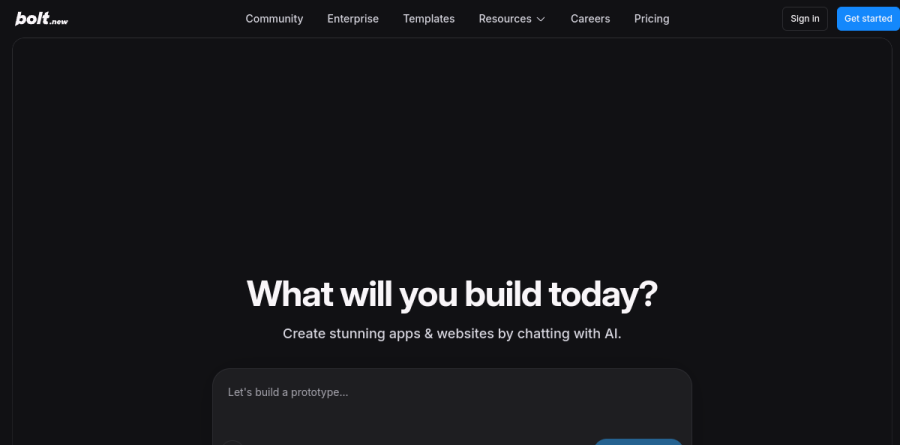
An in-browser AI builder, Bolt turns a plain-language description into a working, deployable web project. You type what you want, Bolt generates the code, streams it into a live preview, and publishes it to a public URL. The vendor FAQ states projects are generated with React, Vite, Tailwind CSS and Node.js by default, though you can request another stack in your prompt. Entry points on the homepage include Website, App, Prototype and Slides, plus imports from Figma or GitHub.
Bolt is not just a chat box wrapped around a model. Every generated project opens in a full browser-based IDE, so you can keep prompting or edit files directly, and nothing installs on your machine.
From prompt to deployed project
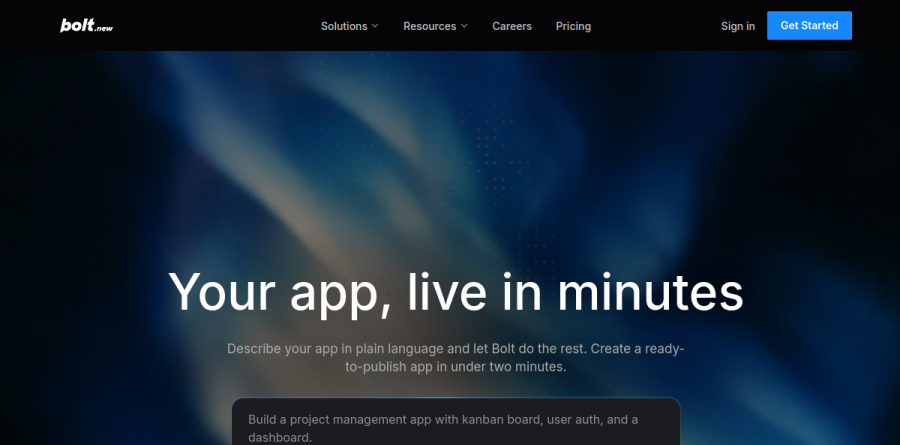
Bolt frames the workflow as three steps: describe what you want, review and refine, then deploy and share. In practice you watch code generate in real time, preview it in the browser, and either send follow-up prompts or open the editor yourself. Layouts come out responsive across mobile, tablet and desktop without extra configuration, and publishing is one click to a live URL with custom domain support. The example prompts Bolt lists — a project management app with kanban board and dashboard, an e-commerce app with catalog, cart and Stripe checkout, a booking app with availability calendar and reminders — give an honest read on the scope it targets.
Bolt Cloud and the built-in backend
Bolt Cloud is the vendor's term for the backend layer shipping with every project, and it is what makes Bolt more than a code generator. Bolt describes Bolt Cloud as enterprise-grade backend infrastructure covering hosting, databases and integrations, listing unlimited databases, user management and authentication, SEO optimization, and hosting with analytics and custom domains, with the Pro plan adding expanded database capacity and a choice of provider. Bolt lists persistent database storage, secure sign-up and login, automated backend functions, version control and history, and secure environment variables as standard on every build. For a marketer spinning up a campaign page or a founder shipping an MVP, that removes the usual scramble of stitching hosting, auth and a database together from separate accounts.
Model routing and bigger builds
Bolt Agent handles model selection for you. The homepage describes automatic routing to the right model for each task, balancing quality against token cost, with a Standard tier available to all users and a Max tier reserved for Pro. The vendor reports 98 percent fewer errors through automatic testing, refactoring and iteration, and says improved context management lets Bolt handle projects a thousand times larger than before. Those are vendor figures, not independent benchmarks, but the direction is clear: Bolt is aiming at longer-lived projects, not throwaway demos.
Security, compliance and team controls
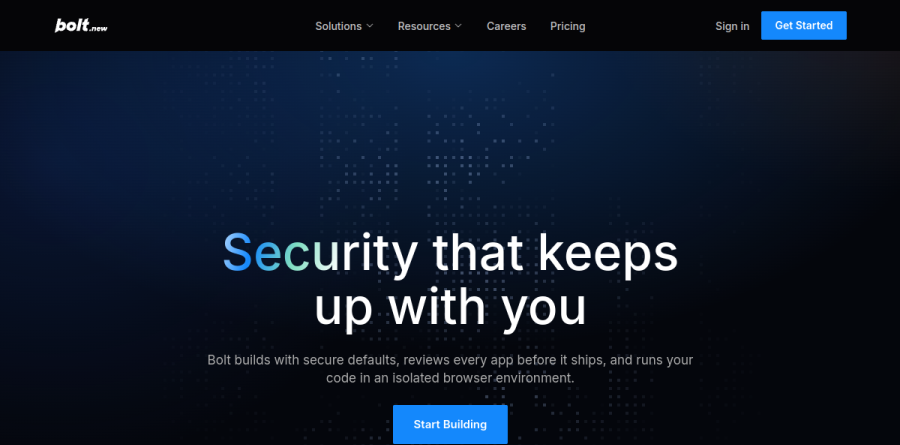
Security is unusually well documented for a tool in this category. Bolt executes your project client-side in an isolated WebContainer sandbox, so code is not running on shared infrastructure while you build. A security agent reads the project, writes fixes and applies them at no extra cost, and the generation layer carries guardrails such as Row Level Security defaults and escaped output. Bolt states it is SOC 2 Type 2 certified, GDPR and CCPA compliant, and that prompts and code are never used to train foundation models. The Teams plan adds centralized billing, team-level access management, granular admin controls and user provisioning, private NPM registries support and Design System knowledge with per-package prompts; Enterprise adds advanced security with SSO, audit logs and compliance support, while Bolt's security page separately describes a BYOK deployment that runs Bolt inside your own AWS or Azure tenant.
Who should choose Bolt
The tool suits product managers, entrepreneurs, marketers, agencies and students — the roles Bolt names itself — and more broadly anyone who wants a deployed, editable web app today rather than a design mockup. Agencies and solo builders get the most leverage, since every project opens in a full browser-based code editor and the default output is standard React, Vite, Tailwind CSS and Node.js rather than a proprietary page format. It is less suited to engineering teams with an established repository, CI pipeline and architecture standards, who will be better served by an agent working inside their existing editor. Pricing is token-metered: Free caps at 300K tokens daily and 1M per month, while Pro at $25 a month removes the daily limit, starts at 10M tokens monthly and rolls unused tokens over — so heavy iteration on Free hits the ceiling fast.
Strengths
- Generates a working full-stack app from a prompt in seconds, entirely in the browser
- Outputs standard React/Vite code you can download and host anywhere, avoiding lock-in
- Integrated preview, npm install, deployment (Netlify) and Supabase database in one flow
- 2026 additions like Figma import speed up designer-to-code handoff
Watch out for
- Token consumption is fast and unpredictable because it re-syncs the whole codebase each turn
- Loses context after roughly 15-20 iterations and struggles once projects exceed ~25 files
- Tends to rewrite entire files when fixing bugs, sometimes breaking working code
- Best for frontend/MVP work; complex production full-stack apps hit its limits
Key features
| Feature | What it does |
|---|
| Prompt-to-app generation | Describe an app in natural language and Bolt scaffolds a runnable React/Vite project. |
| In-browser dev environment | WebContainers run npm install, builds, live preview and debugging with no local setup. |
| Integrated deploy and data | One-click hosting/custom domains plus Supabase database wiring inside the same workspace. |
| Full code export | Download the underlying source at any point; no proprietary format or vendor lock-in. |
How Bolt compares
| Alternative | How it differs |
|---|
| Lovable | Similar prompt-to-app builder; competes directly on full-stack app generation and polish. |
| v0 by Vercel | Strong at UI/component generation and Next.js output, less of a full in-browser IDE. |
| Replit Agent | Broader cloud IDE with an AI agent; more flexible backend work but less design-focused. |
Frequently asked questions
Is there a free version of Bolt?
Yes. The free tier gives roughly 1M tokens per month with a 300K daily cap, but adds Bolt branding, caps uploads at 10MB and excludes custom domains.
Why do my tokens run out so fast?
Bolt syncs the entire project with the model on each interaction, so larger apps burn tokens quickly. A single complex change can use 100K+ tokens, which is the most common user complaint.
Bolt ratings on other platforms
Independent user ratings from third-party review sites, linked here for transparency.
These are not our editorial score, are captured on the date shown, and may have changed since.