Supabase Alternatives: What You Actually Give Up When You Leave
Affiliate disclosure: some links here are affiliate links and we may earn a commission at no cost to you. The order below follows the stated criterion and nothing else; no vendor paid for a position or saw this page before it went up.
If you are looking for Supabase alternatives, the honest answer is that most of them are not alternatives to Supabase at all. They are alternatives to the Postgres inside it. Supabase’s Free plan bundles a 500 MB database with 50,000 monthly active users of auth, 1 GB of file storage, 200 concurrent Realtime connections and 500,000 Edge Function invocations; Pro, from $25/month, raises that to 100,000 MAUs, 100 GB of file storage, 500 realtime connections and 2M edge function invocations. Of the ten products below, exactly one publishes an auth allowance on its own pricing page. The other nine sell you a database and leave the remaining three jobs to you.
That is what this page ranks. Eleven vendors’ pricing pages and the billing and plan docs behind them were read on 2026-09-17 — PlanetScale’s plans doc, the price feed the RDS pricing page loads, Azure’s free-offer documentation, Supabase’s billing FAQ and Turso’s CLI docs among them — while CockroachDB’s figures come from its own rate card, dated effective September 15, 2026. The ten alternatives are ordered by how close they stay to Postgres and how much of the Supabase bundle survives the move. Nothing here was installed, subscribed to or benchmarked. Every figure below is quoted from a page that was opened, and where a vendor does not publish a number this ranking needs, the absence is written down and costs that vendor position rather than being filled in with an estimate.
What this ranking measures
This ranking measures two things and refuses to measure anything else. First, Postgres: does the vendor sell Postgres by name on the page we read, so that a schema, a query and a driver survive the move intact? Second, the bundle: auth, file storage and realtime are the parts people forget were arriving inside the same $25, and a vendor that ships any of them outranks one that does not. Deliberately not measured: query speed, dashboard quality, developer experience, community size, funding, or behaviour under load — no one ran a query against any of these services. Where a rate the criterion needs is missing, such as an egress price or a storage price, the vendor loses position for not publishing it, because a buyer cannot budget around a number that does not exist.
The short answer
The only alternative on this sheet whose own pricing page carries something Supabase bundles: Auth at up to 60k MAU on the permanent Free plan and up to 1M MAU on Launch, plus 5 GB of Object Storage per project and 1M Function invocations a month free during beta. Leaving Supabase for Neon does not mean rebuilding login from scratch.
Postgres by name at $5/month for a single node and $15/month for 1 primary plus 2 replicas across 3 availability zones, with no idle sleeping or deletion on paid plans. It loses the top slot because nothing Supabase bundles comes with it and there is no free plan at all.
The cheapest flat monthly price here that sits on a free tier which cannot generate a bill at all: $4.99/month billed yearly, above a Free plan where overages cannot be enabled, so usage stops at 5GB storage, 500 Million rows read and 10 Million rows written a month instead of charging. Azure SQL’s DTU Basic is cheaper on paper at $4.8971/month, but its free offer can be switched to billed overage; Turso’s cannot be. The price of that is honesty about the criterion — none of it is Postgres, and none of the bundled layers come with it.
All 10 compared
| # | Product | Best for | Price from | What decides its place | |
|---|---|---|---|---|---|
| 1 | Leaving Supabase without rebuilding auth | Launch: “Pay for what you use” — no flat entry fee; $0.106/CU-hour compute and $0.35/GB-month storage, no monthly minimum (Free plan $0/month) | Free plan lists Auth up to 60k MAU; Supabase Free lists 50,000 | Visit | |
| 2 | Production Postgres with replicas, no free tier | Single node — Starting at $5/month; cheapest highly available Postgres is $15/month | No free plan at all; Postgres single node from $5/month | Visit | |
| 3 |  | Teams already inside an AWS account | “0.0160000000” USD per hour — db.t4g.micro, Single-AZ, On-Demand, US West (Oregon) | 0.016 USD per hour; free hours only for pre-July 15, 2025 accounts | Visit |
| 4 | Google Cloud shops that can absorb egress costs | $0.0105 / 1 hour — shared-core db-f1-micro, Iowa (us-central1) | $0.0105/hour carries no SLA; internet egress is $0.19/GiB | Visit | |
| 5 | Edge and offline apps on a free plan that cannot overspend | Developer: $5.99/month billed monthly, or $4.99/month billed yearly (yearly total $59.88) | $5.99/month monthly, $4.99/month billed yearly ($59.88/yr) | Visit | |
| 6 | The largest published free storage allowance here | $4.8971/month — DTU Basic (B), 5 DTUs, 2 GB storage, West US 2, USD | 100,000 free vCore seconds per database per calendar month | Visit | |
| 7 | A hard $30/month ceiling, if you can rewrite | Flex — $0.011/hour, “Up to $30/month”; Free (M0) $0/hour | Flex is capped: $8 to $30 for a month’s usage, never more | Visit | |
| 8 | Multi-region SQL where uptime outranks price | $0.092 per vCPU-hour (Standard, AWS us-east-1; “≈ $203/mo based on 2 vCPU · 100 GB”) | Trial only: 30 days or $400, then paused and deleted | Visit | |
| 9 | A cache beside your database, not instead of it | Essentials: “From $0.007” “/hour” with “Total $5/month” | Free tier is one 30 MB database; Pro minimum is $200/month | Visit | |
| 10 | Internal tools where five editors is the limit | Team: $20 per seat /month billed annually | 1,000 records per base free; $20 per seat/month billed annually | Visit |
1. Neon
Why it sits at 1 Free plan lists Auth up to 60k MAU; Supabase Free lists 50,000
Neon sells serverless Postgres and, alone on this list, sells some of what Supabase wraps around it. Its Free plan table lists Auth at up to 60k MAU — more than the 50,000 monthly active users on Supabase’s Free plan — and adds, free during beta, 5 GB of Object Storage per project and Functions with 1M invocations a month. Free storage is 0.5 GB per project — the same 500 MB Supabase Free gives you.
The trade-off is metering. Launch has no flat fee and no monthly minimum: $0.106 per CU-hour and $0.35 per GB-month, with 500 GB of egress per project included and $0.10 per GB after. Nothing here bundles realtime, and spend cannot be hard-capped on paid plans — the spending control emails alerts at 80% and 100%, and Neon says automatic suspension is not yet shipped. Exceeding a Free limit suspends compute until the next billing month; data is not deleted.
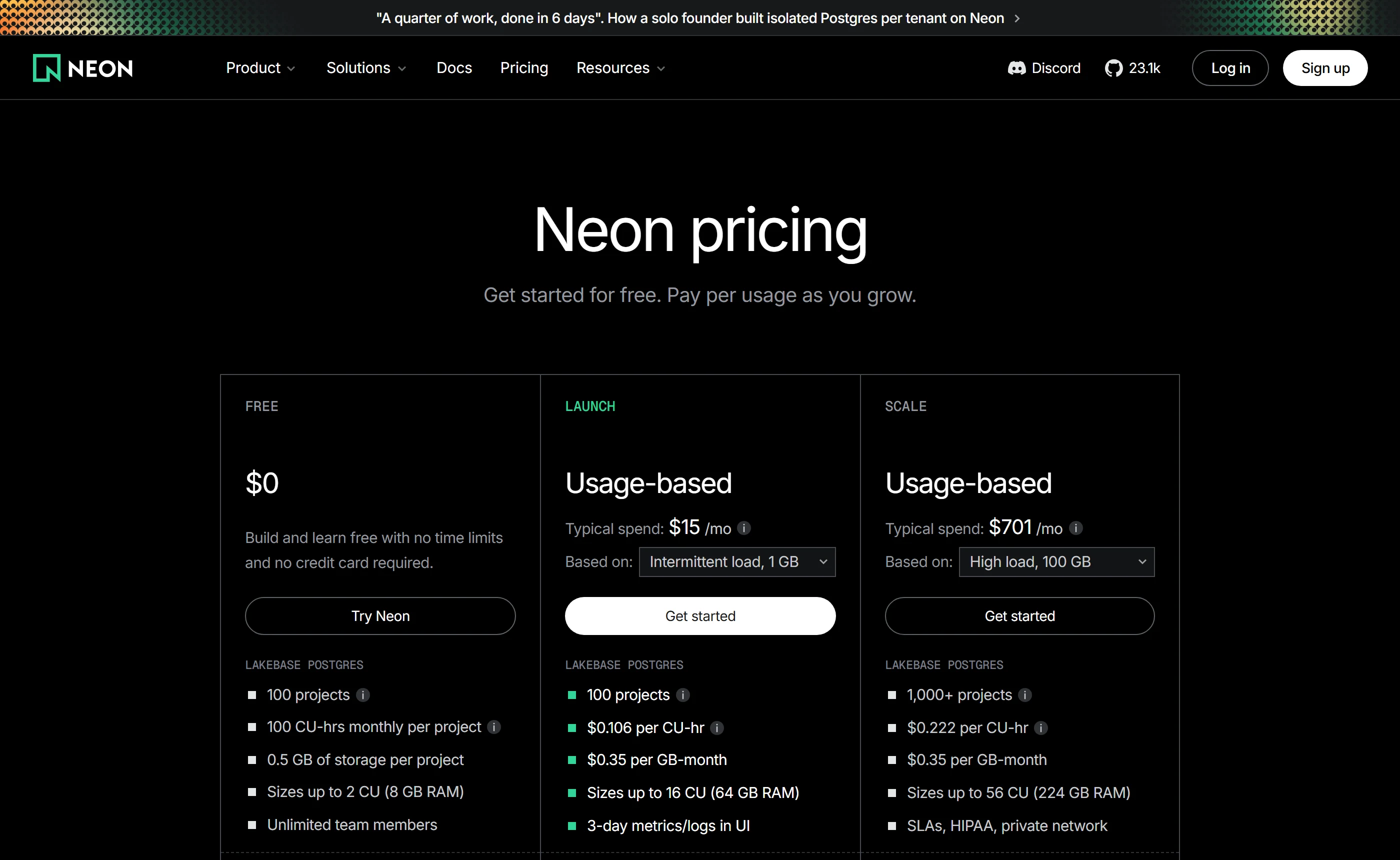
- The Free plan is permanent, needs no card, and is the only plan on this sheet that publishes a bundled auth allowance.
- No hard spend cap on Launch or Scale — only email alerts at 80% and 100%, with automatic suspension not yet shipped, where Supabase Pro ships with its cap on by default.
2. PlanetScale
Why it sits at 2 No free plan at all; Postgres single node from $5/month
PlanetScale sells PlanetScale Postgres as a named product line, priced per cluster rather than per unit of usage. A single-node PlanetScale Postgres database starts at $5/month (PS-5, 1/16 vCPU, 512 MiB RAM, 10 GB storage, 10 GB/month egress), and the cheapest highly available cluster — 1 primary plus 2 replicas across 3 availability zones — is $15/month in AWS us-east-1. Paid databases are never slept or deleted for idleness, which is the exact behaviour that pushes people off Supabase Free.
Everything else is gone. There is no auth, no file storage and no realtime in the plan, and no free tier at all: the docs state the old Hobby/Developer free plan is discontinued and every database requires a paid subscription with a valid card, pre-paid cards rejected. Two rates a budget needs are printed on no page — the per-GB volume rate and the public egress overage rate live behind a per-region endpoint, which returned 0.125 and 0.06 for AWS us-east-1. SSO is a $199/month add-on.
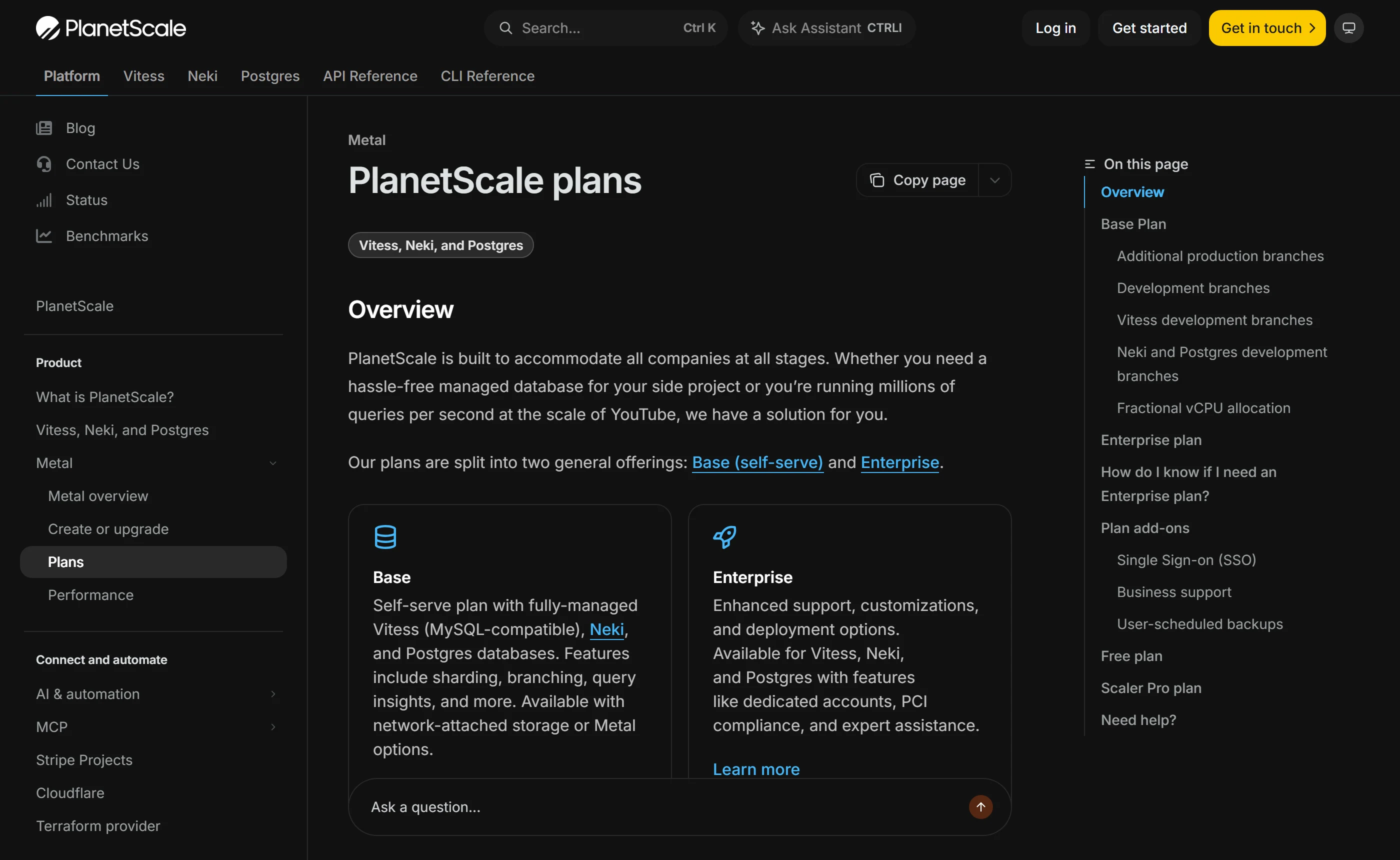
- $15/month buys 1 primary and 2 replicas across 3 availability zones, and paid databases are never slept or deleted for inactivity.
- No free plan, no trial and no free credits — a valid card is required before the first database exists, and pre-paid cards are rejected.
3. Amazon RDS
Why it sits at 3 0.016 USD per hour; free hours only for pre-July 15, 2025 accounts
RDS runs PostgreSQL by name, and its own price feed puts the floor at 0.016 USD per hour for a db.t4g.micro Single-AZ instance in US West (Oregon), billed per second after a 10-minute minimum. Storage is metered separately at $0.115 per GB-month for gp3 and backups at $0.095 per GB-month. Traffic between RDS and EC2 in the same Availability Zone is free, and cross-AZ egress is $0.01 per GB in and out.
The free tier depends on a date. Accounts that signed up before July 15, 2025 get 750 hours a month plus 20 GB of gp2 storage and 20 GB of backup storage for 12 months. Accounts created after it get no RDS-specific allowance at all — only $100 in credits plus up to $100 more, valid for up to 12 months, on an account that closes at 6 months or when the credits run out. Nothing is bundled, nothing scales to zero, and a stopped instance restarts itself after 7 days.
- Same-AZ traffic to EC2 is free and cross-AZ is $0.01 per GB, cheap next to Supabase’s $0.09 per GB egress overage.
- A Reserved Instance does not renew at the reserved rate: AWS states it reverts to the On-Demand hourly rate when the term ends, and that the programme may be terminated at any time.
4. Google Cloud SQL
Why it sits at 4 $0.0105/hour carries no SLA; internet egress is $0.19/GiB
Cloud SQL sells PostgreSQL and publishes the lowest hourly rate of any Postgres instance here: $0.0105 per hour for a shared-core db-f1-micro in Iowa (us-central1) — with a footnote saying shared-core machine types are not covered by the Cloud SQL SLA. Dedicated cores start at $0.0413 per vCPU hour plus $0.007 per gibibyte hour of memory, falling to $0.030975 with a 1-year commitment and $0.019824 with a 3-year one.
Egress is where a Supabase refugee gets hurt. Internet egress is $0.19 per GiB without Cloud Interconnect and $0.12 per GiB cross-region, against the 5 GB Supabase includes free and the $0.09 per GB it charges past Pro’s 250 GB. There is no always-free tier — Cloud SQL is absent from Google’s free-tier usage-limits table — only a 30-day trial instance on a fixed 8 vCPU / 64 GB configuration you cannot modify. An idle reserved IPv4 address bills $0.01 per hour whether or not anyone connects.
- $0.0105 per hour undercuts RDS’s 0.016 USD per hour, and committed use cuts dedicated vCPUs to $0.019824 per hour over three years.
- Internet egress at $0.19 per GiB is more than double Supabase’s $0.09 per GB overage, and the cheapest instance is explicitly outside the SLA.
5. Turso
Why it sits at 5 $5.99/month monthly, $4.99/month billed yearly ($59.88/yr)
Turso’s free plan carries the largest free row-read and row-write allowances on this sheet: 100 databases, 5GB storage, 500 Million rows read and 10 Million rows written a month, 3GB of Embedded Syncs and 1 day of point-in-time restore. It is also a free plan that cannot overspend by construction — overages cannot be enabled at all, so exhaust any single metric and the databases are blocked until the cycle resets, with no setting anywhere to bill through it.
None of it is Postgres, and none of the Supabase layers come with it. Rows read and rows written are the meter instead of compute hours, and every row touched while answering a query counts, not only the rows returned. What lifts it above the three picks below is that every rate it bills on is printed on the same page: $0.75 per GB of storage, $1 per Billion rows read, $1 per Million rows written and $0.35 per GB of syncs on Developer, which is $5.99/month billed monthly or $4.99/month billed yearly, a $59.88 yearly total. Paid plans created after 19 March 2025 have overages switched on by default, so the ceiling disappears the moment you upgrade, and free databases are archived after 10 days of inactivity.
- The free plan cannot generate a bill: overages cannot be enabled, so usage stops at the quota instead of charging.
- Rows read is the compute meter and counts every row touched, so an unindexed query is a billing event rather than just a slow one.
6. Azure SQL Database
Why it sits at 6 100,000 free vCore seconds per database per calendar month
Azure publishes the largest free storage allowance on this sheet — 32 GB of data and 32 GB of backup per database, on up to 10 General Purpose databases per subscription, for the lifetime of the subscription, plus 100,000 vCore seconds of General Purpose serverless compute per database each calendar month — and still ranks sixth, because none of it is Postgres and nothing Supabase bundles arrives with it. What holds the position against the two picks below is publishing: every compute, storage and backup rate a budget needs is printed, and only egress is deferred off-page to Azure’s general bandwidth rates, where the first 100 GB a month is free and North American or European egress is $0.087 per GB.
Its free offer defaults to stopping rather than billing: “Auto-pause the database until next month”, with 4 vCores and 32 GB as the ceiling while that setting stands. The alternative — bill the overage at standard General Purpose serverless rates — cannot be reverted once chosen, and that overage rate is never restated as a number beside the offer. The cheapest paid plan is DTU Basic at $4.8971/month for 5 DTUs and 2 GB in West US 2, visible only after moving the purchase model off its vCore default. Serverless databases auto-pause on a 60-minute default delay, which stops compute billing but not storage.
- 100,000 vCore seconds, 32 GB of data and 32 GB of backup per database per calendar month, for the lifetime of the subscription.
- Choosing to bill overage rather than pause at the free limit is irreversible, and once a region is picked every free database on that subscription is locked to it.
7. MongoDB Atlas
Why it sits at 7 Flex is capped: $8 to $30 for a month’s usage, never more
Atlas is a document database, so this is a data-model rewrite rather than a migration — but two numbers are worth knowing. M0 is free forever with 512 MB of storage, and Flex at $0.011 per hour carries the only true spend ceiling anywhere in Atlas: the page says Flex clusters “can cost between $8 and $30 for a month’s usage”, and $30 is a hard monthly maximum.
The free cluster’s limits are throughput-shaped rather than storage-shaped: 100 operations per second with network throttling above it, 10 GB in and 10 GB out per rolling seven-day period, 500 connections, one free cluster per project and no backups, auto-paused after 30 days with zero connections. Dedicated starts at $0.08 per hour, quoted as $56.94/month on the pricing card and $60 per month elsewhere in MongoDB’s own docs, with no per-GB rate published for storage beyond the tier default and no readable transfer rates for Azure or Google Cloud — three gaps that drop it below the pick above, which prints all of them. Past Flex there is no spend cap at all, only threshold alerts and a cost explorer.
- Flex carries a hard $30 per month ceiling — the only true spend ceiling anywhere in Atlas, where dedicated clusters get threshold alerts and a cost explorer instead.
- Nothing ports: not Postgres, no bundled auth, storage or realtime, and the free cluster is capped at 100 operations per second with throttling above it.
8. CockroachDB
Why it sits at 8 Trial only: 30 days or $400, then paused and deleted
Cockroach Continuum prices Standard compute at $0.092 per vCPU-hour in AWS us-east-1, metered by the minute, and the vendor’s own calculator turns that into roughly $203 a month for 2 vCPU and 100 GB. Mission Critical starts at $0.162 per vCPU-hour, with provisioned storage at $0.155 per GiB-month billed against a 4.5x durability multiplier, so 100 GiB bills as 450 GiB. Add-ons are at least quotable: change data capture is $0.006 per vCPU-hour on Standard and $0.023 on Mission Critical.
It sits below three picks that are no more Postgres than it is, on the rule this page set itself: what it does not print. Egress is billed with no published rate and is excluded from the calculator, no usage-based storage rate is published for Standard at all, and the feature table’s “from $0.057 / vCPU-hr” matches no line in the vendor’s own rate card. The published entry point is also a trial rather than a tier — 30 days or $400 of credit, whichever ends first, after which clusters are paused and then deleted following a 30-day grace period. No auth, file storage or realtime is bundled.
- Add-ons are priced openly per vCPU-hour — change data capture at $0.006 on Standard, $0.023 on Mission Critical — so the extras are at least quotable.
- Egress is billed but no rate is published anywhere and it is left out of the calculator, so the ≈$203/mo figure is not a total you can plan against.
9. Redis Cloud
Why it sits at 9 Free tier is one 30 MB database; Pro minimum is $200/month
Redis Cloud sits beside a primary database rather than replacing one, and its published numbers say so: the free tier is a single 30 MB database with 30 concurrent connections, 1 CIDR allow rule, 5 GB of monthly network bandwidth and 100 ops/sec, one per account. Essentials starts at “From $0.007” per hour with a “Total $5/month”, covering 250 MB to 100 GB of RAM and SSD in a single database.
The step up is steep and strangely documented. Pro shows “FIRST $200 FREE” beside an ongoing “*Minimum $200 /month” whose asterisk has no footnote anywhere on the page. Redis publishes no per-GB storage rate, no egress rate — the calculator says outbound transfer may be charged and refers you to support — and no spend cap. Billing continues on a subscription even after every database in it is deleted, until the subscription itself is deleted, and charges are “Generally... non-refundable.”
- Essentials is a $5/month total at the entry point, and the free 30 MB database is free forever on shared infrastructure.
- Deleting every database does not stop the bill — the subscription keeps charging until the subscription itself is deleted.
10. Airtable
Why it sits at 10 1,000 records per base free; $20 per seat/month billed annually
People do leave Supabase for Airtable, and it ranks last here because it is not a database you point a client at. The free plan caps a base at 1,000 records with up to 5 editors, 1 GB of attachments per base, 100 automation runs and 500 AI credits per editor each month. Team raises that to 50,000 records per base and 25,000 automation runs at $20 per seat per month billed annually.
The billing model is the real difference. You pay per seat rather than per project, so cost scales with headcount rather than data, and the monthly (non-annual) per-seat rate is published nowhere on Airtable’s public pages, so the size of the annual discount cannot be checked. Records and automation runs are hard quotas rather than billable overage, which acts as an implicit ceiling — hitting a cap blocks writes instead of charging. The only refund published is a courtesy window for billing mistakes: 7 days monthly, 14 days annual.
- Quotas block writes instead of billing overage, so spend cannot exceed seats plus any AI credit packs bought deliberately.
- The monthly per-seat price is published nowhere, so the $20 annual rate cannot be measured against anything — and cost scales with headcount rather than data, with a record cap that blocks writes and no paid overage path short of a tier upgrade.
Which one fits your situation
The free tier is enough — do not buy anything yet. Neon’s Free plan is permanent, needs no card, and suspends compute at the limit rather than deleting data. Its 0.5 GB per project is the same 500 MB Supabase Free gives you, and it lists Auth at up to 60k MAU against Supabase’s 50,000.
PlanetScale at $15/month for 1 primary plus 2 replicas across 3 availability zones. Budget past the sticker: the per-GB storage rate and the public egress overage rate are printed on no page, and SSO is a $199/month add-on.
Amazon RDS at 0.016 USD per hour for a db.t4g.micro Single-AZ instance in US West (Oregon) — but check the signup date first. Only accounts created before July 15, 2025 get the 750 free instance-hours and 20 GB of gp2 storage for 12 months.
Stay. Pro from $25/month covers 100,000 MAUs, 100 GB of file storage, 500 realtime connections and 2M edge function invocations. Only Neon publishes an auth allowance at all, and nobody else on this sheet prices file storage or realtime as part of the plan.
MongoDB Atlas Flex: $0.011 per hour with a hard $30 maximum for a month’s usage. It is a document database, so plan for a rewrite. The alternative ceilings are Turso’s free plan, where overages cannot be enabled at all, and Azure SQL’s free offer, which defaults to auto-pausing the database until next month.
What this market gets people for
- Comparing Supabase’s from-$25/month against a $5/month or $0.0105/hour instance rate and calling the difference a saving Those are compute-only numbers. Supabase Pro’s from $25/month includes 100,000 MAUs of auth, 100 GB of file storage, 500 realtime connections and 2M edge function invocations. Cloud SQL’s $0.0105 per hour excludes storage, backups, internet egress at $0.19 per GiB, and a reserved IPv4 address that bills $0.01 per hour while idle.
- Assuming the new free tier behaves like the one you are leaving Every vendor writes its own idle rule. Supabase pauses a Free project after 1 week of inactivity; Turso archives a free database after 10 days; MongoDB auto-pauses free clusters after 30 days with zero connections; CockroachDB deletes trial clusters after a 30-day grace period. Neon is the outlier — exceeding a Free limit suspends compute and leaves the data alone.
- Moving to escape a bill and landing somewhere with no spend cap Supabase Pro ships with its spend cap on by default. Neon’s control only emails alerts at 80% and 100% and says automatic suspension is not yet shipped; PlanetScale offers 75% and 100% alerts with no shutoff; CockroachDB, Cloud SQL and RDS publish no cap at all. The published hard ceilings elsewhere are Atlas Flex’s $30 a month, Turso’s overages-off switch and Azure’s free-offer auto-pause.
- Reading a credit as a discount, and assuming an unused month can be refunded CockroachDB’s $400 and Google’s $300 are time-boxed credits, 30 and 90 days respectively, and Redis’s “FIRST $200 FREE” sits beside an ongoing “*Minimum $200 /month”. None of them lowers a recurring rate. Nor is there a way out: Supabase states “No, we do not provide refunds” and issues non-expiring credits instead, Redis says charges are “Generally... non-refundable”, and the rest publish nothing at all.
Questions buyers ask
Is there anything that replaces Supabase’s bundled auth?
Only Neon, on this sheet. Its Free plan lists Auth at up to 60k MAU and Launch at up to 1M MAU. Supabase’s Free plan lists 50,000 monthly active users and Pro 100,000, metered at $0.00325 per MAU beyond that. No other vendor here publishes an auth allowance on its pricing page, so the cost of moving includes buying or building login separately.
Which of these have a real free tier rather than a trial?
Neon (permanent, no card required), Turso ($0/month), MongoDB Atlas M0 (free forever, 512 MB), Redis Cloud (one 30 MB database), Azure SQL (100,000 vCore seconds and 32 GB per database per calendar month for the lifetime of the subscription) and Airtable (1,000 records per base). PlanetScale has no free plan at all. CockroachDB offers a 30-day, $400 trial. Cloud SQL offers a 30-day trial instance only.
Will my database be deleted if I stop using it?
It depends on the vendor. Supabase pauses a Free project after 1 week of inactivity, with a restore window its docs put at one year. Neon suspends compute and does not delete data. Turso archives free databases after 10 days idle. MongoDB pauses free clusters after 30 days with zero connections. CockroachDB deletes trial clusters after the 30-day grace period. PlanetScale does not sleep or delete paid databases at all.
Can I put a hard limit on what I spend?
Rarely. Supabase Pro ships with a spend cap enabled by default, MongoDB Atlas Flex has a $30 per month maximum, Turso’s free plan cannot enable overages, and Azure’s free offer pauses the database until next month by default. Neon, PlanetScale, CockroachDB, Amazon RDS, Google Cloud SQL and Redis Cloud publish alerts only — PlanetScale’s at 75% and 100%, Neon’s at 80% and 100% — with nothing that stops service.
Is the advertised entry price the price I will actually pay?
Not on the metered vendors. PlanetScale’s $5/month includes 10 GB of storage and 10 GB of monthly egress, with the per-GB volume and egress overage rates served only by a per-region endpoint. Cloud SQL’s $0.0105 per hour excludes storage, backups and $0.19 per GiB internet egress. CockroachDB’s headline is $0.092 per vCPU-hour while its own calculator shows roughly $203 a month for 2 vCPU and 100 GB.
Does an annual price mean a cheaper renewal, and can I get money back?
No vendor here publishes a separate renewal rate, so there is no way to confirm from a vendor page that year two costs what year one costs. Turso’s Developer plan is $5.99/month billed monthly and $4.99/month billed yearly, a $59.88 annual total; Airtable’s $20 per seat/month is the annual-billing rate and no monthly figure is published. On refunds: Supabase says “No, we do not provide refunds”, Redis says charges are “Generally... non-refundable”, Airtable publishes only a 7-day monthly and 14-day annual courtesy window for billing errors, and the rest publish nothing.
What none of them publish
These are the questions a buyer would want settled that no vendor on this page answers in public. If one of them decides your purchase, ask the vendor and hold them to the answer.
- A refund window, almost anywhere. Neon, PlanetScale, CockroachDB, Turso, MongoDB Atlas, Amazon RDS, Google Cloud SQL and Azure SQL publish none; Supabase publishes the opposite; Redis calls charges generally non-refundable; Airtable publishes only a billing-error courtesy window.
- A renewal price. Not one of the eleven vendors publishes a first-term versus second-term rate, so nothing on any page proves that month 13 costs what month 1 costs.
- Airtable’s monthly per-seat price. The $20 per seat/month figure is explicitly the annual-billing rate, and the monthly figure appears nowhere public, so the annual discount cannot be measured.
- PlanetScale’s public egress overage rate and per-GB volume rate, both served only by a per-region endpoint (0.06 and 0.125 for AWS us-east-1 today) rather than printed on a human-readable page.
- CockroachDB’s egress rate and its usage-based storage rate for Standard — both billed, neither published, with egress excluded from the calculator entirely.
- Azure SQL’s free-offer overage rate as a number: the page describes it only as the standard General Purpose serverless rates, and defers egress to Azure’s separate bandwidth page.
- Redis Cloud’s per-GB storage and egress rates, and what the asterisk in “*Minimum $200 /month” refers to; no matching footnote exists on the page.
- What happens to idle data long term. Supabase’s docs put a paused project’s restore window at one year while its own changelog announced 90 days; Turso does not publish what becomes of an archived free database that is never unarchived; MongoDB’s Flex limitations page says nothing about idle pausing at all.
- Enterprise pricing at Supabase, PlanetScale, Turso, Redis Cloud, MongoDB and Airtable — every one listed as custom or contact-sales with no starting figure, minimum commitment or contract length.
Reading this from the other direction? Serverless Database Pricing Without Bill Shock: Ten Vendors Ranked by What They Publish and What They Cap covers the same market against a different rule.