The full review
What is Azure SQL Database?
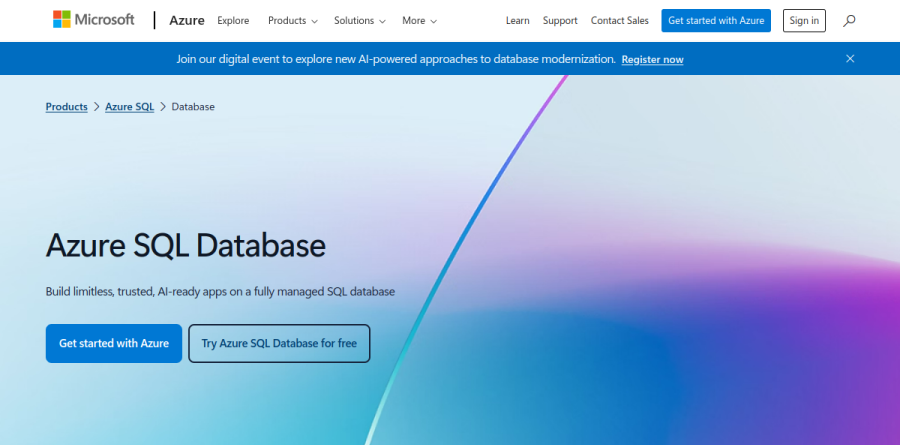
Azure SQL Database is Microsoft's fully managed relational database service, built on the same SQL Server engine teams already run on premises but delivered as a platform-as-a-service. Microsoft handles patching, backups, high availability and monitoring, leaving a development team to own schema, queries and application logic rather than the machine underneath.
The design is cloud-native rather than a lifted virtual machine. Databases scale independently, compute can be pre-provisioned or serverless, and existing T-SQL, drivers and tooling carry over almost unchanged. That continuity is what makes it easy to migrate or modernize existing apps, and Microsoft markets the platform as AI-ready on the strength of Azure OpenAI, Azure AI Search and native vector search support.
Service tiers and purchasing models
Azure SQL Database offers multiple service tiers. General Purpose covers balanced everyday workloads, Business Critical targets low-latency mission-critical systems, and Hyperscale is aimed at elastic applications needing multi-terabyte storage and rapid scale-out. Underneath sits a purchasing model choice between DTU and vCore; the vCore model lets you scale compute, memory and storage to your workload needs and unlocks Azure Hybrid Benefit for SQL Server licenses with active Software Assurance. Alongside single databases, Azure SQL Database supports elastic pools, with either pre-provisioned or serverless compute.
Serverless compute and Hyperscale scale-out
Serverless is the option that changes how small workloads get budgeted. The serverless compute tier auto-scales compute and bills for compute used per second, which Microsoft positions at single databases with intermittent, unpredictable usage. The free offer extends the same idea to evaluation, and Microsoft states it covers up to 10 databases with 100,000 vCore seconds of serverless compute and 32 GB of storage each per month for the life of the subscription. At the other end, Hyperscale handles growth: the vendor reports support for up to 30 named replicas, letting read traffic and reporting move off the primary.
Bringing AI features to operational data

Native vector search support is one of the platform's AI-ready capabilities. Storing embeddings beside relational rows means retrieval-augmented generation can run against live business records without copying them into a separate vector store, and Azure SQL Database connects outward to Azure OpenAI and Azure AI Search to close that loop. Azure Copilot brings AI assistance to the design, operation and optimization of SQL applications, while intelligent query processing improves the query performance of existing workloads with minimal effort.
Data API builder turns database objects into REST and GraphQL APIs, accessible on any platform, language or device. Mirroring in Microsoft Fabric replicates operational data into the analytics estate in near real time, so reporting stops competing with transactions. The familiar toolchain still applies, including the Azure portal, SQL Server Management Studio, the MSSQL extension in Visual Studio Code, and dev container templates that give you preconfigured environments locally or in the cloud. Connections to other Azure services such as Azure Functions need no custom glue code.
Security, continuity and compliance
Business continuity is largely handled on your behalf: Azure automatically handles provisioning, patching, backups and high availability, with backup retention from 7 to 35 days, long-term retention up to 10 years, and LRS, ZRS, RA-GRS and RA-GZRS redundancy options. Security follows a multilayered approach that includes Microsoft Defender for SQL, and the pricing page notes that DC-series hardware supports Always Encrypted with secure enclaves for workloads that demand confidential query processing. Microsoft reports over 100 compliance certifications, including over 50 specific to global regions and countries. For regulated organizations this is the hardest part of the stack to reproduce on self-managed infrastructure.
Who should choose Azure SQL Database
Azure SQL Database is the natural pick for organizations already invested in Microsoft. Existing SQL Server applications migrate with little rewriting, licenses carry across through Azure Hybrid Benefit, and identity, networking and monitoring plug into tooling the team already operates. SaaS builders gain the most from elastic pools and Hyperscale, while smaller teams can start on serverless or the free offer and scale later. It is a weaker fit for anyone standardized on PostgreSQL or MySQL, for multi-cloud strategies that prize portability, and for steady predictable workloads where a plain virtual machine or a leaner managed provider costs less.
Strengths
- Lifetime free offer: 100k vCore-seconds + 32 GB/month across up to 10 databases
- True per-second serverless billing with auto-pause so idle databases cost nothing
- Deep Azure/.NET integration plus built-in HA, patching and automated point-in-time backups
- Scales from a $4.90/mo Basic database up to 128 TB Hyperscale without re-platforming
Watch out for
- Two overlapping purchasing models (DTU vs vCore) make pricing genuinely confusing
- Backup, storage and cross-region egress overages surprise teams and inflate bills
- Serverless without auto-pause can still exceed $200/month for an always-on database
- Free amount and lowest tiers carry no SLA; regional price variation is significant
Key features
| Feature | What it does |
|---|
| Serverless compute | Autoscales vCores to load and auto-pauses when idle, billed at $0.0001450 per vCore-second (~$0.5218/vCore-hour). |
| Two purchasing models | DTU bundles compute+storage (Basic ~$4.90/mo to Premium P15); vCore lets you size compute and storage independently. |
| Hyperscale tier | Decoupled storage scaling to 128 TB with near-instant backups and read replicas, from ~$0.5653/hr for 2 vCores. |
| Built-in HA and PITR backups | Automated point-in-time restore backups (free within the DTU model / storage allowance) and high availability are included. |
| Cost-saving programs | 1- and 3-year reserved capacity, the new Azure Savings Plan for Databases (up to ~35% off), and Azure Hybrid Benefit. |
| Lifetime free offer | Every subscription can run up to 10 free General Purpose serverless databases with 100k vCore-seconds and 32 GB each per month. |
How Azure SQL Database compares
| Alternative | How it differs |
|---|
| Amazon RDS for SQL Server | AWS-native managed SQL Server; instance-hour pricing, no true serverless SQL Server and no equivalent lifetime free SQL tier. |
| Google Cloud SQL | GCP managed MySQL/PostgreSQL/SQL Server; per-vCPU + per-GB billing, but weaker for enterprises standardized on the Microsoft stack. |
| Amazon Aurora Serverless v2 | Comparable auto-scaling per-second billing (per ACU), but MySQL/PostgreSQL-compatible only, not SQL Server T-SQL. |
Frequently asked questions
How much does Azure SQL Database cost?
It is pay-as-you-go, so cost depends on the model. DTU Basic starts around $4.90/month (5 DTU, 2 GB). Standard S3 is about $147/month. vCore General Purpose provisioned runs ~$0.5044/hour for a 2-vCore database (~$368/month) plus storage. Serverless bills $0.0001450 per vCore-second only while active. Prices shown are East US pay-as-you-go.
Is Azure SQL Database free?
Yes, there is a lifetime free offer. Each Azure subscription can run up to 10 free databases, and each gets 100,000 vCore-seconds of serverless compute, 32 GB of data and 32 GB of backup free every calendar month. It runs on production General Purpose infrastructure but carries no SLA, so Microsoft recommends it for dev and proof-of-concept.
What is the difference between DTU and vCore pricing?
DTU bundles compute, memory and I/O into one packaged unit billed per hour (Basic ~$4.90/month up to Premium), so it is simple but rigid. vCore lets you size CPU and storage independently, supports serverless and Hyperscale, and unlocks reserved capacity and Azure Hybrid Benefit discounts. vCore is generally better for larger or variable workloads; DTU suits small, predictable databases.
What is Azure SQL Database serverless pricing?
Serverless is a vCore compute option billed per second at $0.0001450 per vCore-second, roughly $0.5218 per vCore-hour, plus storage per GB/month. It autoscales vCores to demand and can auto-pause when idle so you pay nothing for compute during pauses. Without auto-pause an always-on serverless database can still exceed $200/month.
Azure SQL Database vs Amazon RDS — which is cheaper?
For Microsoft-stack workloads Azure SQL Database is usually more cost-effective: it offers per-second serverless billing, a lifetime free tier and Azure Hybrid Benefit for existing SQL Server licenses. Amazon RDS for SQL Server bills per instance-hour with no true serverless SQL Server and no comparable free SQL tier. Exact totals hinge on region, storage and reservation choices.
Azure SQL Database ratings on other platforms
Independent user ratings from third-party review sites, linked here for transparency.
These are not our editorial score, are captured on the date shown, and may have changed since.