The full review
What is Google Cloud SQL / AlloyDB?
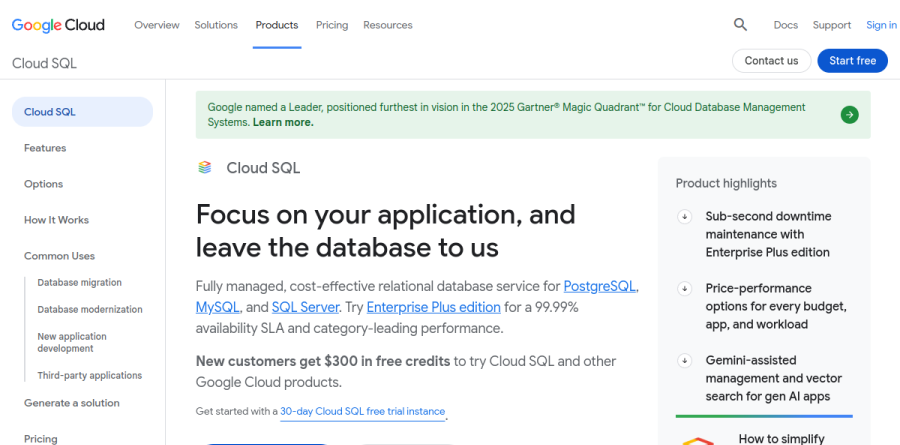
Google Cloud SQL is Google's fully managed relational database service, offering PostgreSQL, MySQL and SQL Server as hosted engines instead of software your team patches. The automation behind that promise covers backups, replication, patching, encryption and storage capacity increases. Instances scale in minutes, replicate across zones and regions, and are managed through the console, CLI or REST API.
Alongside it sits AlloyDB for PostgreSQL, a 100% PostgreSQL-compatible engine aimed at heavier enterprise workloads. Google positions Cloud SQL as the easiest lift and shift to the cloud and its lowest-cost relational option, with AlloyDB as the step up when throughput, data volume or read scale outgrow that envelope.
Editions that match the workload
Cloud SQL splits into two editions, and that choice is the main lever. Cloud SQL Enterprise handles general purpose workloads with 1 to 96 vCPUs, a 1:6.5 core memory ratio and a 99.95% availability SLA. Cloud SQL Enterprise Plus raises the ceiling to 128 vCPUs, a 1:8 ratio and a 99.99% availability SLA; the vendor reports 2x read and write performance for MySQL and PostgreSQL, sub-second planned maintenance downtime, a configurable data cache and 35 days of log retention. SQL Server on Enterprise Plus adds memory-optimized machine families, and shared-core types such as db-f1-micro suit side projects, though Google notes they sit outside the Cloud SQL SLA.

AlloyDB for PostgreSQL is where Google concentrates its performance claims. The vendor reports more than 4x faster transactional performance than self-managed PostgreSQL, and a built-in columnar engine that runs analytical queries up to 100x faster with no impact on operational traffic, making hybrid transactional and analytical processing viable in one system. Read connections scale horizontally through low-lag, scale-out, autoscaling read pools that can contain up to 20 nodes, and each cluster can replicate to secondary clusters in separate regions. The uptime SLA is 99.99% inclusive of maintenance. AlloyDB Omni, a downloadable edition of the same engine, runs in your own data center, at the edge or in another cloud.
Both services are presented as vector databases your team already knows how to operate. Cloud SQL supports pgvector and is presented as a fully-featured vector database, offering comprehensive vector search capabilities for building AI-powered apps without having to learn and manage a separate system. AlloyDB AI uses the Google ScaNN index, and the vendor reports up to 6x faster vector queries and 10x faster filtered vector search than the HNSW index in standard PostgreSQL. With QueryData you can translate natural language into database queries with near-100% accuracy, and the Data Agent Kit bundles secure Model Context Protocol tools, native IDE plugins and pre-codified data engineering, data science and data app developer skills into a single open-source package. Gemini in Cloud SQL, AlloyDB Studio and Database Center cover operations with fleet-wide performance and security recommendations.
Migration, security and daily operations
Getting in runs through Database Migration Service, which Google says migrates securely and with minimal downtime no matter where the source database is located, and Gemini in Database Migration Service helps review and convert database-resident code like stored procedures, triggers and functions to run in Cloud SQL for PostgreSQL. Once live, PITR log retention on Cloud Storage runs up to 7 days on Enterprise and up to 35 days on Enterprise Plus, at no charge in both cases. Data is encrypted in transit and at rest, private connectivity uses VPC and Private Service Connect, and Google lists SSAE 16, ISO 27001 and PCI DSS compliance alongside HIPAA support.
Who should choose Google Cloud SQL / AlloyDB
Google Cloud SQL is a natural fit for teams already building on Google Cloud who want PostgreSQL, MySQL or SQL Server without running servers, particularly where Cloud Run, GKE or BigQuery are part of the stack. Start on Cloud SQL Enterprise for general workloads, move to Enterprise Plus when the 99.99% SLA and near-zero maintenance downtime matter, and reach for AlloyDB when throughput or analytical load exceeds what a standard Postgres instance handles comfortably. Both offer 30-day free trial instances, so the evaluation is cheap. It suits teams chasing multi-cloud portability or a flat subscription less well: billing is metered per vCPU, per GiB and per region, so costs need modelling rather than guessing.
Strengths
- Fully managed across MySQL, PostgreSQL and SQL Server: automated patching, backups, replication and failover
- AlloyDB claims ~4x faster transactions and up to 100x faster analytics vs standard Postgres via its columnar engine
- Cheap to evaluate: $300 90-day credit plus a separate 30-day AlloyDB trial (1TB, 8 vCPU primary + 8 vCPU read pool)
- Committed-use discounts cut compute 25% (1-year) or 52% (3-year)
Watch out for
- No permanent free tier — cheapest always-on Cloud SQL instance still runs ~$8-10/mo, AlloyDB far more
- Consumption pricing (vCPU-hr + GB-hr + storage) makes bills hard to predict; replicas, HA and egress add up fast
- A small always-on AlloyDB production cluster costs hundreds/month once the trial ends
- Enterprise Plus and cross-region HA roughly double compute cost
Key features
| Feature | What it does |
|---|
| Three managed engines | MySQL, PostgreSQL and SQL Server, all fully managed with automated ops. |
| AlloyDB columnar engine | In-memory columnar acceleration for analytical Postgres queries, included in vCPU pricing. |
| Automatic storage scaling | Storage grows automatically; AlloyDB bills only for what you use. |
| High availability & read replicas | Regional HA with automatic failover; read replicas roughly double compute cost. |
| Committed-use discounts | 25% off compute for 1-year, 52% for 3-year commitments. |
| Deep GCP integration | IAM, private networking, BigQuery federation and Vertex AI / vector search. |
How Google Cloud SQL / AlloyDB compares
| Alternative | How it differs |
|---|
| Amazon RDS / Aurora | AWS equivalent; Aurora is the direct AlloyDB rival for managed Postgres/MySQL at similar per-vCPU rates. |
| Azure Database (SQL / Postgres) | Microsoft's managed relational service; natural pick for Azure-centric or SQL Server shops. |
| Neon / Supabase | Serverless managed Postgres with genuine free tiers — cheaper for small or hobby projects. |
Frequently asked questions
How much does Google Cloud SQL / AlloyDB cost?
Cloud SQL is usage-based: a shared-core db-f1-micro dev instance runs about $8-10/month, while production Enterprise instances cost $0.0413 per vCPU-hour plus $0.007 per GB-hour of memory and roughly $0.17-0.22/GB-month SSD. AlloyDB starts around $0.066 per vCPU-hour plus memory and about $0.30/GB-month storage.
Is Google Cloud SQL / AlloyDB free?
Neither has a permanent free tier. New Google Cloud customers get $300 in credits for 90 days, and AlloyDB adds a separate 30-day free trial cluster (up to 1TB, an 8 vCPU primary plus an 8 vCPU read pool). After that, the cheapest always-on Cloud SQL instance still costs about $8/month.
Google Cloud SQL vs AlloyDB — what's the difference?
Cloud SQL is Google's general-purpose managed service for MySQL, PostgreSQL and SQL Server. AlloyDB is a premium, PostgreSQL-only engine tuned for high performance — Google claims about 4x faster transactions and up to 100x faster analytics via its columnar engine. AlloyDB costs more, from roughly $0.066 per vCPU-hour.
How much is an AlloyDB free trial?
AlloyDB's free trial cluster costs $0 for 30 days, with a 15-day grace period. It includes up to 1TB of storage, an 8 vCPU primary instance and one 8 vCPU read pool. You only pay for cross-region data transfer and your final backup. New customers can also stack the $300, 90-day Google Cloud credit.
Cloud SQL vs Amazon RDS — which is cheaper?
They're close. Cloud SQL Enterprise bills about $0.0413 per vCPU-hour plus $0.007/GB-hour memory; comparable Amazon RDS and Aurora instances land in a similar range. Google's committed-use discounts (25% for 1 year, 52% for 3) and AlloyDB's Postgres performance are the main differentiators. Exact totals depend on region, HA, replicas and storage.
Google Cloud SQL / AlloyDB ratings on other platforms
Independent user ratings from third-party review sites, linked here for transparency.
These are not our editorial score, are captured on the date shown, and may have changed since.