The full review

What is Supabase?
Built on Postgres, Supabase is an open source backend platform that the vendor positions as an open source Firebase alternative. The homepage sums up the ambition: build in a weekend, scale to millions. Each project gets a dedicated Postgres instance wrapped in the services most applications need anyway: Database, Auth, Storage, Edge Functions, Realtime, and Vector.
What makes the arrangement unusual is how little of it stays hidden. The same tables are readable through REST and GraphQL endpoints that Supabase auto-generates from your schema, and the platform ships a CLI for developing locally and deploying. Supabase is also self-hostable, which keeps the escape hatch real.
The Postgres core of Supabase
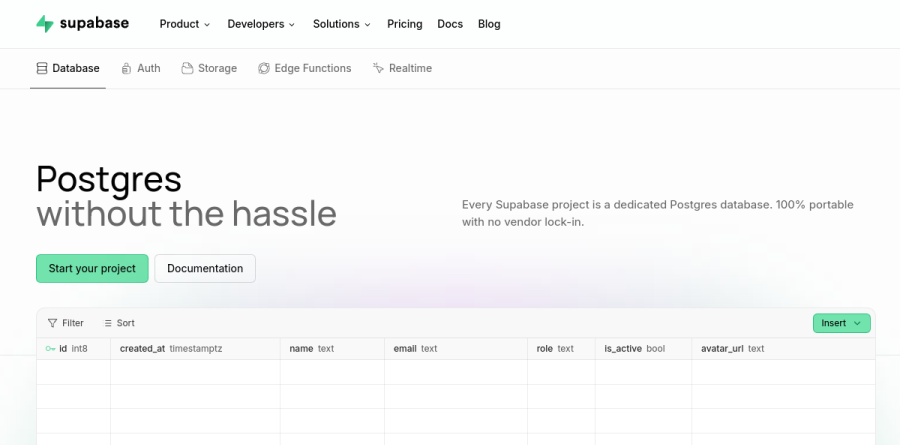
The Database product is the center of gravity. Supabase gives each project a full Postgres database rather than a slice of a shared cluster, then layers on a spreadsheet-style Table Editor for browsing rows, editing JSON columns, and following foreign key lookups. Beside it sits a SQL Editor with autocomplete and saved queries.
API generation saves the most time. PostgREST turns your schema into a REST interface and pg_graphql exposes a GraphQL one, both tracking schema changes with no backend code to maintain. Supabase lists more than forty Postgres Extensions, including pgvector, PostGIS, and pg_cron, plus Read replicas for multi-region latency and Branching that syncs isolated environments with git.
Authentication that lives in the database

Supabase Auth is the clearest expression of the platform design. User records sit in your own Postgres database under the auth schema rather than with a third party, and authorization is written as Row Level Security policies in SQL. Someone signs in, receives a JWT, and Postgres decides which rows that token may reach.
The login surface is broad: social login across more than twenty providers, email and password with confirmation and reset flows, phone and OTP, passwordless Magic Links, and TOTP-based Multi-Factor Authentication. The platform also includes SSO with SAML 2.0, Auth Hooks that customize authentication flows with database functions or Edge Functions, and Server-side Auth helpers for Next.js, SvelteKit, Remix, and other server frameworks.
Storage, Edge Functions, and Realtime
Around the database sit the services that make Supabase a complete backend. Storage covers files with S3 compatibility, a Content Delivery Network, resumable uploads, and on-the-fly image transformations, which is enough for avatars, document libraries, or media-heavy products. Edge Functions run Deno with regional invocations, handling webhooks, payment callbacks, and logic you would rather keep off the client.
Realtime covers the live-data side of the platform. It streams Postgres changes over WebSockets and adds Broadcast and Presence channels for chat, live cursors, and collaborative editing, each with its own authorization model. Database Webhooks close the loop by firing Edge Functions or external endpoints when table events occur.
The developer surface is deeper than the marketing suggests. Supabase ships client libraries for JavaScript, Python, Flutter, and Swift, plus a CLI, a Management API, a Terraform provider, and an MCP Server for AI agents. Inside the dashboard, a Security and Performance Advisor is offered to optimize database security and performance.
The plans track how teams mature. Free suits prototypes but pauses projects after a week of inactivity. Pro raises the limits and adds email support with daily backups. Team introduces SOC2 and ISO 27001 compliance, project-scoped access controls, and priority support with SLAs, while Enterprise adds a designated support manager, uptime SLAs, and BYO Cloud deployment.
Who should choose Supabase
Choose it if you want Firebase-grade speed without leaving relational territory. When your data has real relationships, when you would rather write a Row Level Security policy than run an authorization service, or when self-hosting later matters, Supabase is a strong default. Indie builders and small product teams gain the most, since one person can stand up auth, storage, and a full Postgres database without wiring together separate services.
It fits less well where nobody wants to own a database: the platform rewards people willing to think in schemas, policies, and migrations, so a team seeking a fully abstracted backend will find this one too transparent. Everyone else gets a backend that grows from a weekend prototype into a compliance-bound production system.
Strengths
- Real Postgres (not a proprietary layer) with instant auto-generated REST APIs
- Bundles auth, file storage, realtime and edge functions, cutting backend glue code
- Free tier allows 2 full projects with 50k MAU and 500k edge invocations
- Open source and self-hostable, avoiding hard vendor lock-in
Watch out for
- Free projects pause after 7 days of inactivity, a hassle for hobby apps
- No true scale-to-zero on paid plans; you pay for a dedicated compute instance per project
- Usage-based overages (egress, MAU, storage) can make bills unpredictable at scale
- Jump from Pro $25 to Team $599 is steep for teams needing SOC 2 / compliance
Key features
| Feature | What it does |
|---|
| Postgres database | Dedicated managed PostgreSQL with unlimited API requests and pgvector for AI/embeddings |
| Authentication | Built-in user management with email, OAuth, SSO and row-level security |
| File storage | S3-compatible object storage with a global CDN |
| Edge Functions | Deno-based serverless functions; 500k invocations free, 2M on paid plans |
| Realtime | Live Postgres change subscriptions, presence and broadcast over websockets |
| Auto REST/GraphQL API | Instantly generated APIs from your schema, plus database branching (GA since 2025) |
How Supabase compares
| Alternative | How it differs |
|---|
| Neon | Pure serverless Postgres with scale-to-zero and instant branching; Databricks-owned since early 2026. Better if you only need a database, not a full backend. |
| PlanetScale | Dropped its free tier in 2024; hobby plan reintroduced at $39/mo. Strong on MySQL and non-blocking schema changes, now also offers Postgres. |
| Firebase | Google's NoSQL BaaS. Easier realtime mobile sync but proprietary, no SQL/Postgres, and heavier lock-in than Supabase. |
Frequently asked questions
Is Supabase free?
Yes. The free plan is $0 and includes 2 active projects with a 500 MB database, 50,000 monthly active users, 1 GB file storage, 5 GB egress and 500,000 edge function invocations. The catch: free projects pause automatically after one week of inactivity, and no backups are included. It suits prototypes and small side projects.
How much does Supabase cost?
Supabase Pro is $25/month billed per organization, including 8 GB database, 100k MAU, 100 GB storage, 250 GB egress and $10/month compute credits. Team is $599/month adding SOC 2, ISO 27001 and 14-day backups. Enterprise is custom-priced. All paid plans add usage-based overages, but spend caps are on by default on Pro.
Supabase vs Neon: which is better?
Neon is pure serverless Postgres with scale-to-zero and millisecond branching, ideal if you only need a database. Supabase bundles Postgres with auth, storage, realtime and edge functions, so it wins when you want a complete backend. For a Next.js app needing full backend features, Supabase; for a lean autoscaling database, Neon.
What are the Supabase free tier limits?
The free tier caps you at 2 active projects, 500 MB database storage, 50,000 monthly active users, 1 GB file storage, 5 GB egress, 5 GB cached egress, 500,000 edge function invocations and 200 concurrent realtime connections. Backups are not included, and projects pause after 7 days of inactivity. Paused projects don't count toward your limit.
Is Supabase good for production?
Yes, for most apps. Pro at $25/month adds 7-day backups, $10 compute credits and larger limits, while Team ($599) brings SOC 2, ISO 27001 and 14-day retention. Note there is no scale-to-zero on paid plans, so you pay per dedicated compute instance, and heavy egress or MAU can raise usage bills.
Supabase ratings on other platforms
Independent user ratings from third-party review sites, linked here for transparency.
These are not our editorial score, are captured on the date shown, and may have changed since.