The full review
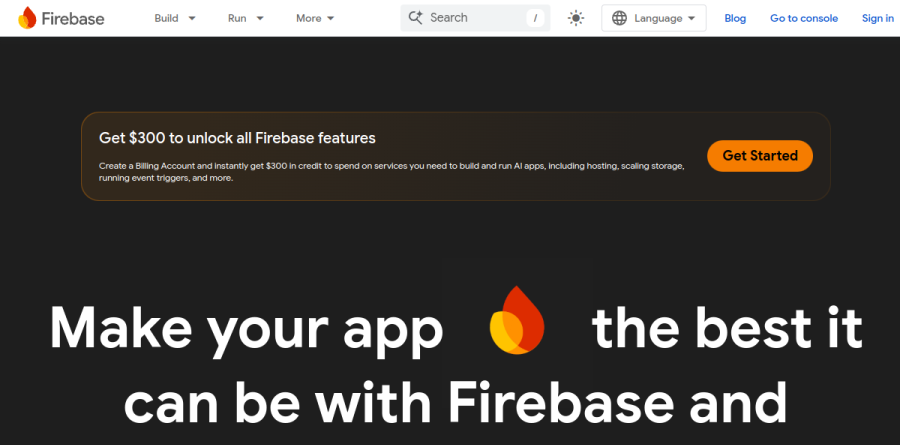
What is Firebase?
Firebase is Google's managed backend platform for teams who would rather ship product than operate servers. It bundles databases, authentication, file storage, serverless functions, hosting, and app health tooling into one console with client SDKs for iOS, Android, and the web. Google positions Firebase as a platform of services that helps developers and AI agents build and run intelligent apps with more speed, security, and scalability.
The catalogue splits cleanly in two. Build products cover what a live app needs behind the scenes; Run products handle everything after release, from crash reporting to analytics and messaging. Firebase provides cross-platform SDKs for Apple platforms, Android, the Web, Flutter, Unity, and C++, so the same services back whichever client a team ships.
Data and backend logic without a server

Cloud Firestore is a NoSQL document database that lets you structure your data easily with collections and documents and retrieve it with expressive queries. Firebase reports that offline mode is available on iOS, Android, and Web, letting users access and change their data at any time even when offline, and that its declarative security language can restrict data access based on user identity data, pattern matching on your data, and more. Firestore has also gained MongoDB API compatibility, so existing drivers and code can point at it.
Realtime Database stores and syncs data between users in near-realtime, on or offline, with strong user-based security, and SQL Connect serves teams needing relational structure by securely connecting an app to a Cloud SQL for PostgreSQL database. Cloud Functions runs server-side logic without provisioning infrastructure, while Cloud Storage handles user-generated files.
Authentication, hosting, and abuse protection
Firebase Authentication adds user sign-in and onboarding from a variety of providers, and Firestore's declarative security rules can restrict data access based on that user identity data. App Check sits beside it, using Android, iOS, and web attestation providers to keep backend resources from being hammered by traffic that never came from your app.
On delivery, Hosting pushes static sites to a global CDN in seconds, while App Hosting targets dynamic full stack apps and leans on Google Cloud for scale. That split matters when choosing between a marketing site and a server-rendered framework.
Firebase AI Logic and generative features
Firebase AI Logic builds AI features by integrating the Gemini API directly into client apps through Firebase's SDKs, available in your favourite languages, so mobile and web code can reach Gemini models without a separate backend service. Paired with Remote Config and A/B Testing, which the vendor says can roll out and experiment with models as well as ordinary feature parameters, teams gain a way to swap or tune a model without shipping a fresh build.
Watching an app after it ships

Crashlytics delivers real-time crash and error reporting with contextual and AI-driven insights, troubleshooting tips, and clear signals about new releases to help you fix crashes faster. Performance Monitoring reports latency from the user point of view, Test Lab exercises builds on virtual and physical devices, and App Distribution puts pre-release versions in front of testers.
For engagement, Cloud Messaging sends targeted push notifications, In-App Messaging nudges active users toward key actions, and Google Analytics connects usage back to behaviour. Keeping crash data, experiments, and analytics inside one project is the practical advantage.
Spark and Blaze in practice
Firebase bills through two plans. Spark is the no-cost tier, with project-level quotas across services and no payment method required, which makes it genuinely usable for prototypes and side projects. Blaze is pay-as-you-go: it opens up the services and higher limits Spark caps, keeps the Spark allowances as a baseline, and charges only for consumption beyond them. Firebase notes that eligible accounts receive a free credit on signing up for Blaze. Watch consumption on Blaze, though, because once usage passes the included no-cost tiers, Firebase bills at Google Cloud rates for what a busy function or query actually consumes.
Who should choose Firebase
Firebase suits mobile and web teams who want a production backend on day one: startups validating an idea, small teams without a dedicated infrastructure engineer, and anyone building realtime or offline-first features where Firestore and Realtime Database carry the hard part.
It is less ideal for teams with heavy relational reporting, complex joins, or a firm requirement to avoid vendor lock-in. SQL Connect softens the first two, but a mature relational model still sits more comfortably on a conventional Postgres stack, and organisations under strict self-hosting mandates should evaluate carefully before committing.
Strengths
- Genuinely generous free Spark tier (50K Auth MAU, 50K Firestore reads/day) with no credit card required
- Fully managed real-time backend: Firestore, Auth, Cloud Functions, and Hosting integrate tightly with strong mobile SDKs
- Blaze keeps all free quotas and bills only for overages, plus $300 Google Cloud credit for new upgrades
- Deep Google ecosystem integration (Analytics, FCM push, Crashlytics) and unlimited free messaging/crash reporting
Watch out for
- Usage-based Blaze billing is hard to predict; read-heavy Firestore workloads can cause surprise cost spikes
- Cloud Storage was removed from the free Spark plan (effective Feb 3, 2026) and now requires the Blaze plan
- Vendor lock-in: Firestore/Realtime Database use proprietary APIs that are painful to migrate off
- Limited querying (no complex joins or rich aggregations) compared with a relational SQL database
Key features
| Feature | What it does |
|---|
| Cloud Firestore | NoSQL real-time document database with offline sync; free tier 50K reads, 20K writes, 20K deletes/day and 1 GiB storage |
| Firebase Authentication | Email, social, and phone sign-in with 50,000 monthly active users free on both plans |
| Hosting & App Hosting | Global CDN for static and SSR sites; 10 GB storage and 360 MB/day transfer free, then $0.15/GB |
| Cloud Functions | Serverless event-driven backend; 2M invocations/month free, then $0.40 per million |
| Cloud Messaging & Crashlytics | Unlimited free push notifications (FCM) and crash reporting on every plan |
| Realtime Database | Low-latency JSON sync database; 1 GB storage and 10 GB/month downloads free, then $5/GB stored |
How Firebase compares
| Alternative | How it differs |
|---|
| Supabase | Open-source Postgres backend with real SQL and no vendor lock-in; the most cited Firestore swap |
| AWS Amplify | Comparable backend-as-a-service with deeper AWS integration but a steeper learning curve |
| Vercel | Frontend hosting/serverless platform; complementary to Firebase, not a full backend replacement |
Frequently asked questions
Is Firebase free?
Yes. Firebase's Spark plan is free with no credit card required. It includes 50,000 Authentication MAUs, 50,000 Firestore reads and 20,000 writes per day, 1 GiB Firestore storage, 10 GB Hosting storage, and 2 million Cloud Functions invocations monthly. Analytics, Crashlytics, and Cloud Messaging are unlimited and free. Cloud Storage, however, now requires the paid Blaze plan.
How much does Firebase cost?
Firebase uses freemium, usage-based pricing. The Spark plan costs $0. The Blaze plan is pay-as-you-go: you keep all free quotas and pay only for overages. Example rates include Hosting transfer at $0.15/GB, Cloud Functions at $0.40 per million invocations, and Realtime Database at $5/GB stored plus $1/GB downloaded. New Blaze users get $300 in Google Cloud credit.
What are the best Firebase alternatives?
Top Firebase alternatives are Supabase, an open-source Postgres backend with real SQL and no lock-in; AWS Amplify, a comparable BaaS tied to AWS; and Appwrite, a self-hostable open-source option. For pure hosting, Vercel and Render are common picks. Supabase is the most cited swap for teams wanting relational queries and portability over Firestore's NoSQL model.
Firebase vs Vercel: which is better?
They aren't direct competitors. Vercel is a frontend hosting and serverless platform optimized for Next.js and edge delivery. Firebase is a complete backend-as-a-service with a database, authentication, storage, and functions. Many teams use both: frontend on Vercel, backend on Firebase. Choose Firebase for a managed real-time database and auth; choose Vercel for frontend-first sites needing minimal backend.
Did Firebase remove the free Cloud Storage tier?
Yes. Since February 3, 2026, Cloud Storage for Firebase requires the pay-as-you-go Blaze plan. Projects still on the free Spark plan lose read/write access to all Storage buckets; data remains but is inaccessible until you upgrade. No-cost usage of about 5 GB still applies on Blaze via Google Cloud's Always Free tier, so light usage stays effectively free.
Firebase ratings on other platforms
Independent user ratings from third-party review sites, linked here for transparency.
These are not our editorial score, are captured on the date shown, and may have changed since.