The full review
What is PlanetScale?
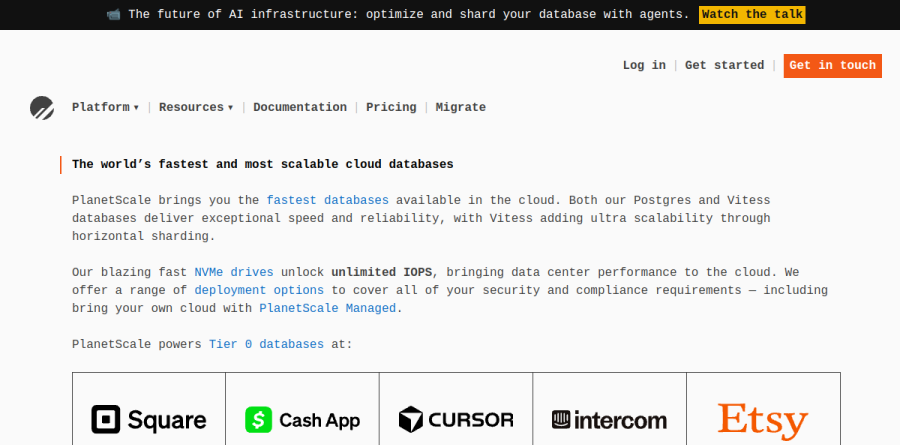
At its core, PlanetScale is a managed cloud database platform that runs two engines under a single control plane: PlanetScale Postgres and PlanetScale Vitess, the MySQL-compatible system originally invented at YouTube. The homepage positions the product squarely around raw speed, and PlanetScale pairs that claim with an operational layer aimed at application engineers rather than dedicated database administrators.
In practice you provision a cluster, either single node or three-node high availability, and get branching, schema deploy workflows, backups, point-in-time recovery, and query-level observability layered on top. PlanetScale is paid-only, with no free tier to grow out of, which sets expectations early about the kind of team it is built for.
PlanetScale Postgres and the Metal storage layer
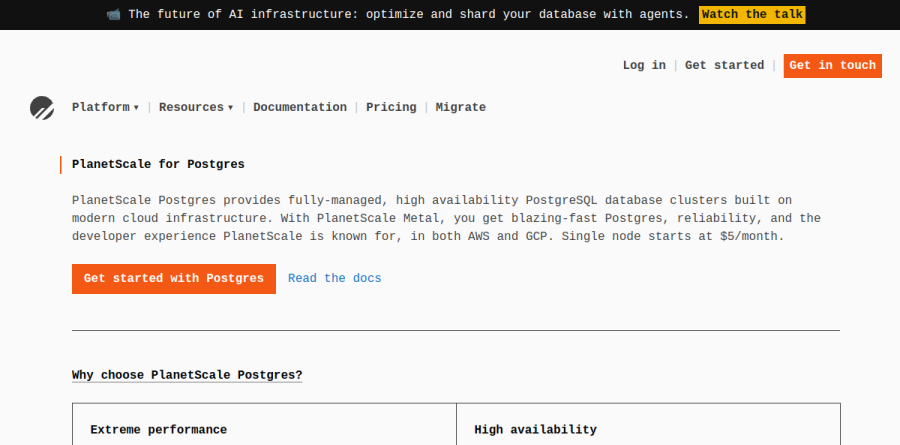
PlanetScale Postgres delivers fully managed, high availability PostgreSQL clusters. The distinguishing piece is PlanetScale Metal, which attaches NVMe drives directly to each instance instead of relying on network block storage. The vendor reports that this unlocks unlimited IOPS, and that Postgres running on Metal outperforms Aurora, AlloyDB, Neon, Heroku, and Supabase in its own published benchmarks.
Standard EBS-backed clusters remain available for teams that want a lower entry point, and cluster sizes are offered in both arm64 and x86-64 variants. PlanetScale states that failover on the HA configuration completes in under 30 seconds in most cases. Connection pooling runs through PgBouncer, with a dedicated pooler available as an add-on.
Horizontal scale with PlanetScale Vitess
When a single primary stops being enough, PlanetScale Vitess brings vertical and horizontal sharding to MySQL. Vitess distributes data across keyspaces and shards, potentially spanning hundreds of servers, and routes queries through the VTGate and VTTablet layers, which also handle connection pooling. PlanetScale frames the value plainly: you harness Vitess without hiring a team of Vitess experts, because sharding topology, automatic failover, and online schema migrations are operated for you.
The company also lists Neki, described as a next-generation Postgres sharding architecture, which signals that the horizontal-scale story will not remain MySQL-only.
Branching and deploy requests

The workflow layer is where PlanetScale departs most sharply from an ordinary managed database. You branch a database the way you branch code: spin up an isolated branch from your production schema, make changes there, then open a deploy request. Schema changes reach production without locking or downtime, and PlanetScale supports revertable schema changes with zero data loss, so a regrettable migration can be rolled back rather than hot-fixed under pressure.
Development branches can run as cost-optimized single instances to keep spend sane, and the PlanetScale CLI, REST API, and GitHub Actions integration let the whole cycle run inside continuous integration instead of a console.
Observability, traffic control, and compliance
Query Insights gives a detailed view of every active query, with automatic detection of performance anomalies and execution plan analysis feeding concrete recommendations. Database Traffic Control adds a governance layer over what actually reaches the cluster, while auto-routing sends replica traffic to the read-only region with the lowest latency. Data teams get Airbyte and Fivetran integrations plus PlanetScale Connect for OLAP movement, and MySQL users get native vector search stored alongside relational data.
On the governance side PlanetScale lists SOC 1 Type 2 and SOC 2 Type 2 attestations with HIPAA, PCI DSS 4.0 as a Level 1 Service Provider, IP restrictions, AWS PrivateLink, and GCP Private Service Connect. PlanetScale also lists safe agent access through the PlanetScale MCP server.
Who should choose PlanetScale
The platform fits engineering teams running serious OLTP workloads where database latency is a visible product concern rather than a background detail: consumer apps, fintech, and SaaS products with real write volume. The branching and deploy request model pays off most for teams that ship schema changes weekly and want migrations reviewed like pull requests. Larger organizations can go further with the Enterprise plan, which adds sharding assistance and PlanetScale Managed, a data plane deployed into an AWS sub-account or GCP project you own while PlanetScale operates it, plus a single-tenant option.
It is not ideal for hobby projects, side builds, or early prototypes, since there is no free tier and even the smallest single-node Postgres cluster carries a monthly charge. Teams that simply need a cheap database with a dashboard will find the operational depth here more than they are paying for.
Strengths
- Very low tail latency; PlanetScale Metal runs on local NVMe, not network-attached storage
- Non-blocking online schema changes and git-like branching make migrations safe and reversible
- Offers both MySQL (Vitess) and Postgres (GA Sept 2025) with proven horizontal sharding
- Built by the Vitess/YouTube team; enterprise HA, SOC 2, and battle-tested at massive scale
Watch out for
- No free tier since April 2024 — cheapest option is $5/mo single-node Postgres with no HA
- MySQL/Vitess entry is $39/mo, far above Neon and Supabase free tiers
- Usage-based add-ons (storage, egress, backups) make monthly bills hard to predict
- Each branch runs its own dedicated cluster, so branching adds real cost rather than being free
Key features
| Feature | What it does |
|---|
| Database branching | Create isolated dev/staging branches, each on dedicated cluster infrastructure, for safe testing. |
| Non-blocking schema changes | Deploy requests apply DDL online without table locks or downtime, with revert support. |
| PlanetScale Metal | Locally-attached NVMe storage (Postgres & MySQL) for lower latency and no per-GB network-storage overage. |
| Vitess horizontal sharding | Managed Vitess scales MySQL across shards to handle very large, high-throughput workloads. |
| Managed Postgres | Postgres product (GA Sept 2025) on a new Neki architecture with isolated per-branch clusters and HA. |
| Insights & query analytics | Per-query performance monitoring to find slow queries and optimize database load. |
How PlanetScale compares
| Alternative | How it differs |
|---|
| Neon | Serverless Postgres with scale-to-zero, instant copy-on-write branching, and a genuinely free tier; the default pick for new and small projects (Databricks-owned since early 2026). |
| Supabase | Postgres plus auth, storage, realtime, and edge functions — a full backend-as-a-service with a free tier; best when you need more than just a database. |
| Turso | SQLite/libSQL at the edge with a generous free tier; a common landing spot for hobbyists after PlanetScale removed its free plan. |
Frequently asked questions
Is PlanetScale free?
No. PlanetScale removed its free Hobby tier on April 8, 2024, and has not reinstated it — as of July 2026 there is no free plan. The cheapest option is a single-node Postgres database at $5/month; a highly available 3-node Postgres cluster starts at $15/month, and MySQL/Vitess starts at $39/month.
How much does PlanetScale cost?
Pricing is usage-based per cluster. Postgres single-node starts at $5/month, HA 3-node Postgres at $15/month, and PlanetScale Metal at $50/month; MySQL/Vitess starts at $39/month. On top, storage is $0.125/GB after 10 GB included, egress $0.06/GB after 100 GB, and backups $0.023/GB per month.
Does PlanetScale support Postgres?
Yes. PlanetScale Postgres went GA in September 2025, built on Neki — a new system from the Vitess team, not a Vitess fork. It adds isolated per-branch clusters, high availability, and PlanetScale Metal NVMe storage. PlanetScale still offers managed MySQL on Vitess with online schema changes and horizontal sharding.
PlanetScale vs Neon: which is better?
Neon offers standard serverless Postgres with scale-to-zero, instant copy-on-write branching, and a real free tier — best for side projects and most new apps. PlanetScale has lower tail latency, non-blocking schema changes, and both MySQL and Postgres, but no free tier and starts at $5/month. Pick PlanetScale for scale and MySQL, Neon for free serverless.
Why did PlanetScale remove its free tier?
In March 2024 PlanetScale announced it was sunsetting the free Hobby plan (retired April 8, 2024) alongside layoffs, to reach sustainable profitability. The move pushed many hobbyists to Neon and Turso. PlanetScale repositioned toward production teams and later cut its entry price to $5/month with the 2025 Postgres launch — but still offers no free tier.
PlanetScale ratings on other platforms
Independent user ratings from third-party review sites, linked here for transparency.
These are not our editorial score, are captured on the date shown, and may have changed since.