The full review
What is CockroachDB?
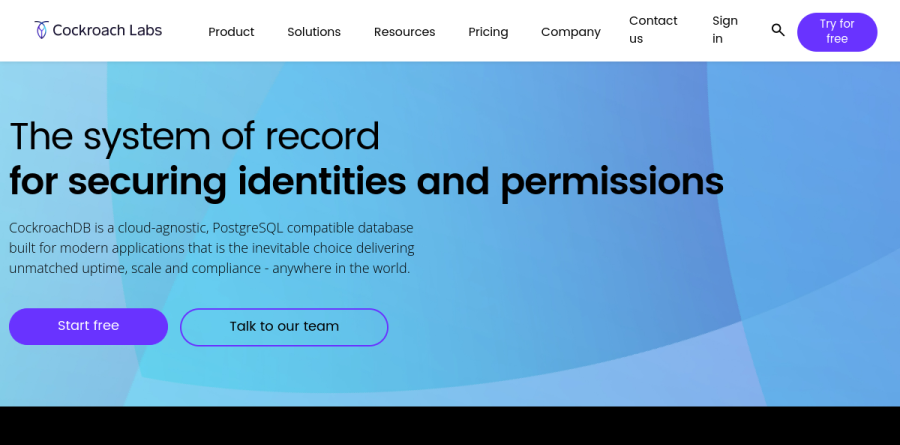
Built by Cockroach Labs, CockroachDB is a distributed SQL database positioned as the system of record for a business rather than a cache or a secondary store. It is cloud-agnostic and PostgreSQL compatible, so applications keep ordinary SQL with no app re-architecture required, while the platform eliminates manual sharding and scales to hundreds of nodes. Automatic 3x data replication is a platform default.
The break from a single-node relational database is that CockroachDB treats horizontal growth and hardware failure as normal operating conditions. Cockroach Labs describes resilience built on zero data loss, automated failover, and strong consistency, so the cluster keeps serving reads and writes when a node, a zone, or an entire region drops out.
Scaling without manual sharding

Teams that outgrow a single Postgres instance normally face sharding by hand: splitting tables by customer or geography, then carrying routing logic in the application forever. CockroachDB distributes ranges of data across nodes itself, and Cockroach Labs points to horizontal scaling with ACID transactions at scale as the return on that design. Clusters on CockroachDB Cloud can start as small as 2 vCPUs; the Standard plan, currently marked Preview, provides provisioned compute with instant scaling up to 200 vCPUs, while Advanced is listed as unlimited scaling and Basic uses on-demand compute and storage that scales to zero.
Postgres compatibility and the migration path
Postgres compatibility is the on-ramp. Existing ORMs, drivers, and SQL knowledge carry over, which shortens evaluation for shops already running Postgres, and Cockroach Labs ships MOLT as its migration tooling for moving schemas and data onto the platform.
Operationally, CockroachDB leans on minimal maintenance windows. Online upgrades, schema changes, and backups are core selling points, with no-downtime version upgrades on the managed service. For a system of record, minimal maintenance windows and no-downtime rolling upgrades are often the deciding capability.
Multi-region placement and compliance controls
Data placement is where CockroachDB separates from ordinary replication. Cockroach Labs describes declarative policies that pin data in specific localities and geographic locations, termed data domiciling in the pricing vocabulary, serving latency and regulation at once.
The security list is deep: row level security, customer managed encryption keys, private connectivity via PrivateLink and Private Service Connect, LDAP support, console single sign-on, and encrypted backups, with stated support for PCI-DSS, HIPAA, ISO, and SOC 2 programs. Advanced advertises availability of up to five nines, while Basic and Standard state four.
Three ways to run it

Deployment choice is a real strength. CockroachDB Cloud is the fully managed route across the Basic, Standard, and Advanced plans, with Basic and Standard available on AWS and GCP and Advanced adding Azure. CockroachDB Bring Your Own Cloud keeps the cluster inside your own cloud account under Cockroach Labs management. CockroachDB Enterprise covers self-hosted installs on premises or in a private cloud, including air-gapped environments, bundled with an enterprise license, P1 technical support, and Professional Services options. Enterprise pricing is quoted through sales.
Newer additions target AI workloads directly. Integration of vector data with transactional data is listed on every CockroachDB Cloud plan, so embedding search sits beside transactional rows instead of in a separate service kept in sync.
Around that sit an MCP Server, the ccloud CLI, and Agent Skills for coding agents provisioning or querying clusters. A Terraform provider and Cloud APIs handle infrastructure automation, and metrics and log export to Datadog is listed on the Standard and Advanced plans.
Who should choose CockroachDB
This database suits engineering teams building a system of record that genuinely cannot go dark: payments, ledgers, identity, order management, anything where a regional outage becomes a revenue event. It is equally strong for products serving several continents under data residency rules, and for organisations wanting one database engine spanning managed cloud, their own cloud account, and on-premise hardware.
It is not ideal for a small single-region application with modest traffic. A managed Postgres instance will be cheaper and simpler to operate at that size, and the distributed transaction model adds latency that only pays for itself once resilience or global reach becomes a real requirement.
Strengths
- True horizontal scaling and multi-region with automatic 3x replication and failover
- PostgreSQL wire-compatible — reuse familiar SQL, drivers, and tooling
- Basic tier is genuinely free to start: 50M Request Units + 10 GiB storage/month, no credit card
- Serializable isolation by default gives strong consistency across distributed nodes
Watch out for
- Request Unit billing on Basic is harder to predict than simple per-GB pricing
- Standard/Advanced pricing is enterprise-flavored — costlier than Neon/Supabase for small apps
- Not a full BaaS: no built-in auth, object storage, or realtime like Supabase
- Distributed architecture adds latency and operational complexity single-region apps don't need
Key features
| Feature | What it does |
|---|
| Distributed SQL | Horizontally scalable, strongly consistent SQL with PostgreSQL wire compatibility. |
| Multi-region survivability | Automatic data replication and failover; databases survive node, zone, or full region failures. |
| Serializable isolation | Strong consistency (serializable) as the default isolation level across all nodes. |
| Vector search | Native vector indexing/search for AI and embedding workloads, added in 2025. |
| Change data capture (CDC) | Streaming change feeds to Kafka, cloud storage, and other sinks. |
| Cloud or self-hosted | Fully managed CockroachDB Cloud (Basic/Standard/Advanced) or self-hosted on Linux, Docker, Kubernetes. |
How CockroachDB compares
| Alternative | How it differs |
|---|
| Neon | Serverless Postgres with branching and scale-to-zero; Databricks-owned (2026) and cheaper for single-region app workloads. |
| Supabase | Full Postgres BaaS bundling auth, storage, and realtime; friendlier free tier, but not distributed/multi-region by design. |
| YugabyteDB | Direct distributed-SQL rival, also Postgres-compatible and open source; competes on global scale-out. |
Frequently asked questions
Is CockroachDB free?
Yes, to start. The CockroachDB Cloud Basic tier has a free monthly allowance of 50 million Request Units and 10 GiB of storage (about $15 of usage) with no credit card required. Beyond that it bills usage-based. CockroachDB is also open-source/self-hostable under a source-available license.
How much does CockroachDB cost?
Basic is usage-based and starts at $0 (free 50M RUs + 10 GiB/month). Standard begins around $146/month per 2 vCPUs on provisioned compute plus usage-based storage. Advanced begins around $295/month per 2 vCPUs with added security and compliance. New users get $400 in free trial credits.
Is CockroachDB compatible with PostgreSQL?
Yes. CockroachDB is PostgreSQL wire-compatible, so most Postgres drivers, ORMs, and SQL work with minimal changes. It is not a Postgres fork, though — it's a distributed database that speaks the Postgres protocol, so some advanced Postgres extensions and features differ or aren't supported.
CockroachDB vs Supabase vs Neon — which should I choose?
Choose CockroachDB for global, multi-region, fault-tolerant SQL that survives region failures. Choose Neon for cheap serverless Postgres with instant branching and scale-to-zero. Choose Supabase for full-stack apps needing built-in auth, storage, and realtime. CockroachDB is the most enterprise/global-scale option of the three.
Is CockroachDB good managed Postgres for a small app?
It can be overkill. For a single-region small app, Neon or Supabase are usually cheaper and simpler. CockroachDB shines once you need horizontal scale, multi-region resilience, or serializable consistency across regions — that's where its distributed architecture pays off versus standard managed Postgres.
CockroachDB ratings on other platforms
Independent user ratings from third-party review sites, linked here for transparency.
These are not our editorial score, are captured on the date shown, and may have changed since.