The full review
What is Turso?
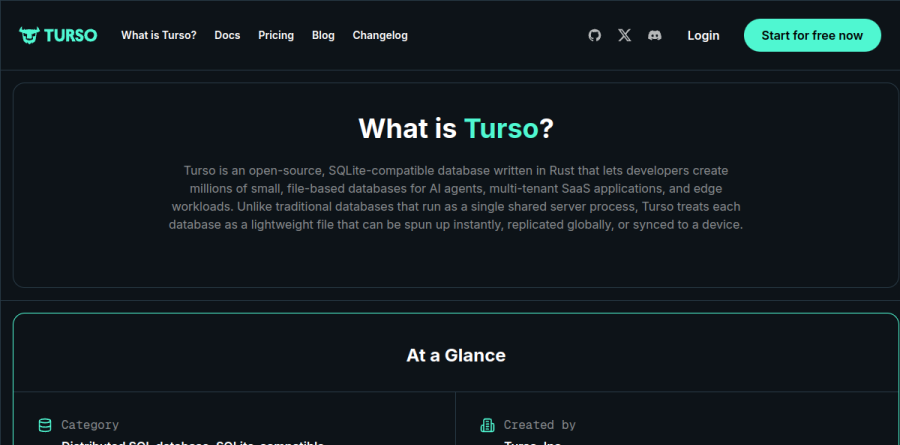
Turso is an open-source, SQLite-compatible database written in Rust, and it is best understood as a ground-up rewrite of the SQLite engine rather than a hosted wrapper around it. The rewrite adds what SQLite historically lacked in server contexts: concurrent writes, native vector search, cloud-native network access, and replication. The design principle stated plainly on the Turso site is that a database is a file, not a long-running server process.
Two product lines carry that idea. The Turso database engine is the open-source, self-hosted piece, currently labeled Beta and aimed at offline, browser, and on-device use. Turso Cloud is the managed service, labeled production ready, offering unlimited databases over the network with syncing built in.
Why the many-database model matters
The central bet is that databases should be cheap enough to multiply. Turso Cloud keeps database files in Amazon S3, split into 128 kB segments, with lazy fetch and replication so a query pulls only the pieces it needs. The Always On card states it directly: databases are files, not processes, so there are no cold starts, no scale-to-zero, and no wake-up penalty, while the Unlimited Databases card adds that an idle database costs only storage. For a multi-tenant SaaS team that inverts the usual calculus, since instead of one shared database with tenant identifiers threaded through every table, you can hand each customer a dedicated file. The vendor reports eleven nines of data durability on the strength of the S3 guarantees underneath.
Vector search and agent memory
Vector Search is built into the engine, and Turso describes it as native similarity search for AI apps and RAG workflows with no extensions required. Paired with unlimited databases, this is the workflow Turso pushes hardest: give every agent its own isolated store for memory and state instead of partitioning one shared index. The site pitches scaling to millions of agents with unlimited databases and built-in vector search for LLMs, and quotes Val Town saying Turso lets it spin up thousands of databases, even for free users. Concurrent writes via MVCC address the classic SQLite single-writer bottleneck, letting multiple writers proceed without locking.
Branching, sync, and the browser
Three capabilities round out day-to-day developer work. Branching creates isolated copy-on-write branches quickly, which suits preview environments and rehearsing migrations against realistic data shapes. Replication and Sync keeps devices aligned on demand through Turso Cloud, the foundation for local-first and offline-capable apps. Browser and Persistence puts the engine itself in the browser via WebAssembly and OPFS, so on-device retrieval-augmented generation becomes viable without a network round trip. Turso also lists change data capture, full text search, and page-level native encryption.
Plan tiers and where the ceilings sit
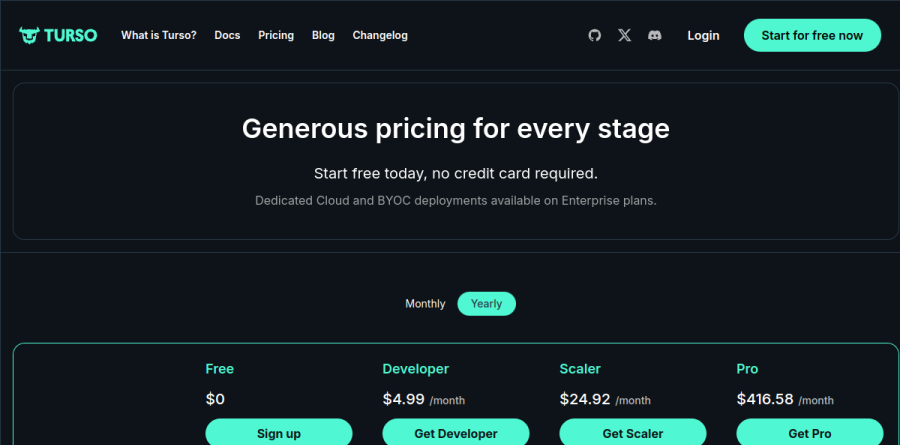
The Free plan costs nothing and needs no credit card, with one hundred databases, community support, a one-day point-in-time restore window, 5 GB of storage, 500M monthly rows read, and 10M rows written. Developer lifts databases to unlimited, extends restore history, and adds a DPA plus IP and AWS VPC allow lists. Scaler introduces Teams and extends audit log retention to fourteen days, though audit logs themselves begin on Developer at three days. Pro is the compliance tier, bundling SSO, BYOK encryption, HIPAA, SOC 2, and priority email and Slack support. Enterprise covers dedicated cloud and BYOC deployments, custom SLAs, and round-the-clock premium support. Developer, Scaler, and Pro each meter storage, rows read, rows written, and syncs with published overage rates, so spend tracks actual usage rather than instance size, while Enterprise is custom-priced with unlimited usage.
Who should choose Turso
Turso fits teams whose data naturally shards by tenant, user, or agent: multi-tenant SaaS products, AI agent platforms that need isolated per-agent state, local-first mobile and desktop apps, and edge services where read latency matters. If you already think in SQLite, the learning curve is short and the Free plan is roomy enough to run a genuine prototype. It is a weaker fit for workloads built around a single large relational dataset with heavy cross-table analytics, where a mature Postgres deployment remains the safer call, and teams that need the standalone embedded engine on stable GA footing should note that it is still labeled Beta, while Turso Cloud is the production-ready half.
Strengths
- Genuinely generous free tier: 100 databases, 5GB, 500M row reads/mo with no cold starts
- Cheapest paid entry point in its class at $4.99/mo (billed yearly)
- Database-per-tenant model with unlimited databases on all paid plans
- Embedded replicas put SQLite in-process for sub-millisecond local reads
Watch out for
- Consumption billing (row reads/writes, storage, syncs) makes costs hard to predict at scale
- Big price jump from Scaler ($24.92) to Pro ($416.58) leaves a gap for mid-size apps
- Cheapest Developer/Scaler pricing requires annual commitment
- Platform is mid-transition: Turso Cloud runs on libSQL while the new Rust engine stays in beta
Key features
| Feature | What it does |
|---|
| Embedded replicas | Sync a full copy of the database into your app process for zero-latency local reads, writes forwarded to primary. |
| Database-per-tenant | Create thousands of isolated SQLite databases cheaply — unlimited on all paid tiers — ideal for multi-tenant SaaS. |
| libSQL foundation | Open-source SQLite fork (open contributions) that powers Turso Cloud today; self-hostable. |
| New Turso engine (beta) | Ground-up Rust rewrite of SQLite adding MVCC concurrent writes, async I/O (io_uring), and built-in vector search. |
| Point-in-time restore | 1 day on Free up to 90 days on Pro, letting you roll a database back to any prior moment. |
| Usage-based overages | Transparent per-unit rates — e.g. $0.75/GB storage and $1/billion row reads on Developer — beyond included quotas. |
How Turso compares
| Alternative | How it differs |
|---|
| Cloudflare D1 | Serverless SQLite native to Cloudflare Workers; tighter edge integration but less generous per-DB model. |
| Neon | Serverless Postgres with branching and scale-to-zero; richer SQL feature set but Postgres, not SQLite. |
| PlanetScale | Serverless MySQL (and now Postgres) with strong scaling; enterprise-grade but pricier and no free-forever tier. |
Frequently asked questions
How much does Turso cost?
Turso has a free tier and three paid plans: Developer at $4.99/mo, Scaler at $24.92/mo, and Pro at $416.58/mo (Developer and Scaler are billed yearly), plus custom Enterprise. Each plan bundles storage, row reads/writes, and sync quotas, then charges usage-based overages such as $0.75/GB storage and $1 per billion row reads on Developer.
Is Turso free?
Yes. Turso's free plan costs $0 and is unusually generous: 100 databases, 5GB storage, 500 million row reads and 10 million row writes per month, 3GB of syncs, and 1-day point-in-time restore. Databases stay warm with no cold starts. It's enough to run real hobby and side projects before you ever need to pay.
Turso vs Cloudflare D1: which is better?
Both are serverless SQLite. Cloudflare D1 wins if you live inside Workers and want one integrated edge platform. Turso wins for its database-per-tenant model (unlimited DBs), embedded in-process replicas for sub-millisecond reads, and a more generous free tier at 500M monthly row reads. Turso also runs outside Cloudflare's ecosystem.
Is Turso the same as SQLite?
Turso Cloud runs on libSQL, an open-source fork of SQLite that's file-compatible and production-ready. Separately, the company is building a brand-new engine (formerly Limbo) — a full SQLite rewrite in Rust adding concurrent writes, async I/O, and vector search — which is in beta in 2026. Your data stays SQLite-compatible throughout.
Is Turso production ready?
The libSQL engine powering Turso Cloud is production-ready and used in live apps today. The new from-scratch Rust engine is still in beta as of 2026, so treat it as forward-looking. For production now, you're on libSQL; the new engine is the long-term direction, not yet a default.
Turso ratings on other platforms
Independent user ratings from third-party review sites, linked here for transparency.
These are not our editorial score, are captured on the date shown, and may have changed since.