Norton 360 Alternatives, Ranked by Who Publishes the Renewal Price
Affiliate disclosure: some links here are affiliate links and we may earn a commission at no cost to you. The order below follows the stated criterion and nothing else; no vendor paid for a position or saw this page before it went up.
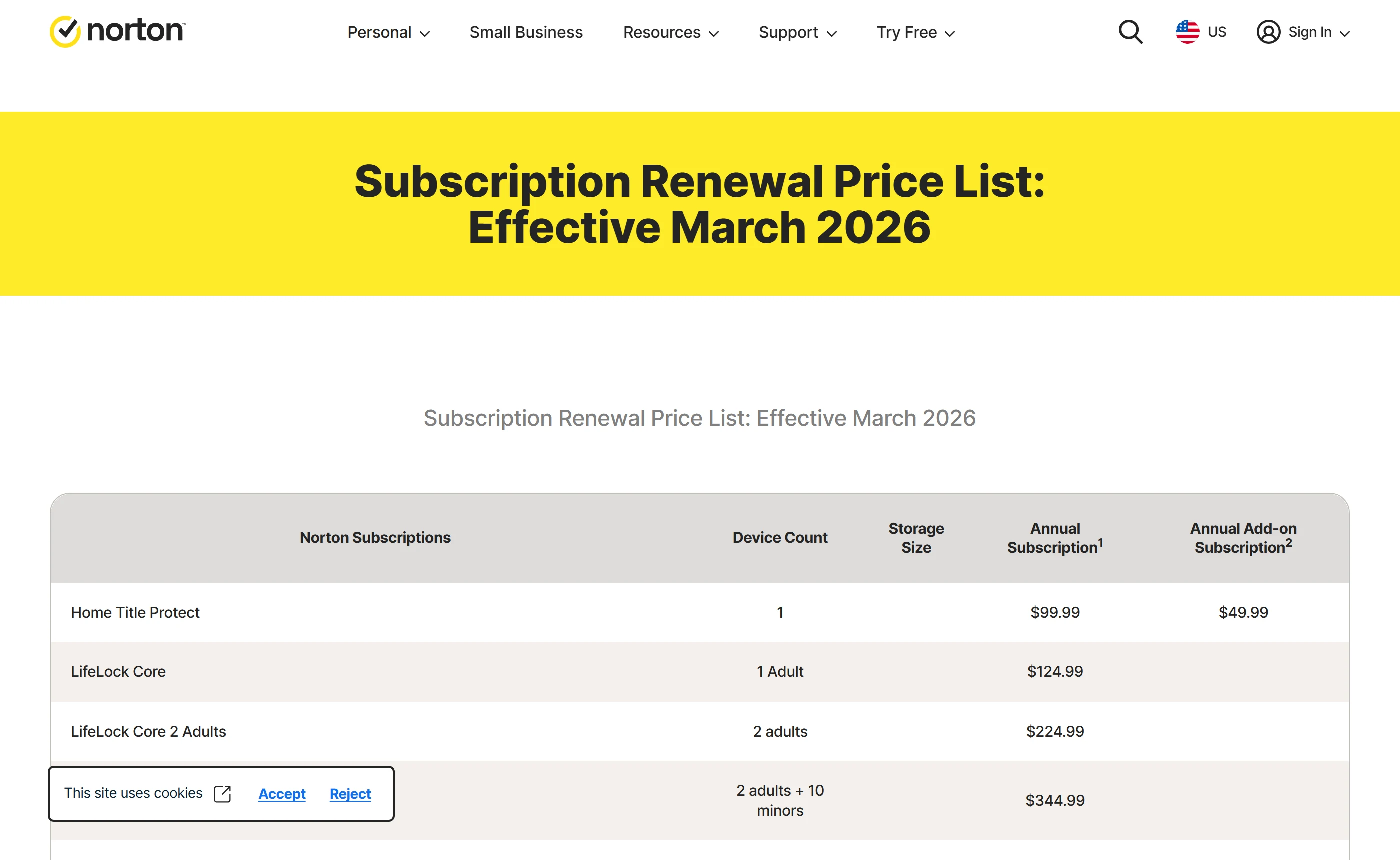
Norton 360 Standard is $39.99 first yr and renews at $94.99/year. Deluxe is $49.99 first yr and renews at $124.99/year. If that second number is why you are reading this, the useful thing to know before switching is that Norton prints it — on its product pages and on a list at us.norton.com/pricing headed “Subscription Renewal Price List: Effective March 2026”. Of the ten alternatives ranked below, four publish a dollar renewal figure you can read before paying: TotalAV, Avira, AVG and Avast. Five publish none at all: ESET, Trend Micro, Sophos, Malwarebytes and Webroot. Bitdefender’s is derivable from a footnote but never stated in words.
So leaving Norton can cost you the number as well as the brand. That is what this ranking measures: whether each vendor tells you what year two costs, and then what the renewal money buys in devices and features. It does not rank on how large the increase is, because a published jump beats a hidden one, and it prints “not published” wherever that is the finding — a price nobody states is a price nobody is bound to. Every figure below was read from the vendors’ own pages on 17 September 2026 and is quoted as it appeared.
What this ranking measures
This page ranks on one thing: whether the vendor publishes, in dollars, on a page anyone can open, what the subscription costs after the introductory term — and then on what that renewal money buys in devices and features. A published increase outranks an unpublished one however steep, which is why the vendor with a 5.2x jump sits at the top and vendors with quieter pricing sit at the bottom. Among the vendors that publish nothing, the tie-break runs the same way: how much of the renewal mechanism is written down anywhere, then devices and features per dollar. What this page deliberately does not measure is detection quality. Nobody installed, subscribed to or ran any of these products; every figure here was read from the vendors’ own pages on 17 September 2026, and independent lab results are mentioned only where the vendor itself cites a dated one. Interface, support and system impact are not scored either. Where a vendor does not publish something the criterion needs, that is recorded as a finding and it costs the vendor position.
The short answer
It is the only vendor here that shows the year-two price on the page where you buy and on a dated rate card — “Subscription renewal rates effective: 05 Jan 2026” — listing annual renewal rates for every plan and add-on, plus monthly rates for all three suites. What it discloses is unflattering: “$19 first year*” for 4 devices becomes “Automatically renews at $99/year”. That is precisely the point of ranking this way. You can decide against a number you can see, and $99/year for 4 devices is within a few dollars of Norton 360 Standard’s $94.99/year for 3.
Both figures sit on the same plan card: “$18.99 / First Year” and “Automatically renews at 44,99 US$ / year, unless the renewal is cancelled.” Prime’s published 76,99 US$ a year covers 5 or 25 devices, the most coverage per published renewal dollar on this page, against Norton 360 Deluxe’s 5 devices at $124.99/year. It misses the top spot because the monthly and 2-year terms carry no renewal figure at all.
The most honest renewal price is no renewal price. Avira states its free product uses “the same scan engine” as Antivirus Pro; what you give up is the firewall, web and email protection on Windows, unlimited VPN (the free cap is 500 MB/month, or 1 GB if you register), dark web monitoring and the Pro mobile apps. Nothing auto-renews, so there is no second-year figure to be surprised by. If you need multi-platform cover, Avast Free Antivirus and AVG AntiVirus FREE run on Windows, Mac, Android and iOS, the AVG one for personal and family use only.
All 10 compared
| # | Product | Best for | Price from | What decides its place | |
|---|---|---|---|---|---|
| 1 | Seeing year two before you hand over a card | “$19 first year*” (TotalAV Plus, 4 devices) — “Automatically renews at $99/year” | $19 first year, then $99/year, both on the buy page | Visit | |
| 2 | Both prices printed on the same plan card | “$18.99 / First Year” (Antivirus Pro, 1 PC / 1 Year), list “44,99 US$ / Year(-58%)” — “Automatically renews at 44,99 US$ / year” | $18.99 first year; card says renews at 44,99 US$ / year | Visit | |
| 3 | Buyers who want the rise announced in advance | “$39.99 /first yr” (Internet Security, 1 Windows PC, struck-through “$77.99”) — renews $77.99/year, rising to $79.99 on 2026-10-08 | Renews $77.99/year, rising to $79.99 on 2026-10-08 | Visit | |
| 4 | A regular yearly price shown on every tier | $49.08/first yr (Avast Premium Security, 1 device; “Save 37%”) — regular $77.99/year | $49.08 first yr against a regular $77.99/year | Visit | |
| 5 | Windows-only users who want a free option | USD 24.99 (Antivirus Plus, “1 account - 1 device”, “First year price. Plus applicable sales tax.”) — struck-through “$49.99” | No renewal in words; $49.99 is the crossed-out old price | Visit | |
| 6 | Renewal mechanics published, though never a price | $37.49 /first year (Webroot Essentials, 1 Device) — regular $49.99, marked “Save 25%” | 70-day refund, and no renewal price on any page | Visit | |
| 7 | A low 12-month entry with no coupon code needed | $29.95 (Antivirus+ Security, 12 months, 1 device) — RRP: $42.95, SAVE $13.00 | $29.95 for 12 months, renewal price never stated | Visit | |
| 8 | A priced ladder from 1 to 5 devices, renewal unstated | $49.99 (HOME Security Essential, 1 DEVICE / 1 YEAR); $59.99 at the store default of 3 DEVICES / 1 YEAR | Pages say only: price valid for the first term only | Visit | |
| 9 | Cleaning up a PC that is already infected | “Starts from US$59.99/yr.” (Standard, 3 devices); US$44.99/yr. for a single device | Plans priced “Starts from”; no renewal figure at all | Visit | |
| 10 | Ten computers on one flat licence | VND 1,349,250 (Sophos Home Premium, 1 Year, VAT-inclusive; strikethrough VND 1,799,000) — no USD figure shown | Renewal price emailed 30 days ahead, never published | Visit |
1. TotalAV
Why it sits at 1 $19 first year, then $99/year, both on the buy page
TotalAV prints year two beside year one on the page where you buy. Plus is $19 first year for 4 devices and “Automatically renews at $99/year”. Internet Security is $49 first year for 6 devices, renewing at $129/year and adding a VPN. Total Security is $69 first year for 8 devices, renewing at $149/year. A separate page headed “Subscription renewal rates effective: 05 Jan 2026” lists annual renewal rates for every plan and add-on, plus monthly rates for all three suites and quarterly and biannual rates for Plus.
It leads on disclosure, not on price. The figure it publishes is a 5.2x jump on Plus, and $99/year for 4 devices sits right beside Norton 360 Standard’s $94.99/year for 3. TotalAV also ships a free downloadable antivirus but publishes no free-versus-paid feature table anywhere on its site, so what the free version withholds is undocumented. Refunds run 30 days on annual and biannual plans, 14 days on monthly, quarterly and add-ons.
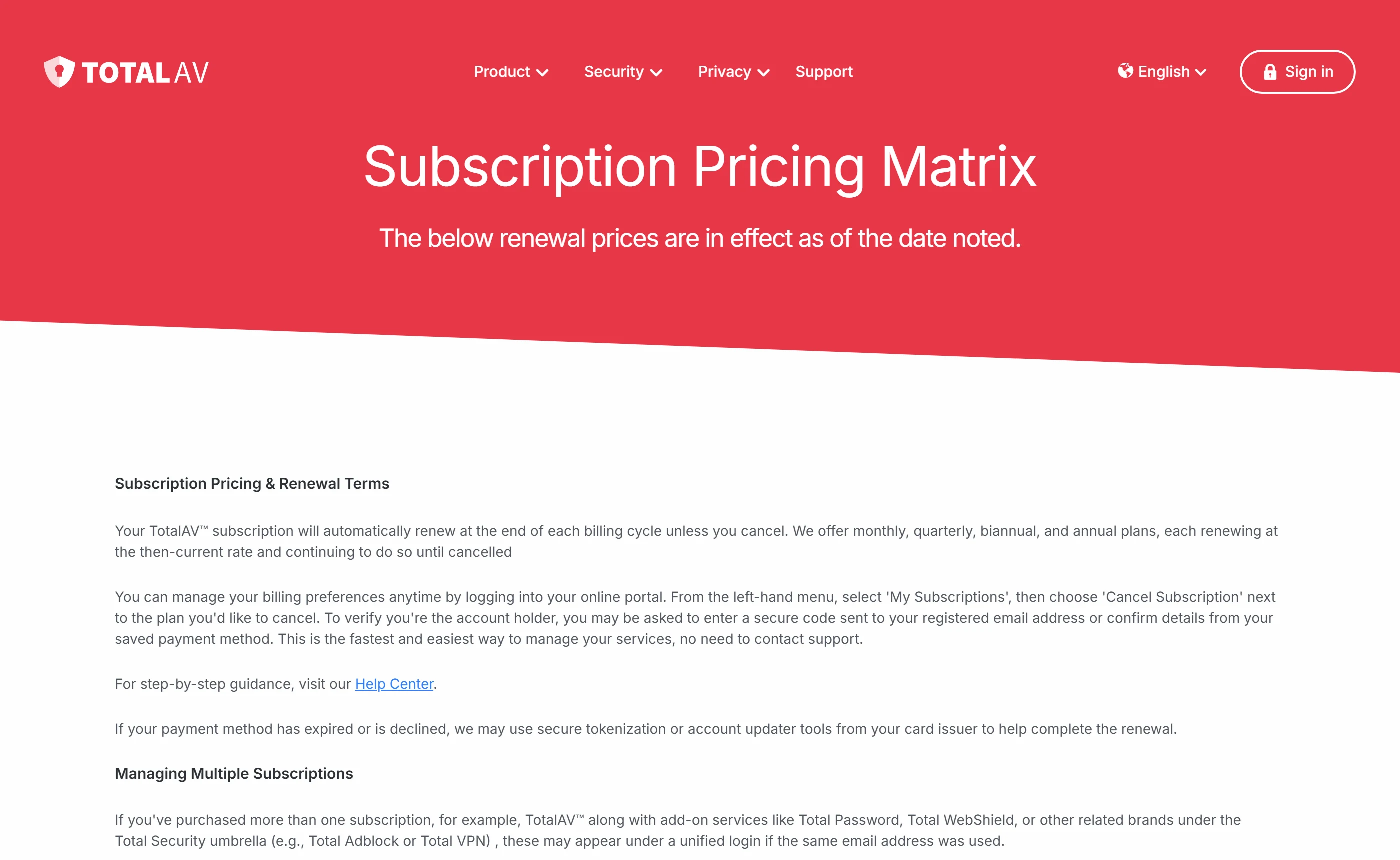
- Renewal rates published twice — inline next to the promotional price, and on a dated rate card listing annual renewal rates for every plan and add-on, plus monthly rates for all three suites and quarterly and biannual rates for Plus.
- The renewal is 5.2x the first-year price, and TotalAV’s own /pricing page shows only the $99, $129 and $149 annual rates with no promotional price, so the two numbers a buyer needs to compare sit on different pages.
2. Avira
Why it sits at 2 $18.99 first year; card says renews at 44,99 US$ / year
Avira puts both numbers on the same card. Antivirus Pro is “$18.99 / First Year” against a list of “44,99 US$ / Year(-58%)”, and the card states: “Automatically renews at 44,99 US$ / year, unless the renewal is cancelled. Price subject to change.” Internet Security is $24.99 first year renewing at 49,99 US$ a year. Prime is $41.99 first year renewing at 76,99 US$ a year for 5 or 25 devices, with unlimited VPN and all the Pro mobile apps.
That makes Prime the most coverage per published renewal dollar here: 25 devices for 76,99 US$ a year, against Norton 360 Deluxe’s 5 devices at $124.99/year. Two gaps keep it off the top. No renewal figure is published for the monthly term (3,99 US$) or the 2-year terms, and the standalone Pro products say only that they renew, with no amount. Avira’s newest dated lab result is an AV-Comparatives Real-World Protection award from June 2022.
- The renewal amount is stated in words on the plan card itself for all three annual bundles — 44,99, 49,99 and 76,99 US$ a year — so both prices are visible in one place.
- The monthly plan at 3,99 US$ and the 2-year terms at 77,99, 87,99 and 142,99 US$ carry no renewal figure at all, and the standalone Pro products say only “Automatically renews, unless the renewal is cancelled. Price subject to change.”
3. AVG
Why it sits at 3 Renews $77.99/year, rising to $79.99 on 2026-10-08
AVG is the only vendor here that publishes what its renewals are about to become. A price-change table effective 8 October 2026 lists Internet Security for 1 PC moving from $77.99 to $79.99 a year, the 10-device version from $99.99 to $109.99, and Ultimate for 1 PC from $109.99 to $119.99. Buy cards repeat the figure inline as “Savings compared to renewal price $77.99/year”. On the criterion’s primary test, nobody discloses more.
What keeps it behind Avira is what the published renewal buys. Internet Security renews at $77.99/year for one Windows PC and $99.99/year for 10 devices, while Avira Prime’s published 76,99 US$ a year covers 5 or 25 devices — more devices per renewal dollar. The disclosure has a hole in it, too: the Ultimate configuration actually sold, 10 devices at a renewal of $149.99/year, has no row in the price-change table, which lists Ultimate only for 1 PC. Internet Security for one Windows PC showed “$39.99 /first yr” against a struck-through “$77.99”, but the Ultimate store card renders only “Save 60%” with no dollar figure. AVG AntiVirus FREE covers Windows, Mac, Android and iOS, restricted to personal and family use. Refunds are 30 days, direct purchases only.
- The only published table here that names both the current renewal price and the higher price replacing it, with the date it takes effect.
- The first-year price is unreadable for parts of the range — the store advertises only “Save 40%” and “Save 60%” with no dollar figure — and AVG reserves the right to charge “the then current published price”, debiting the card up to 35 days before the anniversary.
4. Avast
Why it sits at 4 $49.08 first yr against a regular $77.99/year
Every Avast antivirus tier shows a regular annual price beside the first-year price: Premium Security at $49.08/first yr against $77.99/year for one device, and $69.48/first yr against $99.99/year for ten. Ultimate is $49.08/first yr against $109.99/year. The 30-day money-back guarantee applies to renewals as well as first purchases — a refund can be requested within 30 days of the subscription anniversary, which is rarer than it sounds.
Two things cost it position. Subscription Details says the next period is charged “at the then current published price”, so the struck-through figure is indicative rather than committed. And the same $49.08 buys either a $77.99/year renewal or a $109.99/year one depending on which box you tick. Avast Free Antivirus is real and covers four platforms; the firewall, webcam shield, file shredder, password vault and deepfake video detection are Premium-only.
- A regular annual figure is displayed on every antivirus tier, and the 30-day refund window covers the renewal anniversary, not only the first purchase.
- Avast Ultimate carries the same $49.08 first-year price as Premium Security for one device but renews at $109.99/year instead of $77.99 — and there is no licence size between 1 device and 10, so a three-device household overbuys either way.
5. Bitdefender
Why it sits at 5 No renewal in words; $49.99 is the crossed-out old price
Bitdefender’s entry is Antivirus Plus at USD 24.99 for one device, marked “First year price”, beside a struck-through “$49.99”. No page calls that figure a renewal. The footnote defining the discount does: it “describes the difference between the first term and renewal term subscription prices”. By the vendor’s own definition the crossed-out numbers are year two — Total Security Individual at USD 109.99/yr, Premium Security Individual at USD 129.99/yr, Ultimate Security Individual at USD 159.99/yr.
Derivable is not published, which is why it ranks below the four vendors that print the number and above the five that print nothing. The prose promises only that renewal “may be higher than the initial purchase price”. Bitdefender Antivirus Free never expires, but it is Windows-only, one device, and is not mentioned or linked anywhere on the consumer hub page. VPN traffic is capped at 200 MB/day/device until you reach Premium Security.
- The 30-day money-back window runs from the automatic renewal date as well as the initial purchase, and a separate 30-day trial is offered before buying at all.
- No Bitdefender page states a renewal amount in words, so a buyer has to read a footnote’s definition of “discount” to work out year two — and the monthly figures on the Ultimate Security pages are injected by script and did not render at all.
6. Webroot
Why it sits at 6 70-day refund, and no renewal price on any page
Webroot Essentials is $37.49 /first year for one device against a regular $49.99, rising to $52.49 for 3 devices and $67.49 for 5. Premium is $90.99 /first year against a regular $129.99 for 5 devices plus one identity, and Total Protection is $107.99 /first year against $179.99. Webroot describes the higher figures as list prices, not renewal prices, and publishes no renewal rate on any plan page, the compare page or the list-price page.
It still leads the four vendors below it on the criterion, because the mechanics are at least written down. The Consumer Terms PDF reached through the footer states at §12.5 that the card on file is charged recurring renewal fees unless auto-renewal is cancelled, and reserves the right “to increase Fees in its discretion prior to any renewal Subscription Term” — and every plan carries a single list price beside the first-year one, the nearest thing to a renewal anchor Webroot offers, even though it never commits to it. The fallback is the 70-day money-back guarantee, the longest on this page, published only on a separate refund page a buyer reading the price never sees, though that form does list “Auto Renewal charge” as a refund reason.
- A 70-day money-back guarantee across the entire consumer range, with auto-renewal charges named as an accepted refund reason on the vendor’s own form.
- No renewal price and no auto-renewal fine print appear on any pricing, compare or product page; the terms that permit a price increase are in a PDF several clicks into the legal section, and the 70-day window is never shown next to a price.
7. Trend Micro Security
Why it sits at 7 $29.95 for 12 months, renewal price never stated
Antivirus+ Security is $29.95 for 12 months on one device against an RRP of $42.95, with a 2-year term at $59.95. Above it, Internet Security ($39.95, 3 devices), Maximum Security ($54.95, 5 devices) and Premium Security Suite ($99.95, 10 devices) only reach those prices with coupon codes typed at checkout, sitting above a separate higher “Regular” price and a higher RRP again.
Every page carries the same sentence and no number: “Your subscription renews each year at the then-current subscription renewal price. Pricing is subject to change.” With three price levels on screen for those coupon tiers, the vendor never says which one you renew at — and that is what puts it below Webroot on the criterion, where one struck-through list price is at least a single anchor rather than three unexplained ones. What the money buys climbs by tier: 1 device on Antivirus+, 3 on Internet Security, 5 on Maximum Security, 10 on Premium Security Suite. There is no free suite tier, only a 30-day Antivirus+ trial whose device count and card requirement are unstated, and the newest lab result Trend Micro cites for itself is dated 2020.
- A 2-year Antivirus+ term at $59.95 works out under $30 a year for the first term, the 1-year entry is $29.95 for a single device, and Antivirus+ is the one tier that reaches its advertised price with no coupon code.
- Three of the four tiers advertise prices only reachable with codes LDSALE or LDPSS, above a separate “Regular” price and an RRP, and the vendor never explains which of those levels the renewal is billed at.
8. ESET HOME Security
Why it sits at 8 Pages say only: price valid for the first term only
ESET HOME Security Essential is $49.99 with the store configurator set to one device for one year, and $59.99 at its default of three devices. Premium is $89.99 and Ultimate $179.99 at their defaults, with “Save 15% with 2 years” offered on the lower two. The store says only “Price valid for the first term only”, and its tooltip measures any saving against an “official list price” that is never printed anywhere on the site.
That missing list price is what drops it below Trend Micro: neither publishes a renewal figure, but Trend Micro at least prints an RRP next to the price you pay, while ESET leaves no anchor of any kind. Auto-renew runs continuously unless you switch it off after purchase, and every “RENEW” or “Manage autorenewal” link resolves to a sign-in wall, so the number stays unreadable even if you follow ESET’s own route to it. What ESET does price is every device count from 1 to 5 — the 15-device Family Protection Pack is advertised at 35% off and never given a figure. The trial is the unambiguous good: 30 days, no credit card, and “no automatic charges when the trial ends”. Refunds run 30 days for the full purchase price.
- The 30-day trial takes no payment details and does not convert to a paid subscription when it expires — the opposite of Norton’s 7-day trial, which requires a card and charges at the end unless cancelled.
- No renewal price appears on the store, plans or trial pages, auto-renew is on by default, and the Family Protection Pack advertised at 35% off for 15 devices never renders a price at all.
9. Malwarebytes
Why it sits at 9 Plans priced “Starts from”; no renewal figure at all
Malwarebytes prices its plans “Starts from”: Standard at US$59.99/yr. for 3 devices, Plus at US$79.98/yr. adding a VPN, and Total at US$179.99/yr. struck to US$89.99/yr. under a “Save 50% today” flag, covering 3 devices plus one adult’s identity with $1M insurance. A single device is US$44.99/yr., listed with no “Starts from” label and no struck-through comparison. No renewal figure appears anywhere on the pricing page, and unusually there is no asterisk or footnote disclaimer on it either.
So a struck-through US$179.99 sits on the page with nothing stating whether that is what year two costs. It ranks below ESET for publishing less, not for charging more: both withhold the renewal figure, but ESET prints a first-term disclaimer and prices its whole 1-to-5-device ladder, while Malwarebytes carries no disclaimer at all and leaves part of its range unpriced. The free tier is remediation rather than protection — the vendor says Free “is a cleanup tool for cyberattacks that have already damaged a device” while Premium stops them happening. The mobile apps include seven days of Premium; no desktop trial length is published. Refunds are 60 days on annual plans, matching Norton.
- A 60-day money-back guarantee stated at the top of the pricing page, and the most recent self-cited lab result of any alternative on this page: AV-TEST Top Product at 17.5 out of 18 from a Windows consumer test run in March and April 2026.
- The pricing page carries no renewal figure and no disclaimer whatsoever, and both the Family and the Small business price cards failed to render, so neither of those tabs produces a price at all.
10. Sophos Home Premium
Why it sits at 10 Renewal price emailed 30 days ahead, never published
Sophos sells one consumer product and three term lengths: VND 1,349,250 for a year against a strikethrough of VND 1,799,000, VND 2,249,250 for two years and VND 3,224,250 for three. The checkout served this session Vietnamese dong and displayed no US dollar figure, so there is no US price to print here. One subscription covers up to 10 Windows and Mac computers plus unlimited iOS and Android devices, with no feature tiers to choose between.
On the criterion it finishes last. There is no renewal figure anywhere, only a checkout promise that after 12 months you renew “at the then current renewal price” with an email 30 days in advance — and that sentence is attached to the 1-year term alone, with no equivalent for the 2-year or 3-year options, so two of the three terms have no renewal statement at all. There is no free tier, and the 30-day trial is capped at 3 Windows and macOS devices rather than 10.
- No tier ladder to decode: one product covering up to 10 Windows and Mac computers plus unlimited mobile devices, so the only decision is term length.
- The buy page never states a renewal amount, never restates the 10-device limit and never repeats the 30-day money-back guarantee shown on the marketing pages — and it showed no USD price at all, so a US buyer cannot read what they would pay.
Which one fits your situation
TotalAV Plus at “$19 first year*” for 4 devices, with “Automatically renews at $99/year” already printed in front of you. TotalAV says renewal notice is given at least 15 days prior and the refund window is 30 days on annual plans. Put both dates in a calendar the day you buy, because the renewal is 5.2x the entry price.
The free tier is enough. Avira states its free product offers “the same powerful real-time antivirus protection as Avira Antivirus Pro since both solutions use the same scan engine”; the free VPN is capped at 500 MB/month, or 1 GB if you register. Bitdefender Antivirus Free never expires but is Windows-only and one device. Neither has a renewal price because neither renews.
Avira Prime: $41.99 for the first year, renewing at a published 76,99 US$ a year for 5 or 25 devices. That is the most devices per published renewal dollar here. For comparison, Norton 360 Deluxe covers 5 devices and renews at $124.99/year, and Avast offers no licence size between 1 device and 10.
Do not buy anything yet from this list. Bitdefender Ultimate Security Plus, Malwarebytes Total, ESET HOME Security Ultimate and Trend Micro Premium Security Suite all bundle $1M identity cover, and none of the four publishes a dollar renewal price. Norton’s LifeLock tiers do publish theirs — $189.99, $259.99 and $364.99 a year — so switching for identity cover means trading a number you can read for one you cannot.
ESET HOME Security: 30 days, no credit card, and “no automatic charges when the trial ends”. AVG also offers a 30-day Internet Security trial with no credit card needed. Avoid assuming the same of the others — Norton’s 7-day trial takes a card and charges at the end unless cancelled, and Webroot’s trial page says “No credit card required” while its Consumer Terms reserve the right to demand one.
Malwarebytes Free, which the vendor itself describes as “a cleanup tool for cyberattacks that have already damaged a device” while Premium “stops these attacks from happening in the first place”. Buy nothing until the machine is clean. A subscription bought during an incident renews at a price five of these ten vendors do not publish anywhere.
What this market gets people for
- Reading a per-month figure as a monthly bill. Norton 360 Deluxe displays “$4.17 /month” but is $49.99 first yr and renews at $124.99/year — that is an annual charge divided up, not a monthly plan. Avast’s “$4.09/month” beside $49.08/first yr works the same way. Norton 360 for Gamers is the only tier here that publishes a true monthly price, $7.99/mo. first year renewing to $9.99/month.
- Treating every crossed-out price as the renewal price. At Bitdefender it effectively is one: the auto-renewal terms define a discount as “the difference between the first term and renewal term subscription prices”. At Webroot it is not — the vendor calls those figures list prices and publishes no renewal rate anywhere. At Malwarebytes, Total shows US$179.99/yr. struck through to US$89.99/yr. under “Save 50% today” with no renewal statement and no footnote on the pricing page at all.
- Taking the bigger bundle because year one costs the same. Avast Ultimate for one device and Avast Premium Security for one device are both $49.08/first yr. Ultimate renews at $109.99/year and Premium Security at $77.99/year, so an identical first-year price buys a renewal $32 higher — the steepest first-year-to-renewal gap in Avast’s range.
- Assuming a free trial cannot charge you. Norton’s 7-day trial requires a payment method at sign-up and is charged at the end unless cancelled first. Avast’s 60-day SecureLine VPN trial for free users also requires payment details and auto-bills. Webroot’s trial page says “No credit card required” while its Consumer Terms §12.2 reserves the right to require a card and charge “immediately after the expiration of the trial period”. ESET is the exception: no card, and “no automatic charges when the trial ends”.
Questions buyers ask
Does Norton actually publish its renewal price?
For almost everything it sells, yes. Product pages state a “renewal price of $94.99/year” for 360 Standard, $124.99/year for Deluxe, $119.99/year for Gamers, and $189.99, $259.99 and $364.99 a year for the three LifeLock tiers, with a full list at us.norton.com/pricing headed “Subscription Renewal Price List: Effective March 2026”. The exception is the Norton 360 Premium page, which renders “Savings compared to the renewal price of {ar}/year” — an unfilled template placeholder instead of a number.
Which alternatives publish a renewal price in dollars?
Four of the ten. TotalAV states “Automatically renews at $99/year” inline and runs a dated rate card; Avira prints “Automatically renews at 44,99 US$ / year” on the plan card; AVG publishes a renewal table including a scheduled rise on 8 October 2026; Avast shows a regular annual price such as $77.99/year beside each first-year price. Bitdefender’s renewal is derivable from its crossed-out prices but never stated. ESET, Trend Micro, Sophos, Malwarebytes and Webroot publish no renewal figure at all.
Is there a genuinely free antivirus, or is it all trials?
Six of the ten ship something free rather than a trial, and they are not all the same kind of thing. Four are full free antivirus products: Bitdefender Antivirus Free never expires but is Windows-only and one device; Avast Free Antivirus covers Windows, Mac, Android and iOS; AVG AntiVirus FREE covers the same four platforms but is “For personal and family use only. Not for business or commercial use.”; and Avira Free Security is free on Windows and Mac with a 500 MB/month VPN cap. TotalAV ships a free downloadable antivirus marketed as a product, but publishes no free-versus-paid feature table, so what it withholds is undocumented. Malwarebytes Free is the exception in kind: remediation after infection, not ongoing protection. Norton 360, ESET HOME Security, the Trend Micro suites, Sophos and Webroot have no free tier at all.
How long do I have to get my money back?
Webroot publishes the longest at 70 days across its consumer range, though only on a separate refund page. Norton and Malwarebytes give 60 days on annual plans (Norton drops to 14 days on monthly). Avira gives 60 days on annual plans plus a pro-rated refund on annual renewal payments; its subscription terms also state 14 days for monthly, though no monthly window appears on the plan cards. Bitdefender, Avast, AVG, ESET, Trend Micro and Sophos state 30 days. Bitdefender’s and Avast’s windows also run from the renewal date, not just the first purchase.
Can I pay monthly instead of a year up front?
Rarely, and the published monthly figures are thin. Norton 360 for Gamers is the one Norton tier with a real monthly plan at $7.99/mo. first year renewing to $9.99/month. Avira Antivirus Pro is 3,99 US$ for one month, but no renewal figure is published for monthly terms. TotalAV’s matrix lists monthly renewal rates of $11 and $11.99. Avast publishes monthly billing only for Secure Identity and Secure Browser PRO. ESET, Trend Micro, Webroot, Sophos, AVG and Malwarebytes show annual terms only.
Do these vendors back their claims with dated independent lab results?
It varies sharply, and often not on the page where you pay. Norton cites AV-Comparatives Advanced+ from June 2026; Malwarebytes cites an AV-TEST Top Product score of 17.5 out of 18 from a March–April 2026 Windows test; TotalAV cites AV-TEST from February 2026; Avast cites AV-Comparatives Top-Rated for 2025. Bitdefender’s dated citations appear only in its blog, not on product or pricing pages. AVG’s newest dated citations are January 2024, Avira’s is June 2022, Trend Micro’s is 2020. ESET cites none for its consumer suites, Sophos cites no lab at all, and Webroot’s only lab citation is a PassMark performance study from 30 October 2025.
What none of them publish
These are the questions a buyer would want settled that no vendor on this page answers in public. If one of them decides your purchase, ask the vendor and hold them to the answer.
- What Bitdefender, ESET, Trend Micro, Sophos, Webroot and Malwarebytes charge in year two, in dollars. None publishes a renewal figure on any page a buyer can open before purchase.
- Norton 360 Premium’s renewal price at the point of sale — the product page renders “Savings compared to the renewal price of {ar}/year”, an unfilled placeholder, and the renewal list carries only differently-named Premium I, Premium II and Premium Plus SKUs.
- Avira’s renewal figures for its monthly (3,99 US$) and 2-year terms, and for the standalone Pro products, which say only that they renew.
- AVG’s first-year price for Ultimate — the store card shows only “Save 60%” — and the renewal for the Ultimate 10-device configuration actually sold, which is absent from the price-change table.
- Whether any vendor caps how far a renewal can rise. Nobody here publishes a price lock or multi-year rate guarantee, and Avast, AVG and Webroot all reserve the right to charge whatever price is current at renewal.
- What TotalAV’s free antivirus actually withholds — the vendor publishes no free-versus-paid feature table and states no trial length for its real-time protection.
- ESET’s “official list price”, the figure its savings claims are measured against, and the Family Protection Pack price for 15 devices.
- Whether Trend Micro’s promotional price renews at the “Regular” price or the RRP — three price levels are displayed on the coupon tiers and the relationship between them at renewal is never explained.
- Malwarebytes Family and Small business prices, and whether its 60-day money-back guarantee applies to renewals as well as first purchases.
- A US dollar price for Sophos Home Premium, and any renewal statement for its 2-year and 3-year terms.
- Monthly billing amounts for Bitdefender Ultimate Security and Ultimate Security Plus — the toggles render but the figures are script-injected and did not appear.
- Whether Bitdefender’s 30-day free trial requires a payment method up front, and how long the Malwarebytes desktop trial lasts.
Reading this from the other direction? Antivirus That Does Not Slow Down Your Computer: What Vendors Publish covers the same market against a different rule.