NotebookLM Alternatives, Ranked by Source Grounding
Affiliate disclosure: some links here are affiliate links and we may earn a commission at no cost to you. The order below follows the stated criterion and nothing else; no vendor paid for a position or saw this page before it went up.
Two limits usually send people looking. Fifty sources is not enough for the review you are writing, or the citations point only at the files you uploaded when you wanted them pointing at published papers. Before paying anyone, price what you are leaving. The product is now called Gemini Notebook — notebooklm.google redirects to notebook.google — and its free tier gives 100 notebooks per user, 50 sources per notebook, 50 chat queries a day, three audio and three video overviews a day, and 500,000 words or 200MB per uploaded file, for the price of a Gmail account.
The short answer is that nothing below matches that shape for nothing. The closest is Elicit’s free Basic plan, which searches more than 138 million papers, chats with them at full text and shows the sources behind an answer without a card — but publishes no number for what its free ceiling actually is. Everything here is ranked on one axis: how well each vendor’s own published pages let you predict whether an answer will land on a source you can open. Every figure was read on a vendor page on 2026-09-17.
What this ranking measures
Three things, in this order: how many of your own documents you can put in, whether an answer lands on a passage you can open rather than a paper you still have to go and find, and what the free tier caps. The free-tier clause carries real weight here because the incumbent charges nothing, so a paid rival has to earn the gap rather than assume it. Deliberately not measured: interface quality, speed, writing style, mobile apps, integrations, collaboration features and security posture. Nobody installed, subscribed to or ran any of these products — this is a comparison of published information, and where a vendor does not publish something the criterion needs, that costs it position rather than leaving a blank. Two shortlisted products were cut under the same rule: Google Gemini and Microsoft Copilot ground answers on ranked web results, publish no paper corpus figure at all, and Google states outright that citations are not guaranteed on every answer.
The short answer
It is the only product here that takes your own papers, chats with them at full text, shows the sources behind an answer and searches more than 138 million papers, all without a card. Sentence-level citation is the claim, and the vendor acknowledges hallucination instead of denying it, saying it biases toward silence over an incorrect answer. It leads despite publishing no number for its free ceiling, because the rivals that do publish a number publish smaller ones: 10 Pro messages a month, 5 graphs a month, or 25 MCP credits with no Assistant access at all.
Its answers carry citations linked to specific sections of the source PDF, which is exactly the behaviour someone leaving NotebookLM is trying to keep, and Chat with PDF is free with a published ceiling of Max. 100 MB per file. It loses first place on transparency: the pricing page shows no Free plan card at all and publishes no free credit allowance, while every paid tier states one, so you cannot tell what free gets you before signing up.
It costs nothing, has no paid tier and no pricing page to be routed through, and no account is needed to read papers. Ask This Paper returns supporting statements pulled from the paper you are reading, matched back to its text. Accept the qualifications the vendor itself prints: the feature is under development, covers a subset of papers, and there is no upload of your own files. If you want the cheapest paid figure on this list instead, it is Connected Papers Academic at USD3/month* — “*billed 36 USD annually” — but that buys graphs, not answers.
All 10 compared
| # | Product | Best for | Price from | What decides its place | |
|---|---|---|---|---|---|
| 1 | Uploaded PDFs plus a 138M-paper search, free | Basic: Free. Plus (Academic view): $19 — “Per user/month, billed monthly”. Pro (Industry view): $49 — “Per user/month, billed as $588 annually”, or $75 — “Per user/month, billed monthly”. | Free Basic: unlimited full-text chat with papers, sources shown | Visit | |
| 2 | Chatting with your own PDFs, cited by section | Premium: $12 /month billed annually (a struck-through $20 is shown beside it), or $20 /month billed monthly. Advanced: $70 /month billed annually, or $90 /month billed monthly. | Free Chat with PDF; only published cap is Max. 100 MB per file | Visit | |
| 3 | Free limits you can actually count | Free: $0/mo. Pro: $12/mo shown with “$144 annually” when the Annual switch is on, or $20/mo on the Monthly switch. Deep: $45/mo with “$540 annually”, or $65/mo monthly. | Free: 10 Pro messages per month, up to 3 Deep reviews per month | Visit | |
| 4 | Checking a claim at the exact sentence | Connect: Free. Basic: $20 / month Billed yearly (page shows “Save $96”). Pro: $50 / month Billed yearly (shows “Save $120”). | Free Connect tier states: “No Assistant or Search access” | Visit | |
| 5 | Reading papers at zero cost, forever | Free — no paid tier and no pricing page exists on the site. The Academic Graph and Datasets API is free with or without a key. | 238,070,551 papers, $0, and no upload feature at all | Visit | |
| 6 | Mapping a field without any generated text | Free: “$0, Forever!”. ResearchRabbit+ annual: $10* per month, stated in the help centre as “$120 USD / year (saving 20%)”. RR+ monthly: $12.5* per month. | Free: 50 seed articles per search; RR+ raises it to 300 | Visit | |
| 7 | Mixed document work, not literature search | Free: $0. Pro: $17 / Per month with annual subscription discount ($200 billed up front), or $20 if billed monthly. Max: From $100 / Per month. | Free: Projects capped at 5; no fixed message count published | Visit | |
| 8 | Developers building their own research tool | Starter: Free ($20 credits on sign-up with $10 credits every month, no payment method required). Search: $7 / 1k requests. Contents: $1 / 1k pages. Answer: $5 / 1k requests. Deep Search: $12–15 / 1k requests. | Free Starter: $20 credits at sign-up, then $10 every month | Visit | |
| 9 | Finding neighbours of one seed paper | Free: USD0. Academic (annual): USD3/month* — “*billed 36 USD annually”. Academic (quarterly): USD5/month* — “*billed 15 USD quarterly”. Business (annual): USD10/month* — “*billed 120 USD annually”. | Free: 5 graphs per month, all features included | Visit | |
| 10 | Fact-checking single claims with quotes | Free: “100 credits/day, automatically”. Team: $30 US Dollars / month, per seat, “Between 2 and 150 users”. Plus and Pro: not published on any public page. Enterprise: Contact for pricing. | Free uploads capped at 500 MB; Plus and Pro prices behind login | Visit |
1. Elicit
Why it sits at 1 Free Basic: unlimited full-text chat with papers, sources shown
Elicit searches literature and reads your own papers. The free Basic plan carries what this ranking asks for: unlimited search across more than 138 million papers, unlimited summaries, unlimited chat with papers with full-text access, Zotero import, and “View sources for answers” — citations are not paywalled. The claim is sentence-level citation back to the underlying sources, and the vendor acknowledges hallucination directly rather than promising it away.
The cost is that the free ceiling is a phrase, not a figure. The plan reads “Limited usage for Research Agent and Research Reports”, and the help centre expands that only to a single shared monthly pool that does not roll over. Paid entry also depends on which audience button you press: Academic shows Plus at $19 per user/month billed monthly, while Industry hides Plus entirely and starts at Pro. Elicit also warns its grounding stops short of judging study quality — weak and strong studies get summarised alike.
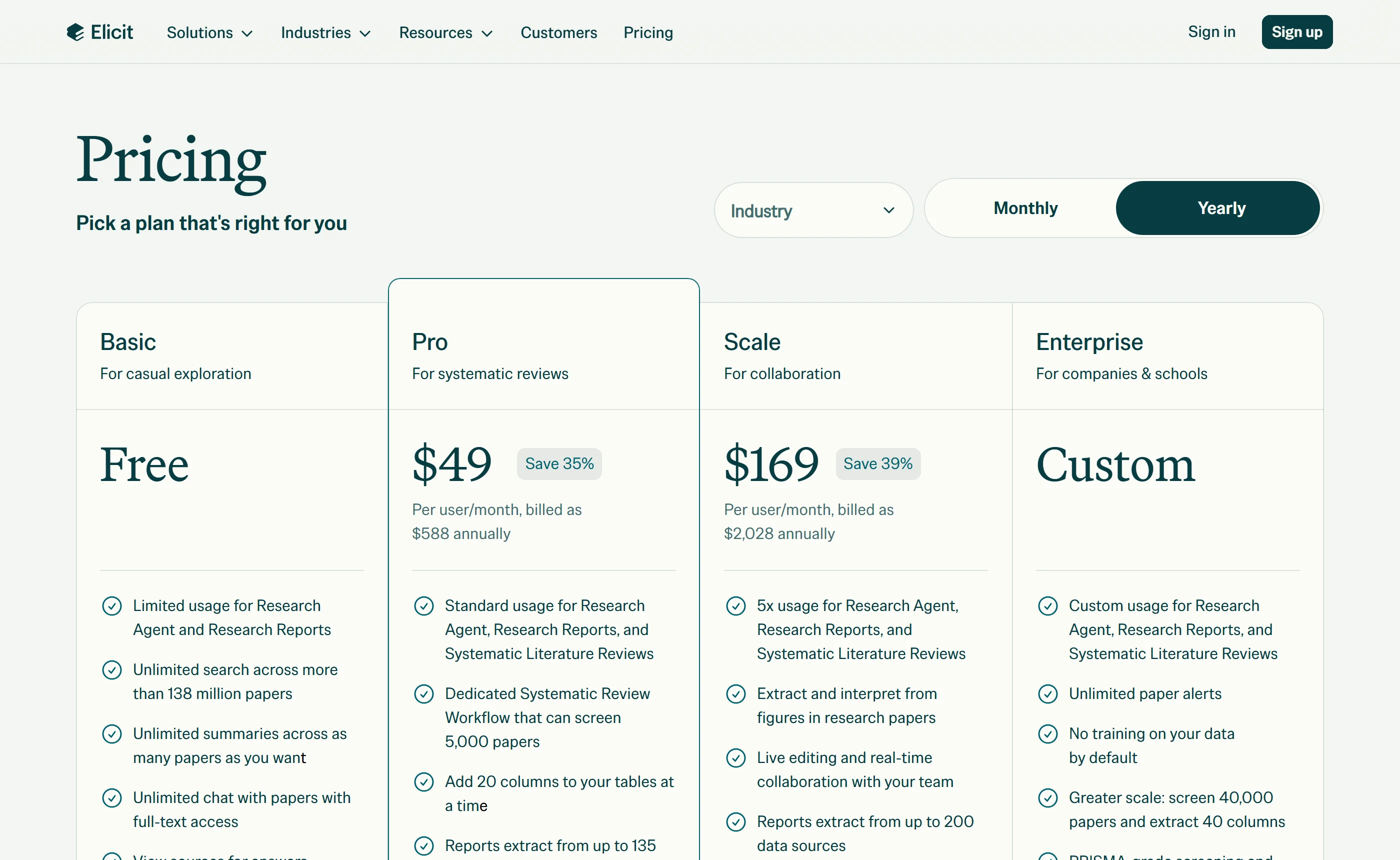
- The free tier includes viewing sources behind answers, so grounding is not the thing you pay to unlock.
- No numeric free-tier limit exists anywhere: not runs, queries, uploads or sources — only the words “Limited usage”. Elicit also publishes no money-back window and states it does not issue partial refunds for unused subscription time.
2. SciSpace
Why it sits at 2 Free Chat with PDF; only published cap is Max. 100 MB per file
SciSpace is the closest thing here to what NotebookLM does with a folder of PDFs. Chat with PDF is advertised as free, and the vendor states that answers carry citations linked to specific sections of the source PDF — passage-level, inside a document you supplied. Literature search sits on a corpus it sizes at over 200 million records, and paid plans widen coverage to three named external indexes the free tier does not reach.
What it will not tell you is what free actually allows. The pricing page shows no Free plan card at all — only Premium, Advanced, Max and an application-only Enterprise — and publishes no free credit figure, though every paid tier states one, from 1,200 monthly credits on Premium to 40,000 on Max. The only hard limit in visible text is “Max. 100 MB per file”. A “Save 40%” yearly discount and an extra promotional code are both live, with no renewal rate stated.
- It publishes a 24-hour 100% money-back guarantee, the only explicit refund promise on this list outside Genspark’s regional windows.
- No free-tier number is published anywhere — no credit allowance, no upload count, no queries per day — and the full rendered pricing page contains no renewal statement of any kind, so the discounted price cannot be compared to a second-term price.
3. Consensus
Why it sits at 3 Free: 10 Pro messages per month, up to 3 Deep reviews per month
Consensus publishes its free limits as numbers you can plan around: basic paper search, 10 Pro messages per month, and up to 3 Deep reviews per month. The grounding architecture is stated rather than implied — retrieval runs before any generation, checker models verify relevance before summarising, and the vendor says it returns nothing rather than filling a gap. It goes further than anyone here in claiming fabricated-source hallucinations are structurally impossible, leaving only misread-source errors.
Two things hold it at third. No document upload appears anywhere in its published plans, so the folder of PDFs that sent you looking has nowhere to go. And the corpus claim is inconsistent in the vendor’s own hands: the homepage says over 250 million papers, another page says 220M+, a third says over 200 million, and the only dated one sits on a post from August 3, 2022. Note also that the pricing page loads with Annual already selected.
- Its free caps are the clearest on this list, stated per month as counts rather than as bands, credits or adjectives.
- There is no upload feature published at any tier, so it cannot replace a notebook of your own sources — and the Terms of Service contain no billing, renewal or refund section at all, with zero occurrences of “renew”, “cancel” or “refund”.
4. Scite
Why it sits at 4 Free Connect tier states: “No Assistant or Search access”
Scite makes the sharpest passage claim on this list: every answer carries a citation traceable to the exact sentence in the source paper, verifiable in one click, across a corpus it puts at over 317 million indexed articles with 1.6 billion-plus Smart Citations extracted. It also argues the point rivals avoid — that tools which cannot read paywalled full text are guessing — and states that its answers are never generated.
Then read the free tier. Connect costs nothing and needs no card, but its bullets are 25 MCP credits/month and, explicitly, no Assistant or Search access. The grounding sits entirely behind the paywall. The homepage also compresses the coverage claim to “317M+ full-text”, which conflicts with the coverage page’s 41 million full-text figure — a contradiction about how much it can actually read at passage level.
- It is the only vendor here that dates its coverage claim, to June 2026, rather than publishing an undated corpus number.
- The free tier gives no Assistant and no Search, the pricing page shows only “Billed yearly” with no month-to-month rate and never prints the amount charged up front, fees are non-refundable, cancellation needs thirty days’ notice, and the 7-day trial automatically enrols you in the plan you selected.
5. Semantic Scholar
Why it sits at 5 238,070,551 papers, $0, and no upload feature at all
Semantic Scholar is free, run by a non-profit research institute, and has no paid tier to be upsold into — there is no pricing entry in the site navigation at all, and no account is needed to read papers. Ask This Paper answers from the single paper you are reading and returns supporting statements from that paper alongside the answer, matched back to the original text. That is passage-level grounding inside a retrievable document.
It sits fifth because of what the vendor qualifies itself. Ask This Paper is “currently under development” and “available on a subset of papers”; the Semantic Reader works only on arXiv papers; and there is no upload feature, so it cannot hold a notebook of your own files. Its own corpus figures also disagree: 238,070,551 on the homepage counter read today, 214 Million on the API page, over 200 million on the About page.
- Nothing is sold, so there is no first term, no renewal, no auto-renew and nothing to cancel.
- The AI features are the weakest published commitment here: the vendor warns its generative features produce errors that are hard to spot, places verification on the reader, and publishes no accuracy rate — while the free API key starts at 1 request per second, raised only by manual review.
6. ResearchRabbit
Why it sits at 6 Free: 50 seed articles per search; RR+ raises it to 300
ResearchRabbit publishes the most generous free tier here: unlimited searches across 310+ million articles, unlimited library and collections, shared collections, Zotero import, BibTeX in and out, and library uploads with no published quota. The single published free cap is 50 seed articles per search, which ResearchRabbit+ raises to 300. Its grounding position is structural rather than promissory: no large language model drives its recommendations, so there is no generative step that could invent a reference.
That same design is why it ranks below the answer engines. It returns real indexed papers reachable through a citation network, not prose with citations attached, so there is no passage to check — you read the papers yourself. Signals integrity badges that flag potentially problematic papers before you cite them are RR+ only and appear disabled on the free plan. Coverage gaps are disclosed too: only articles whose Open Access metadata can legally be indexed are included.
- The free plan is framed by the vendor as enough to complete a literature review, and searches are not capped per day or per month.
- It produces no answers, so passage-level citation is not on offer at any price — and researchrabbit.ai/terms-of-service renders with no terms text at all, so billing, auto-renewal and refund clauses are not publicly readable.
7. Claude
Why it sits at 7 Free: Projects capped at 5; no fixed message count published
Claude is a general assistant with a research wing, and it takes your documents. The Free plan publishes one numeric cap — Projects “Up to 5” — with usage limits that reset on a rolling five-hour session window and, as the pricing page states outright, no fixed message count. Through the Wiley Scholar Gateway connector, answers can carry citations to retrievable papers returned as DOI links, and Claude Science runs an automated background reviewer as its defence against fabricated references.
For a grounding-first comparison it is thin where it counts. Anthropic quantifies research coverage as a count of scientific databases, never as a number of papers, and attaches no date to that. No per-project source cap, upload count or file-size limit is published. The page does not say which plans include the Scholar Gateway or whether Wiley access costs extra, and the research workbench is published as a beta rather than a generally available research tier.
- The free plan publishes both a hard number (5 Projects) and the reset mechanic, and says plainly why a message count cannot be given.
- There is no corpus figure of any kind, no guarantee that generated citations resolve to retrievable papers, no explicit statement on hallucination rates, and payments are described as generally non-refundable with no money-back window in days.
8. Exa
Why it sits at 8 Free Starter: $20 credits at sign-up, then $10 every month
Exa suits someone who wants to build the notebook rather than rent one. The free Starter tier gives $20 in credits at sign-up — the vendor puts that at around 2,800 searches — plus $10 in credits every month with no payment method required, access to all endpoints, 10 search queries per second, 50 agent concurrency, and a dedicated scholarly works index alongside web, people and company indexes. Answers carry citations that include each source’s URL, so the underlying document is retrievable.
It ranks eighth because there is no reading surface and no uploads. Nothing accepts a PDF; Exa is a retrieval API, and its grounding commitment stops at handing your application source URLs and retrieved content, with the vendor explicitly declining to guarantee accuracy and pushing that onto the calling model. Billing is pay-as-you-go with no seats, no subscription and no monthly minimum, which also means there is no renewal price to compare.
- The free tier is metered in credits and throughput rather than feature locks, and the scholarly works index is included on Starter.
- There is no document library and no upload allowance at all, no accuracy or citation-precision benchmark is published, and no refund wording appears on the pricing page or in the billing FAQ.
9. Connected Papers
Why it sits at 9 Free: 5 graphs per month, all features included
Connected Papers builds a similarity graph from a seed paper using co-citation and bibliographic coupling, analysing roughly 50,000 papers per graph and surfacing a few dozen. Every node is a real indexed paper drawn from the Semantic Scholar Paper Corpus under an ODC-BY licence, so there is no generated text that could fabricate a reference. The free tier is honest about its single meter: five graphs per month, with all features included and no feature gating.
On this criterion it finishes near the bottom for the same reason it is good at its job. There are no uploads, no answers and therefore no cited passage; the corpus is described only as hundreds of millions of papers, with no figure and no as-of date anywhere. Note that the headline changes with the billing cycle: the same Academic plan reads USD3/month* annually but USD5/month* on quarterly billing.
- Every feature is on the free plan — the only thing the paid tier removes is the 5-graphs-per-month ceiling.
- It returns no answer text and accepts no documents, so there is nothing to cite a passage from; subscriptions auto-renew with a one-year minimum initial term on annual plans, refunds are excluded except for double coverage minus a 10% processing deduction, and the Terms reserve the right to revise fees without notice.
10. Genspark
Why it sits at 10 Free uploads capped at 500 MB; Plus and Pro prices behind login
Genspark publishes two numbers this criterion asks for, which is two more than several rivals manage: the free plan carries 100 credits a day on a rolling one-month window, and free uploads are capped at 500 MB against 1 GB on paid plans. Its fact-checking agent is described as querying Google Scholar and academic databases, returning full source URLs with verbatim quotes rather than paraphrase, and running a second model that rejects a source which only mentions the topic without confirming the claim.
It is last because you cannot find out what the grounding costs. The personal pricing page redirects to a sign-in screen, so a logged-out buyer sees no Plus or Pro figure at all, and the help centre describes the annual option as saving around 20% compared to monthly without printing either number. The only readable price is Team at $30 per seat per month with a two-seat minimum, so $60 a month in practice.
- It publishes an actual upload ceiling in megabytes for the free tier, which most rivals here do not.
- A prospective buyer cannot read the personal plan prices at all, no corpus or index size is published anywhere, the vendor’s hallucination claim is about a competitor rather than its own error rate, and outside the EU, UK, Turkey and Korea the refund window is 24 hours on monthly plans and voidable for excessive use.
Which one fits your situation
Do not buy anything yet. Those are the published free Gemini Notebook caps, alongside 100 notebooks per user and 500,000 words or 200MB per uploaded file. Nothing on this list gives you more uploaded-source capacity for nothing.
Elicit’s free Basic plan, which includes unlimited chat with papers with full-text access and “View sources for answers”. If you specifically want the citation to land on a section of the PDF, SciSpace’s free Chat with PDF states that behaviour, with a 100 MB per-file ceiling.
The free tier is enough. Consensus gives 10 Pro messages per month plus up to 3 Deep reviews per month at $0/mo, and those are counts rather than bands, so you can tell in advance whether you will run out.
Scite Basic at $20 / month Billed yearly, going in knowing the free Connect tier has no Assistant or Search access, that no month-to-month rate is published, and that the 7-day trial automatically enrols you in the plan you picked.
ResearchRabbit’s free plan: unlimited searches across 310+ million articles with a 50 seed articles per search cap, or Connected Papers’ free 5 graphs per month with all features included. Neither generates text, so neither can invent a reference.
Exa’s free Starter tier: $20 in credits at sign-up, $10 in credits every month, no payment method required, all endpoints, 10 search queries per second and a scholarly works index. There is nothing to upload to, so plan to supply your own reading surface.
What this market gets people for
- Reading a per-month figure as a monthly bill Consensus’s pricing page loads with the Annual switch already selected, so the only price shown without interacting is $12/mo — which is “$144 annually” charged up front. The month-to-month rate is $20/mo. Elicit does the same: Industry Pro defaults to $49 “billed as $588 annually”, while month-to-month is $75.
- Assuming today’s discounted price is the price you keep paying Not one of these ten publishes a renewal rate. SciSpace shows a struck-through $20 beside $12 /month billed annually, plus a “Save 40%” yearly discount and an extra promotional code, and its full rendered pricing page contains no renewal statement at all. Scite’s Terms reserve the right to change fees on thirty days’ notice.
- Paying for grounding you were never able to try Scite’s free Connect tier lists “No Assistant or Search access” outright, so the citation behaviour you are buying cannot be sampled first; fees are non-refundable and cancellation needs thirty days’ notice. SciSpace’s 24-hour money-back window is the only real trial safety net here, and Elicit refuses partial refunds for unused time.
- Treating “has a free tier” as “has known limits” Elicit publishes only “Limited usage”, SciSpace shows no Free plan card and no free credit figure, and Genspark’s personal prices sit behind a login wall. The incumbent you are leaving prints its numbers — 50 sources per notebook, 50 chats a day, 3 audio overviews a day — which is a real thing to give up.
Questions buyers ask
Is NotebookLM still free, and is it still called NotebookLM?
It is free and it has been renamed. notebooklm.google and notebooklm.google.com both redirect to notebook.google, and the vendor calls it Gemini Notebook. The free tier, Gemini Notebook Standard, needs only a Gmail account or a qualifying Workspace or Workspace for Education licence, and caps at 100 notebooks per user, 50 sources per notebook and 50 chats per day, with daily quotas reset after 24 hours.
What does the cheapest paid upgrade actually cost?
There is no standalone paid Gemini Notebook plan. notebook.google/plans publishes no price of any kind — every Notebook tier there is an upgrade link into a Google AI plan. The cheapest entry point shown is Google AI Plus at 132k ₫/tháng, read on a page geo-localised to Vietnam that displays VND only; no USD figure appeared on the page, and only monthly billing is offered.
What do I actually lose by leaving?
A printed source count. Gemini Notebook is the only product in this comparison that publishes how many sources a free user may put in one notebook (50), along with a per-file ceiling of 500,000 words or 200MB. What you gain by leaving is an external corpus: its citations point only at your own uploaded sources, and the vendor publishes no searchable corpus figure at all.
Does any of these promise it will not invent a citation?
Consensus states that fabricated-source hallucinations are structurally impossible in its product, leaving only misread-source errors. ResearchRabbit says no large language model drives its recommendations. Scite claims answers are never generated, though its Terms disclaim all warranties on AI-generated content. Elicit acknowledges hallucination and says it biases toward silence. None publishes a measured error rate or accuracy benchmark.
Which alternative accepts the most uploaded documents?
No vendor here publishes a maximum document count. SciSpace publishes “Max. 100 MB per file”, Genspark caps free uploads at 500 MB versus 1 GB on paid plans, and Claude caps the Free plan at 5 Projects. Consensus, Scite, Semantic Scholar, Connected Papers and Exa publish no upload feature at all.
Is there a money-back window anywhere on this list?
Rarely. SciSpace states “All plans have 100% money back guarantee for 24 hours”. Genspark publishes regional windows: 14 days in the EU, UK and Turkey, 7 days in Korea, and 24 hours on monthly or 72 hours on annual elsewhere, voidable for excessive use. Elicit, Scite and Connected Papers publish explicit no-refund policies; Consensus, ResearchRabbit, Exa and Semantic Scholar publish nothing.
What none of them publish
These are the questions a buyer would want settled that no vendor on this page answers in public. If one of them decides your purchase, ask the vendor and hold them to the answer.
- A maximum number of uploadable documents, from any vendor here. The only upload limits published anywhere are per-file size (SciSpace’s 100 MB, Genspark’s 500 MB free and 1 GB paid) or container counts (Claude’s 5 Projects on Free).
- A renewal or second-term price, from any of the ten. SciSpace runs a yearly discount plus a promotional code and states no renewal figure; Scite shows only a “Billed yearly” rate and never prints the annual total charged; Consensus’s Terms contain no billing section at all.
- What Elicit’s free tier actually allows. “Limited usage for Research Agent and Research Reports” is the only stated cap, and the usage-limits help article confirms a shared monthly pool without a figure.
- What SciSpace’s free tier allows. No Free plan card appears on the pricing page and no free credit allowance is published; a “What are the token limits?” question sits collapsed in the Chat PDF FAQ and was not opened, so a published figure may exist behind it.
- Genspark’s personal Plus and Pro prices. genspark.ai/pricing redirects to a login screen, and the annual option is described only as saving around 20% compared to monthly, with neither number printed.
- An as-of date for most corpus claims: Elicit’s 138 million papers and 545,000 clinical trials, SciSpace’s 200Mn+, Consensus’s 250M+, and ResearchRabbit’s 310+ million on the marketing pages all carry no date. Scite dates its coverage to June 2026; Semantic Scholar publishes three figures that disagree.
- How many sources a single answer draws on. No vendor here publishes a per-answer source count for any tier, free or paid.
- Any measured hallucination rate, accuracy figure or citation-precision benchmark. SciSpace claims a benchmark result against Elicit and Consensus for relevant-paper retrieval but publishes no rate of its own; everyone else publishes claims without numbers.
- Who qualifies as “Academic” on Elicit’s pricing page. The selector exists but no eligibility rule or verification requirement is published, and the Monthly/Yearly toggle changes nothing under that filter, so no annual Academic rate is published at all.
- Institutional and enterprise prices across the board: Elicit Enterprise “Custom”, Consensus Enterprise “CUSTOM”, Scite Team & Enterprise unpriced, Connected Papers Academic Library “Request a Quote”, SciSpace Enterprise application-only, ResearchRabbit Institution “Contact Us”.
- What an MCP credit buys on Scite, or what a SciSpace or Genspark credit buys. The unit metering those plans is never defined on a public page.
- Whether ResearchRabbit’s country-parity discount persists at renewal, and what the discounted prices are. The vendor lists 100+ eligible countries but publishes no per-country figure, and its Terms of Service page renders with no terms text.
Reading this from the other direction? The AI Research Tool That Cites Real Sources: 10 Ranked by Grounding covers the same market against a different rule.