The full review
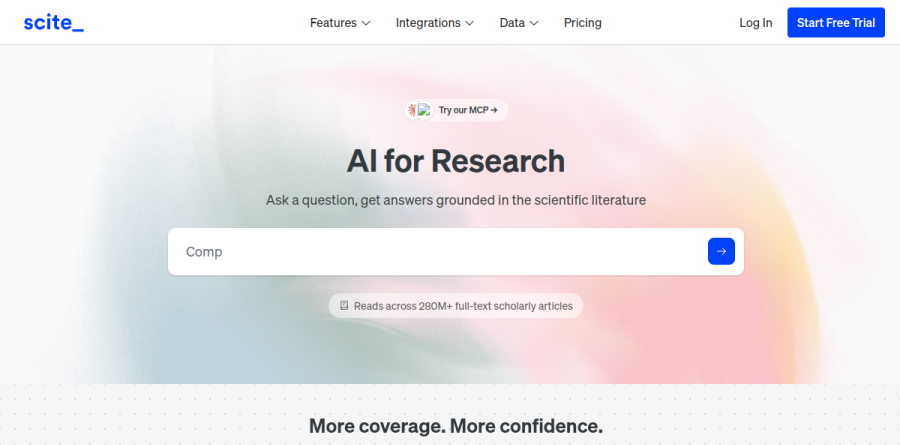
What is Scite?
Scite is a research platform built around Smart Citations, a classification layer that reads the sentence in which one paper cites another and labels it as supporting, contrasting, or mentioning. Rather than a raw citation count, you get a breakdown of how later researchers actually treated a finding. The vendor reports an index of more than 1.6 billion Smart Citations drawn from over 300 million scholarly sources, with full-text access negotiated through direct agreements with Wiley, SAGE, and 30-plus other publisher partners.
Sitting on that base is Scite Assistant, an AI research tool that answers questions in plain language and links every claim back to the specific paper and sentence behind it. Scite is now part of Research Solutions, and it positions the platform as verification-first: the goal is not merely to find literature but to judge whether the evidence has held up.
Smart Citations and the evidence question

Smart Citations are the foundation of everything Scite does, and the vendor claims no other platform offers citation intelligence at this scale. A Scite Report on any indexed paper shows the exact citing text from each downstream study, filterable by classification, section, publication year, or source type. For a researcher deciding whether to build on a 2019 method, that distinction matters: a paper cited 400 times with a cluster of contrasting statements tells a different story than one cited 400 times in passing. Scite applies the same tallies to journals, authors, institutions, and funders, surfacing a Scite Index score alongside supporting and contrasting counts.
Search that reaches past the abstract
Scite Search matches on citation statements pulled from full text, not titles and keywords alone. Methods, null results, and offhand caveats that never reach an abstract become findable. You can chain citations forward and backward, filter by the section of a paper where a statement appeared, and set alerts for fresh matches. Scite reports 32 million-plus full-text sources behind this, including paywalled content that general-purpose AI tools cannot reach.
Collections, alerts, and Reference Check
Collections let you pull articles in from Zotero, Mendeley, a CSV of DOIs, or search results, then watch how citations accumulate. Scite flags new supporting or contrasting citations and surfaces retractions, which helps when tracking your own publication record, monitoring a rival lab, or keeping a syllabus current. Reference Check works the other direction: upload a manuscript PDF and Scite grades every reference in it, flagging retracted sources, editorial notices, and citations that have picked up contradicting evidence. Scite pitches Reference Check at authors, editors, and peer reviewers evaluating citation quality before publishing.
Fitting Scite into an existing workflow

Scite MCP exposes Smart Citations, literature search, and DOI lookup to ChatGPT, Claude, and other MCP-compatible assistants, with MCP credits metered per plan at 250 monthly on Basic and 2,500 on Pro. The Zotero plugin carries citation context into the reference manager, a free browser extension adds badges on Google Scholar and PubMed, and the embeddable Scite Badge shows tallies on your own site. Pro adds API access, patent, clinical trial, and grant datasets, and Collections up to 10,000 papers, while a separate Team & Enterprise tier is quoted by sales, and Scite Holdings connects an institution's own holdings for seamless full-text access.
Who should choose Scite
Scite earns its keep for anyone whose work turns on citation quality rather than citation volume: systematic reviewers, meta-analysts, doctoral students assembling a literature review, research integrity staff, and editors screening submissions. Medicine and the life sciences benefit most, because the patents, clinical trials, grants, and FDA safety datasets Scite layers in let you trace an idea from funded proposal to trial to product label. Teams already working inside ChatGPT or Claude will like that Scite arrives through MCP rather than one more browser tab.
It is a weak fit if you mainly want a drafting assistant or a PDF summarizer, since Scite is built to appraise literature rather than write your manuscript. Fields with thin journal coverage, including much of the humanities and fast-moving areas that publish mostly to preprint servers and code repositories, will find the Smart Citation layer sparse. Solo researchers on a tight budget should note that access continues only on a paid plan once the trial ends.
Strengths
- Unique dataset: 1.2 billion citation statements classified as supporting, mentioning, or contrasting — no rival offers this at scale
- Reference Check flags retracted papers and heavily-contrasted citations in your bibliography before you submit
- Assistant answers questions grounded in citation contexts rather than abstracts alone
- 40% discount on annual billing ($12/mo vs $20) plus a 7-day free trial
Watch out for
- Narrower job than rivals — it evaluates evidence rather than extracting data (Elicit) or answering yes/no questions (Consensus)
- $20 month-to-month is pricier than Consensus ($15) for casual use
- Citation-context snippets depend on publisher agreements, so coverage varies by field and journal
- The free account is a limited preview; sustained use effectively requires the paid plan
Key features
| Feature | What it does |
|---|
| Smart Citations | Shows how each paper was cited — supporting, mentioning, or contrasting — with the surrounding text from the citing paper. |
| Reference Check | Upload a manuscript to flag citations to retracted, corrected, or heavily-disputed papers before submission. |
| Assistant by scite | AI research assistant that answers questions with citation-context-grounded evidence and real references. |
| Citation alerts & dashboards | Track new supporting or contrasting citations to papers, topics, or your own publications. |
| Browser extension | See Smart Citation counts on papers as you browse PubMed, Google Scholar, and journal sites. |
| API & MCP access | Developer plans expose Smart Citations data programmatically, including via Model Context Protocol. |
How Scite compares
| Alternative | How it differs |
|---|
| Consensus | Cheaper Q&A-style academic search with a Consensus Meter; scite goes deeper on how individual papers were received. |
| Elicit | Stronger for systematic reviews and structured data extraction across many papers; weaker on citation-context analysis. |
| Semantic Scholar | Free academic search with citation counts, but no supporting/contrasting classification or reference checking. |
Frequently asked questions
Is Scite free?
Scite offers a limited free account (basic search and a preview of Smart Citations) and a 7-day free trial of premium features. Full access — unlimited Smart Citations, the Assistant, alerts, and Reference Check — requires the Personal plan at $12/month billed annually ($144/year) or $20 month-to-month.
How much does Scite cost?
The Personal plan costs $20/month billed monthly or $12/month billed annually — a 40% saving at $144/year. Organizations (universities, companies) and developers using the API/MCP get custom quotes. A 7-day free trial covers the premium features before you commit.
What are Smart Citations?
Smart Citations show how a paper has been cited, not just how often. Scite classifies over 1.2 billion citation statements as supporting, mentioning, or contrasting, and displays the exact sentence from the citing paper — so you can see at a glance whether a study's findings were later confirmed or disputed.
Scite vs Consensus: which is better?
They answer different questions. Consensus (from $8.99-15/month) tells you what the research broadly says about a yes/no question via its Consensus Meter. Scite ($12-20/month) tells you how specific papers were received — supported or contradicted — and checks your references. Evidence evaluators pick Scite; quick question-answering favors Consensus.
Who owns Scite?
Scite is owned by Research Solutions, a public company (NASDAQ: RSSS) that acquired it in 2023. The platform continues to operate independently at scite.ai, with its citation index covering more than 1.2 billion citation statements across all scientific disciplines.
Scite ratings on other platforms
Independent user ratings from third-party review sites, linked here for transparency.
These are not our editorial score, are captured on the date shown, and may have changed since.