The full review

What is Elicit?
At its simplest, Elicit is an AI research assistant aimed at people who work with peer-reviewed literature rather than the open web. The homepage pitch is direct: use AI to search, summarize, extract data from, and chat with over 125 million papers, and the vendor claims Elicit helps researchers be 10x more evidence-based. The scoping matters. Instead of asking a general chatbot what science says, you put a research question to Elicit and it works against an indexed academic corpus, returning findings tied to sources you can open and check.
The product is organized around a few named surfaces. Paper Search handles discovery, Research Reports assemble a structured synthesis with citations, and the Elicit Research Agent runs longer multi-step investigations. Library and Alerts keep results and new publications organized over time, while a dedicated systematic literature review workflow serves teams doing formal evidence synthesis.
From research question to structured report

The core loop is short. You type a question in plain language, Elicit searches the corpus, and it returns a structured research report with inline citations instead of unsourced prose. The vendor states a single analysis can cover up to 1,000 relevant papers, which is the practical difference between a quick scan and a genuine sweep.
The table view is where Elicit earns its keep. Results arrive as rows of papers with columns you define, so rather than reading forty abstracts hunting for sample sizes, you add a column and let extraction fill it. Pro adds custom extractions from uploaded papers and lets you add 20 columns to a table at a time, while Scale raises that to 30.
Systematic review work, screened and extracted
Formal evidence synthesis is where Elicit looks most differentiated. Its systematic literature review workflow moves a project through screening and data extraction as discrete stages, and the vendor cites PRISMA 2020 support alongside published accuracy figures for search recall, abstract screening, full-text screening, and extraction. Elicit also reports up to 80% time savings on systematic reviews. Those are vendor numbers rather than independent audits — the accuracy figures come from Elicit's own run across 994 Cochrane reviews — but the staged design mirrors how review protocols genuinely run, and the dedicated workflow screens 5,000 papers on Pro and 40,000 on Enterprise.
Keeping a literature base current
Research is rarely a single query, and Elicit accounts for that. Library stores and organizes the sources you find so they can be reused in future projects rather than re-gathered each session. Alerts watch a query and surface newly published work, turning a finished review into something maintainable. Zotero import is available even on the free Basic tier, so existing reference collections come along. Data source coverage widens by plan, and Scale adds figure extraction so the model can consult charts inside papers, not text alone.
Team access and the Elicit API
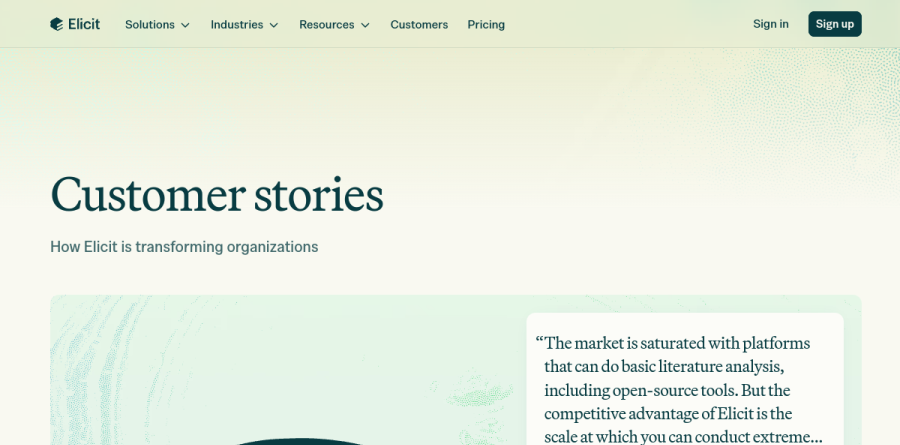
Beyond the app, Elicit publishes an API with endpoints for paper search, clinical trials search against ClinicalTrials.gov, report sessions, and systematic review sessions. An MCP server lets Claude Desktop and compatible clients call Elicit directly, a sensible answer for teams wanting literature retrieval inside an assistant they already use. Scale introduces live team collaboration and an admin panel with usage tracking, while Enterprise adds SSO and SAML, a dedicated success team, and custom integrations. The customer stories page features Orion Pharma, MicroGenDX, and Oxford PharmaGenesis.
Who should choose Elicit
The strongest fit is researchers whose work lives in published literature: pharma and biotech scientists evaluating targets, medical writing consultancies producing client reviews, academic labs running systematic reviews, and analysts who need traceable citations. If your bottleneck is screening hundreds of abstracts and pulling consistent fields from each one, Elicit on the Pro plan is the natural entry point, and Scale makes sense once collaboration and figure extraction matter.
It is a poor fit for general business or market research, since the corpus is academic and Elicit has little to say about a market no journal has studied. Casual users get real value from Basic, though Research Agent and Research Reports usage is limited there, so anyone running reviews regularly meets that ceiling fast.
Strengths
- Genuinely useful free plan: unlimited search, summaries, and full-text paper chat across 138M+ papers
- Purpose-built systematic review workflow screens up to 5,000 papers on Pro (40,000 on Enterprise) with source-linked answers
- Structured extraction into 20–30 column tables turns days of manual tabulation into minutes
- API access from the $49 Pro tier; annual billing cuts 35–39% off monthly rates
Watch out for
- Steep jump from free to $49/mo — the old $12 Plus mid-tier was dropped from the 2026 lineup
- Independent 2025 testing measured ~37.9% average search sensitivity vs 93.5% for traditional methods, so it can't replace database searching in formal reviews
- Headline prices require annual commitment ($588–$2,028 upfront); monthly billing costs 35–39% more
- Coverage leans on the Semantic Scholar index; paywalled full text limits chat and extraction depth
Key features
| Feature | What it does |
|---|
| Systematic Review Workflow | Dedicated screening pipeline handling 5,000 papers on Pro and 40,000 on Enterprise, with PRISMA-grade screening and extraction targets at the top tier |
| Research Reports | Automated literature-review reports that extract from up to 135 data sources on Pro and 200 on Scale |
| Data extraction tables | Pull methods, participants, and outcomes into structured tables — 20 columns at a time on Pro, 30 on Scale, plus custom extractions from uploaded PDFs |
| Research Agent | Multi-step autonomous agent that maps an entire research landscape; Scale plans get 5x usage allocation |
| Paper chat and summaries | Unlimited chat with full-text papers and unlimited summaries across 138M+ papers, included even on the free Basic plan |
| Alerts, API and collaboration | 10 personalized research alerts and API access on Pro; figure extraction, live team editing, and admin usage tracking on Scale |
How Elicit compares
| Alternative | How it differs |
|---|
| Consensus | Closest rival for AI-cited academic search with a cheaper entry point, but lighter on systematic-review screening and multi-column data extraction |
| Scite | Centers on Smart Citations (supporting vs contrasting evidence) rather than end-to-end review workflows; often used alongside Elicit rather than instead of it |
| ChatGPT | General-purpose at $20/mo Plus; fine for drafting and brainstorming but has no dedicated 138M-paper index and is prone to fabricated citations |
Head-to-head: Elicit vs Consensus
Frequently asked questions
Is Elicit free?
Yes. The Basic plan is free and includes unlimited search across 138M+ papers, unlimited summaries, and unlimited chat with full-text papers. Limits apply to Research Agent runs and automated reports (roughly 2/month), and extraction tables are capped at 2 columns. Paid plans start at $49/user/month billed annually ($588/year).
How much does Elicit cost in 2026?
Pro costs $49/user/month billed annually ($588/year), Scale is $169/user/month ($2,028/year), and Enterprise is quote-only. Those are annual-billing rates — Elicit advertises 35–39% savings versus paying monthly. The older Plus ($12/month) and Team ($79/month) tiers no longer appear on the official pricing page as of July 2026.
Elicit vs ChatGPT for research — which is better?
For literature reviews, Elicit: it searches a dedicated index of 138M+ academic papers, links every claim to sources, and extracts data into 20–30 column tables. ChatGPT ($20/month Plus) is cheaper and better for general writing but can fabricate citations. Casual users often pair ChatGPT with Elicit's free Basic tier instead of paying $49/month.
Is Elicit good for systematic reviews?
Partially. Elicit's own benchmarks claim 96.9% screening sensitivity and 95.6% extraction accuracy, and Pro screens up to 5,000 papers (Enterprise: 40,000). But independent 2025 research measured average search sensitivity of just 37.9% versus 93.5% for traditional methods — so use Elicit to supplement, not replace, conventional database searching in formal reviews.
Does Elicit offer a student discount?
No student discount is published on elicit.com/pricing. Students typically stay on the free Basic plan, which covers unlimited search, summaries, and paper chat across 138M+ papers. The cheapest paid route is Pro at $49/user/month on annual billing — 35% below the monthly rate. Some universities license Enterprise access, so check your library first.
Elicit ratings on other platforms
Independent user ratings from third-party review sites, linked here for transparency.
These are not our editorial score, are captured on the date shown, and may have changed since.