The full review
What is Connected Papers?
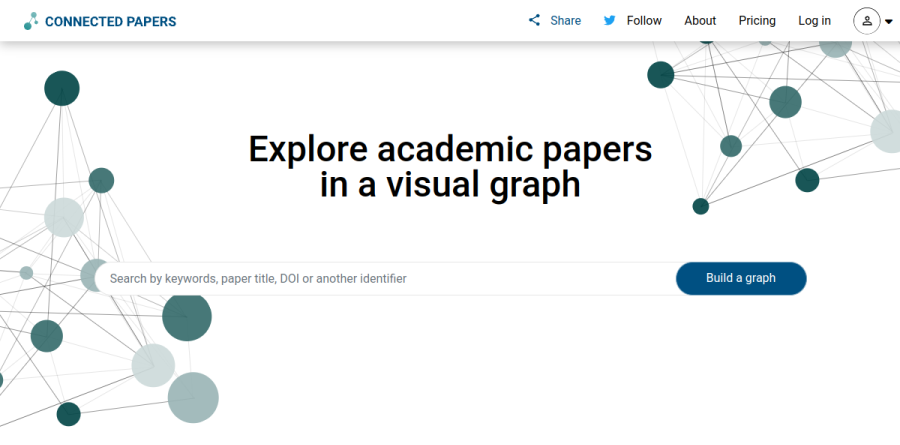
Connected Papers is a visual literature-mapping tool that turns a single seed paper into a map of its neighbourhood. Feed it a paper title, a DOI, an arXiv URL, a Semantic Scholar URL or a PubMed URL, and it returns a force-directed graph of a few dozen closely related works. Search is powered by Semantic Scholar, and the homepage searchbar accepts keywords, paper title, DOI or another identifier.
The vendor describes Connected Papers as a unique, visual tool to help researchers and applied scientists find and explore papers relevant to their field of work. Its founders write that it began as a weekend side project between friends who had worked with academic papers for years and wanted better tools for research.
How the Connected Papers graph gets built
To build each graph, the vendor reports that Connected Papers analyses an order of 50,000 papers and keeps only the few dozen with the strongest connections to the origin paper. The similarity metric rests on co-citation and bibliographic coupling: two papers with heavily overlapping citations and references are presumed to treat a related subject. Works that never cite one another can therefore sit side by side, and Connected Papers is emphatic that this is not a citation tree.
The layout carries real information. Node size is the number of citations, node color is the publishing year, similar papers cluster together on strong connecting lines, and selecting a node highlights the shortest path back to the origin paper in similarity space. Underneath sits the Semantic Scholar Paper Corpus, which the vendor says compiles hundreds of millions of published papers across many scientific fields.
Prior Works and Derivative Works
Above every graph sits a navbar carrying Prior works, Derivative works, List view, Filters and a More menu. The Prior Works view gathers papers most commonly cited by the papers inside the graph, which is the ancestor literature of a field. Derivative Works gathers newer papers inspired by many papers in the graph, which is where survey articles and recent state-of-the-art appear. Selection runs both ways: choosing a prior work highlights every graph paper referencing it, and choosing a graph paper highlights the derivative works citing it.
Where Connected Papers fits a literature search
The vendor pitches four jobs on its landing page. First, getting a visual overview of a new academic field by entering a typical paper and building further graphs from interesting nodes until the trends and popular works become legible. Second, making sure you have not missed an important paper, a problem the site flags for fast-moving areas such as machine learning. Third, creating the bibliography for a thesis by starting from references you already trust and letting Connected Papers fill the gaps. Fourth, separating ancestry from descendants through the two dedicated views.
Plans, seats and institutional access
Every plan ships the same capabilities, listed as Connected Papers similarity graphs, prior and derivative works, multi-origin graphs, saved papers and graph history, so upgrading buys volume rather than features. The Free tier allows five graphs per month, which the vendor says suffices for most users. Academic targets academics, non-profits and personal use; Business targets commercial work; both lift the cap. Billing runs annually or quarterly rather than monthly. Group plans add seats under a single invoice with an administrator assigning access, and an Academic Library option offers email, IP and SSO access for students and staff, quoted on request.
Who should choose Connected Papers
Connected Papers suits exploratory literature search best: doctoral students entering an unfamiliar area, reviewers scoping a field, industry teams checking prior art, and librarians wanting a low-friction tool to hand students. The free allowance is genuinely usable for occasional work, and the graph rewards curiosity in a way a ranked keyword list does not. It is not ideal as a reference manager, since there is no PDF library, annotation layer or citation-style handling here, so a dedicated tool still belongs in the stack alongside it.
Strengths
- Extremely affordable — full features from $3/mo, plus a genuinely usable free tier (5 graphs/month, all features)
- Fast, intuitive force-directed graphs that surface non-obvious related work keyword search misses
- Prior/derivative-works views and multi-origin graphs add real analytical depth
- Broad multi-field coverage via the Semantic Scholar corpus, with export to tools like Zotero
Watch out for
- Requires a seed paper — no natural-language querying or topic-only search
- Not an 'answer engine': no summarization, Q&A or AI chat over the literature
- Graphs get cluttered with many nodes, and coverage can lag for very recent or niche work
- No dedicated mobile app, and the free tier's 5-graph monthly cap is tight for heavy weeks
Key features
| Feature | What it does |
|---|
| Similarity graph | Force-directed map of papers related to a seed via co-citation and bibliographic coupling, not keyword matching. |
| Prior & derivative works | Dedicated views for the foundational papers behind a topic and the newest work building on it. |
| Multi-origin graphs | Build one graph from several seed papers to map a broader research area. |
| Saved papers & graph history | Persist collections and revisit earlier graphs; export references into reference managers like Zotero. |
How Connected Papers compares
| Alternative | How it differs |
|---|
| Research Rabbit | Free citation-mapping and paper-monitoring tool; more collection/alerting focused, no paid tier. |
| Elicit | AI answer engine that summarizes and extracts data across papers — closer to a true research assistant, but pricier. |
| Litmaps | Seed-based literature maps with citation monitoring and alerts; freemium with paid plans. |
Frequently asked questions
Is Connected Papers free?
Yes — the free plan gives 5 graphs per month with every feature included, and you can revisit already-created graphs as many times as you like. Paid plans (from $3/mo) only lift the monthly graph limit.
Is it an AI chatbot that answers research questions?
No. It is a visual discovery tool: you start from a seed paper and explore a graph of related work. It does not summarize papers or answer questions in natural language — for that, look at Elicit or Consensus.
Connected Papers ratings on other platforms
Independent user ratings from third-party review sites, linked here for transparency.
These are not our editorial score, are captured on the date shown, and may have changed since.