The full review
What is Exa?
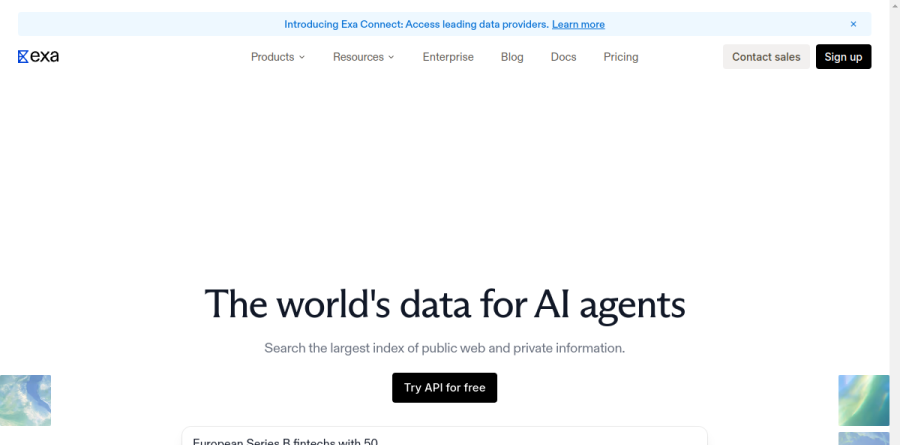
Exa is a web search and retrieval layer built for software rather than for human readers. Instead of a page of blue links, its API returns ranked results with clean page text, highlights, and citations that a language model can consume directly.
Run by Exa Labs, the platform spans far more than a single search call. The site groups its products into Search, Contents, Agent, and Monitors APIs, alongside Websets, an MCP server, and a data-partner layer called Exa Connect; llms.txt documents Deep Search as a mode of the Search API for multi-step reasoning with structured outputs. Exa reports that 500,000 developers now build on its index.
How the search API is built for agents
The Search endpoint sits at the center, and its tuning knobs show an agent-first design. Latency is configurable: the homepage playground exposes Fast at roughly 450ms, Auto near a second, and Deep at about ten seconds, so a coding agent inside a tight loop and an asynchronous research agent can share one API. Results scope by category — Full Web, News, Companies, Research, People, Financials — which removes filtering work that usually falls on the caller.
Contents extracts clean, LLM-ready text from JavaScript-rendered pages, PDFs, and complex layouts, with token-efficient highlights produced by a model trained to pull the most relevant excerpts. Deep Search runs multi-step web search with reasoning and structured outputs for complex research tasks, and Exa lists a Monitors API among its products, priced at $15 per 1,000 requests.
Agent handles research, list-building, and enrichment
Exa's Agent product executes multi-step web research, list-building, and enrichment workflows, returning natural-language responses with citations.
Exa Connect supplies the underlying data, spanning web analytics, private markets, company and contact data, financial data, healthcare intelligence, and compliance data.
Exa Connect, MCP, and integrations
Exa Connect routes agent requests to specialist third-party providers through a single integration. The pricing page names two Connect providers with per-unit rates: Fiber.ai at $0.02 per credit and Baselayer at $0.15–$4.00 per order depending on the operation.
For builders, the Exa MCP Server exposes search, code search, content retrieval, and research tools to Claude, Cursor, Codex, and VS Code. Python and JavaScript/TypeScript SDKs, OpenAPI specifications, and Agent Skills for coding agents round out the toolkit, and llms.txt notes a hosted MCP version that works without an API key.
Teams already building on Exa

The customer page carries references worth weighing. Firefox uses Exa for browser AI features with visible citations. Cognition says Exa powers all parts of Devin, and HubSpot uses it for real-time people and company search behind its agents. CodeRabbit's VP of AI says what Exa does in one search took their old provider multiple searches and five times as long, and HockeyStack's CTO says they evaluated five search providers and none came close to Exa's quality and breadth of data.
Getting started and plan structure
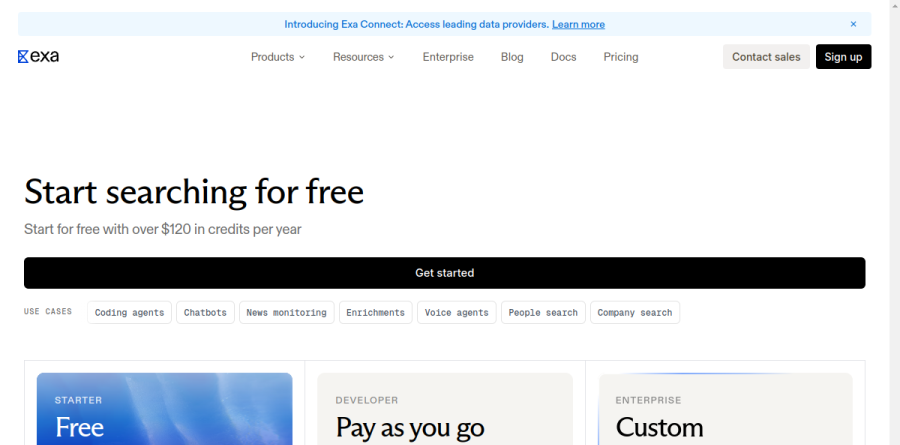
The pricing page offers a free tier of $20 in credits, which it puts at around 2,800 searches, plus $10 in credits every month, and states that Exa is pay-as-you-go with no subscription and no minimum spend. Enterprise, arranged through a sales conversation, covers high volume, custom indexes, higher rate limits, SLAs, zero data retention, and volume discounts, plus up to 1,000 results per search and tailored moderation. Published per-endpoint rates run $7 per 1,000 search requests, $1 per 1,000 pages of contents, $5 per 1,000 answer requests, $15 per 1,000 monitor requests, $12–15 per 1,000 deep search requests, and $0.012–$1.00 per fixed-effort agent run.
Who should choose Exa
Exa suits teams building agents, chatbots, or research tools that need current, citable web context with latency they can dial per call. It also fits go-to-market teams whose target lists a static database cannot produce. It is a weaker choice for anyone wanting a finished end-user search product or a ready-made CRM, since most of the value sits behind an API and credit-metered usage — expect engineering time and some cost modeling before results arrive.
Strengths
- Neural/embeddings search is purpose-built for LLMs — retrieves by meaning and returns clean, token-efficient content and highlights
- Transparent usage-based pricing with a genuinely generous free tier and no seat minimums on the API
- Strong developer experience: simple REST API, Python/TS SDKs, and first-class LangChain, LlamaIndex, and MCP integrations
- Websets adds a no-code UI to turn web searches into enriched, exportable datasets, plus Monitors for tracking web events
Watch out for
- Usage-based costs are hard to predict and scale fast at volume; Deep Search and Agent runs are markedly pricier than basic search
- Splitting into two products (pay-as-you-go API vs. subscription Websets) with different pricing logic confuses newcomers
- Websets' credit system (~10 credits per result) is opaque and can burn through an allowance quickly on large lists
- Less polished as an end-user research assistant than consumer answer engines; quality is sensitive to query phrasing
Key features
| Feature | What it does |
|---|
| Neural + keyword search | Embeddings-based semantic search that finds pages by meaning, with an auto mode that blends neural and traditional keyword retrieval. |
| Contents API | Returns clean, LLM-optimized page text, highlights, and summaries so agents ingest signal rather than raw HTML. |
| Deep Search & Agent | Multi-step agentic research that plans queries, reads sources, and returns structured, web-grounded answers with citations. |
| Websets & Monitors | No-code app that builds enriched datasets/lists from web search, plus scheduled Monitors that push web-event updates via webhooks. |
How Exa compares
| Alternative | How it differs |
|---|
| Perplexity | Consumer/prosumer answer engine; more polished end-user research UX but far less of a composable developer search API. |
| Tavily | The most direct API competitor — a search API purpose-built for LLM/RAG and agents, often cheaper for simple grounding. |
| Linkup | Newer web-search API for AI agents emphasizing sourced answers; smaller ecosystem and integration surface than Exa. |
Frequently asked questions
Is there a free tier?
Yes. The API includes a generous monthly free allowance (up to roughly 20,000 requests per the official page) and new accounts receive one-off free credits; Websets offers a free plan of about 1,000 credits per month. No credit card is needed to start.
Is Exa a search engine or an API?
Primarily an API-first neural search and answer engine for developers and AI agents. The Websets web app layers a no-code research/list-building UI on top, but Exa is not a general-purpose consumer search site.
Exa ratings on other platforms
Independent user ratings from third-party review sites, linked here for transparency.
These are not our editorial score, are captured on the date shown, and may have changed since.