The full review
What is Tavily?
Tavily is a web search and content extraction API built for AI agents rather than for people typing into a search box. Instead of returning a page of links to sift through, it runs the whole retrieval loop in a single call: searching, scraping, filtering and extracting the passages a model can actually use. The Tavily documentation puts it bluntly, describing the service as the first search engine for AI agents and saying it absorbs the burden of searching, scraping, filtering and extracting on your behalf.
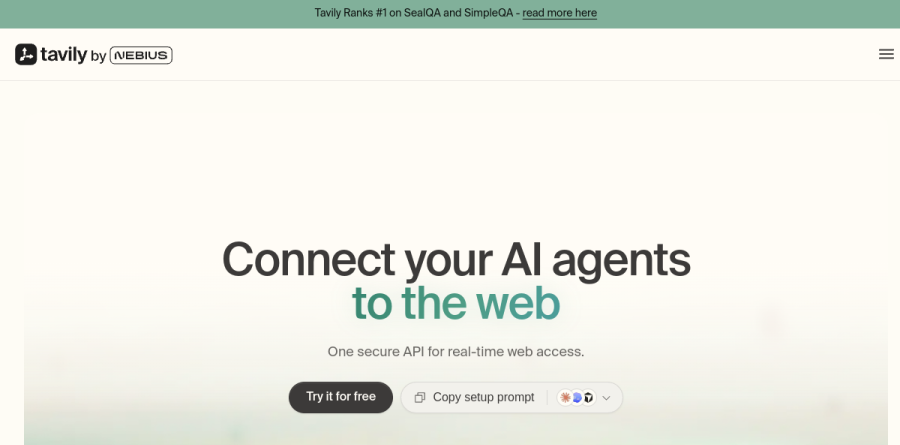
The homepage frames the product as one secure API for real-time web access, and the surface area now reaches well past a single endpoint. Search, Extract, Crawl, Map and Research each handle a different slice of getting live web content into a model, and they share one API key and one credit pool.
Search built for agent workflows
Search is the first product Tavily lists on its homepage, and its parameter list shows how much tuning work has been pushed into the API itself. The search_depth setting trades latency against relevance across advanced, basic, fast and ultra-fast modes. The topic parameter narrows results to general, news or finance. You can bound results with time_range or explicit start_date and end_date values, restrict results to up to 300 domains with include_domains, exclude up to 150 with exclude_domains, and boost a country for general searches. Setting auto_parameters lets Tavily infer a sensible configuration from the query intent.
Extract, Crawl and Map for whole sites
When a single query is not the right unit of work, the rest of the Tavily toolkit takes over. Extract turns pages into clean, structured content for LLMs. Crawl is described in the docs as a graph-based website traversal tool that explores hundreds of paths in parallel with built-in extraction, and it accepts natural language instructions alongside max_depth, max_breadth, limit and regex select_paths filters. The extract_depth option steps up from basic to advanced when you need tables and embedded content. Map simply discovers URLs across a site, so an agent knows what exists before it reads anything.
Where teams put Tavily to work

The Tavily use cases page reads like a tour of live-data problems. The vendor pitches research agents that synthesize insights from across the live web, sales meeting briefs assembled from customer news and executive bios, and recruiting workflows that verify candidate background claims against publications and public records. Product teams track competitor positioning and release notes; finance teams pull filings and analyst commentary with citations; legal and risk teams monitor regulator sites, sanctions lists and supply chain disruptions. Security teams monitor threats and vulnerabilities using live advisories, CVE feeds, vendor blogs and security forums.
Developer experience and plan structure
Tavily ships a Python library and a JavaScript package alongside direct REST access, and the docs call out LangChain and LlamaIndex integrations, which is how most agent frameworks will reach it in practice. Plans run from Researcher, a free tier that needs no credit card, through Pay As You Go and a slider-based Project plan, up to Enterprise with custom rate limits and SLAs. The vendor reports a 99.99% uptime SLA and roughly 180 ms median latency on its search endpoint.
Who should choose Tavily
Tavily is the obvious pick for anyone building a retrieval-augmented agent who would rather not run a crawler, parser and ranking stack in-house. Research assistants, monitoring bots and enrichment pipelines all benefit, and the free Researcher tier makes prototyping cheap enough to validate the idea before committing. It is less suited to non-technical teams shopping for a finished research product, since everything here is an API you have to wire into something yourself. Teams with strict data residency requirements, or with heavy and unpredictable crawl volume, should walk through the Enterprise conversation carefully before scaling up.
Strengths
- Purpose-built for LLMs: returns clean, ranked, LLM-ready snippets rather than raw HTML
- Generous 1,000 free credits/month with no card, plus a free student plan
- Transparent, granular credit pricing that scales down per-credit as you grow
- Broad ecosystem support (LangChain, LlamaIndex, official MCP server, Python/JS SDKs)
Watch out for
- Developer-only: it is an API, not an end-user research app or chat UI
- Credit accounting (search vs advanced vs extract vs research) adds billing complexity
- Result depth and recall can trail neural-search rivals like Exa on niche queries
- Advanced/research endpoints burn credits fast (up to 250 per research call)
Key features
| Feature | What it does |
|---|
| Search API | Real-time web search with basic (1 credit) or advanced (2 credit) depth, returning ranked, source-cited snippets tuned for LLM consumption. |
| Extract & Crawl | Pulls clean content from URLs and crawls/maps sites, converting pages into structured text ready for RAG ingestion. |
| Research endpoint | Higher-order agentic research (mini and pro models) that runs multi-step queries and synthesis, priced 4-250 credits per call. |
| Ecosystem integrations | Official Python/JS SDKs, an MCP server, and native LangChain/LlamaIndex tools for fast agent wiring. |
How Tavily compares
| Alternative | How it differs |
|---|
| Exa | Neural/embeddings-based search API with strong semantic recall; often better on obscure or research-grade queries. |
| Perplexity Sonar API | Answer-engine API returning synthesized, cited responses rather than raw search results; less granular control. |
| Linkup | Newer LLM-grounding search API competing directly on price and citation quality for agent workloads. |
Frequently asked questions
Is Tavily free to use?
Yes. Every account gets 1,000 API credits per month with no credit card required, and there is a separate free plan for students. Beyond that you pay per credit or subscribe to a tier.
How does Tavily credit pricing work?
Actions cost credits: a basic search is 1 credit, advanced search 2, extraction 1 credit per 5 URLs, and research calls 4-250 credits. Pay-as-you-go is $0.008/credit, and subscriptions lower the effective per-credit rate.
Tavily ratings on other platforms
Independent user ratings from third-party review sites, linked here for transparency.
These are not our editorial score, are captured on the date shown, and may have changed since.