AI Phone Answering Service for Small Business: 10 Platforms Ranked by Cost and Setup Effort
Affiliate disclosure: some links here are affiliate links and we may earn a commission at no cost to you. The order below follows the stated criterion and nothing else; no vendor paid for a position or saw this page before it went up.
Your phone rings while you are up a ladder, under a car, or already with a customer, and the caller does not leave a message. That is the problem an AI phone answering service is sold to solve, and the honest answer is narrower than the market looks. Of the thirteen platforms whose published pricing was compared for this page, only two combine a no-code setup, a self-serve price and no commitment: ElevenLabs’ agent tiers, which publish how many call minutes each monthly price includes, and RingCentral AI Receptionist at “Starts at $49 /month” with “100 minutes included” and a phone number inside the price. Everything else is an API, a cloud contact-centre build, or a contract.
This ranking measures one thing: what it costs to answer a few hundred calls a month, and how much engineering it takes to get there. Nothing here was installed, subscribed to or dialled — every figure below was read from the vendor’s own published pricing page on 17 September 2026 and is reproduced as the vendor states it. Where a vendor does not publish something the criterion needs — a telephony rate, an all-in cost per minute, what a “credit” is worth in dollars — that absence is reported as a finding and it costs them position, because a price you cannot read is a price you cannot budget.
What this ranking measures
This page measures four things and refuses to measure the rest. Measured: the published price a self-serve buyer can actually reach without a sales call; what that price includes (call minutes, a phone number, transcription, the model, the carrier); the size and shape of any free allowance; and whether getting to a working phone agent takes a builder UI, an API key, or a signed contract. A platform that needs a developer, or an annual commitment, is ranked as the wrong answer for this reader however capable it is. Not measured: voice quality, how naturally an agent holds a conversation, accent handling, or integration depth — none of that can be established from a pricing page, and pricing pages are all this article is built from. Latency is deliberately unscored: the published figures (400 ms, roughly 600 ms, under 0.725 seconds at the 95th percentile, under 100 ms) come from different methodologies on different pages, and several vendors publish none. Three products on the verified sheet are not ranked: Rime sells text-to-speech, not an agent; Google Conversational Agents and Microsoft Copilot Studio are build-your-own environments where the phone line sits outside the published rate entirely, and Microsoft’s real-time voice agents additionally require a Dynamics 365 Contact Center licence.
The short answer
It is the only platform on the sheet where a published monthly price maps directly onto a stated number of answered minutes — Pro at $99 per month with 1,238 minutes of calls included, Creator at $22 per month with 275 — reachable without a sales call, a developer or a commitment. Overage is a flat $0.08 per minute, and cancelling drops the account back to Free at the end of the billing cycle.
The lowest engineering cost on the list, and the only published monthly price that already contains the phone number, the transcription and the first 100 minutes. It loses first place on running cost: past those 100 minutes it charges $0.50 per minute, rounded up in 30-second increments, and never prices the cheaper minute bundles it says exist.
No monthly platform subscription at all, “$10 in free credits” at sign-up, 20 concurrent calls free on every account, and a $0.055/minute infrastructure layer. Bring your own SIP trunk and Retell’s own $0.015/min telephony line disappears. The catch is assembly — the model, the voice and the carrier are separate meters that the pricing page never totals.
All 10 compared
| # | Product | Best for | Price from | What decides its place | |
|---|---|---|---|---|---|
| 1 | Published minute bundles you can read before buying | Free $0 per month; Starter $6 per month; Creator $22 per month, first month $11; Pro $99 per month; Scale $299 per month; Business $990 per month | Pro: $99 per month, 1,238 minutes of calls included | Visit | |
| 2 | A business with nobody available to build anything | Starts at $49 /month (Standalone, 100 minutes included); AI Receptionist with RingEX $39 + $30 /month | $49 /month, 100 minutes included, then $0.50 per minute | Visit | |
| 3 | Lowest running cost if you can assemble the stack | $0.07-$0.31 / min for AI Voice Agents (Pay as you go) | $0.07-$0.31 / min, no platform fee, $10 in free credits | Visit | |
| 4 | One flat per-minute rate with nothing to assemble | $0.14 /min (Start) — “$0 platform fee. No card required.”; Build $0.12 /min plus $299/month platform fee | $0.14 /min with $0 platform fee; 100 calls/day on Start | Visit | |
| 5 | Builders who want provider costs passed through at cost | $0 to start — “Pre-paid, $0.05/min Vapi hosting”; Core $29 / month | $0.05/min hosting only; models pass through at cost | Visit | |
| 6 | Trying a full agent stack on someone else’s $200 | Free $200 Credit, then pay-as-you-go; Voice Agent API Standard $0.075/min (Pay As You Go) | $200 free credit; Voice Agent $0.075/min, no telephony | Visit | |
| 7 | Teams already running phone numbers on Twilio | $0.07 / minute (Conversation Relay) | $0.07 / minute, plus your own LLM and $1.15/mo number | Visit | |
| 8 |  | Contact centres that already live inside AWS | $0.038 per voice min plus $0.0080 per voice minute (Connect AI agents — voice) | $0.0080 AI agent minute on top of $0.038 voice minute | Visit |
| 9 | Adding AI to a phone team you already pay for | Essentials $30 /license — “3 licenses for $90/month, billed annually”; AI Voice Agents pay-as-you-go $0.37/min up to 2,500 minutes, $0.29/min over | 3 licenses for $90/month, billed annually, before any AI | Visit | |
| 10 | Large deployments with a procurement department | Enterprise contracts start at $30,000 annually. | Enterprise contracts start at $30,000 annually | Visit |
1. ElevenLabs (ElevenAgents)
Why it sits at 1 Pro: $99 per month, 1,238 minutes of calls included
ElevenAgents is a self-serve builder priced in included call minutes, which is exactly what this reader needs to plan a month. Free is “$0 per month” with “15 minutes of calls included”, 4 concurrent calls, the workflow builder, knowledge base and widget — a standing plan, not a countdown trial. The paid tiers publish their allowances outright: Starter $6 per month with 75 minutes, Creator $22 per month (first month $11) with 275 minutes, Pro $99 per month with 1,238 minutes, Scale $299 per month with 3,738 minutes.
The trade-off is what the bundled minute excludes. It covers the ElevenLabs speech stack, knowledge bases and telephony integration, but the model and the carrier appear in the plan table only as “At cost” with no rate, so the page cannot produce a total. A yearly billing toggle exists and renders no annual figure. It still tops the criterion: it is the only platform here whose monthly price maps onto a stated quantity of answered minutes, needs no developer and carries no commitment — cancel and the account drops to Free at the end of the cycle.
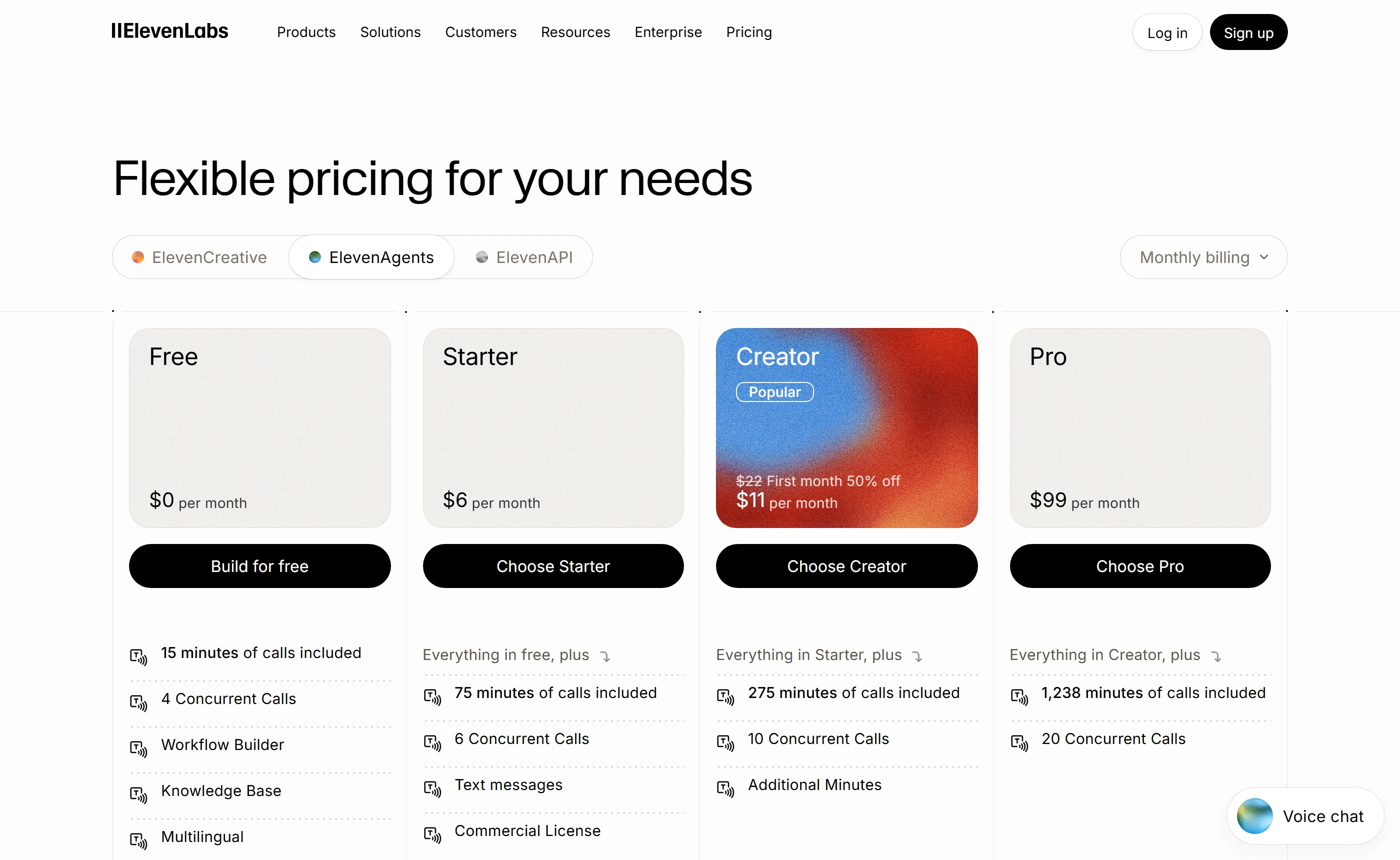
- Every tier states how many call minutes it includes, and overage is a flat $0.08 per minute, so a month of calls can be priced from the plan card before signing up.
- The model and the telephony carrier are listed only as “At cost” with no published rate, and the yearly toggle shows no annual price, so no total is obtainable from the page.
2. RingCentral AI Receptionist
Why it sits at 2 $49 /month, 100 minutes included, then $0.50 per minute
This is the least engineering on the list by a wide margin. The standalone plan “Starts at $49 /month” with “100 minutes included”, a dedicated new phone number, intelligent routing, appointment scheduling, lead capture, SMS follow-ups, transcripts and HIPAA & SOC2 — and it is bought with a Buy now button. Telephony and transcription sit inside the subscription rather than on separate meters, which no other pick manages at a published price, and there is no per-agent seat fee on the “unlimited AI Receptionists” claim.
Cost is where it drops to second. Past the 100 included minutes, calls run $0.50 per minute pay-as-you-go, rounded up in 30-second increments, and the “Additional minute bundles” the disclaimer mentions carry no published price — that is the highest per-minute figure on this entire sheet. The alternative card reads “$39 + $30” for AI Receptionist plus the RingEX Core Plan, a figure the page never totals. Billing is monthly only with no annual discount shown, and the page adds “Additional charges may apply.”
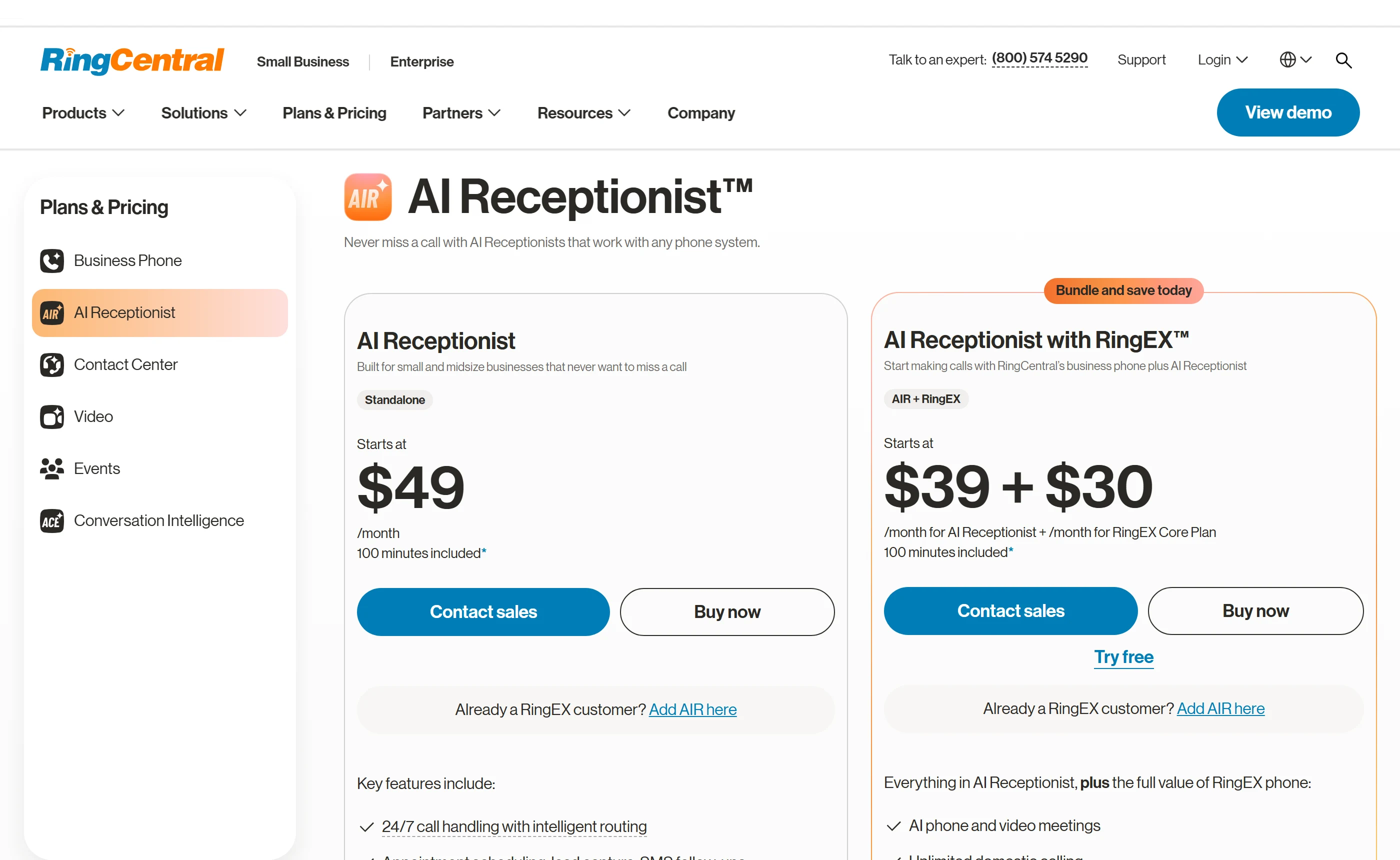
- The published monthly price includes the phone number, the transcription and the first 100 minutes, with a 14-day free trial and no sales call required to buy.
- $0.50 per minute beyond 100 minutes, billed in 30-second increments, with the cheaper minute bundles and any concurrency cap left unpriced and unpublished.
3. Retell AI
Why it sits at 3 $0.07-$0.31 / min, no platform fee, $10 in free credits
“Retell starts at $0, pay only for what you use.” There is no monthly platform subscription at all, sign-up grants “$10 in free credits” with “Full platform access, no commitments”, and every account includes 20 concurrent calls free before $8.00/Concurrency/month applies. The first 10 knowledge bases are free too. For a business making a few hundred calls a month, nothing here forces a recurring floor except the $2.00/month per phone number.
The published $0.07-$0.31 / min is assembled rather than charged: $0.055/minute for Retell’s voice infrastructure, the LLM at its own rate (from $0.0016/min for GPT 5 nano to $0.64/min for the fastest frontier model), text-to-speech at $0.015/minute or $0.040/minute for ElevenLabs voices, and telephony at $0.015/min that vanishes if you bring your own SIP trunk. That 4.4x spread is your configuration choice, and Retell’s page never totals a named setup. Compliance is metered too — PII removal adds $0.01/min.
- No platform subscription, $10 in credits, 20 free concurrent calls, and a telephony line you can zero out by bringing your own SIP trunk.
- The page lists every component and totals none of them, speech-to-text has no line item at all, and all fees are stated as non-refundable.
4. Bland AI
Why it sits at 4 $0.14 /min with $0 platform fee; 100 calls/day on Start
Start is $0.14 /min with “$0 platform fee. No card required.”, plus “2 credits + an inbound number ($15/mo value).” That single rate bundles the language model, speech-to-text and text-to-speech with no token charges and no provider pass-throughs to reconcile, which makes it the most legible bill among the developer-facing options. Start allows 10 concurrent calls, 100 calls/day and 100 calls/hour, with the same 99.9% uptime SLA published on every tier.
Two things cost it position. Telephony sits outside the rate on the pricing page while Bland’s own homepage FAQ claims it is included — a contradiction the vendor has not resolved — and the pass-through carrier cost is never given as a figure. The page also never says what a “credit” is worth in dollars or minutes, or whether credits expire. The next tier up adds a $299/month platform fee to save $0.02 a minute, which is the wrong direction for a few hundred calls, and the Terms of Service carry no billing or refund section at all.
- One bundled per-minute number with a $0 platform fee, no card required at signup, and a free inbound number valued at $15/month.
- Bland’s pricing page and homepage FAQ disagree about whether telephony is included, and the “2 credits” granted at signup are never defined in dollars, minutes or expiry.
5. Vapi
Why it sits at 5 $0.05/min hosting only; models pass through at cost
The entry tier is genuinely self-serve: “Start building”, “$5 free credits to get you started”, 1 included Vapi phone number, 4 concurrent calls, 14 days raw data retention, full model catalogue and full platform access. The metered rate is “Pre-paid, $0.05/min Vapi hosting”, corroborated by the page’s own calculator showing “Hosting Fee / 1,000 minutes / $50”, and the plans section states “No minimum minutes required.” Support is Discord plus email without an SLA.
That $0.05 is orchestration only. Transcription runs $0.0095-$0.0099/min, the model $0.0077-$0.0452/min, the voice $0.0146-$0.0238/min, and Twilio inbound adds $0.008 / min — all at cost, with no blended total published anywhere. The sharper problem for this reader is the ceiling: the cheapest subscription, Core at “$29” “/ month” marked “Pre-paid, auto-renew”, carries a Contact Sales button, so 4 concurrent calls and one phone number is as far as a buyer can get alone. HIPAA compliance is a separate $2,000 / month add-on.
- Provider costs are passed through with no margin, the $0 tier includes a phone number and the full model catalogue, and no minimum minutes are required.
- Every tier above the $0 plan routes to Contact Sales, including Core at $29 / month, so the self-serve ceiling is 4 concurrent calls and one number.
6. Deepgram
Why it sits at 6 $200 free credit; Voice Agent $0.075/min, no telephony
The largest free allowance on the sheet, and the only refund policy anyone publishes. Pay As You Go opens with a “Free $200 Credit” under “No minimums. No expiration. No credit card required.”, and unused credits bought within the last 30 days can be refunded. The Voice Agent API bundles speech-to-text, a Deepgram-hosted LLM and text-to-speech into one rate: $0.075/min on Standard, $0.050/min if you bring your own LLM and TTS, $0.163/min on frontier models — a 2.17x jump for the frontier tier.
There is no phone in it. The word telephony does not appear on the pricing page; calls have to arrive through Twilio, Genesys Cloud CX, Amazon Connect or AudioCodes, which you contract and pay for yourself. Minutes are metered on how long the websocket stays open, so silence and hold time are billed. Concurrency is hard-capped at 45 Voice Agent sessions on Pay As You Go. It is a websocket API for engineers — but $200 is the cheapest way to find out whether an agent can handle your calls before anyone spends.
- A one-time $200 credit with no card and no expiration, a single bundled per-minute rate, and a published 30-day refund on unused credits.
- No telephony of any kind is priced or provided, and billing runs on websocket connection time, so silence and hold time are charged like speech.
7. Twilio ConversationRelay
Why it sits at 7 $0.07 / minute, plus your own LLM and $1.15/mo number
$0.07 / minute, no platform fee, no term: “No commitments. No vendor lock-ins. Our pay-as-you-go pricing makes it easy to start building and scale up or down as needed.” Unlike most of this list, the carrier side is published in the same account — a local number at $1.15 / mo, inbound local at $0.0085 / min, outbound local or toll-free at $0.0140 / min — so the phone half of the bill is a readable number rather than a footnote. The page is stamped “Pricing current as of August 2026”.
The model is yours to bring and to pay for, which is both the engineering cost and an unpublished line on your invoice. Twilio also never states whether speech-to-text and text-to-speech are inside the $0.07 or added on top, and on its own voice pricing page those appear as separate line items. The free allowance is not agent minutes: a $15 credit, framed as enough “to buy a phone number, test Voice features”, with no published trial length.
- Pay-as-you-go with no commitment, and the carrier rates that every other platform leaves out are published on the same account at $0.0085 / min inbound.
- You bring and pay for your own model, and Twilio never resolves whether speech-to-text and text-to-speech are inside the $0.07 / minute rate.
8. Amazon Connect
Why it sits at 8 $0.0080 AI agent minute on top of $0.038 voice minute
The lowest published AI agent rate anywhere on this sheet: $0.0080 per voice minute, “with a 10-second minimum billing requirement”. It is charged on top of the $0.038 per voice min channel rate, and telephony is separate again at $0.0300 per day for a US number, $0.0022 per minute inbound and $0.0048 outbound. Voice is billed per second with a 10-second floor, Amazon Lex is included when calls originate from the Connect instance, and the terms are “No minimums, no long-term contracts, pay for what you need”.
Nothing about it is quick. AWS never publishes a combined per-minute figure, so the buyer stacks three rate cards by hand; there are no named plans, no concurrency figures attached to a price, and no latency figure at all. Critically for this reader, there are no free voice minutes: the headline “100,000 voice call minutes per month for the first 2 months” applies to conversational analytics, not to the call or the agent, and Amazon Connect does not appear on the AWS free tier page.
- The cheapest published AI agent minute on the sheet, billed per second with no minimum, no contract and no platform fee.
- No free voice minutes exist, and AWS publishes no combined per-minute price, so the agent, the channel and the carrier must be added up by hand.
9. Aircall AI Voice Agents
Why it sits at 9 3 licenses for $90/month, billed annually, before any AI
Aircall sells the agent as an add-on to a seat-based phone system, so the floor arrives before the AI does: Essentials is $30 /license, displayed as “3 licenses for $90/month, billed annually”, with a 3-license minimum and 25 for the Custom tier. Every plan does include “50 free AI Voice Agent minutes per account, per month, with 100 additional minutes at sign-up”, and that monthly allowance does not stack. Prepaid bundles run 500 minutes for $130 and 2,500 minutes for $550.
The criterion is unkind here. Self-serve minutes are $0.37/min up to 2,500 and $0.29/min above, while Aircall’s own product page and help centre list $0.49/min and $0.39/min — two live rate cards for one product. The advertised “from $0.14/minute” requires 10,000+ minutes through a sales-negotiated bundle. Refunds are refused outright, contracts above the seat threshold auto-renew if cancellation lands inside 30 days, and the product page still claims “No contract · No minimum usage · Cancel anytime”.
- The AI agent plugs into numbers and a human team you already have, with 50 free AI minutes per account every month plus 100 at sign-up.
- The pricing page, product page and help centre publish conflicting per-minute rates, and the entry plan is three licenses billed annually with refunds explicitly refused.
10. Synthflow
Why it sits at 10 Enterprise contracts start at $30,000 annually
“Enterprise contracts start at $30,000 annually” is the only figure on the pricing page. There is no self-serve tier, no second plan and no per-minute rate; the buttons read CONTACT SALES and GET A DEMO. You can sign up and build an agent at no cost using the template library, but the vendor publishes no free minutes, no trial length and no cap on that build tier, and the docs are explicit that launching means a sales-scoped agreement with renewal handled privately inside it.
The metering detail Synthflow does publish is unusually clear — voice metered per second and aggregated into whole billable minutes, unanswered calls and voicemail hangups billed at a flat 5 seconds, genuinely failed or cancelled calls not billed, chat converted at five AI messages to the minute, and under 100 ms claimed on its own telephony network. None of it helps here. The only price on the page is an annual commitment, which answers this article’s criterion before the feature list is read.
- Unusually precise published metering rules — per-second billing, a flat 5 seconds for voicemail hangups, and no charge for failed or cancelled calls.
- The only published price is a $30,000 annual contract floor, with no per-minute rate, no self-serve tier and no free minute allowance anywhere on the site.
Which one fits your situation
The free tier is enough — do not buy anything yet. ElevenLabs publishes Free at “$0 per month” with “15 minutes of calls included”, 4 concurrent calls, the workflow builder and the knowledge base, and it is a standing plan rather than a countdown trial. If you have technical help, Deepgram’s one-time “Free $200 Credit” needs no card either.
RingCentral AI Receptionist, standalone: “Starts at $49 /month” with “100 minutes included” and a dedicated new phone number, bought with a Buy now button rather than a sales call. Watch the meter after that — overage is $0.50 per minute and call time is rounded up in 30-second increments.
ElevenLabs Pro at $99 per month, which publishes 1,238 minutes of calls included and 20 concurrent calls, with overage at a flat $0.08 per minute. Budget separately for the carrier and the model: the plan table prices both only as “At cost”.
Retell’s pay-as-you-go plan. There is no monthly platform subscription, sign-up grants “$10 in free credits”, every account includes 20 concurrent calls free, and the infrastructure layer is $0.055/minute. Bring your own SIP trunk and the $0.015/min telephony line disappears — Retell states “No Charge for Sip Trunking/Custom Telephony”.
Aircall is the natural fit, but price the floor first: Essentials is “3 licenses for $90/month, billed annually” before a single AI minute, AI minutes are $0.37/min up to 2,500 minutes, and refunds are refused. If you will not commit annually, RingCentral’s standalone plan works alongside any phone system and is billed monthly.
Read the compliance line before the price line. Vapi sells HIPAA compliance as a $2,000 / month add-on. ElevenLabs lists BAAs for HIPAA only under Enterprise. RingCentral lists HIPAA & SOC2 inside the $49 /month standalone plan, making it the only self-serve tier on this list that names HIPAA at a published price.
What this market gets people for
- Reading a headline per-minute rate as the whole bill. Vapi’s “$0.05/min Vapi hosting” is the orchestration fee alone; transcription at $0.0095-$0.0099/min, the model at $0.0077-$0.0452/min, the voice at $0.0146-$0.0238/min and Twilio inbound at $0.008 / min all stack on top, and Vapi publishes no blended figure. Retell prices $0.055/minute for infrastructure and then the LLM, the voice and telephony separately — its page lists components and never totals them. Amazon Connect charges $0.0080 per voice minute for the AI agent on top of $0.038 per voice min, plus carrier. Assume any unbundled headline rate is the smallest line on the invoice.
- Budgeting from the included minutes and ignoring the overage rate. The subscription is rarely what a busy month costs. RingCentral includes 100 minutes at $49 /month and then charges $0.50 per minute, rounded up in 30-second increments, with the cheaper “additional minute bundles” left unpriced. ElevenLabs charges $0.08 per minute past the bundle and $0.16 per minute under burst pricing once you exceed your concurrency. Aircall’s self-serve rate is $0.37/min up to 2,500 minutes. Two plans with similar monthly prices can differ by a factor of six on the minute that actually matters — the one after your allowance runs out.
- Treating a signup credit as a free tier. Only ElevenLabs publishes a standing free plan (“$0 per month”, “15 minutes of calls included”). Deepgram’s $200 is a one-time credit, Retell’s is $10, Vapi’s is $5, and neither Vapi nor Retell publishes an expiry date for it. Bland grants “2 credits” and never defines a credit in dollars or minutes anywhere on the page. Rime’s own pricing page states both “Get ~800 minutes free (about 800k characters)” and “Every new account starts with 3,000 free minutes” without reconciling them. If the allowance is undefined or contradicted on the vendor’s own page, it cannot carry a budget.
- Buying a component and assuming you bought something that answers a phone. Rime prices text-to-speech at $0.03 / 1K characters and sells voice models, not an agent stack — telephony and orchestration come from third parties. Deepgram’s Voice Agent API does bundle speech-to-text, a hosted LLM and text-to-speech at $0.075/min, but the word telephony does not appear on its pricing page at all; calls arrive through Twilio, Genesys Cloud CX, Amazon Connect or AudioCodes, contracted and paid separately. Neither product rings, answers or transfers by itself, and neither page pretends otherwise — buyers supply that assumption on their own.
Questions buyers ask
What does a headline rate like “from $0.05 a minute” actually cover?
It depends entirely on the vendor, and the sheet splits them into two camps. Vapi’s “$0.05/min Vapi hosting” is the orchestration fee only — transcription at $0.0095-$0.0099/min, the model at $0.0077-$0.0452/min and the voice at $0.0146-$0.0238/min pass through at cost, with Twilio inbound at $0.008 / min on top. Retell works the same way: $0.055/minute for voice infrastructure, then the LLM, then text-to-speech at $0.015/minute, then telephony at $0.015/min. Bland’s $0.14 /min and Deepgram’s $0.075/min instead bundle the model, speech-to-text and text-to-speech into one number. Neither camp publishes telephony inside the rate.
Is there a genuinely free way to try one of these?
One standing free plan and several one-time credits. ElevenLabs publishes Free at “$0 per month” with “15 minutes of calls included” and 4 concurrent calls, and the page describes it as a plan rather than a trial. Deepgram grants a one-time “Free $200 Credit” with “No minimums. No expiration. No credit card required.” Retell grants “$10 in free credits” and Vapi “$5 free credits to get you started”. Bland grants “2 credits + an inbound number ($15/mo value).” Aircall includes 50 free AI Voice Agent minutes per account per month. RingCentral offers only a 14-day free trial.
Which of these include the phone line in the price?
Very few. RingCentral AI Receptionist includes a dedicated new phone number inside the $49 /month standalone plan. Bland’s Start plan grants an inbound number valued at $15/month, and Vapi’s $0 tier includes 1 Vapi phone number. Elsewhere the number is a separate line: Retell charges $2.00/month per number and $10.00/month per verified number, Twilio charges $1.15 / mo for a local number plus $0.0085 / min inbound, and Amazon Connect charges $0.0300 per day for a US DID plus $0.0022 per inbound minute. Deepgram’s pricing page does not mention telephony at all.
Are any of these prices introductory rates that jump later?
Only one published promo appears across the whole sheet: ElevenLabs Creator, displayed as “$22 First month 50% off” then “$11 per month”, with the comparison table reading “Creator $22 per month, first month $11” — so $22 is the ongoing price and $11 covers the first month only. Deepgram runs a current-versus-regular split on standalone streaming speech-to-text (Nova-3 Monolingual at $0.0048/min against a regular price of $0.0077/min), but no Voice Agent row carries that flag. No vendor on the sheet publishes a renewal price as a separate figure.
Can I get my money back if the agent does not work out?
Almost never. Deepgram is the only vendor publishing a window, and it is narrow: unused credits purchased within the last 30 days, with older credits non-refundable. ElevenLabs’ Terms of Use state “All sales are final. We may offer refunds at our sole discretion.” Retell states “All fees are non-refundable except as required by law.” Aircall refuses outright — “we do not issue pro-rated refunds or credits for mid-cycle deletions” — and its contracts auto-renew if you cancel inside 30 days above the seat threshold. Vapi, Bland, Twilio, Amazon Connect, RingCentral and Synthflow publish no refund language at all.
Does per-second billing save money compared with per-minute?
Only if the rounding rules are in your favour, and they usually are not. Amazon Connect bills voice per second but with a 10-second minimum. RingCentral rounds call time up in 30-second increments. Google’s Flows voice agent bills $0.001 / 1 second rounded up to the nearest second and still charges the full generated response when a caller barges in. Deepgram meters on how long the websocket stays open, so silence and hold time are billed. Synthflow meters per second but charges a flat 5 seconds for unanswered calls and voicemail hangups. Read the rounding clause before the rate.
What none of them publish
These are the questions a buyer would want settled that no vendor on this page answers in public. If one of them decides your purchase, ask the vendor and hold them to the answer.
- No vendor on the sheet publishes an all-in cost per minute for a named configuration. Retell lists every component and totals none; Vapi publishes its own $0.05/min hosting fee plus three provider ranges; AWS never combines the agent, channel and carrier rates.
- ElevenLabs shows the LLM and the telephony carrier only as “At cost” with no figure, and its yearly billing toggle renders no annual price at all — so neither a total cost per minute nor an annual price can be read from the page.
- What Bland’s “2 credits” are worth in dollars or minutes, and whether they expire. The same expiry question is unanswered for Vapi’s $5 credit and Retell’s $10 credit.
- RingCentral’s “additional minute bundles” have no published price, and no concurrency cap, per-call duration cap or fair-use limit sits behind the “unlimited AI Receptionists” claim.
- Aircall’s monthly (non-annual) per-license prices, the price of the Starter AI Plan — the only plan the help centre says has no license minimum — and the length of the free trial.
- A renewal price published as a distinct figure: nobody publishes one, although Retell’s Terms of Service describe automatic renewal, Vapi’s Core plan is marked “Pre-paid, auto-renew”, and Synthflow’s docs say renewal handling lives in the private agreement.
- Refund windows. Only Deepgram publishes one (30 days, unused credits only). Vapi, Bland, Twilio, Amazon Connect, RingCentral, Google and Synthflow publish nothing; ElevenLabs, Retell and Aircall publish refusals.
- Synthflow’s current per-minute rate. The only figure on its own site sits in a blog post dated August 28, 2025 and is not repeated on the pricing page or in the docs.
- Deepgram’s overage mechanics — a FAQ titled “Can I avoid the 10% overage fee?” exists on the pricing page but its answer text does not render, and the 10% never appears in a rate table.
- Whether speech-to-text and text-to-speech are inside Twilio’s $0.07 / minute ConversationRelay rate. Twilio states only that voice and channel minutes are separate.
- A dollar cost per voice minute for Microsoft Copilot Studio: credits per minute and dollars per credit are published on two different pages and never multiplied out.
- Comparable latency. The published figures use different methodologies on different pages, several vendors publish none, and the only contractual commitments on the sheet are uptime SLAs, not latency.
Reading this from the other direction? Vapi Alternatives Ranked by All-In Cost Per Minute covers the same market against a different rule.