The full review
What is Synthflow?
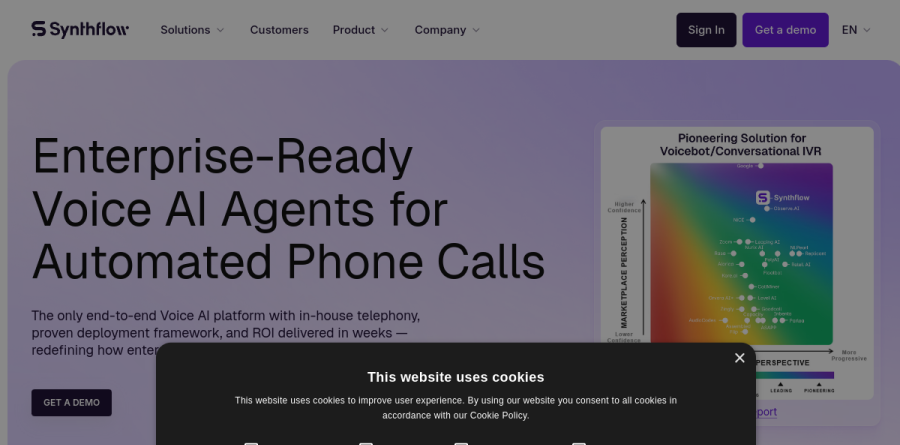
Synthflow builds AI voice agents that hold real phone conversations — answering inbound calls, dialing outbound ones, and carrying a task through to a booked appointment or a resolved request. The homepage positions the product as enterprise-ready voice AI for automated phone calls, and leans on one structural claim: Synthflow is the only end-to-end voice AI platform with in-house telephony, owning the call path rather than renting it.
That framing shapes the rest of the product. Instead of a chatbot with speech bolted on, Synthflow presents a complete voice AI OS — agent design, simulated testing, live call delivery, and post-call analysis under one roof. The vendor reports more than 65 million customer calls handled on the platform.
Designing agents with the BELL Framework
Synthflow organizes the agent lifecycle into the BELL Framework — Build, Evaluate, Launch, Learn — and treats it as one repeatable process rather than four disconnected chores. Building happens in the visual Flow Designer, where you define each step and connect APIs so an agent follows a deliberate path. The Multi-Agent System is a flexible, API-connected builder for modular voice flows, where subflows act as specialized agents that handle tasks independently — which Synthflow frames as giving teams full control over complex logic at scale.
Synthflow routes every agent through the Test Center, where simulated calls measure accuracy, response quality, and compliance against your own KPIs before a live customer ever hears it.
Telephony Synthflow runs in house
Synthflow's pitch in this section is explicitly comparative: unlike other voice AI platforms tied to third-party carriers, it says it runs on its own enterprise-grade communications infrastructure. Synthflow operates its own telephony layer, and the vendor reports sub-100 millisecond latency and carrier-grade reliability as the payoff. Just as important, adoption is not a rip-and-replace: Synthflow plugs into an existing SIP or PBX setup, and its directory lists contact-center platforms including Five9, Genesys, Cisco, Avaya, RingCentral, 8x8, and Dialpad next to carriers such as Twilio, Telnyx, and Plivo.
Workflows Synthflow actually handles
The published use cases are refreshingly unglamorous: AI receptionist, answering service, concierge, appointment setter, AI IVR, customer service, and WhatsApp conversations. Synthflow calls out BPO and call centers, healthcare, financial services, real estate, retail, and telecom as core industries, and the vertical CRM integrations make those claims concrete — a dental group can wire agents to Dentrix, a home services operator to ServiceTitan, Jobber, or Housecall Pro, a brokerage to Follow Up Boss. Synthflow describes its agents as multilingual and human-like, integrating securely with existing systems to automate conversations, boost availability, and reduce cost.
Integrations across the enterprise stack
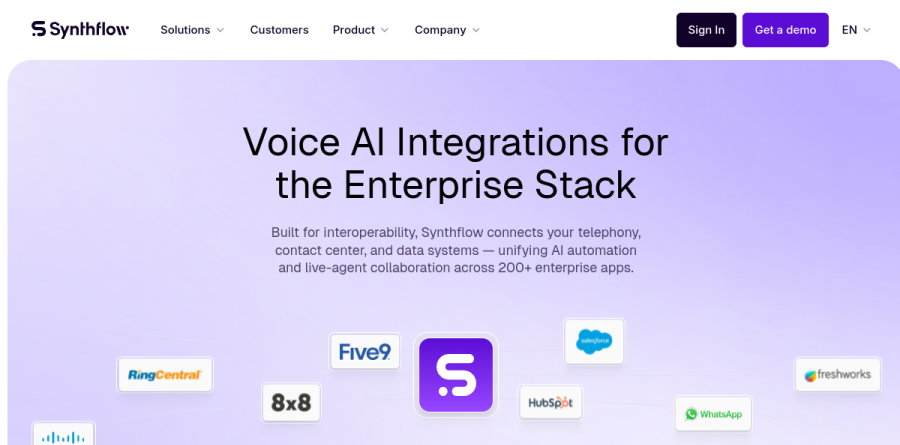
Synthflow headlines its directory as voice AI integrations for the enterprise stack, and the breadth is genuine. Salesforce, HubSpot, Pipedrive, Zoho, and GoHighLevel cover CRM; Cal.com, Google Calendar, and Microsoft Calendar cover booking; Zendesk and Intercom cover support; Gong, Outreach, Apollo.io, and Clay cover revenue teams. Builders who prefer glue over code get Zapier, Make, and n8n. The vendor reports more than 200 integrations in total.
Monitoring, QA, and compliance
Once agents go live, Auto-QA analyzes conversations in real time and feeds accuracy and intent insights into the next version, while real-time monitoring exposes every call, webhook, and API for faster debugging. Synthflow also describes data fine-tuning that will let enterprises improve model behavior using their own conversation history — worth reading as roadmap language rather than a shipped capability. On governance, the platform claims SOC 2, HIPAA, PCI DSS, GDPR, and ISO 27001 coverage with region-based hosting.
Who should choose Synthflow
Synthflow fits mid-market and enterprise teams with genuine call volume, an existing telephony investment they cannot abandon, and compliance obligations that rule out lighter tools. It is not ideal for solo operators or small businesses experimenting with voice AI, since the pricing page now publishes a single Enterprise tier scoped around call volume, concurrency, telephony setup, integrations, and launch support, with no self-serve entry point in sight.
Strengths
- Fastest no-code setup in the category — ease of use is the top theme in G2 reviews (364 mentions) and it holds 4.5/5 with fastest-implementation badges
- True usage billing: no license fee, no contract, and failed calls are not charged — you pay only for connected minutes
- Deep agency tooling: HubSpot, Salesforce, GoHighLevel, Zapier and Twilio integrations plus a full white-label/reseller toolkit with sub-accounts
- Volume pricing scales down meaningfully — from ~$0.12/min at 20,000 min/mo to $0.07/min at 400,000+ minutes
Watch out for
- Advertised $0.08/min is rarely what you pay — voice engine ($0.09) + LLM ($0.02–$0.05) + telephony and $0.04/min add-ons push real rates to $0.13–$0.24/min
- HIPAA compliance and unlimited concurrency are locked behind Enterprise contracts starting at $30,000/year
- Slack support ends after 30-day onboarding; users report slow ticket response times afterward
- Native phone numbers limited to US, Canada and Australia; reviewers report occasional latency spikes and weak barge-in handling
Key features
| Feature | What it does |
|---|
| No-code flow builder | Drag-and-drop conversation designer with branching logic, knowledge bases, and voice previews — build and test agents before adding a payment method. |
| Bundled voice engine | STT plus ElevenLabs-quality TTS at a flat $0.09/min, with optional Performance Routing and Global Low Latency Edge add-ons at $0.04/min each. |
| LLM choice per agent | Pick the brain per use case: GPT-4.1 mini at $0.02/min up to GPT-5/5.1/5.2 at $0.04/min or GPT-4.1 at $0.05/min. |
| White-label & reseller toolkit | $2,000/mo add-on (included in Enterprise) for rebranding the platform with sub-accounts and client billing — a core differentiator vs developer APIs. |
| CRM and workflow integrations | Native HubSpot, Salesforce, GoHighLevel, Zapier, Twilio, calendar booking, webhooks and full API access. |
| Concurrency scaling | 5 simultaneous calls included on PAYG, expandable to 50 at $20/slot/mo; unlimited concurrency with priority queueing on Enterprise. |
How Synthflow compares
| Alternative | How it differs |
|---|
| Vapi | Developer-first voice API: ~$0.05/min platform fee plus at-cost providers, often under $0.10/min all-in for engineering teams — but no no-code builder or white-label. |
| Retell AI | API-based agents from roughly $0.07/min; strong for developers and contact centers, thinner agency/reseller tooling. |
| Bland AI | Flat ~$0.09/min on self-serve with proprietary infrastructure and strong latency claims, but far less no-code and CRM tooling. |
Frequently asked questions
How much does Synthflow cost per minute?
Synthflow's pay-as-you-go stack starts with a $0.09/minute voice engine fee, plus an LLM charge of $0.02 (GPT-4.1 mini) to $0.05 (GPT-4.1), and $0.02/minute for managed Twilio — $0 if you bring your own. Typical all-in rates run $0.11–$0.16/minute. Synthflow advertises entry pricing from $0.08/minute, dropping to $0.07 at 400,000+ monthly minutes.
Synthflow vs Vapi: which is better?
Vapi is developer-first: roughly $0.05/minute platform fee plus at-cost STT/LLM/TTS providers, so engineering teams often land under $0.10/minute. Synthflow costs more ($0.11–$0.16/minute all-in) but ships a no-code flow builder, native CRM integrations, and a $2,000/month white-label toolkit. Agencies and non-technical teams pick Synthflow; developers wanting granular stack control pick Vapi.
Does Synthflow have a free trial?
There's no time-limited trial. You can sign up free, build agents, design flows, add knowledge bases, and preview voices without entering a payment method. Usage charges only begin once you add a card and start placing calls. Some third-party reviews mention a small test allowance of roughly 10–20 call minutes, but Synthflow publishes no official free-minute figure.
Is Synthflow HIPAA compliant?
Only on Enterprise. Pay-as-you-go accounts get SOC 2, GDPR, and ISO 27001 coverage, but HIPAA compliance with BAA support is reserved for Enterprise contracts, which start around $30,000 per year and target 10,000+ minutes monthly. Healthcare teams handling PHI should budget for Enterprise or look at HIPAA-ready alternatives before building on the self-serve plan.
What happened to Synthflow's $29 Starter plan?
Synthflow discontinued its subscription tiers — the $29 Starter, $99–$450 Pro, $449–$900 Growth, and $899 Agency plans referenced in older reviews are no longer sold to new customers. As of mid-2026 there are two options: usage-based Pay As You Go (about $0.11–$0.16 per minute, no base fee) and custom Enterprise contracts from $30,000 annually.
Synthflow ratings on other platforms
Independent user ratings from third-party review sites, linked here for transparency.
These are not our editorial score, are captured on the date shown, and may have changed since.