The full review
What is Google Dialogflow / CCAI?
Google Dialogflow / CCAI is the conversational AI stack Google Cloud offers for building chat and voice agents, and it now spans two generations of tooling. The first layer is Dialogflow ES, which Google describes on its own pricing page as an older agent building platform suitable for smaller and simpler agents. The second is Conversational Agents, which the vendor divides into Flows, also known as Dialogflow CX, for deterministic agents built with intents and natural language understanding, and Playbooks, for generative agents defined through plain instructions.
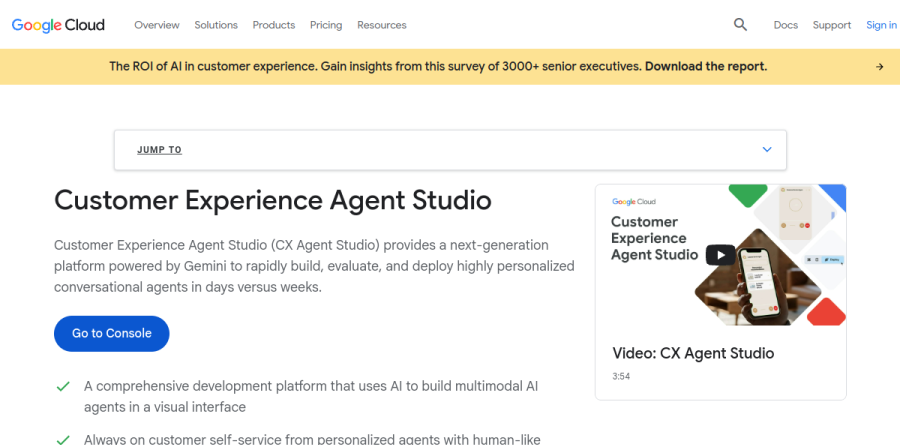
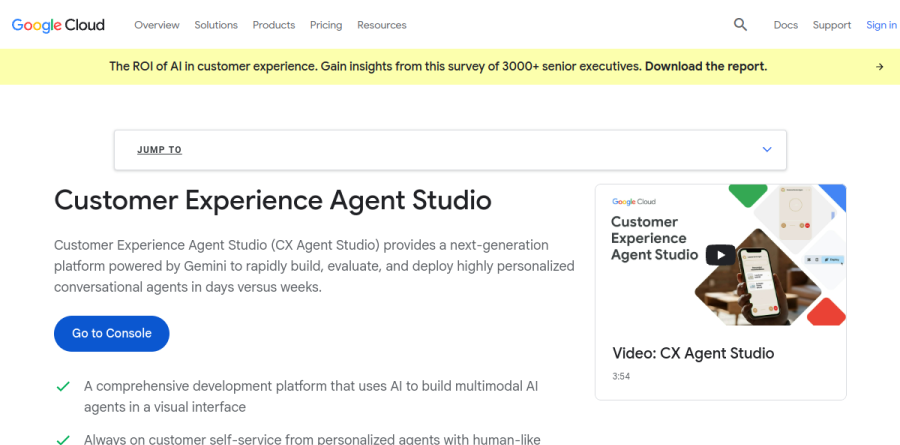
Anyone typing the classic Dialogflow address today lands somewhere new. That path redirects to Customer Experience Agent Studio, which Google presents as a Gemini-powered platform for building, evaluating, and deploying personalized conversational agents inside Gemini Enterprise for Customer Experience. The Dialogflow editions and their pricing pages still sit behind the rename.
Flows, Playbooks, and hybrid agents
The useful split inside Google Dialogflow / CCAI is deterministic versus generative construction. Flows agents route on intents, which suits scripted, regulated journeys that must answer identically every time. Playbooks agents take natural language instructions and draw on building blocks Google lists as Data Stores, generative fallbacks, and generators, which suits open-ended answering grounded in your own content.
Google documents hybrid designs explicitly: a Flow can call a Playbook, a Data Store, a generator, or a generative fallback, and a Playbook can call a Flow, with usage aggregated per conversation turn according to what each turn consumes. The direction of the call changes the bill: when a Flow calls a Playbook, only the turns that use the Playbook are charged at Playbook rates, but when a Playbook calls a Flow, Google charges every turn in the conversation as Playbooks.
Voice, IVR, and multimodal reach
Voice is where Google Dialogflow / CCAI earns its keep in contact centers. The vendor reports human-like voices in over 40 languages, direct audio to audio translation in 10 core languages to cut latency, and agents that handle text, audio, and images in one session. For an IVR replacement project, that combination matters more than any single feature, because callers speak naturally instead of walking a menu tree.
Google also describes an omnichannel gateway covering web, mobile, voice, email, social channels, and apps, with out-of-the-box connectors and MCP support for wiring agents into backend systems. Partnerships with CCaaS vendors let existing deployments tap the same models without a rebuild.
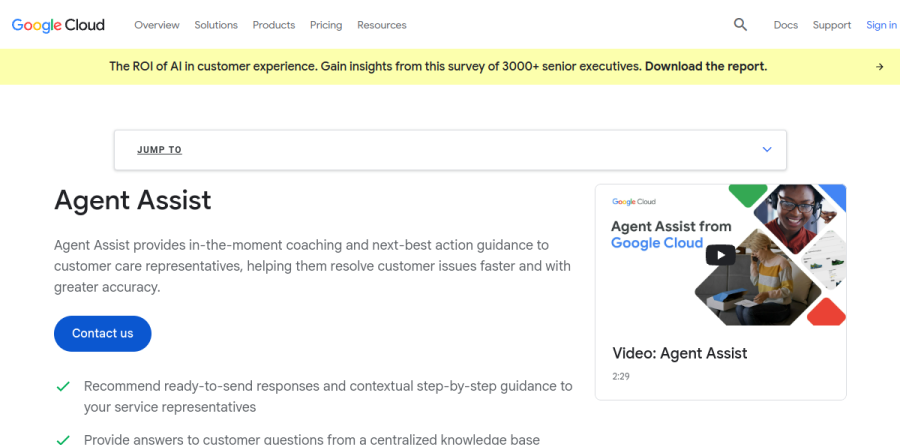
The CCAI half of Google Dialogflow / CCAI equips human representatives rather than replacing them. Agent Assist delivers in-the-moment coaching and next-best action guidance, with an AI Coach feature for step-by-step help during a live contact and an AI Trainer feature that runs interactive simulations for new hires. Smart Reply proposes ready-to-send responses, knowledge suggestions draw on your documentation and CRM, and calls are transcribed in real time then summarized with Gemini models to cut after-call work.
Google reports that Agent Assist helps service reps handle 28% more conversations, and Customer Experience Insights surfaces service trends through plain language questions.
Building, evaluating, and shipping agents
Google describes a low-code conversational agent builder, a multimodal conversation simulator, evaluations, and tracing inside a single interface, alongside 35 prebuilt agent templates, with the vendor claiming teams deploy in days rather than weeks. Evaluations matter most: Google frames them as a way to automate testing, catch regressions after changes, and measure response quality, which is the discipline most bot projects skip.
Who should choose Google Dialogflow / CCAI
Google Dialogflow / CCAI suits organizations already committed to Google Cloud that run heavy call and chat volume and have the engineering capacity to design, connect, and evaluate agents properly. Retail and restaurant operators fit the current direction well, since Google positions Gemini Enterprise for Customer Experience around businesses like retailers and restaurants and layers a prebuilt multimodal Shopping agent and AI Commerce Search onto the same foundation.
It is not ideal for a small business that wants a turnkey website chat widget with flat seat pricing and no cloud project to manage, because consumption billing across requests, audio seconds, and sessions rewards teams that can forecast usage. Existing Dialogflow ES and Flows customers should also plan a migration conversation, since Google now treats flow-based agents as the legacy path.
Strengths
- Mature, production-proven platform with strong 30+ language voice and NLU coverage
- Visual flow builder (CX) plus full API/SDK control for complex, stateful conversations
- Deep integration with Google Cloud, Vertex AI generative features, and Speech-to-Text/Text-to-Speech
- Transparent per-session usage pricing with a genuine free tier and $600 starting credit
Watch out for
- Steep learning curve; CX flows, pages and webhooks are complex for non-developers
- Total cost is hard to predict because voice stacks separate STT, TTS, LLM and telephony charges
- Full contact-center (CCAI) deployment is quote-based and typically needs partners or system integrators
- Splitting legacy ES and newer CX/Conversational Agents creates migration friction and documentation confusion
Key features
| Feature | What it does |
|---|
| Conversational Agents (CX) visual builder | Graph-based designer for multi-flow, stateful agents with pages, intents, entities and webhook fulfillment. |
| Voice / telephony integration | Built-in Phone Gateway plus CCAI partner telephony, powered by Google Cloud Speech-to-Text and Text-to-Speech. |
| Generative AI features | LLM-based generative answers, data-store agents (RAG over your content) and generators backed by Vertex AI. |
| Agent Assist & analytics | Real-time agent suggestions, knowledge assist and conversation analytics for human-in-the-loop contact centers. |
How Google Dialogflow / CCAI compares
| Alternative | How it differs |
|---|
| Amazon Lex | AWS-native voice/chat bot engine, tightly paired with Amazon Connect; similar usage-based pricing and cloud lock-in. |
| Cognigy | Enterprise conversational/voice AI focused on contact centers with a friendlier low-code UX, but enterprise-tier pricing. |
| Vapi | Developer-first voice AI platform with fast LLM-native call building; leaner than Google but less enterprise contact-center depth. |
Frequently asked questions
Is Google Dialogflow free to use?
There is a free tier: a $600 Dialogflow credit valid for 12 months on activation plus the standard $300 GCP new-account credit, and ES includes a small monthly free-request allowance. Beyond that you pay per request (ES) or per session (CX), with voice adding separate speech and LLM charges.
What is the difference between Dialogflow ES and CX?
ES (Essentials) is the older, simpler, per-request product for basic bots. CX (now branded Conversational Agents) is the current enterprise offering with visual flows, stateful sessions, generative AI and per-session billing, better suited to complex voice and contact-center use cases.
Google Dialogflow / CCAI ratings on other platforms
Independent user ratings from third-party review sites, linked here for transparency.
These are not our editorial score, are captured on the date shown, and may have changed since.
