The full review
What is Amazon Connect?
Amazon Connect is the cloud contact center service from AWS, marketed today as Amazon Connect Customer. It runs inbound and outbound conversations across voice, chat, email, SMS and third-party messaging such as WhatsApp Business messaging, and AWS supplies the telephony itself rather than leaving you to contract a carrier.
The current positioning leans on agentic AI: autonomous AI agents that navigate connected systems to find solutions and hand off to a human when needed, assembled on a no-code canvas AWS calls the Agentic CX Designer. Underneath sits the drag-and-drop workflow designer used to build IVR flows and chatbots, plus native flow integration with AWS Lambda for automating processes across other AWS services.
Omnichannel routing and self-service
AWS owns the carriage, so Amazon Connect offers direct inward dial, toll-free, shared cost and Universal International Freephone numbers in over 100 countries, and the vendor reports telephony coverage across 158. Omnichannel routing places voice, chat, email and tasks into one agent interface, with skills-based routing and a rules engine deciding who receives what.
Self-service is where the product has changed most. Instead of a rigid IVR tree, agentic self-service lets AI agents work through connected systems toward a resolution, with Amazon Lex requests included when they originate inside your instance. Outbound campaigns add a predictive dialer with answering machine detection that throttles dialing against predicted agent availability.
Agent workspace and live assistance
The Amazon Connect agent workspace pulls the Contact Control Panel, customer context and casework onto one screen. Step-by-step agent guides recommend the next action, real-time agent assist delivers AI recommendations and responses during the live conversation, and AI-powered summaries of customer conversations streamline and automate post-contact work. Unified customer profiles show who is on the line, case management carries issues spanning several interactions, and Amazon Connect Tasks tracks follow-up work.
Analytics, quality and workforce planning
Conversational analytics scores sentiment and trends across voice and chat, categorizes contacts for compliance tracking, and redacts sensitive fields such as name, address and social security number. AI-powered automated evaluations can assess every interaction rather than a sampled few, and screen recording captures agent screens with audio. Workforce management is bundled too: contact forecasting at 15- or 30-minute intervals, capacity planning for staffing budgets, and scheduling aligned to demand.
How the pricing model works
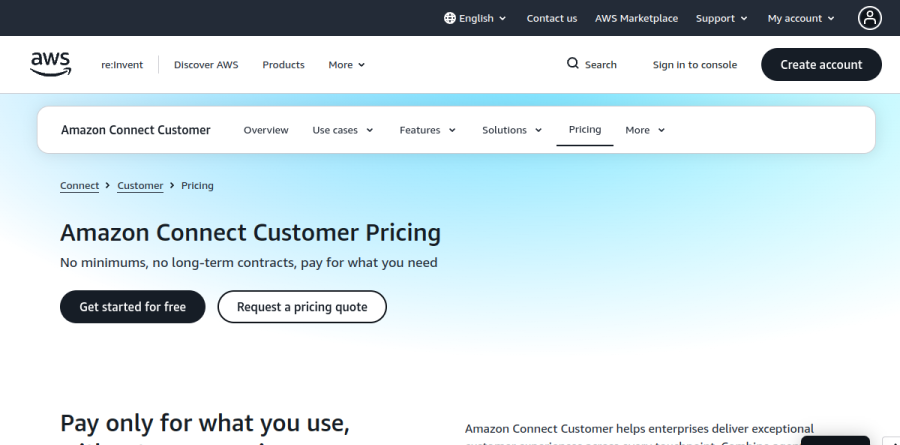
Amazon Connect bills by consumption rather than by seat: AWS states there are no minimums, no long-term contracts and no seat-based licensing. The current Amazon Connect Customer plan folds conversational analytics, real-time agent assistance, forecasting and agent scheduling, performance evaluations and screen recording into the per-channel rate. Customer Basic, which AWS says some customers might still be on, charges lower per-channel rates, offers a subset of AI capabilities, and prices extras such as screen recording and performance evaluations separately.
Telephony is charged on top of the voice service rate as a per-day fee for each claimed number plus per-minute carrier usage, so any honest budget must include the Global Telephony rates for your countries. An AWS Free Tier allowance and several first-use free trials let teams pilot first.
Integrations and the AWS backbone
Living inside AWS is the strength and the complication. Speech runs through Amazon Polly generative text-to-speech and Amazon Nova Sonic, with third-party speech models configurable. Custom AI agents reach outward through Amazon Bedrock AgentCore Gateway, including agents exposed over Model Context Protocol, and ground answers in Bedrock Knowledge Bases. There is a native Salesforce Contact Center with Amazon Connect Customer integration that unifies routing across both platforms, and Zendesk Contact Center, powered by Amazon Connect Customer, unifies voice and digital channels in a single agent environment. The split matters for budgeting: Polly, Nova Sonic, third-party speech model configuration and in-instance Lex requests are included in the channel rate, while AI agents using Bedrock AgentCore Gateway or Bedrock Knowledge Bases incur those services' costs on top.
Who should choose Amazon Connect
Amazon Connect suits organizations already standardized on AWS with developers available to build flows, wire integrations and manage IAM. It rewards contact centers with volatile or seasonal volume, since consumption billing avoids paying for idle seats, and it appeals to teams consolidating workforce management, quality management and telephony contracts into one platform.
It is not the right pick for a small support team wanting a turnkey phone system running this afternoon. Amazon Connect hands you a construction kit rather than a finished product, and the configuration surface plus multi-part billing will frustrate anyone without technical help. Those buyers are better served by an all-in-one helpdesk with a phone channel.
Strengths
- True pay-as-you-go — no seat licenses, minimums or contracts, so you pay only for actual voice minutes and messages, ideal for seasonal or spiky volume
- New AI-inclusive per-minute rate bundles Contact Lens, Amazon Q and agentic AI, simplifying what was previously a maze of separate add-ons
- Elastic scale from a handful to tens of thousands of concurrent agents on AWS infrastructure
- Deeply programmable via Lambda, Lex, Bedrock and APIs, with a visual flow designer for fully custom routing and self-service
Watch out for
- Billing is fragmented across many line items — platform usage, telephony/number rental and add-ons are all separate, making total monthly cost genuinely hard to forecast
- Steep learning curve: building and maintaining flows needs AWS and developer expertise, so it is not turnkey for non-technical teams
- Bare-bones out of the box — no built-in unified-comms (internal chat, meetings), and support requires a paid AWS support plan
- Telephony (carrier minutes plus number rental) is charged on top of every platform minute, so headline per-minute rates understate the real cost
Key features
| Feature | What it does |
|---|
| Agentic AI & Amazon Q | Pre-built AI voice/chat agents, real-time agent assist, AI-powered manager insights and automated post-contact summaries. |
| Contact Lens analytics | Real-time transcription, sentiment and conversational analytics, performance evaluation and screen recording across voice and chat. |
| Omnichannel routing | Voice, chat, email, SMS, tasks and third-party messaging unified in one skills-based routing engine and flow. |
| AWS-native extensibility | Native integration with Lambda, Lex, Bedrock, S3 and Kinesis, plus APIs and a visual flow designer for custom logic. |
How Amazon Connect compares
| Alternative | How it differs |
|---|
| Genesys Cloud CX | Turnkey CCaaS with per-seat or concurrent/hourly pricing; faster to deploy but far less programmable than Connect. |
| Five9 | Established cloud contact center with strong outbound dialer and AI; per-seat licensing, more packaged and less DIY. |
| Twilio Flex | Similarly developer-first, programmable contact center billed per active user hour or usage; comparable build-it-yourself model. |
Frequently asked questions
Does Amazon Connect charge per seat or per agent?
No. It is pure usage-based — you pay per voice minute and per message with no seat licenses, minimums or contracts. AI features are either bundled into the ~$0.038/min AI-inclusive rate or billed a la carte on the cheaper Customer Basic voice rate.
Is the per-minute rate the full cost?
No. Telephony is billed separately on top: number rental (~$0.03/day for a DID, ~$0.06/day for toll-free) plus carrier per-minute charges on every call. Add-ons like Voice ID ($0.025/transaction) and Tasks ($0.070/task) are also extra, so budget beyond the headline rate.
Amazon Connect ratings on other platforms
Independent user ratings from third-party review sites, linked here for transparency.
These are not our editorial score, are captured on the date shown, and may have changed since.
