The full review
What is Twilio Voice AI?
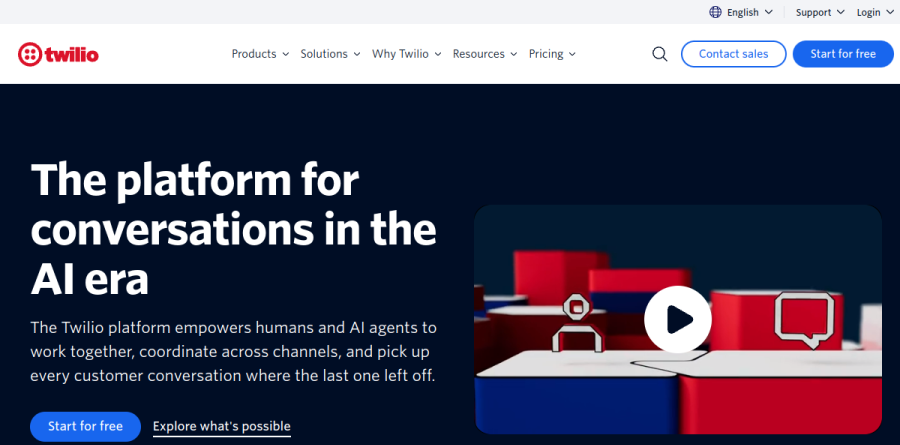
Twilio Voice AI is less a product you switch on than a stack you assemble. It joins the long-standing Twilio telephony business to the newer Conversations layer, with Conversation Relay as the connective piece linking a live phone call to the language model of your choosing. The Twilio homepage frames the platform around humans and AI agents working together, picking up each conversation where the last one left off.
In practice, Twilio supplies the ears and the voice while your application supplies the reasoning. Conversation Relay pairs real-time speech-to-text with text-to-speech and brokers the exchange over a WebSocket API, attached to a call by a short block of TwiML. Twilio pitches this bring-your-own-LLM approach as a way to control the experience, manage costs, and adopt new models as they ship.
Inside Conversation Relay

The detail work in Conversation Relay is about making a synthetic voice feel less synthetic. Twilio cites Deepgram Flux, automatic language detection, and SSML tags as the tools for curing awkward digital pauses, and adjustable interruption sensitivity keeps an agent composed in noisy environments. Text-to-speech can come from Twilio or from a provider you bring yourself.
Latency gets top billing, reasonably so, since a lag of half a second reads as hesitation on a call. The vendor reports internal benchmarks of roughly half a second median and about three quarters of a second at the 95th percentile, noting that results vary by model. When a request exceeds what the agent should handle, Conversation Relay supports a clean transfer to a live person.
The telephony foundation underneath
This is where Twilio separates itself from newer voice AI entrants. Beneath the model sits Programmable Voice, phone numbers across more than 100 locales, SIP interfaces, BYOC trunking, and Media Streams, infrastructure that has carried production call traffic for years. Branded Calling puts a verified identity on outbound calls, and Answering Machine Detection keeps your agent from pitching a voicemail box.
Twilio also recommends a sequence rather than a leap: measure answer rates with Voice Insights and Conversation Intelligence, raise trust with Branded Calling, then decide which calls deserve automation. It is sober framing for a category that usually opens with a demo.
Memory, intelligence, and orchestration
The Conversations layer is what keeps a caller from repeating themselves. Conversation Orchestrator connects channels into one continuous conversation with coordinated routing and workflows. Conversation Intelligence applies Language Operators, Twilio-authored or custom, to transcribe and analyze interactions. Conversation Memory maintains customer profiles alongside memory generation and recall, while Enterprise Knowledge grounds answers in your policies and reference documents.
For contact centers, the payoff shows up at handoff. A human picks up with the context the AI agent already gathered, which is the difference between a warm transfer and starting over.
How teams put it to work

The Conversation Relay page groups use cases around self-service, lead qualification, appointment scheduling, and AI agent observability. The Voice AI page adds outbound campaigns, appointment reminders, payment nudges, CSAT surveys, and agent assistance that generates transcripts in real time.
Not every team wants to write a WebSocket server. Twilio offers a Conversation Relay Studio Widget for drag-and-drop flows, plus an onboarding guide and developer documentation, and trusted partners for buyers who would rather adopt a prebuilt agent. Regulated industries get PCI-compliant workflows and HIPAA-eligible architectures.
Who should choose Twilio Voice AI
Twilio Voice AI suits engineering teams that want to own their agent logic while keeping the telephony boring and reliable. If you already run Twilio numbers, adding Conversation Relay is an incremental step rather than a migration. A global footprint, regulated workloads, and heavy call volume all favor this stack, and committed-use agreements exist once usage outgrows the volume tiers.
It is a poor fit for a small team hoping to launch a voice agent this afternoon without a developer. Conversation Relay assumes you host an endpoint and supply your own model, so a non-technical buyer spends more time integrating than configuring. Those teams are better served by a turnkey bot, or by one of the Twilio partners.
Strengths
- Transparent, competitive $0.07/min ConversationRelay rate with bring-your-own-LLM cost control
- Carrier-grade reliability and global telephony reach that most rivals resell rather than own
- Vendor-flexible: pick your own LLM and TTS provider (Google, Amazon, ElevenLabs)
- Deep ecosystem — Studio, Flex, Segment and Conversation Intelligence for routing and post-call analytics
Watch out for
- Not turnkey: a production voice agent means stitching ConversationRelay, Studio and an external LLM together
- All-in cost is hard to estimate — relay + telephony + LLM tokens + premium TTS stack up quickly
- Steep engineering overhead; unsuitable for non-technical teams or rapid, no-code deployment
- Advanced and enterprise features are quote-based, reducing upfront pricing transparency
Key features
| Feature | What it does |
|---|
| ConversationRelay | Managed real-time speech-to-text, text-to-speech and LLM orchestration over a live phone call. |
| Bring-your-own-LLM | Connect any model (OpenAI, Anthropic, self-hosted) to control latency, behavior and token cost. |
| Multi-vendor TTS | Choose Google, Amazon or ElevenLabs voices to trade off output quality against latency and price. |
| Conversation Intelligence | Real-time transcription with custom operators for extraction and post-call analytics. |
How Twilio Voice AI compares
| Alternative | How it differs |
|---|
| Retell AI | More turnkey voice-agent platform; far faster to deploy for teams without infra engineers. |
| Vapi | Developer-focused voice orchestration with built-in models and less DIY assembly than Twilio. |
| Bland AI | End-to-end managed voice agents with simpler, more predictable per-minute pricing. |
Frequently asked questions
How much does a Twilio voice AI agent actually cost per minute?
ConversationRelay is $0.07/min, but that excludes telephony (~$0.014/min outbound US), your own LLM token costs and any premium TTS such as ElevenLabs. Budget roughly $0.10/min and up all-in, more with high-end voices.
Is Twilio Voice AI a plug-and-play bot builder?
No. It ships the building blocks — ConversationRelay, Studio, bring-your-own-LLM — and you still need engineering to assemble a production agent. Purpose-built platforms like Retell or Vapi deploy noticeably faster.
Twilio Voice AI ratings on other platforms
Independent user ratings from third-party review sites, linked here for transparency.
These are not our editorial score, are captured on the date shown, and may have changed since.