The full review
What is Deepgram?
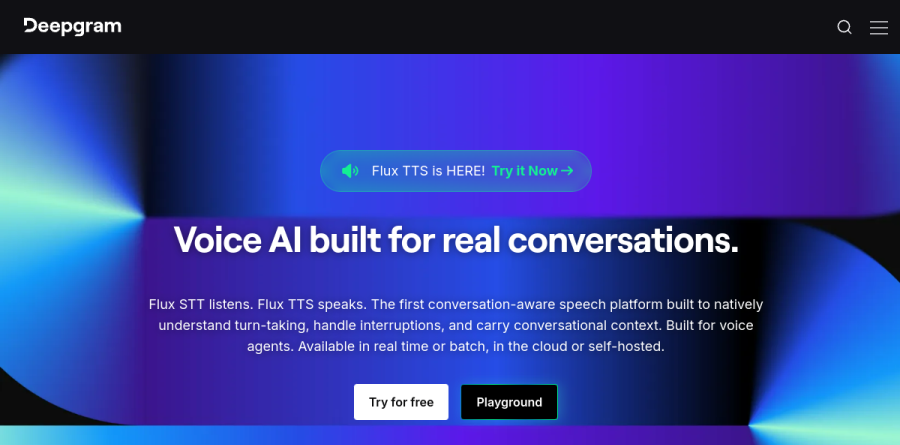
Deepgram is voice AI infrastructure aimed at developers. The homepage leads with the idea of voice AI built for real conversations, and the framing is deliberate: rather than selling transcription alone, Deepgram packages speech-to-text, text-to-speech and LLM orchestration behind one set of APIs so a team can ship a talking application without stitching three vendors together.
Deepgram builds its own models - Flux for conversational speech, Nova-3 for transcription and the Aura family for synthesis - alongside a hosted Whisper Large option. Flux is the conversation-aware layer, Nova-3 handles general recognition, and the Aura family covers synthesis. Owning that stack is what lets Deepgram argue on latency and cost at once, and it shows in the product menu: Speech-to-Text API, Text-to-Speech API, Voice Agent API and Audio Intelligence API, each usable alone or together.
Transcription built for production audio

The Speech-to-Text API is the foundation of the lineup, powering everything from transcription and analytics to real-time voice agents. Deepgram exposes real-time streaming and pre-recorded processing, with Nova-3 offered in monolingual and multilingual variants and Whisper Large available for batch work. The vendor reports more than 50 supported languages and streaming latency under 300ms.
What makes the service practical rather than merely accurate is the option list around each model. Smart formatting is included at no extra cost, while redaction, keyterm prompting, entity detection and speaker diarization are metered add-ons billed per minute on top of the base model rate. A contact centre team can enable speaker labels and PII redaction; a medical scribe product can push domain vocabulary through keyterm prompting instead of retraining. Custom model training and industry-tuned models cover audio that never resembles a benchmark set.
Voice agents on a single unified API

The Voice Agent API is where Deepgram is pushing hardest, bundling speech-to-text, LLM orchestration and text-to-speech into one real-time connection. The vendor describes it as a unified conversational AI API for building enterprise-ready voice agents, and the features that matter on a live call are there: barge-in detection so a caller can interrupt, turn-taking prediction so the agent knows when a sentence has actually ended, function calling for tool use, and mid-session control for changing behaviour partway through.
Deepgram also lets you keep pieces you already like. BYO LLM and BYO TTS are supported configurations, and agent settings expose model choices directly, with Flux-General-EN as the listen model and Flux-Kit-EN as the speak model alongside third-party reasoning options such as Gemini-3.1-Flash-Lite.
Synthesis and audio intelligence
On the output side, Aura-1 and Aura-2 are the established text-to-speech models, joined more recently by Flux TTS for conversational work. The Audio Intelligence API layers understanding on top of transcripts through summarization, topic detection, sentiment analysis and intent recognition, covering post-call analytics without a second vendor.
Deployment options and plan structure
Deepgram runs in the cloud or self-hosted, and lists SOC 2 Type 1 and Type 2 certification, HIPAA compliance with BAAs signed for Enterprise customers handling ePHI, GDPR readiness with a dedicated EU endpoint at api.eu.deepgram.com, plus CCPA and PCI compliance among its controls. Buyers who cannot route audio through the shared cloud endpoint can use the dedicated EU endpoint or run the models self-hosted.
Commercially the ladder is short. Pay As You Go starts with a free credit and no card required, Growth is an annual pre-paid commitment that discounts per-unit rates across STT, TTS and Voice Agent usage, and Enterprise is quote-only. Speech-to-text and Voice Agent usage meters per minute, text-to-speech per 1,000 characters and Audio Intelligence per 1,000 tokens, so a pilot runs on the $200 free credit while Growth starts at $4K+ per year and only pays off at volume.
Who should choose Deepgram
Deepgram suits engineering teams embedding voice into a product - the vendor names contact centres, medical transcription, conversational AI, speech analytics and media transcription - and especially anyone assembling a real-time agent who would rather call one Voice Agent API than orchestrate three services. The deployment options and per-request add-ons make it particularly strong for regulated industries and for products with unusual vocabulary.
It is a poor fit for non-technical buyers wanting a finished application, because what ships here is an API and a key, not a dashboard you hand to an operations team. Businesses needing occasional transcription of a few files will find a consumer app simpler and cheaper than a metered developer platform.
Strengths
- Owns its full speech stack (Nova-3 STT, Aura-2 TTS), giving strong accuracy and low latency
- Transparent, granular usage-based pricing with a genuinely generous $200 no-card free credit
- Voice Agent API unifies STT, LLM orchestration, and TTS with barge-in and turn-taking built in
- Flexible deployment: cloud, single-tenant, in-VPC, self-hosted, and on-prem with HIPAA/GDPR support
Watch out for
- Developer-first and API-only — no no-code builder, dashboard flows, or prebuilt agent templates
- Add-ons (diarization, redaction, summarization) and per-channel stereo billing can multiply effective cost
- Growth plan's $4,000/year floor risks overpayment for seasonal or low-volume users
- Advanced Voice Agent tier ($0.163/min) is pricey versus the standard tier and BYO options
Key features
| Feature | What it does |
|---|
| Voice Agent API | Single API that orchestrates speech-to-text, an LLM, and text-to-speech in real time, with barge-in detection, turn-taking prediction, and function calling. |
| Nova-3 speech-to-text | Deepgram's flagship STT model for streaming and pre-recorded audio, with monolingual and multilingual options tuned for accuracy and speed. |
| Aura-2 text-to-speech | Low-latency neural voices priced per 1k characters, designed for natural, real-time conversational output. |
| Bring-your-own LLM/TTS | Use Deepgram's orchestration while swapping in your own language model or TTS provider to cut cost or meet specific requirements. |
How Deepgram compares
| Alternative | How it differs |
|---|
| Vapi | No-code/low-code voice agent orchestration that stitches third-party STT/LLM/TTS; faster to launch but not a first-party model owner. |
| Retell AI | Turnkey conversational voice agent platform aimed at contact centers, with more built-in call tooling but less model-level control. |
| ElevenLabs | Best-in-class TTS with a Conversational AI product; stronger voice quality, weaker STT and self-hosting story than Deepgram. |
Frequently asked questions
Does Deepgram have a free plan?
There is no perpetual free tier, but new accounts get a $200 credit with no credit card required and no expiration — enough for substantial testing before you pay.
How much does the Deepgram Voice Agent API cost?
The standard full-stack Voice Agent runs about $0.075/min ($4.50/hr) pay-as-you-go. Bring-your-own-LLM/TTS tiers fall to roughly $0.041–0.065/min, while the Advanced tier is $0.163/min.
Deepgram ratings on other platforms
Independent user ratings from third-party review sites, linked here for transparency.
These are not our editorial score, are captured on the date shown, and may have changed since.