The full review
What is DigitalOcean?
At its core, DigitalOcean is a cloud infrastructure provider built around the Droplet, which the company defines as a Linux-based virtual machine running on virtualized hardware, usable as a standalone server or as part of a larger cloud infrastructure. The appeal is predictability: every Droplet plan is listed at a flat monthly rate on the pricing page, alongside a bundled monthly transfer allowance.
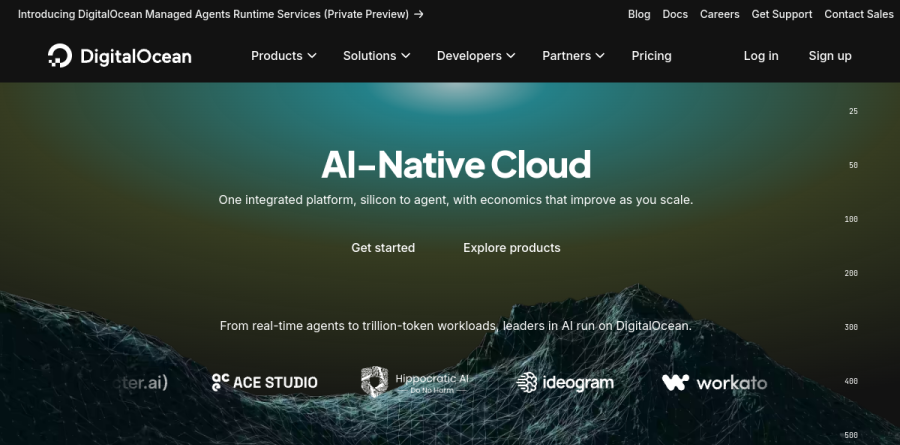
The positioning has shifted recently. DigitalOcean now presents itself as an AI-Native Cloud organized into five layers — Infrastructure, Core Cloud, Inference Engine, Data and Learning, and Managed Agents — under the banner Scale inference, not complexity. The classic VPS business still sits underneath all of it, but the platform story now runs from silicon to agent.
Droplets and predictable compute

Droplets ship in named families: Basic, General Purpose, CPU-Optimized, Memory-Optimized, Storage-Optimized, and GPU, with Regular and Premium Intel CPU options in the pricing tables and a Premium AMD option on Basic plans. Basic Droplets run on shared CPU and are pitched as the most efficient CPU usage at lower cost. Every plan bundles an outbound transfer allowance, from 500 GiB on the entry Basic plan up to 10,000 GiB on the largest Memory-Optimized configurations, and inbound bandwidth is always free.
Cloud Firewalls and Monitoring cost nothing extra, weekly Backups are billed as a percentage of the Droplet cost, and Snapshots handle on-demand disk images. DigitalOcean publishes a 99.99% SLA for Droplets. Marketplace 1-Click Apps — WordPress, LAMP, Docker, MySQL, Node.js, MongoDB — turn an empty server into a working stack in minutes.
Managed services that absorb the operations work
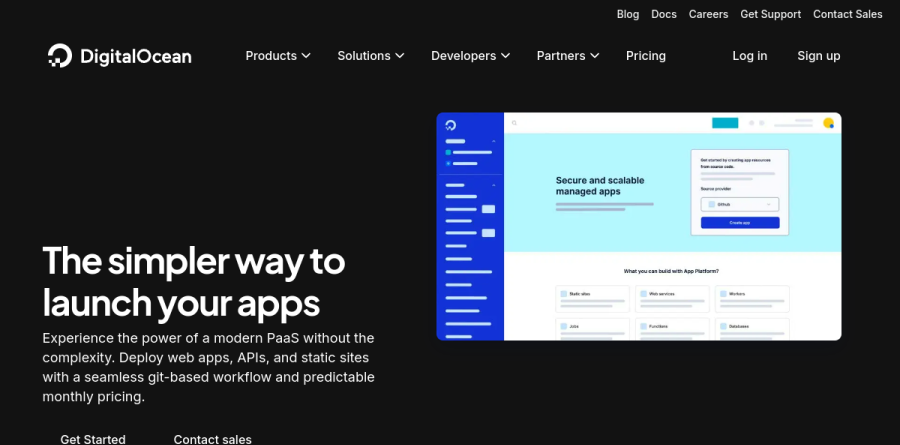
App Platform is the DigitalOcean PaaS for web apps, APIs, and static sites. It deploys straight from GitHub, GitLab, and Bitbucket, or from container images in Docker Hub and the DigitalOcean Container Registry, and layers on built-in CI/CD, staging, production, and preview environments, CPU-based autoscaling, managed SSL certificates with automatic renewal, scheduled jobs, and rollback to previous deployments. Supported runtimes cover Node.js, Python, PHP, Ruby, Go, Java, and .NET.
DigitalOcean Kubernetes, or DOKS, manages the control plane at no additional charge — a genuine line-item difference the vendor contrasts against clouds that bill per cluster — and adds Nodepool Scale-to-Zero, a Cluster Autoscaler reaching 1,000 nodes, and an optional High Availability control plane with a 99.95% uptime SLA. Managed Databases spans PostgreSQL, MySQL, MongoDB, Valkey, Kafka, and OpenSearch, with free daily backups, seven-day restore, and automatic failover to a standby node.
The AI and GPU layer
The newer half of DigitalOcean aims squarely at inference. GPU Droplets and Bare Metal GPUs offer NVIDIA H100, H200, and Blackwell hardware alongside AMD Instinct MI300X, MI325X, and MI350X. The Inference Engine provides serverless access to more than 80 models, including DeepSeek V3.2, Qwen 3, and Llama, with routing that sends each request to an appropriate model. Knowledge Bases and Vector Databases handle retrieval.
The vendor reports sub-second time-to-first-token and output speed 3.9 times higher than AWS Bedrock — benchmark claims worth verifying against your own workload, but the intent is clear: keep teams from wrangling GPU infrastructure. Capacity spans 20 data centers across 12 regions.
Who gets the most value
The sweet spot is a team that needs real infrastructure without a dedicated platform engineer. A Laravel or Rails shop can run staging on App Platform and production on a Basic Droplet, attach Managed Databases instead of babysitting Postgres, and add Load Balancers and Block Storage Volumes as traffic grows. Agencies use Cloudways, the DigitalOcean managed hosting arm, for client WordPress fleets. Startups can prototype LLM features on the Inference Engine and graduate to dedicated GPU Droplets once usage justifies it.
Who should choose DigitalOcean
Choose DigitalOcean if you want predictable infrastructure with a short learning curve — indie developers, small SaaS teams, agencies, and AI startups that value clear billing over an infinite service catalog. The documentation and community tutorials are a genuine asset when something breaks at midnight. It is less ideal for enterprises with deep compliance requirements or dependencies on the long tail of niche AWS and Azure services, where the narrower catalog eventually becomes a constraint rather than a simplification.
Strengths
- Flat, predictable pricing — a 4 GB Droplet is a fixed $24/mo with no surprise bills
- Clean dashboard and industry-leading documentation and tutorials
- Generous $200 credit for 60 days, free App Platform/Functions tiers, and free Kubernetes control plane
- Per-second billing (since Jan 2026) makes short-lived and batch workloads cheap
Watch out for
- Far fewer services than AWS/Azure/GCP — limited enterprise and advanced managed offerings
- Fewer global regions/data centers than the hyperscalers
- $200 signup credit expires after 60 days with no rollover or extension
- Backups add 20-30% to Droplet cost; load balancers, volumes and bandwidth overages billed separately
Key features
| Feature | What it does |
|---|
| Droplets (VPS) | Flat-rate Linux virtual machines from $4/mo across Basic, CPU-, memory- and storage-optimized tiers; Premium AMD from $7, Intel from $8. |
| Managed Databases | Fully-managed PostgreSQL, MySQL, Valkey (Redis), MongoDB, Kafka and OpenSearch from $15/mo with automated backups and failover. |
| Managed Kubernetes (DOKS) | Free control plane — you pay only for worker Droplets. Starts at $12/mo. |
| App Platform | Fully-managed PaaS to deploy apps directly from Git; free starter tier scaling to paid containers. |
| GPU Droplets & Inference | On-demand AI GPUs from $0.76/GPU/hr and model inference from $0.05 per million tokens. |
| Spaces & Block Storage | S3-compatible object storage with built-in CDN from $5/mo; block volumes from $10/mo. |
How DigitalOcean compares
| Alternative | How it differs |
|---|
| Akamai (Linode) | Closest flat-rate VPS rival with similar low entry pricing, now on Akamai's global edge network. |
| Vultr | Comparable developer VPS with more global locations and competitive GPU pricing. |
| AWS Lightsail | Amazon's simplified flat-rate VPS targeting the same developers, with an upgrade path into full AWS. |
Frequently asked questions
Is DigitalOcean free?
DigitalOcean isn't fully free, but it offers real free tiers: App Platform and Functions have $0 starter plans and Kubernetes includes a free control plane. New users get $200 in credit for their first 60 days (a credit card or PayPal is required to activate it). Paid Droplets start at $4/month, and unused credit expires at day 60.
How much does DigitalOcean cost?
Costs are usage-based with flat monthly caps. Basic Droplet VPS start at $4/month (1 vCPU, 512 MB RAM); a popular 2 vCPU/4 GB config is $24/month. Managed databases begin at $15/month, Kubernetes at $12/month, Spaces object storage at $5/month, and load balancers at $12/month. Since January 2026, Droplets bill per-second with a 60-second minimum.
Does DigitalOcean have a free tier?
Yes. App Platform and Functions both offer $0/month starter tiers, and Kubernetes includes a free control plane. New accounts also receive $200 in credit valid for 60 days — enough to run Droplets, test managed databases, or trial GPU compute. You must add a credit card or PayPal to activate it, and leftover credit doesn't roll over.
DigitalOcean vs AWS: which is cheaper?
DigitalOcean is usually cheaper and simpler for small workloads: a 4 GB Droplet is a flat $24/month with predictable bandwidth, versus AWS EC2's complex per-hour pricing plus separate data-transfer fees. AWS wins on breadth, global regions, and enterprise services. DigitalOcean holds roughly 2.7% of the IaaS market, targeting developers and SMBs rather than large enterprises.
What is a DigitalOcean Droplet?
A Droplet is DigitalOcean's Linux virtual private server (VPS) — a scalable cloud VM you launch in seconds. Basic plans start at $4/month for 1 vCPU and 512 MB RAM, scaling up to CPU-, memory-, and storage-optimized tiers. Since January 2026 they bill per-second (60-second minimum), and images include Ubuntu, Debian, Fedora, Rocky, and AlmaLinux.
DigitalOcean ratings on other platforms
Independent user ratings from third-party review sites, linked here for transparency.
These are not our editorial score, are captured on the date shown, and may have changed since.
