The full review
What is Microsoft Azure?
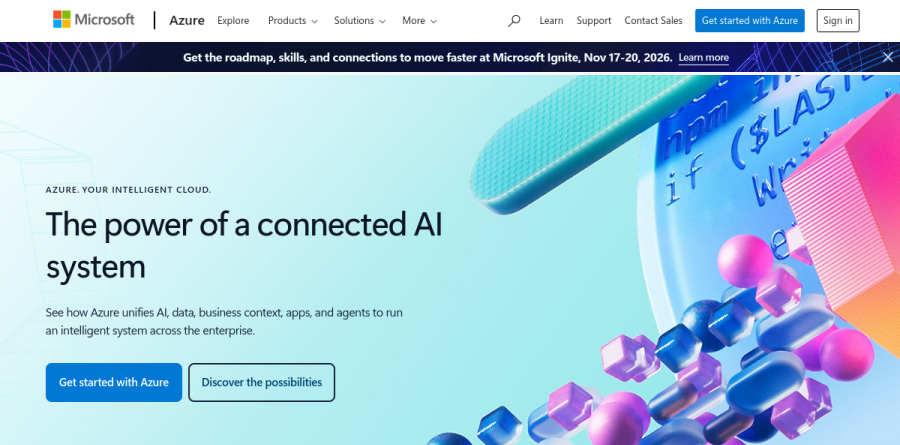
Microsoft Azure is Microsoft's public cloud platform, and the homepage frames it as an intelligent cloud built around the power of a connected AI system. Behind that positioning sits a catalogue of more than 200 products, sorted in the product directory into families including Compute, Storage, Networking, Databases, Analytics, Identity, Security and AI + machine learning. Under Pay As You Go you pay only for what you use, with no upfront commitment and the option to cancel anytime.
The product directory sorts everything into roughly twenty families, from Compute and Containers to Hybrid + multicloud, Migration and Virtual desktop infrastructure, so Azure behaves less like a single product than an operating layer teams assemble from. Its closeness to the rest of Microsoft is visible in the catalogue itself, which lists Windows Server workloads, SQL Server on Azure Virtual Machines, and GitHub Copilot and GitHub Enterprise.
Compute, containers and the migration path
Azure Virtual Machines remain the workhorse for lift-and-shift migrations, while Azure Kubernetes Service handles orchestration once teams commit to containers. Azure Functions runs event-driven code with no servers to manage, and Azure Container Apps sits between the two, described in the product directory as a way to build and deploy modern apps and microservices using serverless containers. A common path is moving existing Windows or Linux servers onto Virtual Machines first, then refactoring selected components into App Service or Container Apps after the migration settles. Azure Migrate, promoted on the pricing pages, models that move beforehand.
AI and data services on Azure
AI is where Microsoft has concentrated its recent effort. Microsoft Foundry is now the hub for model work, and the homepage news feed announced GPT-5.6 availability there. Azure Machine Learning covers custom training, Azure AI Search supports retrieval patterns, and Microsoft IQ is pitched at agent context management. On the data side, Azure Cosmos DB, Azure SQL, Azure Database for PostgreSQL, Microsoft Fabric and Azure Databricks give analytics teams operational stores and a lakehouse layer without leaving the platform.
Hybrid and multicloud through Azure Arc
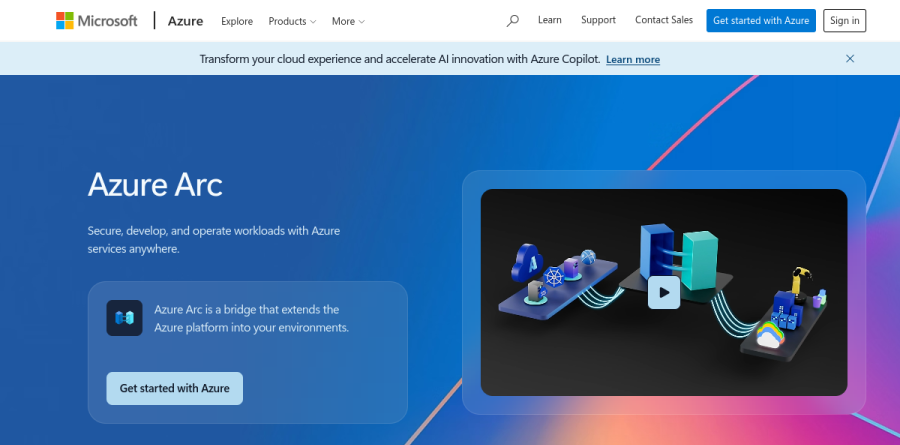
Azure Arc is the capability that most separates Microsoft from pure public-cloud rivals. Its product page describes Arc as a bridge extending the Azure platform into your environments, which in practice means governing Windows and Linux servers, CNCF-certified Kubernetes clusters, VMware estates, Azure Local and SCVMM resources as though they were native Azure objects. For regulated firms that cannot move everything, or manufacturers with edge sites and latency limits, that yields one policy and inventory plane instead of two disconnected toolchains.
Security, identity and governance
Microsoft Entra ID anchors identity, synchronizing on-premises directories and enabling single sign-on. Microsoft Defender for Cloud handles posture management and workload protection across subscriptions, Microsoft Sentinel provides SIEM and threat hunting, Azure Key Vault stores secrets and certificates, and Azure Monitor gathers telemetry. Defender for Cloud is listed under Hybrid + multicloud in the product directory and described as protecting multicloud and hybrid environments, which matches Arc's own promise of consistent inventory, management, governance and security for servers across your environment.
How Azure billing and cost control work
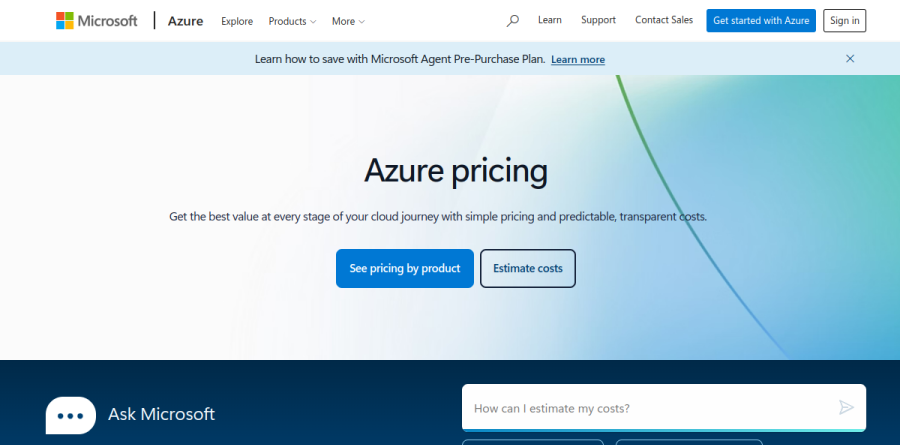
Azure bills on consumption, so the real work is optimization rather than picking a tier. The Azure free account opens with a USD 200 credit to use on Azure services within 30 days, free monthly amounts of 20+ popular services for 12 months for new customers, and free monthly amounts of 65+ always-free services; Pay As You Go covers everything past those allowances. Three levers pull the bill down: Azure reservations for one- or three-year committed capacity, Azure savings plan for compute for flexible commitments, and Azure Hybrid Benefit for owned Windows Server and SQL Server licenses.
Who should choose Microsoft Azure
Azure fits best where Microsoft is already the default: shops running Windows Server, SQL Server, Active Directory or Microsoft 365 inherit identity, licensing and support continuity that rivals struggle to match, and Azure Hybrid Benefit converts owned licenses into ongoing savings. Regulated and hybrid estates benefit from Arc, and enterprises wanting frontier models under an existing commercial relationship reach them through Foundry. It suits solo developers and small teams far less well, because the portal, subscription hierarchy and role model carry real learning overhead that lighter hosting platforms avoid.
Strengths
- Deep Microsoft-ecosystem integration — Entra ID (Azure AD), Microsoft 365, Windows Server, SQL Server
- Azure Hybrid Benefit reuses existing Windows/SQL licenses; strongest hybrid story via Azure Arc
- Exclusive Azure OpenAI Service (GPT models) plus a broad, mature AI/ML stack
- Generous entry: $200 credit for 30 days, 750 hrs/mo of free VMs for 12 months, and 55+ always-free services
Watch out for
- Usage-based billing across hundreds of metered services is complex and hard to forecast
- #2 in market share (~21%) with a smaller region footprint and community than AWS in places
- Sprawling portal and tooling; steeper learning curve for non-Microsoft shops
- The $200 credit expires after just 30 days — a short runway to evaluate
Key features
| Feature | What it does |
|---|
| Compute | Virtual Machines, App Service, AKS (managed Kubernetes), and Azure Functions serverless |
| AI & Machine Learning | Exclusive Azure OpenAI Service, Azure AI Foundry, Azure Machine Learning, and Cognitive Services |
| Hybrid & Multi-cloud | Azure Arc, Azure Stack, and ExpressRoute connect on-prem, edge, and other clouds |
| Data & Databases | Azure SQL, Cosmos DB, Synapse Analytics, and Microsoft Fabric |
| Identity & Security | Microsoft Entra ID, Defender for Cloud, and Sentinel SIEM |
| Cost Management | Reservations, Savings Plans, Azure Hybrid Benefit, and built-in Cost Management + Billing |
How Microsoft Azure compares
| Alternative | How it differs |
|---|
| Amazon Web Services (AWS) | Market leader (~28% in Q1 2026); broadest service catalog and most regions, but weaker native Windows integration |
| Google Cloud (GCP) | #3 (~14%); strong in data, AI, and Kubernetes, with a smaller enterprise install base |
| Oracle Cloud (OCI) | Aggressive database and egress pricing; niche versus the Big Three's breadth |
Head-to-head: Microsoft Azure vs AWS
Frequently asked questions
Is Microsoft Azure free?
Azure isn't fully free, but it has a real free tier. A new free account includes a $200 credit to spend in the first 30 days, plus 55+ always-free services and 750 hours per month of B1s virtual machines free for 12 months. After that, you pay only for what you use with pay-as-you-go billing.
How much does Microsoft Azure cost?
There's no single price — Azure is usage-based (pay-as-you-go), billing per second or hour across hundreds of metered services like VMs, storage, and bandwidth. A small VM can run under $10/month, while enterprise workloads reach thousands. Reservations and Savings Plans cut compute costs by up to ~72% with 1- or 3-year commitments.
What is the Azure free tier?
The Azure free tier bundles three things: a $200 credit valid for 30 days, over 55 always-free services (including Azure Functions at 1M requests/month and Cosmos DB at 1,000 RU/s), and popular services free for your first 12 months — such as 750 hours of Linux/Windows VMs and Blob storage.
Microsoft Azure vs AWS — which is better?
AWS leads in market share (~28% vs Azure's ~21% in Q1 2026) and has the broadest catalog. Azure wins for organizations already using Windows Server, SQL Server, and Microsoft 365, thanks to tight integration and Azure Hybrid Benefit licensing savings. Azure also offers exclusive Azure OpenAI. Choose based on your existing stack.
How long does the $200 Azure credit last?
The $200 Azure credit is valid for 30 days from sign-up. Any unused amount expires at the end of that period — it can't be extended, carried over, or transferred to another subscription. After the credit is used or expires, your account moves to pay-as-you-go, but the 55+ always-free and 12-month free services continue.
Microsoft Azure ratings on other platforms
Independent user ratings from third-party review sites, linked here for transparency.
These are not our editorial score, are captured on the date shown, and may have changed since.
