The full review
What is Tray.ai?
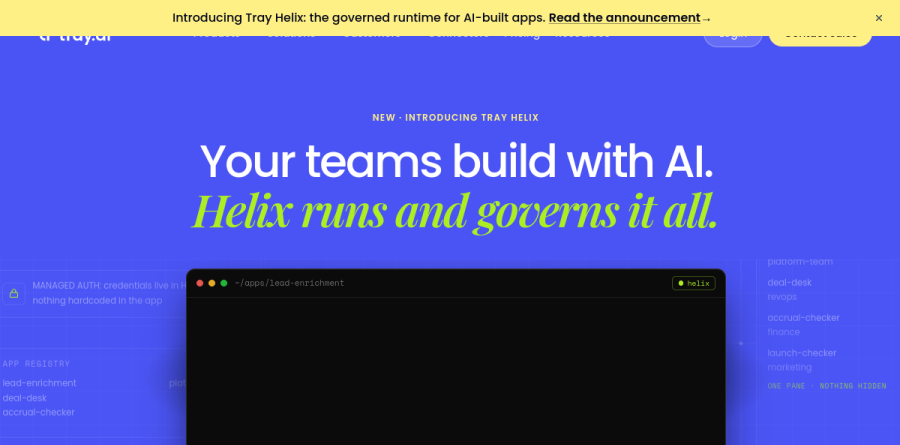
Tray.ai is an enterprise orchestration platform for integration, automation, and AI agents. The Tray iPaaS product covers familiar ground — process automation, data integration, and API management — backed by a library the vendor puts at more than 700 pre-built connectors. Layered on top are newer modules aimed at AI work: Merlin Agent Builder, Tray Helix, and an Agent Gateway for MCP.
The framing across the site is less about shuttling records between systems and more about making AI work survive contact with production. Tray.ai reports that only 1 in 20 AI builds ever reach production and deliver real value, and the platform is organized around closing that gap with governance, observability, and managed credentials rather than another chat window.
Merlin Agent Builder and agent workflows
Merlin Agent Builder is the no-code entry point, pitched on the platform page as less chat, more action, no code. It handles both conversational and autonomous agents, with a composable agent hub and guardrails as the control surface. In practice a revenue operations team can assemble an agent that reads a Salesforce opportunity, checks a Snowflake table, and posts a summary into Slack, each step backed by a maintained connector instead of a hand-rolled API call that breaks on the next schema change. Because agents share the platform repository, credentials, and access control, they inherit the same audit posture as a long-running integration.
Tray Helix and the road to production
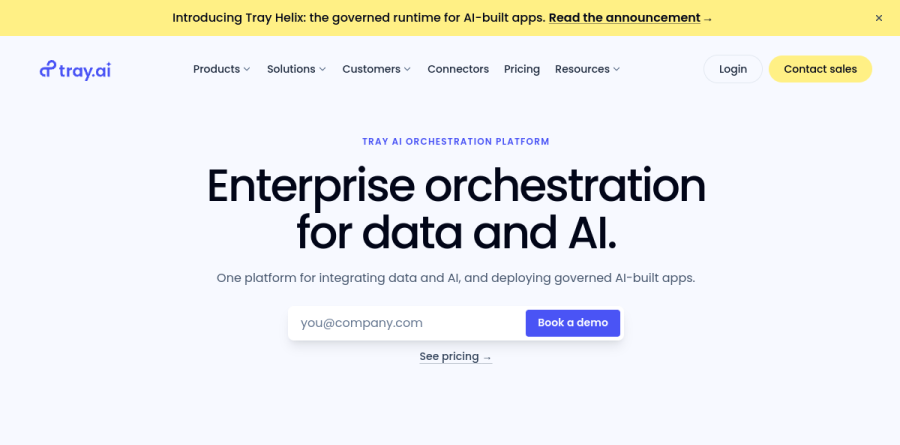
Tray Helix is the piece most likely to interest teams already building with coding assistants. Tray.ai positions it as a governed runtime for AI-built apps and says a single command takes an app from Claude Code, Codex, or Cursor to production. The scaffolding matters more than the deploy step: App Security handles managed auth so secrets are not hardcoded into a prototype, AI Visibility gives one live pane over every app in production showing owner, connections, and activity, and the App Registry works as an internal marketplace where colleagues self-serve what already exists. For a platform team fielding a stream of internally vibe-coded tools, Helix is a way to say yes without inheriting an uninventoried maintenance liability.
Connectors, Tray Build, and Tray Headless

The connector catalog is grouped into categories including Marketing, Databases, Finance, Human Resources, LLMs, and Security and Compliance, with names such as Salesforce, HubSpot, NetSuite, Snowflake, Google BigQuery, Jira Cloud, Zendesk, Slack, OpenAI, and Anthropic. Gaps can be closed with a universal HTTP connection or a custom connector built on the SDK, which keeps legacy and homegrown systems in scope. Development runs two ways — code or canvas, as Tray.ai puts it. Tray Build is the visual low-code builder, while Tray Headless is the code-first path, built for Claude Code, Codex, and any coding assistant.
Governance and plan-level controls
Governance is where the plans genuinely differentiate. Pro covers three workspaces with 7-day insights and 7-day log retention. Team raises that to 20 workspaces and 30-day insights, adds log retention management and Guardian Log Masking, and unlocks all add-ons for purchase. Enterprise moves to unlimited workspaces, 180-day insights, log streaming, advanced on-premise deployment, and compliance options including SSO, HIPAA, and regional hosting. A Cost Management module attributes LLM, token, and compute spend per app and team with budgets and caps, and every plan includes Tray Advantage with business-hours support and knowledge base access — though Team and Enterprise add Tray Advantage Plus with 24/7/365 coverage, enhanced SLAs, and a dedicated Slack channel.
Who should choose Tray.ai
Tray.ai suits organizations that are past the question of whether to run AI agents and into the harder one of who owns them. If engineers are shipping prototypes with coding assistants, ops teams are building automations on a canvas, and security wants to know where credentials live, the combination of Tray iPaaS, Merlin Agent Builder, and Tray Helix serves all three from a shared control plane. Regulated buyers needing on-premise, HIPAA, or regional hosting should look straight at the Enterprise tier.
It is not ideal for solo founders or small teams who want to sign up with a card and automate something this afternoon, since every tier routes through a sales conversation and this much depth is wasted on a handful of app-to-app triggers.
Strengths
- Deep integration layer with 700+ connectors underpinning both automations and AI agents
- Merlin Agent Builder plus Agent Gateway for MCP bring real governance (RBAC, audit trails, observability) to agent actions
- Spans no-code (Build), low-code canvas, and developer/headless paths including AI-IDE integration
- Strong enterprise credentials: repeat Nucleus iPaaS leader and Gartner recognition
Watch out for
- No public pricing; every tier requires a sales conversation, making budgeting hard upfront
- Task-based usage billing can escalate unpredictably as workflows grow more complex
- No self-serve free tier; the 'free trial' is a guided, sales-assisted evaluation
- Enterprise-oriented complexity and learning curve overkill for SMBs or simple automations
Key features
| Feature | What it does |
|---|
| Merlin Agent Builder | No-code builder for conversational and autonomous AI agents backed by knowledge, tools, guardrails and a composable agent hub. |
| Agent Gateway for MCP | Managed Model Context Protocol servers exposing 700+ connectors as governed tools with audit trails and observability. |
| Intelligent iPaaS | Connects 700+ apps for process automation, data integration and API management across the enterprise stack. |
| Flexible build surfaces | Tray Build visual low-code canvas plus Tray Headless for native integration with Claude Code and AI IDEs. |
How Tray.ai compares
| Alternative | How it differs |
|---|
| Workato | The closest enterprise rival: mature iPaaS with an AI/agent layer, also sales-led custom pricing. |
| n8n | Source-available, developer-friendly workflow automation with AI-agent nodes and transparent, far cheaper pricing. |
| Zapier | Mass-market automation now adding AI agents (Central); broader app catalog but shallower enterprise governance. |
Frequently asked questions
How much does Tray.ai cost?
There is no published price. Tray.ai uses a quote-based model of a base plan (Pro, Team, or Enterprise) plus usage (task-based billing) and optional add-ons, so you must contact sales for a figure tailored to your workspace and volume needs.
Is there a free trial or free plan?
There is a trial, but it is not self-serve. Tray.ai runs a guided evaluation: you speak with a Tray expert about what you want to build, and they provision access afterward. There is no permanent free tier.
Tray.ai ratings on other platforms
Independent user ratings from third-party review sites, linked here for transparency.
These are not our editorial score, are captured on the date shown, and may have changed since.