The full review
What is Tabnine?
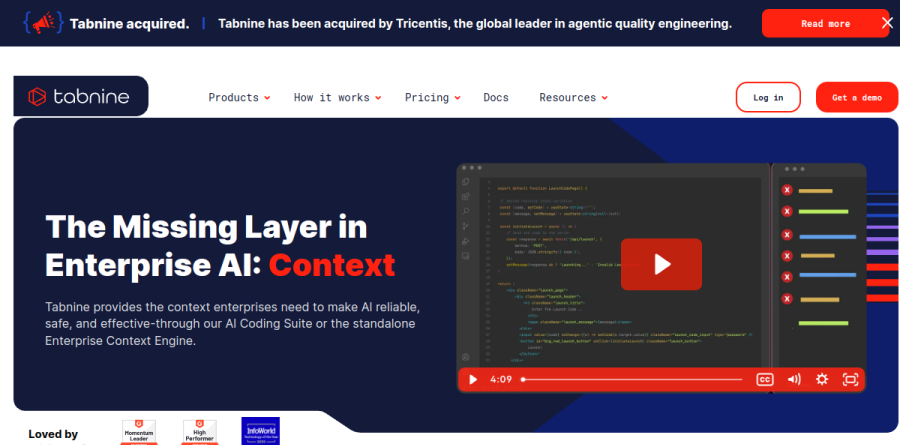
Built for organizations that cannot hand source code to a public model endpoint, Tabnine covers the familiar assistant surface — inline completions, multi-line function implementation, and AI chat inside the IDE — but it positions itself less as an autocomplete convenience than as what the company calls an AI control plane for trusted software development. The homepage frames the pitch bluntly: the missing layer in enterprise AI is context.
Two things separate Tabnine from a crowded assistant field. First, deployment: it runs as secure SaaS, inside a private VPC, on-premises, or fully air-gapped. Second, the Tabnine Enterprise Context Engine, a layer that models your systems and feeds that understanding to agents — including agents that are not Tabnine.
Inside the Enterprise Context Engine

The Enterprise Context Engine is the piece worth the most attention. Instead of plain retrieval, Tabnine describes a hybrid graph and vector approach that continuously ingests repositories, documentation, tickets, APIs, and infrastructure metadata to build a structured model of your systems, their entities, relationships, and dependencies.
Named capabilities include Real-Time Organizational Awareness, Dependency and Blast Radius Analysis, and Verification Against Standards, which automatically checks outputs against architectural patterns, coding standards, and organizational rules. The layer is deliberately agent-agnostic: Tabnine positions it as shared memory for multi-agent systems and says it can serve Cursor, GitHub Copilot, and Claude Code alongside its own tools. The vendor reports gains in accuracy, token efficiency, and time to resolution, which are worth validating against your own repositories.
Completions, chat, and the Tabnine CLI

Day to day, the Tabnine Code Assistant plan handles familiar ground: current-line and multi-line completions, bug fixing, refactoring, test writing, logic explanation, and documentation generation across major IDEs. Teams can pick a model per use case, choosing frontier or open-source options rather than accepting a single default.
The Tabnine Agentic Platform adds the Tabnine CLI, a terminal agent that runs autonomously or under supervision. The advertised workflow runs end to end: implement a feature from an issue description, refactor across files, update tests, run commands and validate results, then open a branch and pull request. Model Context Protocol tool integration connects the agent to the rest of your stack, and coaching guidelines ship as a native MCP tool so team standards travel with it. Codebase connections cover Bitbucket, GitHub, GitLab, and Perforce P4.
Headless agents and CI/CD automation
Headless Agents are an optional add-on rather than a seat feature. Tabnine describes them as agents running in the background inside CI/CD and other automated pipelines, covering code generation, code review, test creation, remediation, and policy checks without a developer working interactively in an IDE or CLI. Licensing is capacity-based, measured in monthly token throughput rather than headcount, which fits pipeline automation better than per-seat math.
Privacy, provenance, and IP safeguards
For regulated buyers, this is the whole argument. The code-privacy page states that your code is never stored, never trains Tabnine models, and is never shared, with ephemeral processing and zero code retention. The vendor also says it does not depend on third-party APIs or models to deliver the service, and that custom enterprise models pretrained on your code stay accessible only to you. Provenance and Attribution is pitched as a way to minimize IP liability for GenAI output, the platform page cites license-aware safeguards with enterprise indemnification built in, and the pricing page lists IP indemnification subject to terms and conditions. Listed compliance includes GDPR, SOC 2, and ISO 27001.
Who should choose Tabnine
The core fit is an engineering organization where security, legal, or regulatory constraints drive tooling decisions: aerospace and defense suppliers, financial services, healthcare, and any team running an air-gapped network or a firm rule against code leaving the perimeter. Tabnine also appeals to platform teams that already standardized on another assistant but want a governed context layer underneath, since the Context Engine is sold as agent-agnostic. It is not ideal for solo developers, students, or early-stage startups shopping on price, because both seat plans bill annually at enterprise rates and route through a sales quote rather than self-serve signup.
Strengths
- Genuine deployment flexibility: SaaS, VPC, on-premises, and fully air-gapped installs that never send code to third parties
- Strong privacy and legal posture: zero code retention, no training on your code, and IP indemnification on generated output
- Model choice plus a Context Engine that grounds suggestions in your own connected repositories
- Enterprise compliance (SOC 2, ISO 27001, GDPR) and governance/analytics built in rather than bolted on
Watch out for
- Expensive entry point at $39/user/mo versus GitHub Copilot at $10 and comparable per-seat rivals
- No free tier anymore and annual-only billing make it hard for individuals or small teams to adopt
- Raw completion and agentic quality trail frontier-model tools like Cursor and Claude Code
- Tabnine-hosted LLM usage adds provider cost plus a 5% handling fee on top of the seat price
Key features
| Feature | What it does |
|---|
| Flexible/air-gapped deployment | Run entirely inside your own infrastructure (VPC, on-prem, or offline air-gapped) so source code never leaves your network. |
| Zero code retention & IP indemnification | Tabnine does not retain or train on your code and indemnifies customers against IP claims on generated suggestions. |
| Agentic Platform & CLI | Autonomous agents with optional human oversight, plus a terminal CLI and MCP support for multi-step tasks and CI/CD via Headless Agents. |
| Context Engine | Connects unlimited repositories across Git, GitHub, GitLab, Bitbucket, and Perforce to ground completions and chat in your actual codebase. |
How Tabnine compares
| Alternative | How it differs |
|---|
| GitHub Copilot | Far cheaper ($10/mo individual) with strong completions and a free tier, but weaker privacy guarantees and no air-gapped self-hosting. |
| Cursor | More capable agentic editing on frontier models and a free tier, but SaaS-only and less focused on air-gapped enterprise compliance. |
| Amazon Q Developer | AWS-native rival with enterprise governance and a free tier; strongest for AWS shops rather than deployment-agnostic on-prem needs. |
Frequently asked questions
Does Tabnine still have a free plan?
No. The permanent free 'Basic' tier and the old $12/mo 'Dev' plan were discontinued. Tabnine now offers only a time-limited free trial; after it, the cheapest paid tier is the Code Assistant Platform at $39/user/month billed annually.
Can I run Tabnine without sending my code to the cloud?
Yes. Tabnine supports on-premises and fully air-gapped deployments alongside VPC and SaaS, with zero code retention. This is its core differentiator for regulated and privacy-sensitive organizations.
Tabnine ratings on other platforms
Independent user ratings from third-party review sites, linked here for transparency.
These are not our editorial score, are captured on the date shown, and may have changed since.