The full review
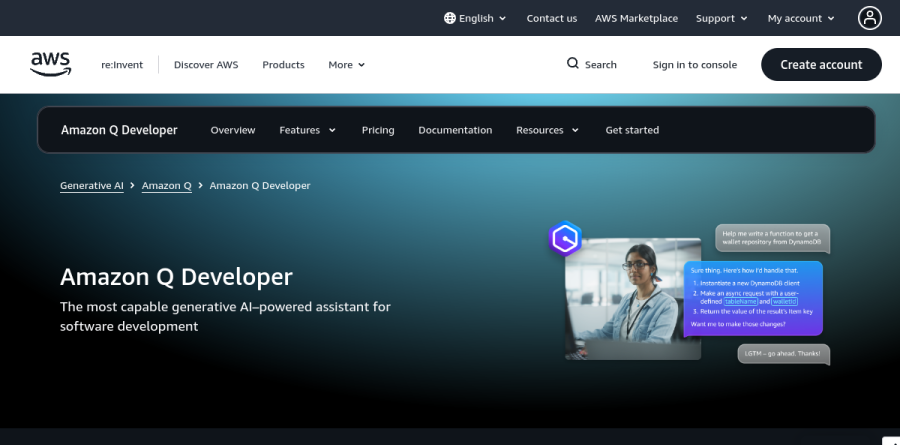
What is Amazon Q Developer?
Amazon Q Developer is the AI coding assistant AWS builds and ships itself, organized around an agentic workflow rather than autocomplete alone. It runs inside JetBrains, VS Code, Visual Studio and Eclipse, on the command line, in the AWS Management Console and Console Mobile Application, and in chat tools including Microsoft Teams and Slack.
Scope is what separates Amazon Q Developer from a plain suggestion engine. AWS positions it across implementing features, documenting, testing, reviewing and refactoring code, then adds a job most rivals do not attempt: helping you operate the AWS account your application actually lives in.
Agentic coding from the terminal

The Q Developer CLI agent is the piece experienced developers reach for first. AWS describes it as reading and writing files locally, calling AWS APIs and running bash commands, drawing on native and MCP server-based tools across macOS Terminal, iTerm2 and the VS Code terminal.
The vendor describes a typical loop: Amazon Q Developer analyzes your codebase, maps a step-by-step plan spanning multiple files, then on your approval executes the changes and tests. Inside the editor that same agent surfaces as inline chat for quick edits and workspace context for whole-project questions.
Review, tests and documentation
Three of the most useful Amazon Q Developer features are the unglamorous ones. Automated code review runs across a pull request and flags bugs, security vulnerabilities and infrastructure-as-code issues. Automated test generation writes unit tests for functions that never got any. Automated documentation generates and updates README files and can produce data-flow diagrams. The vendor reports that its security scanning outperforms leading publicly benchmarkable tools on detection across most popular programming languages, and that its agentic capabilities have topped the SWE-Bench Leaderboard.
Operating AWS, not only writing code

This is where Amazon Q Developer diverges from general-purpose rivals. In the console it answers architecture questions, helps you pick the right instance for a job and explains cloud costs. Console-to-Code converts actions you clicked through into deployment-ready infrastructure as code. On the operations side it diagnoses console errors, investigates operational issues and runs network reachability analysis via VPC Reachability Analyzer, while ChatOps integration puts the same assistant into Slack and Microsoft Teams.
The transformation features target technical debt directly. The marquee example on the AWS site is upgrading Java 8 applications to Java 17; the same machinery ports .NET Framework code to cross-platform .NET and transforms embedded SQL inside Java applications. Both plans include a monthly lines-of-code allowance for Java upgrade transformation, with Pro pooling that allowance at account level and adding increased limits for Java and .NET app transformation. Amazon Q Developer also reaches into AWS Glue, Amazon Redshift for natural language to SQL, and SageMaker Studio and Canvas.
The Free tier and Amazon Q Developer Pro
The Free tier is perpetual rather than a trial. It bundles a monthly allowance of agentic requests, the latest Claude models in your IDE or CLI, general Q&A in the console, plus reference tracking and public code suppression. Amazon Q Developer Pro raises the agentic request limit and adds an admin dashboard with user and policy management, IP indemnity, and automatic opt-out from data collection. Pro bills per seat monthly and pro-rates the first month.
Who should choose Amazon Q Developer
Teams already building on AWS get the most from Amazon Q Developer, because the console troubleshooting, cost explanations and resource management have no real equivalent elsewhere. The Free tier is generous enough to evaluate properly before paying, and enterprises carrying Java or .NET debt will see the clearest payback from the transformation features. One caveat matters: AWS has published an end of support notice stating it will discontinue Amazon Q Developer IDE plugins on April 30, 2027, and points developers toward Kiro for comparable agentic coding, chat and MCP support. If your plan rests entirely on the IDE plugin, weigh that timeline. It is also a poor fit for teams with no AWS footprint, where a vendor-neutral assistant serves better.
Strengths
- Flat $19/user Pro price undercuts most rivals and includes IP indemnity
- Genuine perpetual free tier with access to current Claude models
- Deep, first-party integration with AWS services, console, and CLI
- Strong agentic code-transformation and modernization tooling (Java, .NET upgrades)
Watch out for
- Most valuable inside the AWS ecosystem; weaker for cloud-agnostic stacks
- Agentic request and transformation caps can be hit quickly by heavy users
- Cloud-only with no self-hosting or air-gapped option
- IDE/chat UX feels less polished than Cursor or GitHub Copilot
Key features
| Feature | What it does |
|---|
| Agentic requests | Multi-step agents that read, edit, and run code across a workspace, metered per request with monthly allowances by tier. |
| Code transformation | Automated modernization of legacy Java and .NET projects, metered in lines of code (1,000/mo free, 4,000/mo Pro, $0.003/line over). |
| Claude model access | Both tiers route to the latest Claude models for chat, inline completion, and agentic work inside the IDE and CLI. |
| AWS-native integration | Answers questions about your AWS account, troubleshoots the console, and generates infrastructure and CLI commands in context. |
How Amazon Q Developer compares
| Alternative | How it differs |
|---|
| GitHub Copilot | Broader, more polished general-purpose coding assistant; comparable $10-19 seat pricing but not AWS-native. |
| Cursor | AI-first editor with a stronger agent/UX for everyday coding; pricier at ~$20/mo and less tied to any cloud. |
| Tabnine | Enterprise-focused rival emphasizing self-hosting and data isolation, which Amazon Q lacks. |
Frequently asked questions
Is there a free version of Amazon Q Developer?
Yes. There is a perpetual free tier at $0 with roughly 50 agentic requests per month, access to current Claude models in the IDE and CLI, and up to 1,000 lines of code transformation. You sign in with an AWS Builder ID; no credit card is required.
How much does Amazon Q Developer Pro cost?
Pro is $19 per user per month, billed monthly (pro-rated for the first month). It raises agentic request limits, includes 4,000 lines/month of transformation pooled across the account, and adds IP indemnity, SSO, and data opt-out. Extra transformation lines cost $0.003 each. No annual-discount plan is currently published.
Amazon Q Developer ratings on other platforms
Independent user ratings from third-party review sites, linked here for transparency.
These are not our editorial score, are captured on the date shown, and may have changed since.
