The full review

What is Salesforce Einstein?
Salesforce Einstein is the artificial intelligence layer built into Salesforce rather than a separate product you bolt on afterwards. Salesforce traces it to 2016, when the company shipped what it calls the first predictive AI for CRM, with capabilities such as Predictive Lead Scoring and Predictive Forecasting landing directly inside sales workflows. Generative features and the Trust Layer followed in 2023, and Agentforce arrived in 2024 with the Atlas Reasoning Engine.
The current AI page frames three kinds of intelligence working together across the Customer 360: predictive AI for probabilities and pattern-finding, generative AI for drafting and summarizing, and agentic AI that plans and executes multi-step tasks. Salesforce Einstein therefore shows up inside opportunity records, forecasts, call recordings, and Slack instead of in a separate console.
Predictive scoring where reps already work

The predictive side of Salesforce Einstein is the part longest in market, going back to the 2016 Einstein launch and what Salesforce calls nearly a decade of machine learning behind its predictive AI. Einstein Opportunity Scoring rates conversion probability and flags at-risk pipeline, while Predictive Scoring and AI-driven Deal Insights sit alongside embedded summarization for every account, opportunity, lead, and contact. Sales planning adds a Territory Optimization Summary that explains recent territory changes in plain language. A media.monks executive quoted on the Sales AI page credits Einstein Opportunity Scoring plus Sales Cloud forecasting with a double-digit win rate improvement.
Conversation intelligence for sales calls
Einstein Conversation Insights is listed on the Sales AI page as a companion product to Sales Cloud, promising to accelerate time to close and scale coaching with actionable insights from sales calls. Call Insights flags key moments across recorded conversations, so a manager can see what customers said about competitors, pricing, and objections without replaying an entire call, and admins can register custom keywords for Einstein to watch. Call Explorer and Sales Signals push that same conversation data into coaching and deal review, and Salesforce lists Conversation Intelligence from the Enterprise edition upward.
Agentforce turns Einstein into autonomous agents
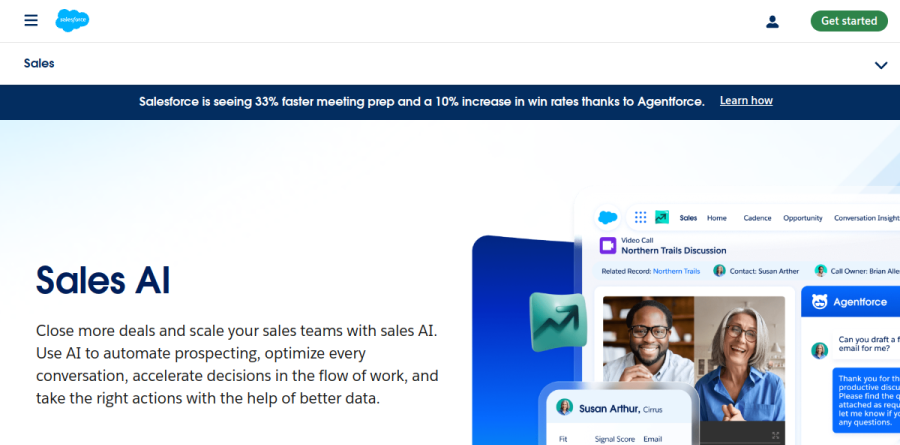
Agentforce is where Salesforce Einstein stops suggesting and starts acting. The sales prospecting agent continuously builds prioritized, high-intent account lists enriched from Salesforce, the web, and third-party sources, then hands sellers a researched shortlist in the CRM or in Slack. Builders get Agentforce Builder, Prompt Builder, and Agent Script, with Agentforce Voice for phone channels and AgentExchange for prebuilt partner agents. The vendor reports that its own teams saw faster meeting prep and higher win rates after adopting Agentforce.
Grounding, trust, and usage visibility
Salesforce is blunt that large language models alone are not enough. Data Cloud unifies siloed customer records so agent answers reflect real business facts, and Data 360 pulls in external and unstructured material such as web engagement, product usage, and FAQ content. The Trust Layer governs how that data reaches the model. On the consumption side, each Agentforce action draws Flex Credits, and Digital Wallet tracks credit burn in near real time with threshold alerts, which matters a great deal once agents run unattended.
How Einstein maps to Salesforce editions
Capability is tied to edition. Starter Suite covers core lead, account, contact, and opportunity management with automatic email and event syncing. Pro Suite adds quoting, forecasting, and AgentExchange access. Enterprise is the first tier listing Conversation Intelligence and Agentforce, Unlimited layers on Predictive AI and Sales Engagement, and Agentforce 1 Sales bundles the full AI suite with unmetered employee agent usage plus Salesforce Spiff, Sales Planning, Salesforce Maps, Tableau Next, and Slack Enterprise Plus. Salesforce notes that AI can be added to Enterprise and above.
Who should choose Salesforce Einstein
Salesforce Einstein makes sense for organizations already committed to Sales Cloud, especially mid-market and enterprise revenue teams with enough historical data for scoring models to mean something and enough process complexity to justify agents. If your customer data also lives across service, marketing, and commerce, the Data Cloud grounding story is the strongest argument here. It is a poor fit for small teams shopping for cheap standalone AI, since the genuinely useful layers sit in higher editions and consumption billing adds a second variable to forecast. Budget for admin time as well, because Einstein rewards clean records and clear process far more than it compensates for messy ones.
Strengths
- Deepest native integration with the world's most-used CRM: AI acts directly on live records, no data piping
- Full stack under one governed platform: predictive scoring, generative copilots, and autonomous agents, with the Einstein Trust Layer
- Agentforce 1 Sales bundles unmetered employee-agent usage plus Flex and Data Cloud credits for more predictable budgeting
- Strong security, governance, and admin controls suited to regulated, large-scale deployments
Watch out for
- Expensive: meaningful AI starts at Enterprise ($175) and the full suite is $550/user/mo, before Data Cloud and implementation
- Customer-facing Agentforce adds hard-to-forecast usage costs ($2/conversation or ~$0.10/action)
- Real value effectively requires Data Cloud plus significant implementation and admin effort; it is not turnkey
- Only worthwhile inside the Salesforce ecosystem; a poor fit for non-Salesforce shops
Key features
| Feature | What it does |
|---|
| Einstein predictive AI | Native lead/opportunity scoring, forecasting, and deal insights computed directly on CRM records. |
| Agentforce autonomous agents | Configurable AI SDR/service agents that reason over Salesforce data and trigger workflows and handoffs. |
| Conversation Intelligence | Call recording, transcription, and keyword/competitor tracking (Einstein Conversation Insights) tied to opportunities. |
| Data Cloud grounding and Trust Layer | Unifies customer data to ground generative AI, with Prompt Builder and the Einstein Trust Layer for governance. |
How Salesforce Einstein compares
| Alternative | How it differs |
|---|
| Gong | Best-in-class revenue intelligence and conversation analytics; CRM-agnostic and easier to adopt, but not a full agent platform. |
| Microsoft Copilot for Sales | AI layer over Dynamics 365 and Microsoft 365; strong for Microsoft-first orgs with a cheaper entry point than Agentforce. |
| HubSpot Breeze | AI agents and copilots inside HubSpot; far simpler and cheaper, better suited to SMB and mid-market. |
Frequently asked questions
Is Salesforce Einstein a separate product I buy?
No. Einstein is the AI layer built into Salesforce's clouds, now marketed under Agentforce/Einstein 1. Predictive AI is included from the Unlimited edition, and autonomous agents come via Agentforce (bundled in Agentforce 1 Sales or added by consumption).
Do I need Data Cloud to use it?
For grounded generative AI and Agentforce, effectively yes. Agentforce 1 Sales bundles Data Cloud credits; on lower tiers Data Cloud is a quote-based add-on and a significant hidden cost.
Salesforce Einstein ratings on other platforms
Independent user ratings from third-party review sites, linked here for transparency.
These are not our editorial score, are captured on the date shown, and may have changed since.