The full review

What is HubSpot AI?
HubSpot AI is the umbrella term for Breeze, the artificial intelligence layer HubSpot runs through its customer platform rather than bolting on as a separate app. The homepage now brands the whole thing the HubSpot Agentic Customer Platform, aimed at go-to-market teams. Because the AI reads directly from the Smart CRM, agents work on the same contacts, companies, deals and tickets your reps already touch.
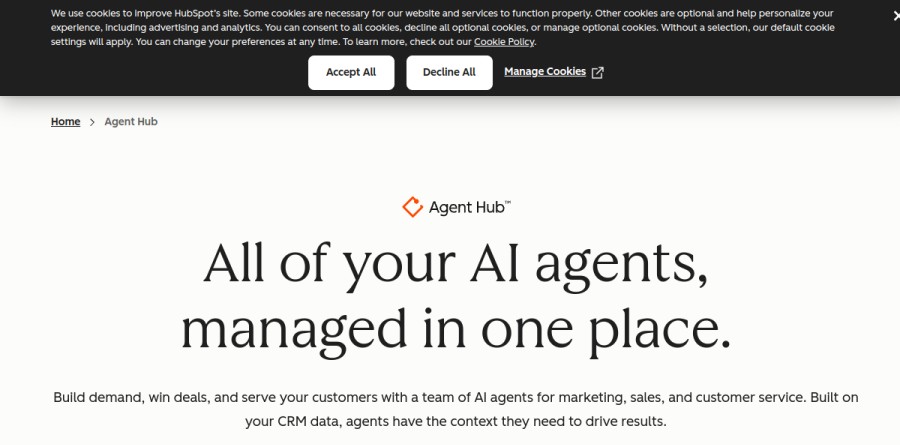
The operational center is Agent Hub, which HubSpot describes as the central home for building and managing AI agents across the platform. Agent Hub absorbed the branding HubSpot previously used for Breeze Agents, and it sits in the main navigation beside Marketing Hub, Sales Hub, Service Hub, Content Hub, Data Hub and Revenue Hub.
The agents doing the work
Three named agents carry most of the load. The Prospecting Agent watches buying signals and launches personalized outreach, and the vendor reports 65% more sales leads created on average per month. The Customer Agent handles common support questions around the clock using contact and contract history, with HubSpot reporting 77% more tickets closed on average. The Data Agent answers ad hoc questions about a contact or company straight from CRM records, which the vendor frames as roughly 10x faster prospect research.
What makes these useful is less the model and more the grounding. A Customer Agent that knows which contract a customer signed answers differently than a generic chatbot, and the Prospecting Agent finds accounts, sources buying committees and executes personalized outreach in a single workflow.
HubSpot AI inside the Sales Hub workflow

Sales Hub leads with the promise of AI-powered tools for building pipelines and closing deals, and the feature list backs that framing. Alongside the Breeze Prospecting Agent (beta) and Breeze Customer Agent sit AI Guided Selling, Smart Deal Progression (beta) and Conversation Intelligence, layered over conventional machinery like Deal Pipelines, Sales Automation, Meeting Scheduler, Call Tracking and Forecasting.
After a call, Smart Deal Progression analyzes the conversation transcript and deal history to suggest CRM updates, draft follow-up emails and propose next steps. CPQ Software and Sales Analytics close the loop from quote to reporting.
Custom agents and AI visibility
Agent Builder separates HubSpot AI from a fixed menu of features, letting teams assemble their own agents without writing code. That matters for workflows no vendor ships by default, such as renewal chasing, partner onboarding or territory research.
HubSpot has also added AEO, currently in beta, tracking how visible a brand is inside AI-generated answers. The vendor reports 20% more web traffic from AI referrals on average. Treat that as directional, but its presence signals where HubSpot believes discovery is heading.
How HubSpot AI is packaged
Access follows the Sales Hub tiers rather than a separate AI subscription. The Free plan supports up to two users, Starter runs on Core Seats, and Professional and Enterprise use Sales Seats. Each paid tier bundles a HubSpot Credits allowance that agent activity draws against, rising from 500 on Starter to 3,000 on Professional and 5,000 on Enterprise, plus extras sold separately.
Two details deserve attention. Professional and Enterprise each carry a mandatory one-time onboarding fee, and the credit meter makes heavy agent usage a variable cost rather than a flat one. Model your expected agent volume instead of assuming the seat rate is the whole bill.
Who should choose HubSpot AI
HubSpot AI makes the most sense for teams already standardized on HubSpot, or willing to consolidate onto it. The value comes from agents reading one CRM rather than from any individual model, so the more of your marketing, sales and service data living in Smart CRM, the better every agent performs. Mid-market teams with a real support queue and an outbound motion see the clearest return.
It is not ideal for teams committed to a best-of-breed stack with their CRM elsewhere, since most of the intelligence depends on HubSpot owning the record. Very small inbound-only teams may also find the Free plan sufficient before the agent layer earns its keep.
Strengths
- Deeply native to HubSpot's Smart CRM — agents act on live contact and deal data with zero integration work
- Outcome-based agent pricing means you largely pay per result (resolution, lead) rather than per AI seat
- Broad AI surface in one platform: prospecting, support, Clearbit-powered enrichment, content and copilot
- Genuinely usable free tier and low Starter entry point make it easy to trial AI features
Watch out for
- Credit and outcome pricing gets expensive and hard to forecast at scale; credits expire monthly with no rollover
- Best agents (Prospecting) gated behind Professional/Enterprise plus mandatory four-figure onboarding fees
- Value is locked to the HubSpot ecosystem — little benefit unless you commit to their CRM
- Dedicated AI-SDR tools go deeper on pure outbound; Breeze is broader but shallower per use case
Key features
| Feature | What it does |
|---|
| Breeze Prospecting Agent | Autonomously researches target accounts, surfaces buying signals and drafts personalized outbound; requires Pro/Enterprise |
| Breeze Customer Agent | Resolves inbound support inquiries automatically, with HubSpot claiming 70%+ of conversations handled without a human |
| Breeze Intelligence | Data enrichment (the former Clearbit) adding firmographic and buyer-intent data to CRM records, billed via credits |
| Breeze Copilot / Assistant | In-app AI for drafting emails, summarizing records, answering data questions and automating CRM tasks |
How HubSpot AI compares
| Alternative | How it differs |
|---|
| Apollo.io | Cheaper all-in-one prospecting with a huge B2B database and AI outreach, but far less CRM depth than HubSpot |
| Clay | Flexible AI enrichment and outbound automation; more powerful for GTM engineers but more technical to run |
| Salesforce Agentforce | Enterprise AI agents on the Salesforce platform; more configurable and powerful, but pricier and heavier to deploy |
Frequently asked questions
Is HubSpot AI (Breeze) free?
There is a free tier with Breeze Assistant and 100+ embedded AI features, but the autonomous agents and data enrichment consume paid HubSpot Credits and mostly require Starter or higher plans.
How is Breeze AI billed?
Since a 2025 change it uses unified HubSpot Credits (about $0.01 each) plus outcome-based agent pricing — roughly $0.50 per support resolution, $1.00 per qualified lead and $0.10 per data answer. Included monthly credits vary by plan tier.
HubSpot AI ratings on other platforms
Independent user ratings from third-party review sites, linked here for transparency.
These are not our editorial score, are captured on the date shown, and may have changed since.