The full review
What is Apollo.io?
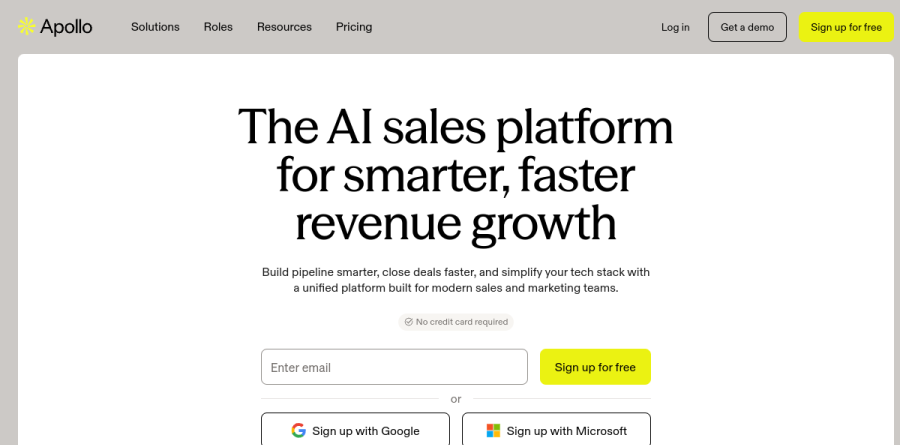
Apollo.io is a go-to-market platform that pairs a large B2B contact database with the outreach and deal tooling most sales teams otherwise assemble from four or five separate vendors. Apollo positions it as an AI sales platform for revenue growth, arguing on its homepage that it replaces a data provider, outreach tool, dialer, enrichment service, and CRM.
In practice Apollo.io spans four solution areas the vendor labels Outbound, Inbound, Data Enrichment, and Deal Execution. Beneath those sit the platform pieces: Apollo Data, an AI Assistant, a Chrome Extension, Workflow Automation, Integrations, and Apollo MCP, which exposes the data layer to external AI agents.
The Apollo Data layer
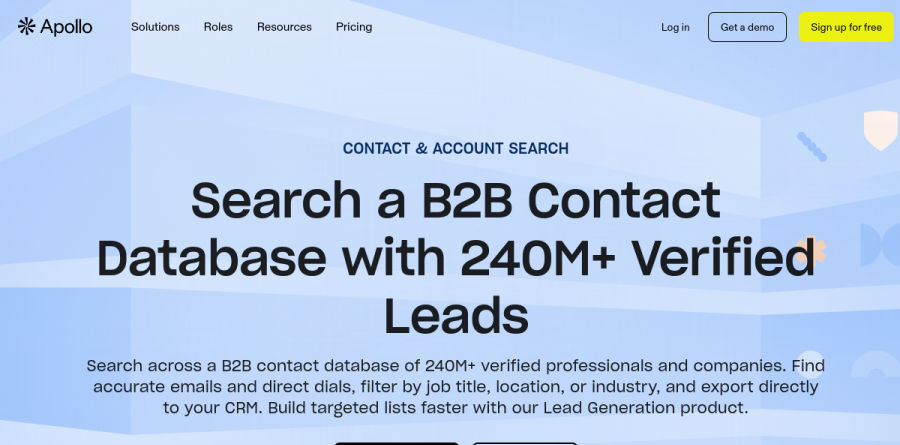
The database anchors everything else. Apollo reports more than 240M contacts and 30M companies, searchable through what the vendor counts as 65-plus precision filters spanning job title, location, industry, and buying signals, with a claimed 98.5% verified accuracy rate.
Apollo.io does not treat that database as a static list. Waterfall Enrichment checks trusted partner sources when an Apollo record is thin, while Automated CRM Enrichment, CSV Enrichment, and Job Change Enrichment keep fields current as people move roles. Reps working inside LinkedIn or Gmail pull the same records through the Apollo Chrome Extension.
Sequences, deliverability, and the dialer

Apollo.io treats sales engagement as its strongest category, and the machinery is Sequences: multi-step email and call campaigns, with A/Z Testing on paid tiers. A Deliverability Suite handles email warmup, and domain and mailbox purchasing happens in-platform, so reps are not juggling registrars alongside outreach.
Dialing scales with the plan. Every paid tier includes a US Dialer that draws on credits, while the Advanced Dialer add-on covers Parallel Dialer, Power Dialer, Local Presence, and international calling. AI Research drafts personalized openers from prospect context, and the vendor reports meaningful reply-rate and productivity gains from it.
Converting inbound traffic into pipeline
Outbound gets the marketing attention, but the Inbound side is where small teams often find quiet leverage. Website Visitor Identification names companies browsing your site, Real-time Form Enrichment completes firmographics as a lead submits, and Inbound Routers push qualified records to the right rep without a manual handoff.
AI Lead Scoring and Intent Topics then rank what arrives, with the number of intent topics rising across tiers. Customers featured on the Apollo.io site describe cutting research hours and lifting open rates using these signals.
Deal execution and workflow automation
Once a meeting lands, Apollo.io keeps working. Sales Call Recording, Conversation Intelligence, Pre-meeting AI Insights, Deal Management, Analytics, and Coaching share the same workspace, with recording minutes scaling by tier. The Workflow Engine automates the connective tissue between them, which is the practical argument for consolidating rather than stitching five tools together.
How the Apollo.io plans work
Apollo.io runs on a credit economy rather than flat data caps. Every plan grants a per-seat credit pool, and actions draw against it: an email address costs one credit, a phone number costs eight, and dialer minutes bill per minute. Free grants credits monthly, while Basic, Professional, and Organization grant them upfront.
Feature gates matter more than credit counts for most buyers. Unlimited Sequences begin at Basic, analytics and unlimited mailboxes at Professional, and SSO plus advanced security configurations at Organization. Two add-ons, Inbound and Advanced Dialer, sit outside the core tiers and are purchased in-app.
Who should choose Apollo.io
Apollo.io suits SMB and mid-market sales teams that want prospecting data, sequencing, dialing, and deal tracking under one login and one invoice, especially founders and small SDR pods who cannot justify separate contracts for each layer. Professional is the natural landing spot, since that tier unlocks analytics, unlimited mailboxes, and serious recording minutes.
It is a weaker fit for enterprises with an entrenched CRM and a dedicated data vendor, where Apollo duplicates spend instead of replacing it, and for teams selling mainly outside North America, since the dialer and visitor-contact identification lean US-first. Trial the data quality against your own ICP before committing.
Strengths
- Exceptional value: 230M+ contact database plus sequences, dialer, and enrichment from $49/user/mo — replaces 3-4 separate tools
- Genuinely useful free plan with unlimited fair-use email credits, 5 mobile credits, and 2 sequences
- Strong built-in sequencer with multichannel steps, A/B testing, and conditional logic tied directly to the database
- AI layer included: research credits, AI email composer, and AI call summaries on paid tiers rather than as a paid add-on
Watch out for
- Data accuracy drops sharply outside North America — independent tests report ~88% US accuracy but roughly 60-70% for EMEA/APAC, versus Apollo's claimed 97%
- Phone numbers cost 8 credits each, are frequently stale, and mobile credit pools (75-200/mo) run out fast for calling-heavy teams
- Credit system is confusing and costly: overages run $0.20/credit with a 250-credit ($50) minimum and no monthly rollover
- Support is the weakest sub-score (about 4.2/5 on G2), and the Organization tier requires a 3-seat minimum
Key features
| Feature | What it does |
|---|
| B2B Contact Database | 230M+ contacts and 30M+ companies with verified emails; unlimited email credits on all plans under a fair-use policy |
| Sales Sequences | Multichannel email, call, and task sequences with A/B testing and conditional logic; unlimited active sequences on paid tiers |
| Built-in Dialer | US dialer with call recordings (4,000 min) on Professional; international dialing and 8,000 recording minutes on Organization |
| Apollo AI | AI research credits (2,500-15,000/mo by tier), AI email composer, and AI-powered call summaries, follow-ups, and task creation |
| Enrichment & CRM Sync | Real-time form enrichment and data cleansing with two-way Salesforce and HubSpot integration |
| Buying Intent Data | 6 intent topics on Basic scaling to 12 on Organization for prioritizing in-market accounts |
How Apollo.io compares
| Alternative | How it differs |
|---|
| ZoomInfo | Deeper enterprise data and intent, but quote-based contracts typically run five figures annually — overkill for SMBs |
| Cognism | Stronger EMEA coverage and phone-verified mobile numbers; quote-based pricing without a free plan |
| Lusha | Simpler credit-based prospecting tool with a free tier; cheaper entry but no sequencing or dialer engagement layer |
Head-to-head: Apollo.io vs Clay
Frequently asked questions
How much does Apollo.io cost?
Apollo.io starts free with 5 mobile and 10 export credits monthly. Paid plans on annual billing run $49/user/month (Basic), $79 (Professional), and $119 (Organization, 3-seat minimum); monthly billing costs $59, $99, and $149. All paid tiers include unlimited email credits under fair use, while mobile numbers and exports draw from monthly credit pools.
Is Apollo.io free?
Yes. The free plan includes unlimited email credits capped at 10,000/month with a corporate email (100/month otherwise), 5 mobile credits, 10 export credits, 2 active sequences, and basic filters. It's enough for a founder testing outbound, but serious prospecting quickly hits the export and mobile-credit ceilings that push you to the $49 Basic plan.
How accurate is Apollo.io's data?
Apollo claims 97% email accuracy across 230M+ contacts, but independent 2026 tests put US accuracy near 88% and EMEA/APAC closer to 60-70%. Email data is the strength; phone numbers cost 8 credits each and draw the most complaints. Teams targeting Europe or Asia typically budget $50-$200/month extra for a verification tool.
Apollo.io vs ZoomInfo: which is better?
Apollo wins on price and breadth: $49-$119/user/month with sequences, a dialer, and AI built in, versus ZoomInfo's quote-based contracts that commonly reach five figures annually. ZoomInfo offers deeper enterprise data, org charts, and intent signals. SMBs and startups should default to Apollo; enterprises needing managed data quality lean ZoomInfo.
What are Apollo.io credits and how do they work?
Credits meter usage on top of your subscription. Email credits are unlimited under fair use, but revealing a mobile number costs 8 credits and exports consume export credits (1,000/month on Basic up to 4,000 on Organization). Overages cost $0.20 per credit with a 250-credit ($50) minimum purchase, and unused credits don't roll over.
Apollo.io ratings on other platforms
Independent user ratings from third-party review sites, linked here for transparency.
These are not our editorial score, are captured on the date shown, and may have changed since.