The full review
What is Qodo?
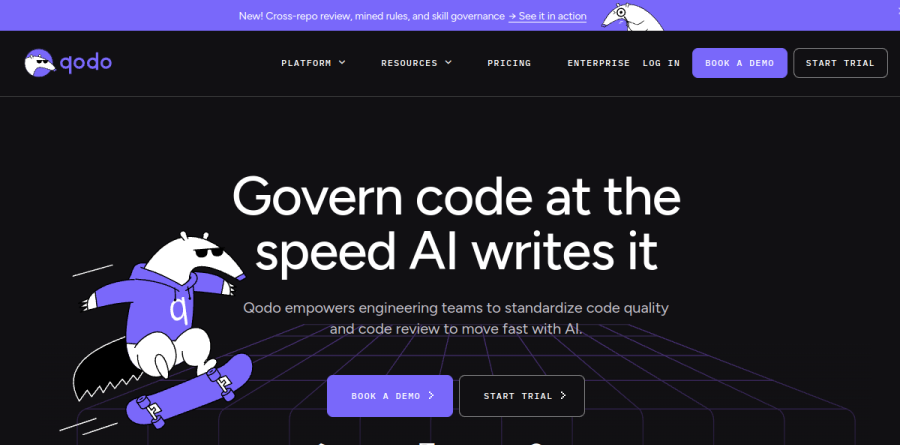
Qodo is an agentic code review platform aimed at engineering teams whose code output has outpaced their capacity to review it. The positioning across its site is direct: govern code at the speed AI writes it. Rather than acting as another autocomplete assistant, Qodo works at the pull request layer and inside the IDE, judging each change against the surrounding system and against standards the team has actually agreed on.
The platform is built from a few connected parts: pull request review through Git integration, a Context Engine providing full codebase intelligence, and a Codebase Quality layer covering rules, standards, and code health. Qodo calls itself code quality infrastructure for the agent era, which fairly describes its target.
How Qodo handles pull request review

Qodo connects to GitHub, GitLab, Bitbucket, or Azure DevOps, then reviews incoming pull requests automatically. The framing on the Qodo Git feature page is about surfacing real issues instead of noise, and the design follows: specialized agents each carry one review mission, critical findings are prioritized ahead of cosmetic nits, and suggestions arrive as implementation-ready prompts a coding agent can act on directly.
Requirement validation runs in the same pass, checking whether a change does what the ticket described. A customer engineering leader featured on the Qodo homepage reports the platform covering roughly ninety percent of the initial review pass.
Rules and the governance layer
Where Qodo separates itself from generic review bots is the Living Rules System. Teams encode their standards once, and Qodo enforces them consistently across repositories instead of hoping a model recalls local convention. Rules Miner extends this by watching recurring pull request comments and turning the patterns humans keep repeating into enforceable rules, a genuinely useful way to capture knowledge that otherwise lives only in senior reviewers' heads.
Governance Visibility collects every issue into one dashboard, so a platform lead can see whether standards hold. Qodo also ships Skill Review Standards to govern how AI coding tools behave inside a codebase.
Context engineering across repositories
The Context Engine addresses the central weakness of automated review, which is judging a diff without understanding the system around it. Qodo frames this as seeing the system rather than only the change in front of you. Cross Repo Context, currently in beta, pushes that reasoning across dependent repositories to surface breaking changes and dependency conflicts before they ship, a scenario that slips past both linters and tired human reviewers.
Language coverage spans Python, TypeScript, JavaScript, Java, Kotlin, Go, PHP, Swift, and the C family, so polyglot organizations are not pushed toward a single-language tool.
Plans, deployment, and developer reach

Qodo meets developers well before the pull request. Its VS Code and JetBrains extensions carry install counts the company publishes openly, and Pre-PR review skills catch problems while a branch is still local. Commercially the ladder is short: a Free 14 Day Trial runs without a credit card, then Pro Team is designed for up to thirty users and sells pooled monthly credits the whole team draws from, with a customer-set overage cap.
Enterprise serves larger headcounts and adds SSO with SAML, audit logs, a governance analytics dashboard, advanced self-learning, and BYOK so you can bring your own model keys. Deployment extends to single-tenant SaaS, private cloud, and air-gapped installs.
Who should choose Qodo
Qodo suits engineering organizations where AI-generated volume has turned review into the bottleneck, and where consistency across many repositories matters. Platform teams and engineering leaders extract the most value, because Living Rules System, Rules Miner, and Governance Visibility only pay off when somebody owns standards as a real responsibility. Regulated companies get a credible story too, since Qodo states SOC 2 Type II certification and zero data retention platform-wide, and Enterprise adds audit logs plus on-prem, private cloud, and air-gapped deployment.
It is a weaker fit for solo developers and very small teams working from a single repository, where the governance machinery becomes overhead and a lighter assistant would cover the need. Anyone shopping for an autonomous coding agent rather than a reviewer should look elsewhere, since Qodo deliberately owns the quality gate instead of the authoring.
Strengths
- Flat pooled pricing: $30/month covers up to 30 users, undercutting per-seat rivals for teams with modest PR volume
- Rare compliance depth at this price: SOC 2 Type II certified, zero data retention, BYOK, and on-prem or air-gapped deployment
- Top review accuracy in third-party 2026 benchmark roundups (60.1% F1), catching real issues with fewer false positives than rivals
- Free for qualifying open-source projects (Google-backed program), and the MIT-licensed PR-Agent offers a self-hosted no-cost alternative
Watch out for
- No permanent free tier since the 2026 'Qodo 2.0' repackaging — the old free Developer plan (30 PR reviews/month) was discontinued
- Credit math stings: $30/month buys only ~18 reviews, and premium models like Claude Opus burn 5 credits per request instead of 1
- G2 reviewers report the IDE plugin slows down on large codebases and find the UI confusing to navigate
- Generated tests and /improve suggestions often need manual fixes — reviewers cite it recommending code that already exists
Key features
| Feature | What it does |
|---|
| Agentic PR review | Multi-agent pull request review with full codebase context, prioritizing findings by severity on GitHub, GitLab, Bitbucket, and Azure DevOps. |
| Rules system | Automatically discovers and enforces team coding standards; unlimited custom rules on all paid plans. |
| Context Engine | Full-codebase understanding that grounds reviews in your actual architecture rather than just the diff. |
| Pre-PR IDE review | Real-time code validation and review skills inside VS Code, the JetBrains suite, and Visual Studio before a PR is opened. |
| Cross-repo review | Analyzes changes across multiple connected repositories (Enterprise plan). |
| Dashboard and analytics | Team-level review analytics; Enterprise adds a governance analytics dashboard and audit logs. |
How Qodo compares
| Alternative | How it differs |
|---|
| CodeRabbit | Per-seat pricing ($24/user/mo annual) with unlimited reviews and a persistent free tier, versus Qodo's capped credit pool. |
| Greptile | $30/seat/month with 50 reviews per seat; benchmarks show it catches more bugs than most rivals but with notably more false positives. |
| GitHub Copilot | Bundles code review into general Copilot subscriptions from $10/month, but lacks Qodo's standards-enforcement rules and on-prem deployment. |
Head-to-head: Qodo vs CodeRabbit
Frequently asked questions
Is Qodo free?
As of mid-2026, no — Qodo dropped its permanent free tier. New users get a 14-day free trial with unlimited reviews and no credit card required, after which the cheapest plan is Pro Team at $30/month. Qualified open-source projects (public repos, roughly 500+ GitHub stars) can get Qodo free through its Google-backed open-source program.
How much does Qodo cost?
Qodo Pro Team starts at $30/month for 2,500 pooled credits — roughly 18 PR reviews — shared by up to 30 users. Larger packs cost $60/month (5,000 credits, ~36 reviews) and $240/month (20,000 credits, ~144 reviews), with overage at $0.012 per credit. Enterprise pricing for 30+ users is custom and adds SSO, BYOK, and on-prem deployment.
Qodo vs CodeRabbit: which is better?
CodeRabbit charges per seat ($24/user/month billed annually) with unlimited reviews and still offers a free tier, while Qodo charges a flat $30/month pool covering up to 30 users but only ~18 reviews. Qodo suits teams wanting enforced coding standards, SOC 2 Type II compliance, and on-prem options; CodeRabbit is simpler and cheaper for high-volume per-developer review.
What is Qodo Merge?
Qodo Merge is Qodo's hosted AI pull-request review agent, which grew out of PR-Agent, an MIT-licensed open-source project with about 12,000 GitHub stars. In 2026 it was folded into the broader Qodo 2.0 platform, running agentic PR reviews on GitHub, GitLab, Bitbucket, and Azure DevOps with severity-ranked findings and coding-standard enforcement.
Is Qodo safe to use with proprietary code?
Qodo is SOC 2 Type II certified and states a zero data retention policy — code is analyzed and discarded, never used for model training. Enterprise customers (30+ users) can add SSO/SAML, audit logs, bring-your-own-key LLM access, and single-tenant SaaS, on-premises, or air-gapped deployment, which is why regulated industries are a core target market.
Qodo ratings on other platforms
Independent user ratings from third-party review sites, linked here for transparency.
These are not our editorial score, are captured on the date shown, and may have changed since.