The full review
What is Outreach?
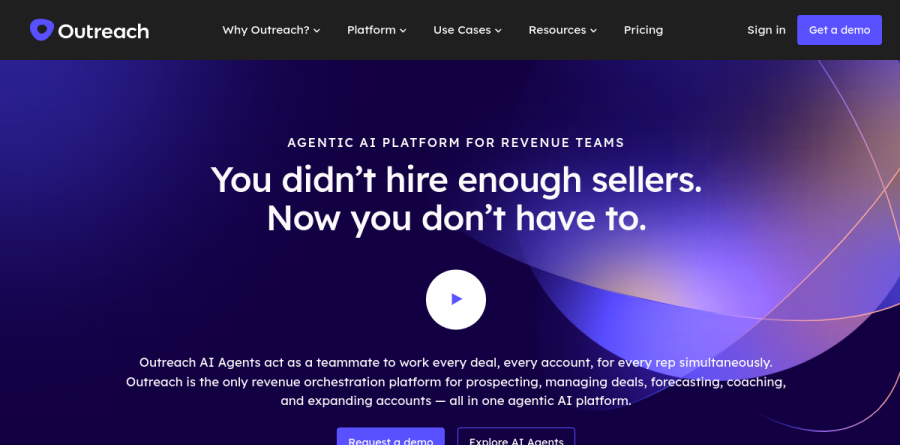
Outreach is a sales engagement platform that has repositioned itself around AI agents. The vendor now describes it as an agentic AI platform for revenue teams, and the product spans prospecting, deal management, forecasting, coaching, and account expansion inside a single workspace. Worth knowing before you go looking: the old outreach.io address redirects to outreach.ai, where all current product marketing now lives.
On its platform page, Outreach positions itself as an AI revenue orchestration layer that unifies prospect engagement, customer retention, coaching, and revenue intelligence. In practice that means sequences, dialing, meeting recording, pipeline hygiene, and forecast rollups sit in one system rather than several separate tools. The vendor reports that sellers on the platform close over 2 million opportunities every month.
Where the AI agents actually help

The agent roster is the clearest expression of what Outreach has become. Omni Agent is the conversational front door, answering questions across accounts, conversations, and pipeline, then acting on them. Research Agent blends conversation data with first-party and third-party sources, Personalization Agent turns that research into channel-appropriate messaging, and Meeting Prep Agent produces a brief so nobody walks into a call cold.
Deal Agent surfaces recommended opportunity field changes pulled from conversation intelligence, which is exactly the CRM housekeeping reps tend to skip. Revenue Agent identifies high-intent accounts and drives engagement against them. Agent Studio lets an ops team wire agents to triggers and revenue-cycle actions, while Outreach MCP exposes the platform to the rest of a go-to-market stack. A Reply Agent for handling email objections is listed as coming soon.
Conversation intelligence and rep coaching
Kaia is the conversation intelligence engine, and it is considerably more developed than a bolt-on call recorder. Real-time Assist surfaces guidance mid-call, Topics and Reactions tag what buyers actually respond to, and the Topics Report plus AI Topics Explorer let a leader see which themes move deals. Kaia Playlists compile best-in-class recordings to share with the team, Kaia Translations serve multilingual teams, Kaia for Mobile covers field reps, and CRM Sync pushes recordings, summaries and metadata into the CRM. AI Coach Cards with automated scoring sit on top, so coaching rests on evidence rather than recall.
Pipeline, deals, and forecasting
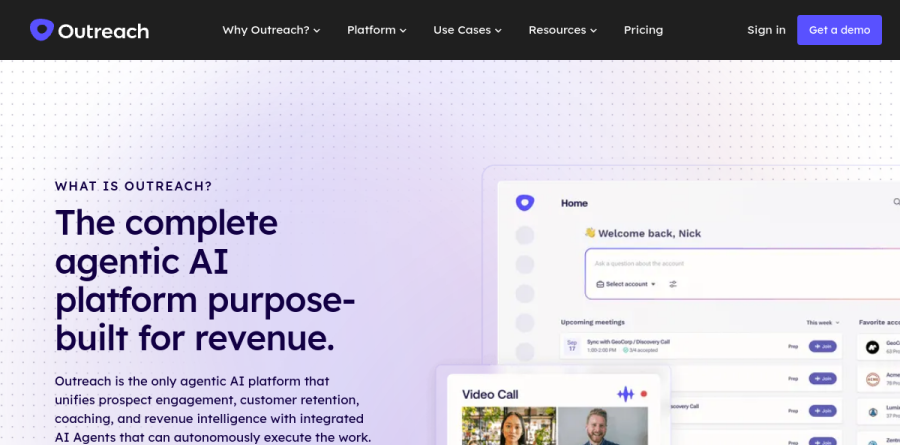
For managers, Outreach folds in Deal Management and Pipeline Management, which diagnose funnel quality and show where opportunities stall. Deal Health and Alerts raise risk before a quarter quietly slips. Mutual Action Plans keep buyer and seller aligned on next steps, Relationship Maps chart the buying committee, and Territory Management with Forecast Rollups gives leadership structure. AI Forecast Projection and the Scenario Planner let a revenue leader model outcomes instead of arguing over a spreadsheet.
How the Amplify plans are structured
Outreach publishes four tiers under the Amplify name. Essentials centres on conversation intelligence, real-time coaching, and rep performance. Core targets pipeline creation and account management for teams that want quick time to impact with room to expand. Plus, flagged as the most popular option, adds agents that guide reps live in meetings and automate follow-ups and pipeline updates. Pro is the end-to-end agentic revenue tier, with advanced forecasting, revenue trend visibility, and dedicated services support. Billing mixes seat-based pricing with consumption through AI credits, and the vendor states there are no platform fees. Every tier is quote-only, so budget for a sales conversation.
Who should choose Outreach
Outreach suits mid-market and enterprise revenue teams already running structured outbound that want coaching, forecasting, and CRM hygiene handled by one system instead of three vendors. The logos the company displays skew large — Siemens, Snowflake, ServiceNow, Databricks, Zoom, Okta — and the platform genuinely rewards organizations with sales ops capacity to configure Agent Studio, connect Outreach MCP, and keep data clean enough for the agents to reason over. It is not ideal for small teams or solo founders who need inexpensive sequencing and nothing more; the breadth, the credit-based consumption model, and the request-pricing process are all overkill at that size.
Strengths
- Deepest sales-engagement feature set in the category: sequences, dialer, conversation intelligence, deal and forecast modules in one platform
- Mature, enterprise-grade CRM sync and analytics with strong Salesforce integration
- New Amplify AI agents automate research, prospecting and follow-up rather than just bolting a chatbot onto the UI
- Proven at scale with large, established customer base and reliable deliverability tooling
Watch out for
- No published pricing, no free trial, and mandatory annual contracts force a demo/sales cycle before you see a number
- Expensive once modules stack up; implementation fees ($5k-$25k+) and annual platform fees add substantial first-year cost
- 2026 shift to consumption-based AI credits on top of seats makes total spend hard to predict and budget
- Overkill for small teams or simple cold-email needs; steep setup and admin overhead
Key features
| Feature | What it does |
|---|
| Multi-channel sequences | Automated email, call and social touch cadences with triggers, A/B testing and reply detection. |
| AI agents (Amplify) | Autonomous research, prospecting, personalization and follow-up agents metered by an AI-credit allotment per tier. |
| Conversation intelligence | Real-time transcription, call recording, coaching and deal-risk signals from recorded meetings and calls. |
| Pipeline and forecasting | Deal health scoring, pipeline management, scenario planning and forecast rollups for revenue ops (higher tiers). |
How Outreach compares
| Alternative | How it differs |
|---|
| Salesloft | Closest head-to-head sales-engagement rival with its own Rhythm AI signals; similar enterprise positioning and quote-based pricing. |
| Apollo.io | Combines B2B contact data with engagement at a far lower, transparent price point; better fit for SMB and mid-market. |
| Gong | Stronger, more focused revenue/conversation intelligence; often deployed alongside or instead of Outreach's Meet module. |
Frequently asked questions
Does Outreach publish its prices?
No. All three Amplify tiers (Core, Plus, Pro) are quote-only via a demo request. Widely reported third-party estimates put seats at roughly $100/$130/$160 per user per month on annual contracts, but Outreach does not confirm figures publicly.
Is there a free trial?
No free trial or free tier is offered. Access requires contacting sales, and add-on modules plus AI-credit consumption can raise the effective cost well above the base per-seat rate.
Outreach ratings on other platforms
Independent user ratings from third-party review sites, linked here for transparency.
These are not our editorial score, are captured on the date shown, and may have changed since.