The full review
What is MindStudio?
Built by GoMeta, Inc., MindStudio is a no-code platform for designing, building, and deploying AI agents. The homepage pitch is direct: build powerful AI agents for yourself, your team, or your enterprise, no coding required. What separates it from a general automation canvas is stated on the same page, where MindStudio describes itself as specifically made for the creation, deployment, and management of AI-native agents, and positions the product against Zapier, Make, and n8n.
In practice that means a visual builder, more than 100 templates, and a model catalog spanning dozens of providers. The vendor reports over 400,000 agents deployed and puts an average build at fifteen minutes to an hour, matching the scope most teams start with: a competitor monitor, an email assistant, a post generator.
Building agents without writing code
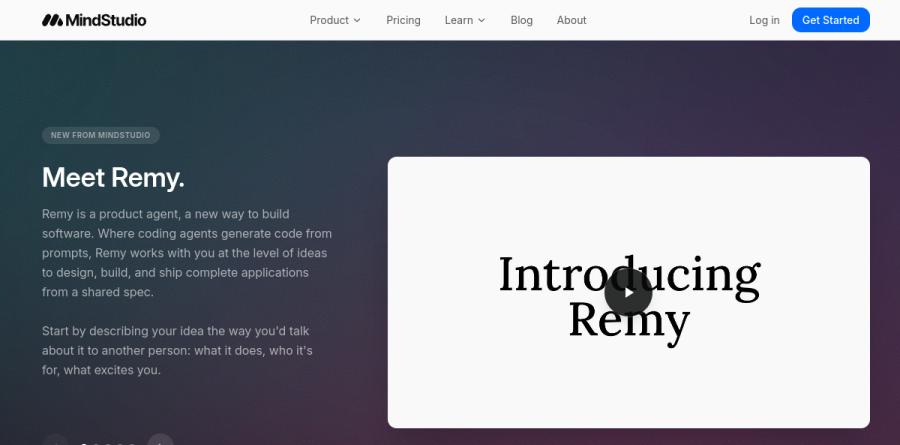
The fastest on-ramp is what MindStudio calls vibe coding an agent: you describe the agent you want to build, the MindStudio Agent Architect builds the scaffold for you, and you refine it by describing the changes you want. For bigger ambitions there is Remy, a product agent the vendor positions as a new way to build software; MindStudio says Remy goes from plan to product and ships real apps, typically within thirty to sixty minutes.
The escape hatch matters as much as the on-ramp: MindStudio is explicit that it is no code but you can code, supporting custom JavaScript and Python functions inside a workflow, so teams hitting the ceiling of drag-and-drop logic do not have to leave the platform.
Model access without API key sprawl

The AI Models catalog is one of the strongest arguments for MindStudio, listing well over 300 options across text generation, vision, image, video, transcription, text-to-speech, music, lip sync, embedding, reranking, and document extraction. Providers include Anthropic, OpenAI, Google, Mistral, DeepSeek, Perplexity, ElevenLabs, and Runway.
Access runs through the MindStudio Service Router, which reaches those providers with no API keys required and, the vendor states, bills model usage at cost with no markup over going direct. Usage therefore sits on top of the subscription rather than inside it, and per-agent and total spending limits keep that variable line predictable.
Deployment surfaces and integrations
Agents are only useful where the work happens, and MindStudio ships a broad set of endpoints: AI-powered web apps, autonomous agents, browser extensions, email-triggered agents, webhook and API endpoints, and agentic MCP servers, with more than 1,000 pre-built integrations handling the connective tissue.
Inside a workflow you can pull from URL scraping, SQL databases, vector databases, and web search, then emit PDFs, HTML, CSVs, interactive calculators, or multi-step forms. Human-in-the-loop controls such as custom UIs, file uploads, and approval checkpoints keep a person on the decisions that warrant one.

The AI Media Workbench gathers image, video, and audio models into one workspace with more than twenty media tools, among them upscaling, background and watermark removal, face swap, subtitles, and clip trimming. For reliability, MindStudio adds automated diagnostics, an AI debugger, side-by-side model comparison, and version history. That comparison feature is worth using, because testing a workflow against several models before committing is what keeps a catalog this large from becoming noise.
Plans, teams, and governance
Tier boundaries follow scale rather than feature lockout. Free runs a single agent with a capped monthly run allowance and full catalog access. Individual lifts that to unlimited agents and unlimited runs, and adds access to the MindStudio Slack community. Business is quote-based and covers team workspaces, enterprise support, and the compliance surface: SSO, SCIM, RBAC, audit logging, custom domains, and self-hosting. The vendor states it is SOC II and GDPR compliant and that customer data is never used for training.
Who should choose MindStudio
The platform suits operations, IT, marketing, and HR teams that want working agents without a development cycle, and it suits agencies and systems integrators building the same class of automation repeatedly for different clients. At-cost model billing, a genuinely broad catalog, and deployment as extensions, MCP servers, or web apps make it a strong fit when delivery is the bottleneck.
It is a weaker fit for teams needing deterministic, high-volume data plumbing between business systems, where a traditional automation tool with mature error handling and retry semantics will serve better than an agent framework. Budget-conscious buyers should model usage carefully too, because the subscription is only part of the bill.
Strengths
- AI model usage is passed through at provider cost with no markup — genuinely uncommon and buyer-friendly for high-volume work
- Access to 200+ models (OpenAI, Anthropic, Google, Meta) through one router, with no API keys to manage
- Individual plan is a flat $20/mo (or $16 annual) with unlimited agents and unlimited runs
- Strong knowledge management/RAG and 1,000+ integrations for a no-code tool, plus SOC 2 and 'data never used for training'
Watch out for
- Total cost is unpredictable: the low subscription masks variable model-usage fees that scale with volume
- Team/Business pricing is quote-only, so organizations get no transparent, self-serve path
- Advanced logic, custom functions and debugging complex multi-model flows carry a real learning curve
- Platform lock-in and thinner native connectors than dedicated automation tools like Zapier or n8n
Key features
| Feature | What it does |
|---|
| Visual agent builder | Drag-and-drop canvas with 100+ templates to assemble multi-step reasoning agents without code. |
| Service Router (200+ models) | Switch between OpenAI, Anthropic, Google and others in one workflow; bring-your-own API keys optional. |
| Pass-through usage billing | Model costs are billed at provider rates with no MindStudio markup, on top of the flat subscription. |
| Knowledge base and RAG | Document retrieval and long-term memory rated among the more stable in the no-code category. |
How MindStudio compares
| Alternative | How it differs |
|---|
| Stack AI | More enterprise/RAG and compliance-focused (HIPAA, SOC 2, on-prem) for regulated industries. |
| Relevance AI | Geared toward autonomous multi-agent 'AI workforces' for sales and ops; can get costly at scale. |
| Gumloop | Deterministic node-based flow builder for data-heavy pipelines; more predictable but less agentic reasoning. |
Frequently asked questions
Is there a genuinely free plan?
Yes. The Free tier is permanent (not a trial) and includes 1 agent and 1,000 runs/month with access to 200+ models. You still pay pass-through model-usage costs on top.
How does MindStudio pricing actually work?
It is two-part: a flat platform subscription (Free, $20/mo Individual, or custom Business) plus the actual AI model costs, passed through at provider rates with no markup. Your monthly bill therefore varies with how much your agents run.
MindStudio ratings on other platforms
Independent user ratings from third-party review sites, linked here for transparency.
These are not our editorial score, are captured on the date shown, and may have changed since.