The full review
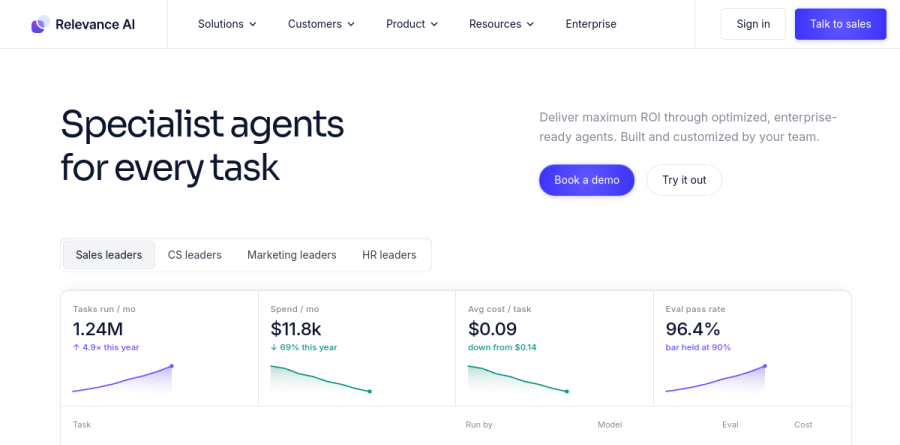
What is Relevance AI?
Relevance AI is a no-code platform for building and running teams of specialist AI agents, which the company brands as an AI Workforce. Rather than pointing one general-purpose model at every job, you assemble narrow agents that each own a single task, connect them to your business systems, and let them run on triggers or schedules.
The product bundles a no-code agent builder, an orchestration layer that groups agents into teams, a job queue that retries failed runs, an LLM router, tracing, and an evaluation system. Relevance AI presents these as one stack rather than parts you bolt together yourself, which is the core of its pitch.
How you build agents in Relevance AI
The AI Agents page describes three build paths: drag and drop on a visual canvas, Build with AI for describing what you want in plain language via Invent, and Build with MCP, which lets developers construct agents programmatically from Claude Code, Codex, or Cursor. A revenue operations manager can sketch a workflow visually while an engineer wires deeper logic through code.
Above the builder sits a shared context layer. You define tone of voice, business context, and knowledge once, drawing on Tables, Files, and Docs, so every agent draws on one source instead of repeated setup.
Prebuilt agent roles for revenue teams
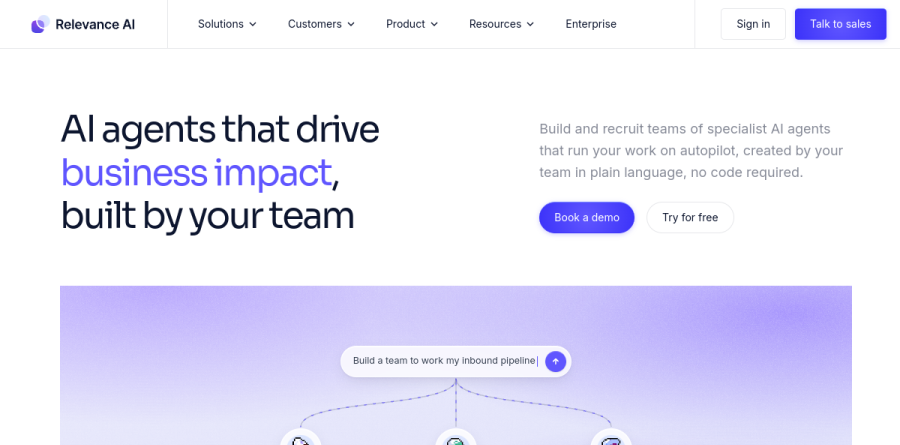
The clearest picture of what Relevance AI does comes from the agent roles it showcases. Research & Enricher pulls prospect data from live, dynamic sources. Pre-meeting Prepper surfaces context for reps before a call, and Post-call Actioner logs notes and fires follow-ups afterward. Meeting Scheduler books qualified meetings, Outbound Prospector personalizes multi-channel sequences, Forecast Roll-up turns deal signals into a pipeline call, Deal Reviewer flags risk against your criteria, and Proposal Builder drafts tailored quotes.
Beyond sales, Relevance AI names Contract Reviewer, Invoice Matcher, Ticket Triager, and Inbound Qualifier, with use-case sections spanning customer success, marketing, support, operations, human resources, and research.
Evals and model routing keep quality and cost honest
Two capabilities separate Relevance AI from simpler automation builders. Agent Evaluations sample live runs, chart the pass rate, and flag drift long before it reaches a customer; the vendor illustrates this with accuracy broken out field by field for a Lead Enrichment Agent. Paired with version control, evals are meant to catch regressions between agent versions before they ship.
The LLM router then hunts for the lowest-cost model that still clears your quality bar, comparing options across providers. Combined with tracing, it yields per-task cost visibility, which is how Relevance AI frames its return-on-investment case.
Enterprise controls and integrations
Relevance AI reports SOC 2 Type II and GDPR compliance alongside data residency, PII masking, audit logs, and a commitment not to train on your data. Access controls cover role-based permissions, SSO and SAML, human-in-the-loop approvals, and version control, while oversight adds real-time monitoring, full agent tracing, and OTEL plus Delta Share export. An MCP Gateway governs which tools agents may reach, and the platform advertises connections to more than 1,000 apps.
How Relevance AI is packaged today
The public pricing page now presents a single Enterprise plan routed through a talk-to-sales path rather than a self-serve tier list, promising Custom Actions, Custom Vendor Credits, unlimited agents and workforces, calling and meeting agents, Enterprise Triggers, Agent Evaluations, and a dedicated account manager.
Relevance AI also describes an embedded deployment team that maps use cases in the first two weeks, builds your first squad of agents by roughly week six, then trains internal staff to ship new agents unaided.
Who should choose Relevance AI
Relevance AI suits mid-market and enterprise teams that have already proven a repeatable AI workflow and now need it to run reliably, cheaply, and under governance. Revenue operations, customer success, and support functions with genuine task volume stand to gain most, especially where per-run cost and audit trails matter to a finance or security stakeholder. It is not ideal for solo founders or small teams wanting a quick automation they can wire up in an afternoon, since the deployment-led onboarding and quote-only packaging assume a budget and an executive sponsor.
Strengths
- Genuinely no-code visual builder that lets non-engineers ship working agents fast
- Modular tools that can be reused and composed into larger multi-agent workflows
- 2,000+ integrations plus BYOK across major LLM providers for cost and model control
- Vendor Credits pass through AI compute at wholesale with no markup and roll over
Watch out for
- Cost unpredictability is the top recurring complaint; Action overages and retry billing surprise teams at production volume
- Steep learning curve for reliable multi-agent configurations despite the easy first impression
- Pricing model (Actions + Vendor Credits, restructured Sept 2025) is confusing and hard to forecast
- Overage rates are steep and some published figures conflict ($80 vs $40 per 1,000 Actions)
Key features
| Feature | What it does |
|---|
| Multi-agent orchestration | Build a coordinated 'AI workforce' where multiple agents hand off tasks across a workflow. |
| Modular reusable tools | Create micro-functions once and combine them into agents, cutting duplication and speeding iteration. |
| 2,000+ integrations & triggers | Connect Slack, Salesforce, HubSpot and more, with event-driven triggers for automated runs. |
| Bring-your-own-key (BYOK) | Plug in your own LLM provider keys to bypass Vendor Credits and control inference costs directly. |
How Relevance AI compares
| Alternative | How it differs |
|---|
| Lindy AI | AI agent builder aimed at sales/ops automation; simpler pricing but fewer modular building blocks. |
| n8n | Workflow automation with strong AI nodes and self-hosting; more technical, more predictable cost. |
| Gumloop | No-code AI automation builder; comparable audience, lighter on true multi-agent orchestration. |
Frequently asked questions
Is there a free version of Relevance AI?
Yes. The Free tier gives 200 Actions per month plus a one-time 1,000 Vendor Credits, enough to evaluate the builder and run light single-agent tests before upgrading.
Why do costs become unpredictable?
Billing splits into Actions (each task run) and Vendor Credits (AI compute). At production volume, Action overages and retries accumulate quickly, so high-throughput workflows need active budget monitoring.
Relevance AI ratings on other platforms
Independent user ratings from third-party review sites, linked here for transparency.
These are not our editorial score, are captured on the date shown, and may have changed since.