The full review
What is Koyeb?
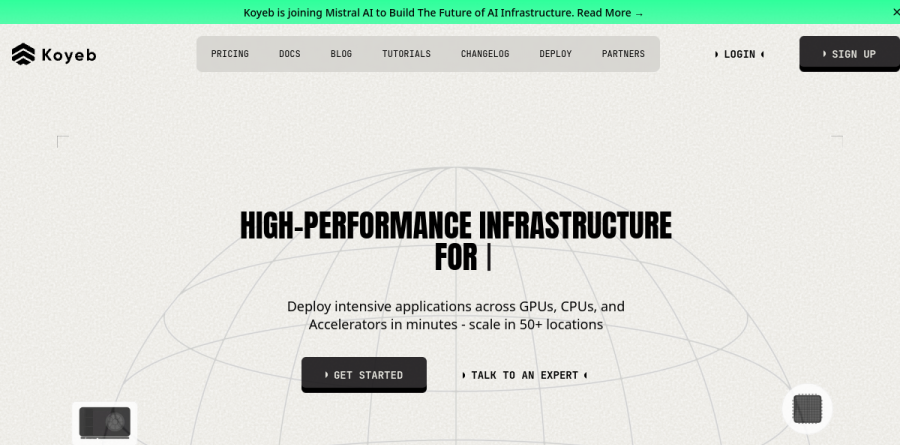
Koyeb is a serverless platform for running containers, APIs and AI models on managed infrastructure spanning CPUs, GPUs and accelerators. The homepage positions it as high-performance infrastructure for APIs, inference and databases, with a promise of deploying intensive applications in minutes. You push a Git repository or point Koyeb at a Docker image, and the platform handles builds, TLS, routing, health checks and rollouts.
What separates Koyeb from a plain container host is the billing and scaling model: compute is metered by the second, and services autoscale, including scale-to-zero when traffic stops.
Git-driven deploys and container workflows
Koyeb supports two main paths into production. Git-driven deployment builds native code straight from a repository, with documented buildpack support for Node.js, Python, Go, Ruby, Java, PHP and Scala. Teams already on containers deploy Docker images instead, and the Koyeb CLI covers the same operations from a terminal for scripting and CI.
Around those deploys sit the operational pieces you would otherwise assemble yourself: Zero-Downtime Deployments, Smart and Fast Autoscaling, native HTTP/2, WebSocket and gRPC support, plus logs and instance access for debugging a live service.
Instance types built around workload size

Koyeb splits compute into clear families rather than one generic size. Free instances give a single small allocation per organization, enough to keep a demo or side project online. Eco instances run from eco-nano to eco-2xlarge, spanning 0.1 to 8 vCPU and 256MB to 16GB RAM, and are offered in Washington D.C., Frankfurt and Singapore. Standard instances run from nano through 5xlarge for production services needing consistent performance. Because compute is metered by the second, right-sizing becomes a genuine lever: moving a service down a tier changes the bill immediately rather than at renewal.
GPU inference and AI workloads
GPU instances span RTX 4000 SFF Ada, L4, RTX A6000, L40S, A100, H100, H200, B200 and RTX PRO 6000, with multi-GPU configurations up to 8x, priced per hour and accounted per second. The vendor reports sub-200ms cold starts on autoscaling, roughly 10x faster inference with dedicated performance, and around 80 percent savings compared with hyperscalers.
For teams serving open models, the practical gain is the removal of a reservation: capacity spins up per request rather than sitting idle against a monthly commitment.
Global regions and edge routing
Deployments land in core regions including Frankfurt, Washington D.C., Singapore, Tokyo, Paris and an AWS US East location, with San Francisco documented as a preview region for paid plans. On top of those, the Koyeb Global Edge Network serves users from nearby edge locations and routes each request to the closest core deployment. That matters for latency-sensitive APIs and for data residency: running one service in Frankfurt and another in Singapore is a configuration choice, not a second provider relationship.
Sandboxes, Postgres and one-click apps

Two newer pieces round out the platform. Koyeb Sandboxes are ephemeral compute environments for isolated code execution, with an SDK in Python and JavaScript for launching instances, exposing ports, running background processes and cleaning up afterwards, an obvious fit for agent-generated or untrusted code. Serverless Postgres with pgvector covers the database side, metered by the second with storage charged per gigabyte.
The Koyeb one-click apps catalogue is worth a browse before writing any Dockerfile: hundreds of templates spanning models like Ollama and Llama, frameworks such as Next.js and FastAPI, and tools including Grafana and Metabase.
Who should choose Koyeb
Koyeb fits teams shipping containerized APIs, background workers or model inference who want per-second billing and autoscaling without operating Kubernetes. Pro at $29/mo covers 10 users and 100 services, Scale at $299/mo raises that to 50 users and 1,000 services with a 99.9% uptime SLA, and Enterprise adds a 99.99% SLA with 24x7x365 premium support. Solo builders can validate on a Free instance, then step up to Eco or Standard as traffic arrives.
It is less ideal for organizations needing deep cloud-native breadth, such as managed queues, granular IAM and a wide regional footprint, where a hyperscaler still wins. Check the region list early: with a handful of core locations, some latency and residency requirements will not be met.
Strengths
- Forever-free instance (0.1 vCPU / 512MB / 2GB SSD), typically no credit card required
- Per-second billing on both CPU and GPU means no idle-time waste
- Cheap standard instances from $2.68/mo (nano), eco instances from $1.61/mo
- Global edge deploy with built-in autoscaling and scale-to-zero
Watch out for
- Free instance limited to one region and cold-starts after 1 hour idle
- Team plans add a flat platform fee ($29/mo Pro) on top of compute usage
- Managed Postgres gets expensive fast ($59.52/mo for a 0.5 vCPU Medium)
- Direction uncertain after Mistral AI acquisition in February 2026
Key features
| Feature | What it does |
|---|
| Serverless deploy | Git-push or Docker deploys to a global edge network with zero infra management |
| Autoscaling & scale-to-zero | Instances scale automatically on traffic and drop to zero when idle |
| On-demand GPUs | RTX-4000, L4, A100 and H100 instances billed per second, $0.50-$2.50/hr |
| Per-second billing | Formula: instances x seconds x instance size price; pay only while running |
| Managed PostgreSQL | Free tier (1GB, 5 compute-hrs/mo) plus paid tiers from $0.08/hr; storage $0.50/GB/mo |
| 1TB bandwidth included | Overage $0.02/GB EU/US, $0.04/GB Asia; startups get up to $30k in credits |
How Koyeb compares
| Alternative | How it differs |
|---|
| AWS Lambda | True function-as-a-service billed per request + GB-second; cheaper for spiky, low-volume events but no persistent servers or GPUs |
| Google Cloud Run | Container serverless with scale-to-zero and similar model; larger ecosystem, but no native on-demand GPU marketplace like Koyeb |
| Render / Railway | Comparable developer-friendly PaaS pricing and DX; Koyeb differentiates with global edge and per-second GPU billing |
Frequently asked questions
Koyeb pricing
Koyeb bills usage-based per second. The forever-free tier includes one instance (0.1 vCPU, 512MB RAM). Paid standard instances start at $2.68/mo (nano); eco instances from $1.61/mo. GPUs run $0.50-$2.50/hr (RTX-4000 to H100). Team plans add a flat fee: Pro $29/mo plus compute, Scale $299/mo plus compute.
Is Koyeb free?
Yes. Koyeb offers one forever-free instance per organization: 0.1 vCPU, 512MB RAM, 2GB SSD, in Frankfurt or Washington, D.C. It scales to zero after one hour idle, so expect cold starts. A credit card usually isn't required. You also get one free PostgreSQL database with 1GB storage and 5 compute-hours per month.
Koyeb vs AWS Lambda
Both are serverless but differ. Lambda is function-based, billed per request plus GB-seconds, ideal for spiky, event-driven workloads. Koyeb runs long-lived containers billed per second, with scale-to-zero, global edge deploy, and on-demand GPUs (A100, H100). Koyeb suits always-on APIs and ML inference; Lambda wins for bursty, low-volume functions.
How much do Koyeb GPUs cost?
Koyeb GPU instances are billed per second at these hourly rates: RTX-4000-SFF-ADA $0.50, L4 $0.70, A100 (80GB) $1.60, H100 (80GB) $2.50, and 8x H100 $20.00. Scale-to-zero means no idle charge, so you pay only while the instance runs. GPU access requires a paid team plan.
Does Koyeb require a credit card?
Usually not. Koyeb tries to keep the free tier available without a credit card, but may request one if it can't automatically verify you're human. Paid usage - standard instances from $2.68/mo, GPUs from $0.50/hr - is billed per second under a Pro ($29/mo) or Scale ($299/mo) team plan.
Koyeb ratings on other platforms
Independent user ratings from third-party review sites, linked here for transparency.
These are not our editorial score, are captured on the date shown, and may have changed since.