The full review
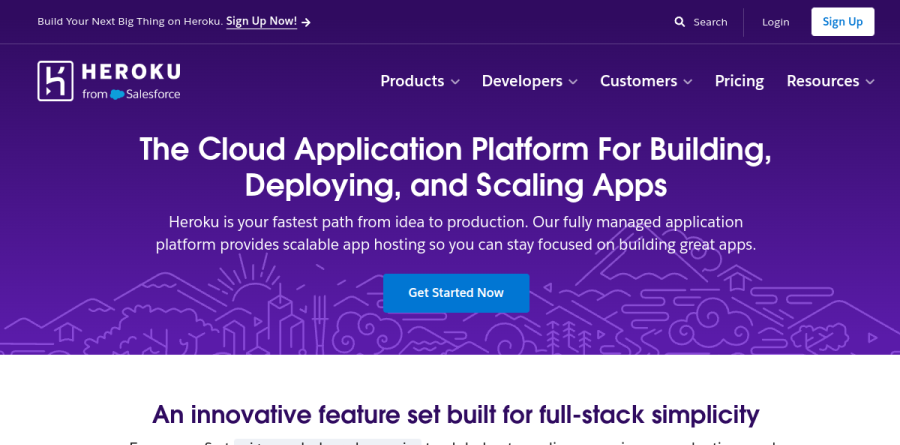
What is Heroku?
A platform-as-a-service in the original sense, Heroku runs application code without asking anyone to provision, patch, or babysit a server. You deploy straight from Git - the homepage starts the story at your first git push heroku main - and the code goes to a build system that produces an app ready for execution, which then runs inside a dyno, described by Heroku as a smart container on a reliable, fully managed runtime environment. The homepage frames the product as the cloud application platform for building, deploying, and scaling apps, and the vendor describes it as the fastest path from idea to production.
First-class language support covers Ruby, Python, Node.js, Java, PHP, Go, Scala, Clojure, and .NET, with buildpacks handling the rest. Wrapped around that runtime are managed databases, an add-ons marketplace, and a release pipeline, which together let a small team ship a production web app without anyone on staff running infrastructure.
Push to deploy, then scale by dyno

The Heroku Runtime is where most of the value sits. Scaling is a matter of changing dyno size or count from the Heroku Dashboard or the Heroku CLI, with no capacity planning meeting attached. The pricing page lists two dyno generations side by side: Cedar, running from Eco and Basic up through Standard-1X, Standard-2X and the Performance, Private and Shield sizes, and the Kubernetes-powered Fir, split into Classic, General Purpose, Compute and Memory families, which Heroku positions as the option for enhanced observability and fine-tuned control. Eco, at $5 a month, is limited to personal accounts and sleeps after 30 minutes of inactivity, while Standard-1X at $25 adds simple horizontal scalability, app metrics and threshold alerts, and preboot with zero-downtime deploys.
Review Apps, pipelines and the release path
Heroku Flow bundles the delivery workflow. Review Apps create a disposable, fully running copy of an application for every pull request, so a designer or product manager can click a link instead of pulling a branch. Heroku Pipelines then handle the staging-to-production layout, which Heroku describes as handling the infrastructure layout for you and keeping your deployment workflow clean and automated. Heroku CI runs test runs on CI-enabled Pipelines - Heroku Enterprise includes an unlimited number of them, with test runs drawing on existing dyno credits - and Heroku Teams manages people, app-level permissions, software delivery and billing.
Managed data and the Elements marketplace
Heroku Postgres is the anchor service: its Classic plans ladder from Essential - Essential-0 starts at $5 a month with shared RAM and a 1 GB disk - through Standard, Premium, Private and Shield, and the pricing page lists a separate Advanced lineup priced across Common Runtime, Private and Shield. Heroku Key-Value Store is the fully managed Redis service, and Apache Kafka on Heroku connects the leading open-source solution for handling streaming data as a fully managed service for real-time data processing and event-driven architectures. Everything else arrives through the Heroku Elements marketplace, where Add-ons extend an app, Buildpacks customize the language stack and Buttons jumpstart projects, across what Heroku counts as 150+ third-party add-ons and 380+ open source buildpacks.
Heroku AI for teams shipping agents

Heroku Managed Inference and Agents gives apps access to top AI models through a production-ready API, set up with just a few CLI commands. The vendor reports that its MCP Toolkits provide a unified gateway for deploying and managing multiple MCP servers, giving agentic clients a consistent interface. pgvector for Heroku Postgres stores embeddings alongside relational data for retrieval-augmented workloads, and Heroku AppLink connects apps to Salesforce business logic.
Compliance controls for regulated teams
Heroku Enterprise is where the platform earns its keep in larger organizations. Private Spaces give network-isolated, dedicated runtime environments in a chosen region. Heroku Shield adds the controls needed for HIPAA and PCI workloads. Heroku Connect keeps Postgres synchronized with Salesforce objects, SSO integrates identity providers such as Okta, PingOne, and Salesforce Identity, and Enterprise Accounts centralize administration with audit logs.
Who should choose Heroku
Reach for Heroku when the scarcest resource is engineering attention: startups validating an idea, agencies shipping client apps, internal tools inside a Salesforce shop, and any Rails, Django, or Node service where the deploy story should be boring. The developer experience is the centerpiece - Heroku calls it an app-centric approach to software delivery, so developers are not distracted by servers or infrastructure - and Postgres, Key-Value Store and Apache Kafka are all delivered as fully managed add-ons. Heroku is not the pick for teams that need GPU training - no dyno family on the pricing page offers one - or kernel-level control, since Heroku patches the kernel itself. There is no free dyno tier: the cheapest Cedar dyno on the pricing page is Eco at $5 a month, and the cheapest Postgres plan, Essential-0, is $5 a month as well.
Strengths
- Git-push deploys with no infra config; live in seconds
- Huge add-on marketplace (Postgres, Redis, Kafka, monitoring) provisioned in one command
- Mature, stable 18+ year platform with well-regarded managed Postgres
- Per-second billing with monthly caps; scale dynos via slider or CLI
Watch out for
- No free tier since Nov 28, 2022; cheapest is $5/mo Eco with sleep
- Costs stack up: dynos plus separately-billed Postgres and Redis add-ons
- No SSH access to dynos on any tier
- Salesforce ownership slowed DX vs Render, Railway, and Fly.io
Key features
| Feature | What it does |
|---|
| Git-push & container deploy | Deploy by pushing to Git or the Heroku Container Registry; buildpacks auto-detect the language. |
| Add-on marketplace | Hundreds of one-click add-ons for databases, caching, logging, email, and monitoring. |
| Managed Heroku Postgres & Key-Value Store | Fully managed Postgres (from $5/mo) and Redis-compatible Key-Value Store (from $3/mo) with backups. |
| Pipelines & Review Apps | Built-in CI/CD flow with staging-to-prod pipelines and disposable per-PR review apps. |
| Dyno scaling & autoscaling | Scale process count manually or autoscale Performance dynos based on response time. |
| Private Spaces & Shield | Isolated network runtimes with HIPAA/PCI/SOC compliance for enterprise workloads. |
How Heroku compares
| Alternative | How it differs |
|---|
| Render | Genuine free tier (750 hrs/mo), native Docker and infra-as-code; the leading modern Heroku replacement. |
| Vercel | Frontend/Next.js specialist with a generous free tier; not a true backend PaaS swap. |
| Railway | Usage-based PaaS with slicker DX and trial credits; popular with indie devs leaving Heroku. |
Frequently asked questions
Is Heroku free?
No. Heroku permanently removed all free product plans on November 28, 2022, retiring free dynos, free Postgres, and free Redis. The cheapest option today is the Eco dyno plan at $5/month for 1,000 pooled dyno hours, though Eco apps sleep after 30 minutes of inactivity. There is no longer any no-cost tier.
How much does Heroku cost?
Heroku starts at $5/month (Eco dynos, pooled hours) or $7/month for an always-on Basic dyno. Production Standard dynos cost $25 (1X) or $50 (2X), and Performance dynos run $250 to $1,500. Databases bill separately: Postgres from $5/mo and Key-Value Store (Redis) from $3/mo. A realistic app-plus-database stack typically lands around $80-105/month.
What are the best Heroku alternatives?
The most popular 2026 alternatives are Render (genuine free tier, native Docker, cheaper stacks), Railway (usage-based with strong DX), Fly.io (edge deployment), and Vercel (best for Next.js frontends). For teams needing free hosting, Render's 750 free compute hours per month is the closest drop-in replacement for Heroku's retired free dynos.
Heroku vs Vercel: which is better?
They target different jobs. Vercel is built for frontend and Next.js apps with a generous free tier and an edge network, while Heroku is a general-purpose backend PaaS for Rails, Django, Node, and Java with managed databases and add-ons. Choose Vercel for JAMstack and frontend work; choose Heroku for full-stack apps needing background workers and Postgres.
Heroku vs Render: which is cheaper?
Both start at $7/month for always-on hosting. In one 2026 test a Node+Postgres+Redis stack cost about $15/month on Heroku versus $24 on Render, since Heroku's add-on databases start lower. However, Render offers a genuine free tier (750 hours/month) that Heroku lacks, making Render cheaper for hobby and non-production use.
Heroku ratings on other platforms
Independent user ratings from third-party review sites, linked here for transparency.
These are not our editorial score, are captured on the date shown, and may have changed since.