The full review
What is Flowise?
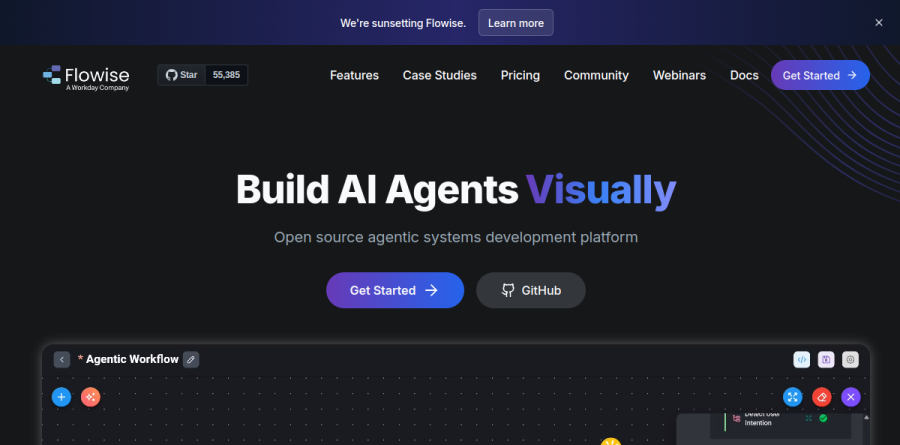
Flowise is an open source platform for building AI agents on a visual canvas, billed on its homepage as an agentic systems development platform. The idea is modular building blocks you wire together, spanning simple compositional workflows through to autonomous agents. Getting started is a two-liner: install the package globally with npm, start it, and open the app on localhost.
The project is Apache 2.0 licensed and organised as a monorepo of four modules: a Node backend serving API logic, a React frontend, a components package of third-party node integrations, and auto-generated Swagger UI API documentation. It runs self-hosted or on the managed Flowise Cloud.
Agentflow and Chatflow
Flowise splits building into two named canvases. Agentflow handles multi-agent systems, where orchestration is distributed across coordinated agents that pass work between them. Chatflow covers the single-agent case, chat assistants and bots, with tool calling and knowledge retrieval from various data sources built in.
For retrieval work the site lists the document types Flowise ingests, among them PDF, DOC, RTF, HTML, CSV, JSON, XML, MD and SQL. That range shows what a realistic Flowise RAG project looks like: point it at internal documents and database exports, add an embedding model and a vector store, then expose the result as an assistant.
Oversight, traces and evaluation
Two features address the part of agent work that usually gets neglected. HITL, or human in the loop, lets people review tasks an agent performed inside the feedback loop rather than after the fact. Observability provides full execution traces and, the vendor reports, supports Prometheus and OpenTelemetry. Evaluations and Metrics appear from the Free plan upward, so output quality measurement is not gated behind the top tier.
Embedding Flowise in your own product
Flowise is built to disappear into an existing application. The developer surface covers REST APIs, an embedded chat widget, and SDKs for Typescript and Python; the site shows a prediction endpoint you POST a question to and read JSON back from. Custom embedded chatbot branding is listed from the Free plan upward, not held back for paid tiers.
On infrastructure, the vendor reports support for more than a hundred LLMs, embedding models and vector databases, on-premises or cloud deployment, and horizontal scaling using a message queue with workers.
Flowise is winding down
This is the most important thing to know before adopting Flowise. The vendor has published a letter on its own site announcing a decision to wind down operations, reasoning that as models improve at reasoning, developers increasingly lean on coding agents, and rigid low-code workflows hit a ceiling.
The published timeline: feature development and pull request reviews ceased on 29 July 2026; on 10 August 2026 the GitHub repository moved to public archive status, with npm packages and Docker images marked deprecated; core team presence in Discord and GitHub concludes on 31 August 2026. The archival has already happened and the repository is read-only. The team stresses that the Apache 2.0 source stays on GitHub for teams to fork.
Plans and deployment options
The Flowise Cloud lineup runs Free, Starter and Pro, with an Enterprise track handled through a sales conversation. Free is trial-shaped, with a small allowance of flows, predictions and storage. Starter lifts that to unlimited flows and assistants with a far larger prediction quota. Pro adds unlimited workspaces, seats with a per-user add-on, admin roles and permissions, and priority support. Self-hosting the Apache 2.0 build carries no license fee, now the more sensible path.
Who should choose Flowise
Flowise still makes sense for a narrow group: teams already running it who need a stable base to fork, engineers who want to study a mature agent orchestration codebase, and people who learn faster on a visual canvas than in a framework. The feature set is broad and the code permissively licensed, so forking suits a team able to maintain it.
It is not a good choice for anyone shopping for new, vendor-supported production tooling. With the repository archived, packages deprecated and the core team stepping back, there is no maintained upstream, no security patch pipeline, and no roadmap. If you cannot own a fork, look elsewhere.
Strengths
- Genuinely open source and self-hostable, avoiding vendor lock-in and per-prediction cloud limits
- Very affordable managed cloud ($35-65/mo) compared with enterprise agent platforms
- Broad integration surface: 100+ LLMs, vector databases, tools, plus REST APIs and SDKs
- Covers single-agent chatflows, multi-agent agentflows, and human-in-the-loop review in one canvas
Watch out for
- Cloud prediction caps are low (10k Starter, 50k Pro) and overage pricing is not published, creating budget uncertainty
- Subscription is only a fraction of true cost; LLM tokens, vector DB, and infra are billed separately
- Self-hosting demands real DevOps effort to reach production reliability and scale
- Enterprise pricing is entirely quote-based with no public transparency
Key features
| Feature | What it does |
|---|
| Agentflow (multi-agent) | Visual orchestration of multi-agent systems with branching, tools, and workflow logic. |
| Chatflow + RAG | Drag-and-drop single-agent chat assistants with tool calling and retrieval over your own data. |
| Human-in-the-loop | Built-in HITL review steps so humans can approve or correct agent actions mid-run. |
| APIs, SDKs and traces | Embed flows via REST API/SDK and inspect execution traces for observability and debugging. |
How Flowise compares
| Alternative | How it differs |
|---|
| Langflow | The closest rival: open-source visual LLM/agent builder (now backed by DataStax/IBM). Similar canvas UX; heavier Python/LangChain leaning. |
| n8n | Broader workflow automation with strong AI/agent nodes; better for connecting business apps, less LLM-native than Flowise. |
| Dify | Open-source LLM app platform with agents, RAG, and prompt management; more app-lifecycle focused, comparable pricing model. |
Frequently asked questions
Is Flowise free?
Yes, in two ways. The open-source project is free to self-host (you only pay for infrastructure, LLM tokens, and any vector database). The managed cloud also has a free evaluation tier capped at 100 predictions/month, with paid cloud plans starting at $35/month.
What does the cloud subscription actually cover?
Only the Flowise platform and its prediction/storage quotas. You still pay separately for LLM API usage (e.g. OpenAI/Anthropic), any vector database, and infrastructure, so real total cost is typically several times the listed subscription.
Flowise ratings on other platforms
Independent user ratings from third-party review sites, linked here for transparency.
These are not our editorial score, are captured on the date shown, and may have changed since.