The full review
What is Dify?
Dify is an open-source development platform for LLM applications, and its current positioning is specific: the homepage calls it the platform for production-ready agentic workflows. The promise is that you build agentic workflows and RAG pipelines, with broad model and tool support, inside one collaborative workspace, then move from prototype to production without rebuilding the stack.
A visual canvas replaces prompt strings with connected nodes, so the steps between a user request and a dependable answer stay legible. Dify ships in three forms: Dify Cloud, hosted with no infrastructure to manage; Dify Enterprise, self-hosted or running in your VPC; and Community Edition, a single-command Docker deploy under an Apache-2.0-derivative license and, per the site, 152K+ GitHub stars.
Inside Workflow Studio
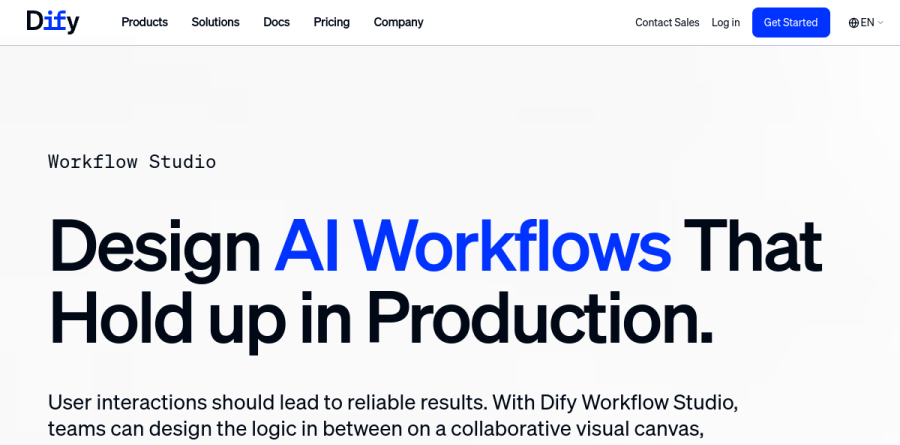
Workflow Studio is where most of the building happens. The node library spans User Input, Scheduled trigger, LLM, Knowledge Retrieval, Question Classifier, If / Else, Iteration, Tool, Code, and Human Input, grouped into start, reason and retrieve, control flow, act, and human review. The act group is broader than it sounds, covering Dify tools, custom APIs, MCP tools, HTTP requests, and sandboxed code.
Two run modes share that library. A Workflow makes one pass end to end, suiting batch jobs, document processing, and backend pipelines; a Chatflow runs once per message with conversation memory across turns, suiting assistants and guided support. Runs can also start themselves from scheduled jobs, plugin events, or inbound webhooks, and the Human Input node pauses a run so a person can approve, edit, comment, or forward it before anything touches sensitive data.
Knowledge Pipeline and tunable retrieval

Dify treats retrieval as engineering rather than an upload box. Knowledge Pipeline lays out source, extract, process, store, and retrieve as swappable nodes on the same canvas as Workflow Studio. You pick how documents are split, choosing among Standard for general text, Long Context for parent-child structure, Tables, or Q&A; whether chunks are indexed with embeddings for high quality or keywords for economy; and whether queries match semantically, by full-text keyword, or both. Metadata filters narrow scope, rerank reorders results, and citations attribute them. Retrieval Testing simulates real queries before any app connects.
Debugging, versions, and traces
Because prototype and production are the same artifact, debugging carries weight. You can run a single node against sample input or execute the whole flow, and LLM, HTTP, Code, and Tool nodes can stop, return defaults, or route to recovery branches with typed error metadata. Published builds are restorable, and DSL export moves a workflow between workspaces. Traces stream to Langfuse, LangSmith, Arize, and W&B Weave. Finished logic publishes as a hosted web app, an API endpoint, an MCP server for clients such as Claude Desktop and Cursor, or a Template Marketplace entry.
Plans, deployment, and enterprise controls
Sandbox exists for trying core features. Professional targets independent developers and small teams shipping production apps; Team is aimed at medium-sized groups needing collaboration and higher throughput. Both bill per workspace, with a discounted annual option. Message credits, Dify notes, let you try models from OpenAI, Anthropic, Gemini, xAI, DeepSeek, and Tongyi. Dify Enterprise adds SSO and SAML, RBAC, audit logs, a Helm chart for Kubernetes, and a dedicated CSM, with SOC 2 Type II and ISO 27001 listed. The vendor reports Maersk cut build time to two weeks per AI app, down from four months.
Who should choose Dify
Dify suits teams that need agent logic to stay visible, testable, and transferable: product, ops, or platform groups that have outgrown a folder of prompts but do not want to hand-roll an orchestration framework. It is strong where data residency matters, since Community Edition and Dify Enterprise keep the stack on your own infrastructure, and where human approval must sit inside an automated path. It is less suited to anyone wanting a drop-in chatbot widget with no build work, because the canvas rewards people willing to model their process. Note too that the entry paid tier caps team members at three.
Strengths
- Genuinely full-featured open-source core; self-hosting is free with no feature gating and avoids vendor lock-in
- Strong built-in RAG pipeline and model-agnostic support for OpenAI, Claude, Gemini, Llama, Mistral, and more
- Visual drag-and-drop builder covers chatbots, agents, and multi-step workflows without deep coding
- Native bidirectional MCP support plus 2026 additions (Human Input nodes, Supervisor multi-agent mode) keep it current
Watch out for
- Cloud plans are gated by message credits and seat/app caps that get tight fast for production, and LLM API usage is billed separately on top
- Documentation frequently lags the product by a release or two, causing avoidable friction
- The visual canvas has a real ceiling; complex custom logic still pushes you back to code
- Self-hosting shifts infra, scaling, and maintenance burden onto you, and enterprise SSO/access control is passable but not polished
Key features
| Feature | What it does |
|---|
| Visual workflow & agent builder | Drag-and-drop canvas for chatbots, autonomous agents, and multi-step LLM pipelines with branching and tool calls. |
| Built-in RAG engine | Knowledge-base ingestion, chunking, embedding, and retrieval, rated among the strongest in open-source packages. |
| Model-agnostic orchestration | Swap between OpenAI, Claude, Gemini, Llama, Azure, Mistral and others, or bring your own API keys to avoid lock-in. |
| MCP & multi-agent orchestration | Consume external MCP services and publish agents as MCP servers; Supervisor mode coordinates multiple agents. |
How Dify compares
| Alternative | How it differs |
|---|
| n8n | Open-source, source-available workflow automation with strong AI/agent nodes; broader integrations but less LLM-app-specialized than Dify. |
| Flowise | Open-source visual LLM/agent builder in the same niche; lighter and more developer-flexible but a thinner managed-cloud and RAG offering. |
| Langflow | Visual LangChain-based flow builder (DataStax-backed); comparable canvas UX, less emphasis on turnkey self-hosted app deployment. |
Frequently asked questions
Is Dify really free?
Yes, in two ways: the cloud Sandbox tier is free (200 one-time credits, evaluation-only), and the self-hosted Community Edition is fully free with no feature restrictions. You only pay for cloud upgrades, your own infrastructure, or LLM API usage.
Do Dify's message credits cover my LLM costs?
Not for production. Credits cover calls routed through Dify's hosted model access. When you connect your own provider keys (recommended for scale), OpenAI/Claude/etc. API usage is billed separately by that provider on top of your Dify plan.
Dify ratings on other platforms
Independent user ratings from third-party review sites, linked here for transparency.
These are not our editorial score, are captured on the date shown, and may have changed since.