The full review
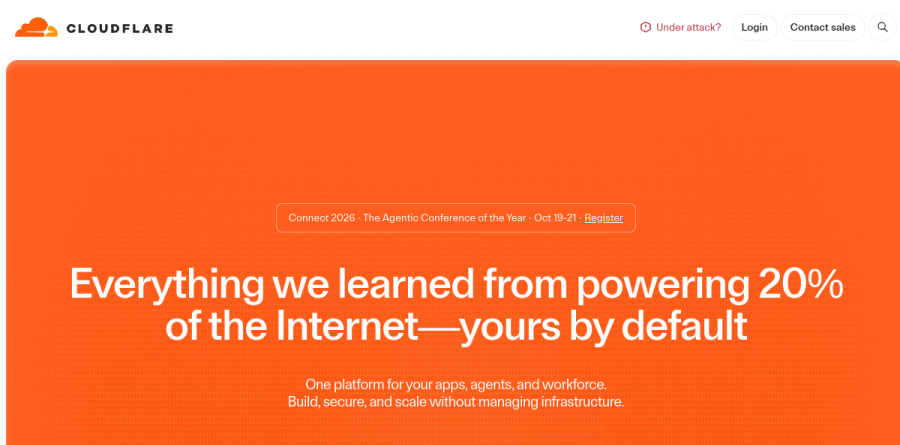
What is Cloudflare?
At its core, Cloudflare runs a global network that sits in front of websites, APIs, and internal infrastructure, acting as a reverse proxy between visitors and origin servers. Switching DNS is usually the only setup step, and from there Cloudflare handles caching, TLS termination, DDoS absorption, and request filtering before traffic reaches your own machines. The vendor reports the network spans more than 335 cities worldwide.
What began as a CDN and DDoS shield is now marketed as a connectivity cloud, bundling content delivery, application security, serverless compute, object storage, AI inference, and a full SASE stack under one account and control plane.
Content delivery and edge caching

The Cloudflare CDN caches static and dynamic content close to users, and setup requires no URL rewriting or separate hostname. Developers get granular Cache Rules, instant purging, and API-driven control, plus Tiered Caching and Cache Reserve for origins serving heavy volumes. Bandwidth is bundled rather than metered per gigabyte, which underpins the Cloudflare campaign against cloud egress fees.
The vendor cites Docker Hub as a customer that raised cache hit ratio and cut a large share of its S3 egress costs using Tiered Caching and Cache Reserve.
Security on the same network path
Because traffic already flows through Cloudflare, security attaches without extra hops. Every plan includes unmetered DDoS protection, Universal SSL, and a free managed WAF ruleset, Pro and above add lossless image optimization, and Business and Contract add PCI DSS 4.0 compliance and a 100% uptime SLA. Turnstile replaces traditional CAPTCHA, Bot Management blocks bad bots, Rate Limiting curbs abuse, and Client-Side Security watches JavaScript dependencies for supply chain tampering.
Cloudflare Workers is the serverless runtime, and the vendor emphasizes zero cold starts and no region selection. Around it sits a broad set of primitives: Durable Objects for stateful coordination, Containers and Sandboxes for arbitrary languages and untrusted code, Workflows for multi-step orchestration, and Browser Rendering for programmable headless browsers. Storage covers R2 for egress-free objects, D1 for serverless SQL, Workers KV, Queues, and Hyperdrive for making existing databases global.
For AI work, Workers AI runs models at the edge, Vectorize supplies the vector database, AI Search handles retrieval, and AI Gateway adds observability in front of model calls. The Agents framework targets stateful AI applications. On the media side, Images covers transformation and delivery, Stream handles video hosting and live streaming, and RealtimeKit with TURN and SFU infrastructure supports WebRTC conferencing.
Cloudflare One for zero trust access

Cloudflare One is the SASE and zero trust side of the platform, marketed as identity-first access that retires the VPN. It combines Access for ZTNA, Gateway for web and DNS filtering, CASB for SaaS posture, DLP, Remote Browser Isolation, Email Security, and Magic WAN for linking branches and data centers to the Cloudflare backbone. The vendor highlights post-quantum encryption across the stack and claims to be the first SASE platform securing connections to Model Context Protocol servers.
Who should choose Cloudflare
The Free plan is aimed at personal or hobby projects that aren't business-critical, Pro adds image optimization for professional websites, Business adds PCI DSS 4.0 compliance and a 100% uptime SLA for small businesses operating online, and Contract covers mission-critical applications. Developers should start on Workers Free before Workers Paid, and small security teams can pilot Cloudflare One free before moving to Pay-as-you-go or a Contract package.
It is less ideal for teams needing long-running stateful servers, heavyweight VMs, or a conventional managed-database estate, since the Cloudflare compute model favors short-lived edge execution over traditional cloud instances.
Strengths
- Best-in-class free tier: $0 CDN, unmetered DDoS, free WAF ruleset, plus 100,000 Workers requests/day
- No egress or bandwidth fees on Workers and R2 storage — large savings versus AWS
- Flat, predictable per-domain plan pricing ($20 Pro, $200 Business) with 20% annual discount
- Largest CDN by adoption (~38-40% share) on a 300+ city global edge network
Watch out for
- Paid CDN plans bill per domain (zone), so costs multiply across many sites
- Steep cliff from Business ($200/mo) to Enterprise, which often starts near $5,000/mo
- Usage-based developer products (Workers, R2, D1) make bills harder to predict at scale
- Advanced features like bot management, full WAF tuning, and SLA credits are gated behind Enterprise
Key features
| Feature | What it does |
|---|
| CDN & Edge Network | Caches content across a 300+ city global network to cut latency near users |
| WAF & DDoS Protection | Unmetered DDoS mitigation and managed WAF rulesets, included even on the free tier |
| Authoritative DNS | One of the fastest DNS resolvers, free with every plan including Free |
| Workers Developer Platform | Serverless edge compute paired with R2 storage, KV, D1 SQL, Durable Objects, and Queues |
| Zero Trust (Cloudflare One) | SASE stack with ZTNA and secure web gateway, free for up to 50 users |
| R2 Object Storage | S3-compatible object storage with zero egress fees |
How Cloudflare compares
| Alternative | How it differs |
|---|
| AWS CloudFront | Deeper cloud integration but complex usage billing and egress fees; ~25% CDN share by site count |
| Akamai | Enterprise CDN leader by revenue (~$4.2B); pricier and sales-led with less self-serve onboarding |
| Fastly | Developer-friendly edge with instant config, but a smaller network and higher cost at scale |
Frequently asked questions
Is Cloudflare free?
Yes. Cloudflare's Free plan costs $0 forever and includes global CDN caching, unmetered DDoS protection, a free managed WAF ruleset, fast DNS, and universal SSL, with no credit card required. The developer platform is also free-tier: Workers allows 100,000 requests per day, and Zero Trust covers up to 50 users at no cost. Paid application upgrades start at $20/month.
How much does Cloudflare cost?
Cloudflare uses freemium, per-domain pricing. The Free plan is $0, Pro is $20/month billed annually ($25 monthly), and Business is $200/month annually ($250 monthly). Enterprise is custom, often starting around $5,000/month. Developer products bill by usage: Workers Paid starts at $5/month for 10 million requests, then $0.30 per additional million requests, with no egress fees.
What is Cloudflare's free tier?
The Free plan ($0 forever) delivers global CDN caching, unmetered DDoS mitigation, a free managed WAF ruleset, fast DNS, and universal SSL per domain. Beyond CDN, Workers Free allows 100,000 requests/day with 10ms CPU per invocation, R2 and KV include free allotments, and Zero Trust protects up to 50 users free. No credit card is needed to start.
Cloudflare vs AWS: which is better?
Cloudflare wins on simplicity, flat predictable pricing, and a generous free tier, with no egress fees on Workers or R2 storage. AWS CloudFront and Lambda offer deeper cloud integration and more raw compute but complex, usage-metered billing. Cloudflare leads CDN by website count (~38-40% share); AWS is the better fit for teams already inside its ecosystem.
Does Cloudflare charge per website?
Yes, for its application plans. Pro ($20/mo) and Business ($200/mo) are billed per domain (zone), so each site on a paid plan pays the full fee. The Free plan covers your domains at $0. Developer platform products such as Workers, R2, and Pages bill per account by usage instead of per domain, starting at $5/month.
Cloudflare ratings on other platforms
Independent user ratings from third-party review sites, linked here for transparency.
These are not our editorial score, are captured on the date shown, and may have changed since.
