The full review
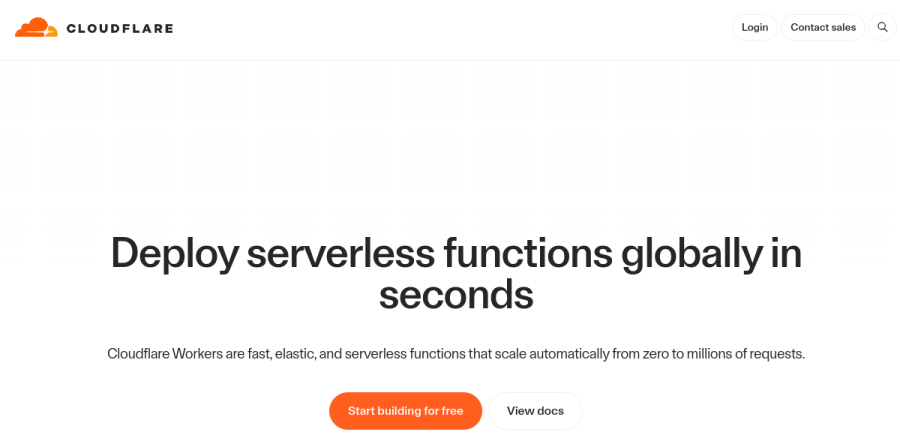
What is Cloudflare Workers?
Cloudflare Workers is a serverless compute platform that runs your code across Cloudflare's global network instead of inside a single cloud region. You write a function, deploy it with one Wrangler command, and it becomes reachable from the 330+ cities Cloudflare lists for its network, with no servers to size or autoscaling rules to tune.
What separates Workers from a conventional function-as-a-service product is the execution model. Code runs inside V8 isolates rather than containers, and Cloudflare meters CPU time rather than wall-clock time, so a function waiting on a slow database or third-party API is not burning budget while it idles. The vendor describes Workers as elastic functions that scale automatically from zero to millions of requests.
Zero cold starts and CPU-time billing
Zero cold starts is the benefit Cloudflare leads with on the Workers product page, and it follows from the isolate model: no container needs to boot before the first request gets served. Cloudflare also advertises infinite concurrency without the markup, so traffic spikes are absorbed by the network rather than by a ceiling you must raise in advance. The pricing documentation adds two points that matter to finance as much as engineering: no additional charges for data transfer or bandwidth, and requests to static assets are free and unlimited.
Languages, Wrangler, and framework support

Workers accepts JavaScript, TypeScript, Python, Rust, and WebAssembly, so the platform is not reserved for Node-shaped teams. Daily work runs through the Wrangler CLI, which the documentation names as the way to deploy, and Cloudflare describes workerd, the runtime underneath, as open source. The documentation lists React, Vue, Svelte, Next, Astro, and React Router among the frameworks you can use, making Cloudflare Workers a credible host for a whole application, not just a parking spot for stray functions.

Compute alone rarely finishes a project, which is where bindings earn their keep. A Worker binds natively to KV for low-latency key-value storage, D1 for serverless SQL, R2 for zero-egress object storage, Durable Objects for stateful real-time coordination, Queues for guaranteed delivery, and Hyperdrive for accelerated, edge-cached queries against an external database. Workers AI, Vectorize, Workflows, and Browser Run extend the same pattern to inference, vector search, durable multi-step jobs, and headless browsing. The documentation frames bindings as the way to connect to external databases, APIs, and storage in just a few lines of code.
Operational controls once real traffic arrives
Smart Placement is offered to optimize latency when a Worker connects to a data store, addressing the classic edge trap of fast compute stranded far from a slow database. Cron Triggers handle scheduled and background jobs, and the pricing documentation grants them a longer CPU allowance than ordinary invocations. Gradual rollouts and instant rollbacks give teams a release valve, while real-time logs and analytics arrive built in.
How the plans are structured
Three tiers cover most situations, and the differences concern limits more than features. The Free plan sets a daily request allowance and a tight per-invocation CPU ceiling, which is ample for prototypes, side projects, and learning the model. The Workers Paid plan, called Standard in the documentation, includes a monthly pool of requests and CPU milliseconds, meters overage beyond it, and raises the ceiling to a maximum of five minutes of CPU time per invocation, with a 30-second default. Workers for Platforms carries a monthly subscription, a larger included pool of requests and CPU milliseconds than the Standard plan, and a per-script allowance that bills for each script beyond it.
Who should choose Cloudflare Workers
Cloudflare Workers suits teams building APIs, full-stack apps, and request-time logic where latency and unpredictable traffic both matter, particularly if egress charges or concurrency caps have bitten you on a traditional cloud. Organizations already routing DNS and CDN through Cloudflare gain the most, since bindings turn a network they pay for anyway into an application platform.
It is a weak fit for long-running, CPU-heavy batch work such as video encoding or model training, or for anything expecting a persistent VM with a full filesystem, because per-invocation limits are intrinsic to the isolate design. Teams tied to Node-specific native modules should prototype first.
Strengths
- Genuinely free tier: 100,000 requests/day with no credit card and near-zero cold starts
- Billed on CPU time only — no charge for wall-clock time spent waiting on I/O, DB, or network
- Runs at the edge in 300+ cities worldwide for very low latency, with no egress or bandwidth fees
- Flat $5/mo Paid plan bundles Workers, KV, Durable Objects, Hyperdrive, and Pages Functions
Watch out for
- 128 MB memory cap and CPU-time limits (default 30s, max 5 min) restrict heavy compute jobs
- V8 isolate runtime is not full Node.js — some npm packages and native binaries won't run
- Two metered dimensions (requests + CPU-ms) make bills harder to predict than a single metric
- Smaller managed-service ecosystem than AWS Lambda for complex cloud architectures
Key features
| Feature | What it does |
|---|
| Edge execution | Runs on Cloudflare's global network (300+ cities) close to users, using V8 isolates for near-zero cold starts. |
| CPU-time billing | You pay only for CPU milliseconds actually used, not total wall-clock duration — idle I/O wait is free. |
| Bundled storage & state | The $5 Paid plan includes Workers KV, Durable Objects, and Hyperdrive usage; D1 and R2 available. |
| No egress fees | No charge for bandwidth or data transfer out, unlike most major cloud providers. |
| Wrangler tooling | CLI with local dev and CI/CD deploys; also deployable via dashboard or REST API. |
| Configurable CPU limits | Up to 5 min CPU per request (default 30s); 15 min CPU for Cron Triggers and Queue consumers. |
How Cloudflare Workers compares
| Alternative | How it differs |
|---|
| AWS Lambda | More services and memory (up to 10 GB), but cold starts, per-GB-second billing, and egress fees. |
| Google Cloud Run | Runs full containers with more runtime freedom; regional rather than edge, and pricier at low scale. |
| Vercel Functions | Smoother DX for Next.js/frontend teams, but built on similar infra with higher usage-based costs. |
Frequently asked questions
How much does Cloudflare Workers pricing cost?
Cloudflare Workers has a free tier with 100,000 requests per day and 10 ms of CPU time per invocation. The Workers Paid plan is $5 per month and includes 10 million requests plus 30 million CPU-milliseconds. Beyond that you pay $0.30 per additional million requests and $0.02 per additional million CPU-milliseconds, with no egress fees.
Is Cloudflare Workers free?
Yes. The free plan requires no credit card and gives you 100,000 requests per day and 10 ms of CPU time per invocation, plus local development and unlimited deployments. For higher limits, longer CPU time, or bundled KV and Durable Objects, you upgrade to the $5-per-month Workers Paid plan, which adds 10 million requests monthly.
Cloudflare Workers vs AWS Lambda — which is cheaper?
For most edge and API workloads Workers is cheaper: it bills only CPU time ($0.02 per million CPU-ms) with no egress fees, versus Lambda's per-GB-second model plus data-transfer charges. Lambda's free tier (1M requests/month) suits low volume, but Workers' 100k requests/day free tier and lack of cold starts win for latency-sensitive, high-request apps.
What are the limits of Cloudflare Workers?
Each Worker gets 128 MB of memory and runs in a V8 isolate, not full Node.js, so some npm packages fail. CPU time defaults to 30 seconds and is configurable up to 5 minutes (15 minutes for Cron Triggers and Queue consumers). Billing counts CPU time only, so time waiting on I/O or subrequests is free.
Does Cloudflare Workers charge for bandwidth or duration?
No. Workers has no egress or bandwidth fees, and you are not billed for wall-clock duration — only for CPU time actually consumed. Time spent waiting on network, database, or subrequest responses is free. You pay per request ($0.30 per million over the included 10 million) and per CPU-millisecond ($0.02 per million).
Cloudflare Workers ratings on other platforms
Independent user ratings from third-party review sites, linked here for transparency.
These are not our editorial score, are captured on the date shown, and may have changed since.