The full review
What is ClickHouse Cloud?
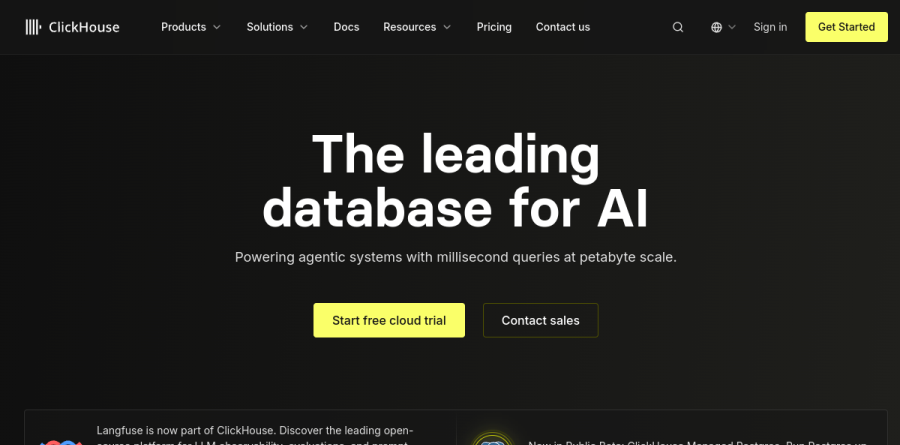
ClickHouse Cloud is the fully managed edition of ClickHouse, the open source column-oriented database built for online analytical processing. The vendor positions it on its homepage as the leading database for AI, powering agentic systems with millisecond queries at petabyte scale, and the service runs on AWS, GCP, and Azure, including each provider marketplace.
ClickHouse ships as a free open source server you can download, as ClickHouse Local for querying files such as CSV, TSV, and Parquet without a server, and as ClickHouse Cloud for teams that would rather not design shards, rebalance replicas, or babysit upgrades. Cloud is the same engine with provisioning, autoscaling, backups, and monitoring handled by the platform.
Why the columnar engine changes query economics
The performance story is architectural rather than magical. Row stores keep every value of a record physically together, while ClickHouse stores each column together, so an analytical query touching three fields out of two hundred reads only what it needs. ClickHouse reports that column-oriented databases are at least 100x faster on most queries, crediting compression and vectorized execution for high CPU efficiency.
That design shapes the four workloads ClickHouse Cloud markets itself against: real-time analytics, observability, data warehousing, plus ML and GenAI. In practice it means dashboards that stay responsive over billions of rows, ad hoc slicing of event streams, and analytics served directly to customers rather than an internal reporting team.
Getting data in with ClickPipes

ClickPipes is the managed ingestion layer exclusive to ClickHouse Cloud, and it removes most of the glue code from a typical pipeline. Supported sources include Apache Kafka, AWS S3, PostgreSQL, MongoDB, GCS, and MySQL. You select a source and format, tune the schema, and ClickPipes keeps ingestion running continuously.
Once data lands, the interactive SQL console covers exploration with a table explorer, a query interface, an import wizard, and visualization features. Teams that prefer infrastructure as code get a Terraform provider and infrastructure APIs for repeatable service configuration.
Observability workloads and ClickStack

ClickStack is the open source observability stack built on ClickHouse, unifying logs, metrics, traces, and session replays behind the HyperDX UI. It supports Lucene-style search for quick log hunting and full SQL when an investigation needs more than keyword matching, with event deltas and event patterns aimed at speeding root cause work.
Managed ClickStack runs that stack on ClickHouse Cloud, where full separation of storage and compute brings elastic scaling and cost efficiency, and compute-compute separation lets ingestion and queries run independently on dedicated resources. ClickHouse also ships a ClickStack MCP server that exposes semantic observability tools to Claude Code, Cursor, or any custom agent framework, covering investigation, correlation, and operational workflows.
Choosing between Basic, Scale, and Enterprise
Three plans sit on top of the same engine. Basic suits testing and starter projects, with capped storage and memory, a single availability zone, and next business day expert support. Scale is the production tier, adding unlimited storage, configurable memory and backups, separate compute layers for read and write isolation, private networking, automatic vertical scaling, and multi-zone deployment.
Enterprise layers on SAML single sign-on, private regions, transparent data encryption with customer managed keys, scheduled upgrades, a named lead support engineer, and HIPAA plus PCI compliance. Billing is metered on compute units and storage rather than seats, autoscaling limits can cap runaway queries, and Bring Your Own Cloud covers organizations with strict data residency rules.
Who should choose ClickHouse Cloud
ClickHouse Cloud is the right call for engineering teams building real-time analytics products, customer-facing dashboards, or observability platforms over event volumes large enough that a general purpose warehouse starts to hurt. The open source lineage means portability, and the managed layer removes sharding and upgrade toil that makes self-hosting expensive in headcount.
It is less suitable for transactional applications with heavy row-level updates, since this is an OLAP engine first and the Managed Postgres option remains in beta. Small teams with modest datasets and routine reporting will find the metered unit-hour model harder to reason about than a flat per-seat BI tool.
Strengths
- Separates compute and storage billing, with automatic scale-to-zero that eliminates idle compute costs
- Extremely fast columnar engine for aggregations over billions of rows
- Generous 30-day, $300 trial and no upfront commitment on pay-as-you-go
- Available on AWS, GCP, and Azure with marketplace committed-spend options
Watch out for
- Consumption pricing is hard to predict; costs can spike with heavy or always-on workloads
- No permanent free tier once the 30-day trial ends
- Data-transfer egress ($0.1152/GB public) and ClickPipes ingestion bill separately
- Enterprise features (SSO, advanced compliance) require the top tier or custom quotes
Key features
| Feature | What it does |
|---|
| Serverless autoscaling | Compute scales up and down automatically with workload and can idle to zero, so you pay only for what you use. |
| Separated compute & storage | Compute (per compute-unit-hour) and storage (~$25.30/TB-month on compressed data) are billed independently. |
| Columnar OLAP engine | Open-source ClickHouse core delivers sub-second analytical queries over very large datasets. |
| ClickPipes managed ingestion | Built-in connectors for Kafka, S3, Postgres and more; billed at ~$0.04/GB ingested plus compute. |
| Multi-cloud deployment | Run on AWS, GCP, or Azure in many regions, self-service or via cloud marketplaces. |
| Tiered security & compliance | Scale and Enterprise add private networking, SSO/SAML, and advanced compliance controls. |
How ClickHouse Cloud compares
| Alternative | How it differs |
|---|
| Snowflake | Broader data-warehouse platform with per-credit pricing; easier governance but slower/pricier for high-frequency real-time analytics. |
| Tinybird | Managed ClickHouse with an API/developer layer on top; simpler DX but a markup over raw ClickHouse Cloud compute. |
| Altinity.Cloud | Alternative managed ClickHouse (BYOC or hosted) with a pricing calculator; appeals to teams wanting more infra control. |
Frequently asked questions
How much does ClickHouse Cloud pricing cost?
ClickHouse Cloud is usage-based. Compute is metered per compute-unit-hour (8 GiB RAM/2 vCPU): about $0.2181 on Basic, $0.2985 on Scale, and $0.3903 on Enterprise. Storage runs ~$25.30 per TB-month on compressed data. A small always-light Basic service costs roughly $66/month; there is no fixed subscription fee.
Is ClickHouse Cloud free?
There is no permanent free tier, but new accounts get a 30-day free trial with $300 in credits and no credit card required to start. After the trial you pay only for the compute and storage you use. Because Basic scales to zero when idle, a lightly used service can still cost very little per month.
What are the ClickHouse Cloud pricing tiers?
Three tiers: Basic (single replica, scales to zero, ~$0.2181/unit-hr), Scale (multi-replica with autoscaling and private networking, ~$0.2985/unit-hr), and Enterprise (high-memory configs, SSO/SAML, advanced compliance, ~$0.3903/unit-hr). Storage is ~$25.30/TB-month across all tiers. Enterprise entry bills typically run into the thousands per month.
ClickHouse Cloud vs Snowflake — which is cheaper?
For high-frequency real-time analytics, ClickHouse Cloud is usually cheaper and faster because compute idles to zero and storage is ~$25.30/TB-month. Snowflake bills per credit and suits broad warehousing and governance. Actual cost depends on query patterns: bursty, always-on dashboards favor ClickHouse; occasional heavy batch jobs can favor Snowflake's auto-suspend.
How does ClickHouse Cloud billing work?
Compute and storage are metered separately, per minute, in 8 GiB RAM increments. You pay per compute-unit-hour at your tier's rate plus ~$25.30/TB-month storage on compressed data. Data-transfer egress (from ~$0.1152/GB public) and ClickPipes ingestion (~$0.04/GB) bill on top. Pay monthly by card, or commit via annual credits or cloud marketplaces.
ClickHouse Cloud ratings on other platforms
Independent user ratings from third-party review sites, linked here for transparency.
These are not our editorial score, are captured on the date shown, and may have changed since.