The full review
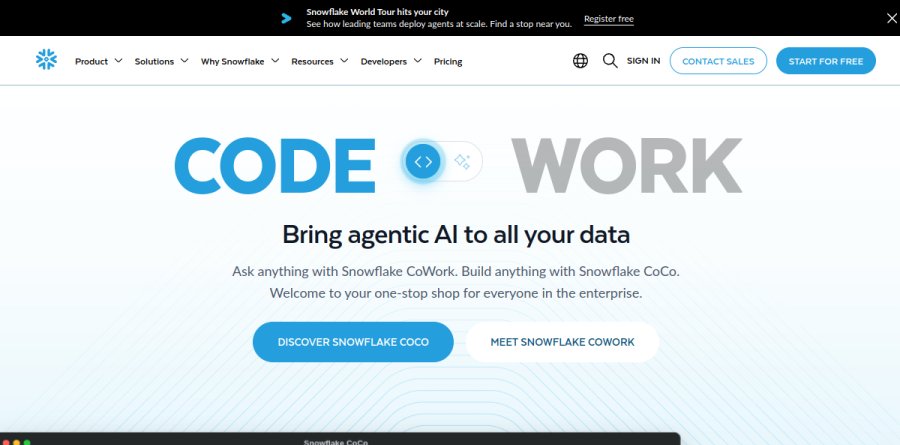
What is Snowflake?
Snowflake is a fully managed cloud data platform that the company brands as the AI Data Cloud. It runs on AWS, Azure and Google Cloud, and the platform page describes multi-cloud and cross-region operation handled by Snowgrid. Warehousing, pipelines, analytics, machine learning and application development all live inside one service, so there is no cluster to patch and no capacity to pre-size by hand.
Snowflake presents the platform as fully managed and enterprise-ready, spanning data engineering, analytics, AI, applications and collaboration, and transactions. Data sits in optimized storage with compression and Time Travel, and the pricing page describes a consumption-based pricing model in which storage is charged monthly on the average amount used after compression.
Compute sized per workload

Snowflake includes fully managed elastic compute as part of core platform functionality on every edition. Enterprise edition adds the ability to use multi-cluster compute on top of everything in Standard. Snowpark Container Services goes further, running containers and ML apps natively alongside the data.
The vendor reports 2.0x faster performance for core analytics on Standard Warehouse Generation 2, its refreshed hardware tier, and is rolling out Snowflake Adaptive Compute to right-size resources and route queries automatically.
Pipelines, notebooks and open tables
Openflow handles data movement and integrations, giving engineers a managed route into Snowflake without stitching together separate ingestion tooling. Snowpark provides libraries and code execution environments that run Python and more, so processing happens inside Snowflake. Snowflake Notebooks and Streamlit close the loop, turning exploratory work into a shareable app over the same governed tables.
Snowflake Trail adds built-in observability with exportable telemetry, while Snowflake Postgres and Unistore Hybrid Tables let transactional apps sit beside analytical ones instead of in a separate database.
Cortex AI and the agent layer
Cortex AI is the managed route to large language models, which the product page describes as instant access to industry-leading LLMs. Snowflake ML covers model development and MLOps from a central interface.
Two agents build on that: Snowflake CoCo, described as a governed AI coding agent that works wherever you build, and Snowflake CoWork, the personal work agent that operates within Snowflake's perimeter and lets users answer complex questions in natural language.
Governance and data collaboration

Horizon Catalog centralizes compliance, security, privacy and access policy, so identical rules apply whether a table feeds a dashboard, trains a model or leaves through a share. It also brokers cross-engine access to Iceberg tables, which matters for shops committed to open formats.
Collaboration is where Snowflake pulls ahead of a plain warehouse. Data Clean Rooms enable privacy-preserving data collaboration, Marketplace connects third-party data sources within minutes, and Native Apps covers end-to-end, Snowflake-native app creation and distribution.
Editions and spend control
Four editions scale the security envelope. Standard covers core functionality, Snowpark, data sharing and automatic encryption. Enterprise, which Snowflake flags as its most popular, layers on multi-cluster compute, granular governance and extended Time Travel windows. Business Critical targets regulated industries with Tri-Secret Secure, private connectivity and failover. Virtual Private Snowflake isolates the environment completely.
Consumption billing cuts both ways, so budget discipline matters. Snowflake counters with a unified Cost Management Interface for seeing, controlling and optimizing spend, plus a published Credit Consumption Table covering how services draw credits.
Who should choose Snowflake
Snowflake suits organizations whose data problem is breadth as much as volume: multiple clouds, many teams, mixed analytics and AI workloads, and a governance obligation that makes copying records into point tools untenable. It rewards groups that would otherwise staff a platform team to babysit clusters, and the sharing story is unusually strong when external partners consume your data.
It is not ideal for a small team with one steady workload and a fixed budget, since credit-based billing punishes unattended queries and a modest Postgres instance will be cheaper to reason about. The 30-day trial with free credits is the sensible way to find out which camp you occupy.
Strengths
- Compute and storage bill separately, per-second after a 60-second minimum, so you pay only for what runs
- Warehouses scale instantly from X-Small (1 credit/hr) to 6X-Large (512 credits/hr) with no downtime
- Runs identically across AWS, Azure and Google Cloud with built-in data sharing and Marketplace
- Generous 30-day free trial including $400 in credits and no credit card
Watch out for
- Consumption pricing is hard to forecast; idle or runaway warehouses can spike bills fast
- Credit rate rises 50-100% for Enterprise/Business Critical editions often required for compliance
- Storage, serverless and cloud-services usage bill on top of compute credits
- No flat monthly plan, so budgeting demands active cost monitoring and warehouse governance
Key features
| Feature | What it does |
|---|
| Separated storage & compute | Scale each independently; multiple virtual warehouses hit the same data without contention |
| Multi-cluster warehouses | Auto-scale out under concurrency (Enterprise edition and above) |
| Time Travel & Fail-safe | Query and restore historical data up to 90 days plus a 7-day recovery window |
| Tri-Secret Secure | Customer-managed encryption keys and private connectivity in Business Critical |
| Secure Data Sharing & Marketplace | Share live data across accounts and clouds without copying it |
| Snowpark & Cortex AI | Python/Java processing and built-in LLM/ML functions billed in credits |
How Snowflake compares
| Alternative | How it differs |
|---|
| Databricks | Lakehouse rival, stronger for ML/Spark; DBU consumption pricing similar in complexity |
| Google BigQuery | Serverless, per-TB-scanned or slot pricing; no warehouses to manage |
| Amazon Redshift | AWS-native, node-hour or serverless RPU pricing; cheaper if all-in on AWS |
Frequently asked questions
How much does Snowflake cost?
Snowflake is consumption-based. Compute is billed in credits at roughly $2/credit (Standard), $3 (Enterprise) and $4 (Business Critical) on AWS US East, charged per-second with a 60-second minimum. Storage runs about $23/TB per month after compression. Actual credit rates vary by edition, cloud and region.
Is Snowflake free?
There is no permanently free tier, but Snowflake offers a 30-day free trial that includes $400 in free credits with no credit card required. That covers real compute and storage usage for testing. Once the trial ends or the credits are used, you move to on-demand or capacity billing.
What is a Snowflake credit?
A credit is Snowflake's unit of compute. A warehouse consumes credits per hour based on size, doubling each step: X-Small uses 1 credit/hour, Small 2, Medium 4, Large 8, up to 6X-Large at 512. Billing is per-second with a 60-second minimum, so you only pay for time the warehouse actually runs.
Snowflake vs Databricks: which is cheaper?
Neither is flatly cheaper. Snowflake bills compute credits (~$2-4) plus $23/TB storage; Databricks bills DBUs plus your own cloud storage. Snowflake often wins for SQL analytics and ease of use, Databricks for heavy ML and Spark. Both use consumption pricing, so real cost depends on workload and tuning.
How is Snowflake storage priced?
Storage is billed monthly on the average compressed volume stored, at about $23/TB per month on-demand (AWS US East); pre-paid capacity contracts lower that rate, and non-US regions cost more. It is separate from compute credits, and Time Travel plus Fail-safe copies also count toward stored data.
Snowflake ratings on other platforms
Independent user ratings from third-party review sites, linked here for transparency.
These are not our editorial score, are captured on the date shown, and may have changed since.