The full review
What is Clay?
At its core Clay is a go-to-market data platform that works in tables and columns and behaves like an integration engine, what the site itself calls the GTM data layer. The company frames it around building systems to grow revenue, which in practice means pulling accounts or people into a table, layering enrichment onto every row, and routing finished records wherever the revenue team works.
Clay organizes itself into four layers on its own navigation: data infrastructure covering Audiences, the Data marketplace, Signals and Intent, and Waterfall; an agent layer built on Claygent; orchestration through Workflows, Functions, and AI formatting; and execution via Ads and Sequencer. That structure is what separates it from a single-vendor database.
How waterfall enrichment changes the coverage math

Clay pitches Waterfall as combining multiple data providers for the best coverage. Rather than committing to one provider, Clay queries them in sequence until a valid match returns. The waterfall enrichment page lists work-email routes through Prospeo, DropContact, Datagma, Hunter, PeopleDataLabs, Nimbler, Apollo, Lusha, and Snov, with People Data Labs, ContactOut, and Selligence covering mobile numbers.
The vendor says this sequential approach routinely triples its customers' data coverage and quality, and quotes Anthropic saying it has 3x'd its enrichment rate with Clay's combination of data providers versus its previous solution. Those are vendor-supplied figures, but the logic holds: every database has gaps, and querying several in sequence beats subscribing to one that misses the records you need.
Claygent and the agent layer
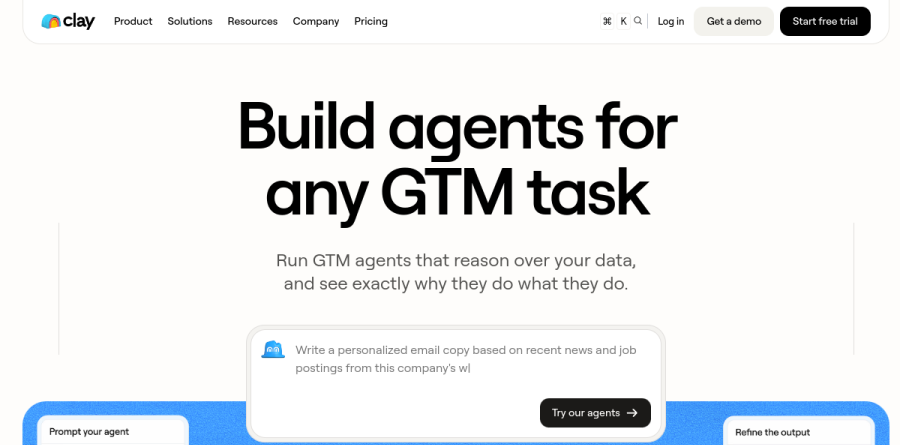
Claygent is Clay's research agent. Give it inputs, a plain-language instruction, and a destination column, and it goes after unique data no provider has: niche company attributes, buying triggers, org changes, or contact info. Clay calls this a glass box rather than a black box, exposing the reasoning trace behind every cell so a bad output can be diagnosed instead of guessed at.
Above the cell level sit Account Research Agents, which run across an entire Audience, keep persistent memory of what they learned, and sync findings to a CRM or warehouse unattended. The vendor displays a running counter of Claygent executions now past five billion.
Signals that trigger real workflows
Signals and Intent is where Clay stops being a database and becomes a trigger system, watching job changes, funding announcements, website visitor de-anonymization, social mentions, and technology adoption, then firing a workflow on a match. Clay documents how Vanta layers four at once: SOC2 announcements, compliance-related website changes, funding news, and CISO job postings.
Published examples show the range. Rippling enriches job changers and uses location data to pick the right corporate office for direct mail, Cursor tracks mentions of its product and rival AI tools on social platforms, and Amplitude blends product usage data with Clay research to rank cross-sell candidates.
Where Clay plugs into the existing stack
The Data marketplace is the commercial heart of the platform, pitched as buying data from 200+ providers in one place, spanning contact data, technographics, intent, web analytics, and funding intelligence. Integrations reach Salesforce, HubSpot, Pipedrive, Outreach, Gong, Clearbit, Apollo.io, and HG Insights, so Clay sits between your sources and your system of record rather than replacing either.
Consumption is metered in two units, actions and data credits, across the Free, Launch, Growth, and Enterprise plans, with a 14-day trial available. SSO is a Growth add-on; Enterprise adds an annual commitment and a dedicated Growth Strategist.
Who should choose Clay
The platform suits revenue teams that have outgrown a single data vendor and have someone willing to own the tables. It rewards operators, whether RevOps leads, growth engineers, or technical founders, who think in columns and conditions, and pays off fastest on the use cases Clay names itself: CRM enrichment, TAM sourcing, ABM, territory planning, and automated inbound. Customers including Intercom, Hex, Verkada, and Recharge indicate it scales well past the startup tier.
It is not ideal for a small team that only wants verified emails, since a single straightforward provider costs less and needs none of the setup time. Budget for a learning curve, and remember that credits burn whether or not the workflow behind them was designed well.
Strengths
- Waterfall enrichment queries 100+ providers sequentially and stops charging on failed lookups (since March 2026), so match rates beat any single database
- Unlimited seats on every plan including Free — no per-user fees as your team grows
- Claygent AI research agent automates web research (tech stacks, hiring signals, case studies) that would take SDRs hours per account
- March 2026 repricing cut marketplace data costs 50-90% on most providers and moved CRM auto-sync from the old $800 Pro tier down to $495 Growth
Watch out for
- Steep learning curve — you need spreadsheet-formula and API comfort plus waterfall design skills to get real value
- Credit math is opaque and heavy enrichment (especially phone numbers) burns Data Credits fast; top-ups still carry roughly 30% markup
- Actions never roll over and Data Credits cap at 2x monthly rollover, so unused allocation partly expires
- No native contact database or dialer — you pay to orchestrate other vendors' data, and CRM auto-sync requires the $495/mo Growth plan
Key features
| Feature | What it does |
|---|
| Waterfall enrichment | Sequentially queries 100+ data providers for emails, phones, and firmographics, consuming credits only on successful finds |
| Claygent | Built-in AI research agent that browses the web to answer custom questions about accounts and prospects at scale |
| Data Credits + Actions system | Two-currency model introduced March 2026 — Data Credits buy enrichment lookups, Actions power workflow automation steps |
| CRM auto-sync and HTTP API | Two-way Salesforce/HubSpot sync plus arbitrary API integrations, included from the Growth plan up |
| Signals and intent | Job-change tracking, web intent signals, and ads audiences enable trigger-based outbound plays |
| Clay Sequencer | Native email sequencing available on all plans, including Free, so enriched lists flow straight into campaigns |
How Clay compares
| Alternative | How it differs |
|---|
| Apollo.io | All-in-one outbound platform from ~$49/user/mo with its own 210M+ contact database, dialer, and sequencer — cheaper but far less flexible enrichment |
| ZoomInfo | Enterprise B2B data and intent leader with contracts typically $15K+/year; deeper native database, rigid annual pricing |
| BetterContact | Budget waterfall-enrichment specialist covering the multi-provider lookup piece without Clay's workflow engine or AI agent |
Head-to-head: Clay vs Apollo.io
Frequently asked questions
How much does Clay cost?
Clay's free plan includes 100 data credits and 500 actions monthly. Launch starts at $185/month ($167 on annual billing) with 3,000 data credits and 15,000 actions. Growth runs $495/month ($446 annual) with 6,000 data credits, 40,000 actions, and CRM auto-sync. Enterprise is custom-quoted; third-party contract data puts the median near $30,400/year.
How do Clay credits work?
Since March 2026 Clay uses two currencies: Data Credits for enrichment lookups (emails, phones, firmographics) and Actions for workflow steps. Costs vary by provider — premium phone data consumes more per lookup. Unused Data Credits roll over up to 2x your monthly allocation; Actions reset monthly. Failed lookups no longer consume credits, and top-up markup dropped to roughly 30%.
Clay vs Apollo: which should I choose?
Apollo is cheaper — paid plans start around $49/user/month — and bundles a 210M-contact database, dialer, and sequencer in one tool. Clay starts at $167/month but waterfalls 100+ data providers, so email and phone match rates beat any single database. Choose Apollo for simple all-in-one outbound; choose Clay for data quality and custom GTM workflows.
Does Clay have a free plan?
Yes. The free tier includes 100 data credits and 500 actions per month, unlimited seats, multi-provider waterfalls, Claygent access, and tables up to 200 rows — enough to test workflows but not run production outbound. Paid plans also offer a 14-day trial with no credit card required, and annual billing saves 10%.
Is Clay worth it in 2026?
For teams running serious outbound, usually yes: the March 2026 repricing cut marketplace data costs 50-90% on most providers and stopped charging for failed lookups. Budget realistically, though — credit top-ups push many teams past the $495 Growth sticker, and someone must own the spreadsheet-style workflow building to see the full return.
Clay ratings on other platforms
Independent user ratings from third-party review sites, linked here for transparency.
These are not our editorial score, are captured on the date shown, and may have changed since.