The full review
What is Axiom?
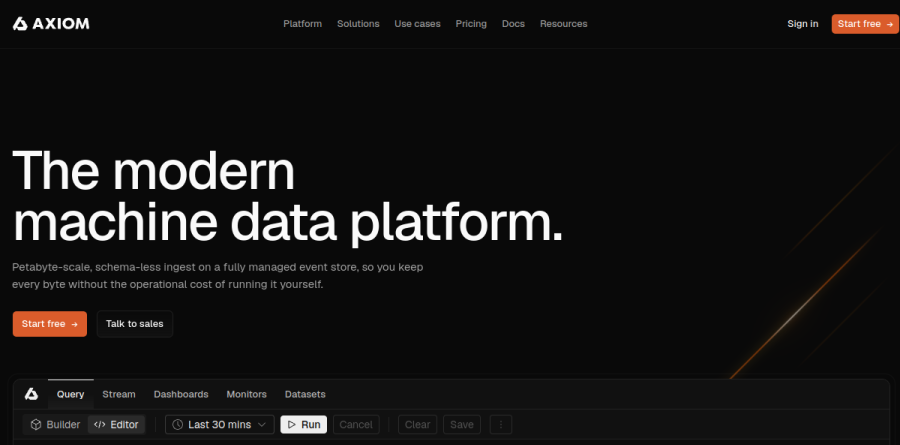
Axiom is a serverless observability platform that bills itself as the modern machine data platform. The pitch running across its site is petabyte-scale, schema-less ingest on a fully managed event store, summed up in the line no data left behind. Instead of asking teams to sample or pre-select which logs are worth keeping, Axiom is built to swallow the whole firehose and sort out structure later.
Two engines sit underneath. EventDB handles logs, events and traces, while MetricsDB is a purpose-built store for time series. Both are reachable from one console, so a noisy function log, a distributed trace and a metrics dashboard live in the same workspace rather than three separate tools.
Schema-less ingest and query-time structure

Axiom leans on a schema-on-read architecture, so you do not model fields before data arrives. Structure gets applied when you query, and virtual fields let you derive new values at query time without reindexing or resending anything. Datasets are the organizing unit, and the Dataset Library gives teams a searchable place to find what already exists. The vendor reports compression above 95 percent on stored events.
Querying with APL and MPL
Axiom ships two query languages. APL, the Axiom Processing Language, is piped and sequential in the tradition of log-oriented query tools, so filters and aggregations chain left to right in a way most SREs can read on sight. MPL covers the metrics side. The console wraps both in a Builder for point-and-click composition and an Editor for people who would rather type. Stream gives a live tail of incoming events, Dashboards hold the standing views, and Monitors carry alerting.
Tracing, metrics and OpenTelemetry data

Axiom is OpenTelemetry-native, and distributed tracing is a first-class signal rather than a bolt-on. The workflow the vendor highlights is pivoting from a slow span straight into the surrounding logs without stitching databases together, which is exactly the investigation that normally costs an engineer several context switches. Query compute is serverless, so heavy retrospective searches spin up capacity instead of competing with a fixed cluster. Axiom cites Hapn as a customer keeping a year of AWS Lambda logs continuously queryable.
Agent-native access through the MCP server
The MCP server is included on both plans rather than sold as a separate add-on. The platform ships a native MCP server, so coding agents and AI assistants can query observability data directly instead of waiting for a human to paste screenshots into a chat. Axiom pairs that with packaged skills, including an SRE skill and a Metrics skill, and frames the product as built for engineers and their agents. For teams already putting agents into incident response, that removes a real integration chore.
Plans, add-ons and spend control
Two self-serve plans carry the product. Personal is a permanently free tier with fixed retention and a monthly ingest and query allowance. Axiom Cloud adds a flat platform fee plus usage, configurable retention, larger allowances, automatic volume discounts past those allowances, and compute credit pre-purchase for deeper discounts. Enterprise controls are sold as self-serve add-ons rather than a quoted contract: Role-Based Access Control, Audit Log, SAML SSO, Directory Sync and a HIPAA BAA each switch on from the console. Spend alerts and hard caps answer the usual anxiety around usage-based billing, and an Axiom for Splunk app offers a migration route that avoids ripping out the incumbent first.
Who should choose Axiom
Axiom suits engineering teams drowning in log volume who have been pushed into sampling by per-gigabyte pricing elsewhere, serverless and event-driven shops on AWS Lambda or similar, and platform teams wanting observability without operating a cluster. The self-serve add-ons also make it workable for a small security-conscious startup that needs SSO and audit logging without a procurement cycle. Axiom is less ideal for organizations requiring a heavily negotiated contract, on-premises deployment, or a full APM suite with session replay and synthetic monitoring, since it concentrates on the data platform underneath rather than every layer above it.
Strengths
- Genuinely generous free tier: 500 GB/mo ingest with no credit card
- Transparent usage-based pricing; cheap compressed storage at $0.030/GB/mo
- No log sampling or manual index management (serverless design)
- Cloud plan starts at just $25/mo with no minimum commitment
Watch out for
- Compute-based query billing can spike unexpectedly during incidents
- Cloud-only; no true self-hosting (BYOC reserved for enterprise)
- Enterprise essentials (SSO, RBAC, audit logs) are paid add-ons
- OpenTelemetry metrics support is still in public preview
Key features
| Feature | What it does |
|---|
| Serverless log management | Ingest logs with no sampling and no manual index management; scales automatically. |
| Usage-based credits | Pay only for what you consume: data loading 0.06-0.12 credits/GB, query 0.08-0.2 credits/GB-hour, storage $0.030/GB/mo. |
| OpenTelemetry native | First-class OTel ingest for logs and traces (metrics in public preview). |
| APM & tracing | Distributed tracing and application performance monitoring alongside logs. |
| Volume discounts | Pre-purchased compute credits earn automatic 10-30% discounts at higher tiers. |
| Enterprise controls | SSO/SAML, Directory Sync, RBAC, and Audit Logs available as paid add-ons; BYOC for enterprise. |
How Axiom compares
| Alternative | How it differs |
|---|
| Datadog | Far broader feature set and integrations, but notoriously expensive per-GB log pricing; Axiom is much cheaper at volume. |
| SigNoz | Open-source, self-hostable, predictable $0.30/GB pricing with no separate query charges; better for teams wanting flat costs and self-hosting. |
| Better Stack | Transparent ingest-based billing that avoids Axiom's variable query-compute costs; strong for straightforward log tailing and uptime. |
Frequently asked questions
How much does Axiom cost?
Axiom has a free-forever Personal plan ($0). The paid Axiom Cloud plan starts at a $25/month platform fee with no minimum commitment, plus usage-based credits (1 credit = $1) for compute and storage. Enterprise pricing is custom. Storage is billed at $0.030/GB/month for compressed data.
Is Axiom free?
Yes. The Personal plan is free forever with no credit card, including 500 GB/month of data loading, 10 GB-hours/month of query compute, 25 GB of storage, and up to 30-day retention for one user. The paid Axiom Cloud plan raises the always-free allowance to 1,000 GB/month ingest.
How is Axiom's usage-based pricing calculated?
Beyond the free allowance, you pay in credits ($1 each): data loading runs 0.06-0.12 credits/GB and query compute 0.08-0.2 credits/GB-hour, with rates dropping at higher volume. Storage is $0.030/GB/month compressed. Pre-purchased credits earn 10-30% automatic discounts.
Axiom vs Datadog: which is cheaper?
Axiom is typically far cheaper for high-volume logs. Datadog charges premium per-GB rates and per-feature add-ons, while Axiom bills usage-based compute plus $0.030/GB storage. The trade-off: Axiom's query-compute billing can spike during heavy incident querying, whereas Datadog's log costs are more predictable but higher.
Can I self-host Axiom?
Not in the traditional sense. Axiom is cloud-only. A Bring Your Own Cloud (BYOC) deployment option exists but is reserved for Enterprise customers. Teams needing full self-hosting usually look at SigNoz or the Grafana stack instead, both of which are open-source and self-hostable.
Axiom ratings on other platforms
Independent user ratings from third-party review sites, linked here for transparency.
These are not our editorial score, are captured on the date shown, and may have changed since.