The full review
What is Better Stack?
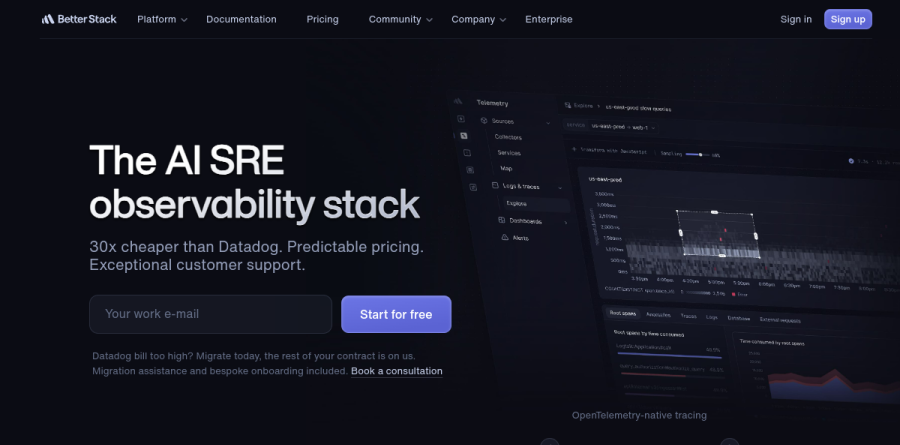
Better Stack is an observability platform that bundles uptime monitoring, on-call and incident management, log management, distributed tracing, and error tracking into one product rather than a stack of separately purchased tools. The vendor positions it as the AI SRE observability stack and reports that it runs roughly 30 times cheaper than Datadog with predictable pricing.
In practice the platform has two halves that share one alert pipeline. One watches your service from the outside and wakes the right engineer when something breaks; the other ingests telemetry from inside your infrastructure so that engineer has logs, traces, and metrics ready on arrival. Both live under a single login and a single bill, so the handoff from alert to investigation never crosses a vendor boundary.
Uptime monitoring and on-call routing

Better Stack runs website and API checks as often as every 30 seconds, captures a screenshot and error log at the moment of failure, and offers traceroute and MTR diagnostics when a timeout needs explaining. It also monitors SSL and domain expiry, ping, DNS, POP3, IMAP, and SMTP, while Playwright transaction monitoring tests vital interactions by running a real Chrome browser instance with a full-fledged JavaScript runtime. Heartbeat monitors catch cron jobs and serverless workers that fail silently by never reporting in.
Alerting is where Better Stack earns its keep for lean teams. Smart incident merging collapses a cascade of simultaneous alerts into a single incident, flexible incident escalations route by time and team availability, and unlimited voice call alerts sit alongside SMS, email, Slack, Teams, and push notifications. A branded status page keeps customers informed, with email subscriptions for updates.
Logs, traces, and the OpenTelemetry core

The telemetry half is OpenTelemetry-native, and Better Stack uses eBPF to instrument Kubernetes and Docker clusters with no code changes, producing a service map of network flows and auto-instrumented database calls. Plaintext logs are structured into queryable JSON; you can query them with SQL, PromQL, or a drag-and-drop builder, then explore anomalies visually through the bubble up view. One-click pattern filtering, drag and drop dashboards, Apdex and RED metrics, and anomaly detection alerts complete the analysis layer, with Prometheus, Vector, and syslog accepted alongside OpenTelemetry. Regional hosting and the option to store logs in your own S3 bucket cover data residency needs.
AI SRE, error tracking, and real user monitoring
Better Stack has pushed hard on AI-assisted response. AI SRE chat, AI written post-mortems, and resolving incidents in Slack or Teams are aimed at decreasing MTTR, and the vendor describes the agent as a Claude Code-like UI with the knowledge of your infrastructure, adding that a human is always in charge. An MCP server exposes the same telemetry to your own LLM tooling. Error tracking is compatible with Sentry SDKs, which keeps migration cheap, and supports configurable exception grouping. Real user monitoring adds session replay, web vitals, and product analytics with event funnels.
How the plans fit together
Pricing is assembled from parts rather than sold as all-in bundles. Seats split into Team member access for telemetry viewing and Responder licenses for anyone taking uptime alerts and on-call shifts. Telemetry capacity arrives as Nano, Micro, Mega, and Tera bundles at 30-day retention, with rates that vary by hosting region. Nearly everything else is an add-on: extra status pages, white-label branding, password protection, SSO beyond Google, audit logs, call routing numbers, Playwright minutes, and monitor packs. The Free plan is genuinely usable for a side project, covering ten monitors, ten heartbeats, and a status page.
Who should choose Better Stack
Better Stack fits small and mid-sized engineering teams looking to cut a large Datadog bill — the vendor claims 30x cheaper than Datadog and up to 80x more data on the same budget — and startups that want on-call, status pages, and log search running on day one without stitching three vendors together. The OpenTelemetry and eBPF foundation avoids proprietary agent lock-in, and Sentry SDK compatibility lowers the switching cost further.
It is a weaker fit for anyone who wants one flat all-inclusive number, because the line-by-line add-on model takes effort to forecast; buyers with stricter requirements are directed to the enterprise page, which covers custom deployments on request, a dedicated S3 bucket in your own VPC, SOC 2 Type 2 attestation under NDA, GDPR compliance, and ISO 27001 data centers.
Strengths
- Genuinely useful free tier: 10 monitors, a status page, and 3 GB of logs at $0
- Unified uptime, incident management, status pages, and logging in one modern UI
- ClickHouse-backed logs with sub-second SQL-compatible queries at ~1/10 Datadog cost
- Predictable base pricing versus Datadog; free viewer seats keep team costs down
Watch out for
- Modular add-ons (monitor packs, telemetry bundles, workflows) make bills hard to forecast
- $29/responder feels steep if you only need basic uptime monitoring
- White-label status pages and call routing add-ons run $208-250/mo each
- Telemetry ingestion/retention prices vary by region, complicating budgeting
Key features
| Feature | What it does |
|---|
| Uptime monitoring | 10 monitors free (3-min checks); extra packs of 50 for ~$21-25/mo. Global check locations and heartbeats. |
| Incident management & on-call | On-call scheduling, escalation, SMS/phone alerts on the Responder plan; advanced workflows +$9/responder/mo. |
| Log management | ClickHouse-based, SQL-compatible sub-second queries; usage-priced ingestion ($0.10-0.35/GB) and retention ($0.05-0.18/GB/mo). |
| Status pages | One status page free; white-label branding and custom email domains available as paid add-ons. |
| Full-stack telemetry | Logs, metrics, traces, error tracking (exceptions), session replays, and real-user monitoring bundled by volume tier. |
| Alerting integrations | Slack and email on free tier; SMS, phone calls, and richer routing unlocked on paid responder seats. |
How Better Stack compares
| Alternative | How it differs |
|---|
| Datadog | Deeper APM, integrations, and security, but far pricier and notoriously hard to forecast. |
| PagerDuty | Stronger enterprise incident/on-call workflows (from ~$21/user/mo) but not a monitoring tool itself. |
| Grafana Cloud | Open-source-rooted observability with a generous free tier; more setup, less all-in-one polish. |
Frequently asked questions
How much does Better Stack cost?
Better Stack starts free with 10 monitors, a status page, and 3 GB of logs. Paid plans begin at $29 per responder per month billed annually (about $34 monthly), which adds on-call, SMS/phone alerts, and incident management. Log/metric telemetry bundles start around $25-30/mo for ~40 GB and scale to $500/mo.
Is Better Stack free?
Yes. Better Stack has a permanent free tier for personal and small projects: 10 monitors and heartbeats, one status page, Slack and email alerts, 100,000 exceptions, 5,000 session replays, 3 GB each of logs and traces (3-day retention), and 30 GB of metrics. Paid seats and telemetry bundles are only needed as you scale.
Better Stack vs Datadog: which is cheaper?
Better Stack is dramatically cheaper, delivering comparable full-stack observability at roughly one-tenth the cost of an equivalent Datadog deployment. Its base pricing is also far more predictable, whereas Datadog bills many capabilities as separate units that are hard to forecast. Datadog still wins on deep APM, integrations, and security breadth.
How does Better Stack pricing work?
It is modular: a free base, then per-responder seats at $29/mo (annual) for uptime and incident features, plus usage-based telemetry bundles (Nano ~$25 to Tera $500) for logs, metrics, and traces. Viewers are free. Add-ons like extra monitor packs, white-label status pages, and call routing increase the total.
Does Better Stack offer an annual discount?
Yes. Paying annually reduces the responder seat from about $34 to $29 per month, and telemetry bundles are discounted roughly 22-25% on annual billing. For teams committing long-term, annual plans meaningfully lower the effective monthly cost across both seats and telemetry volume.
Better Stack ratings on other platforms
Independent user ratings from third-party review sites, linked here for transparency.
These are not our editorial score, are captured on the date shown, and may have changed since.